
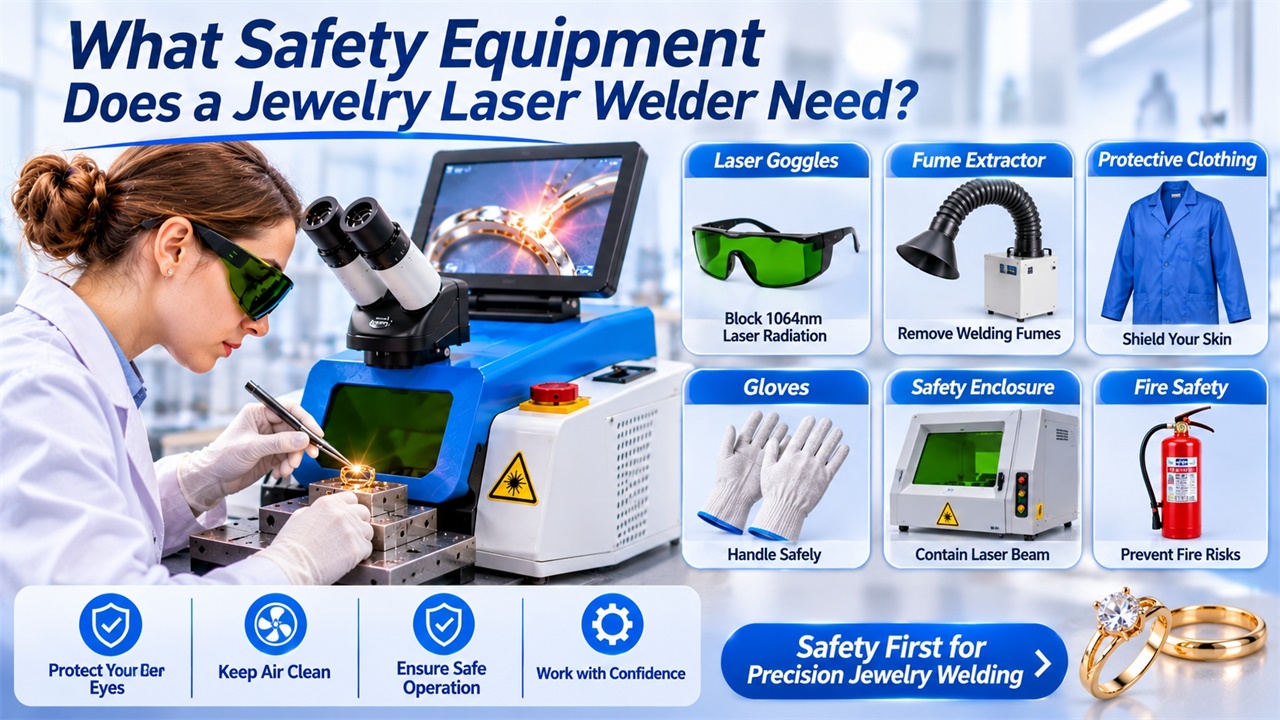
Jewelry laser welding is widely used for repairing gold chains, rebuilding ring prongs, welding small metal components, and manufacturing delicate jewelry. However, operating a laser welding machine also involves potential eye, skin, respiratory, electrical, and fire hazards. Many jewelry workshop owners focus on laser power and welding precision when purchasing equipment but overlook the safety equipment required for daily operation. Whether you operate a 150W or 200W YAG jewelry laser welder, preparing the correct protective equipment is essential. In this guide, we explain what safety equipment a professional jewelry workshop should have and how to build a safer working environment with a Dowin Jewelry Laser Welding Machine.
1. Why Is Safety Equipment Important for Jewelry Laser Welding?
A jewelry laser welder uses concentrated laser energy to melt and join small metal components. Although the welding area is relatively small, the equipment can still generate hazards that operators must understand.
There are five major safety considerations:
- Laser radiation: Direct or reflected laser radiation can cause serious eye injuries and skin burns.
- Welding fumes: Heating metals, coatings, and surface contaminants may produce airborne particles and gases.
- Fire hazards: Laser energy can ignite combustible materials near the working area.
- Electrical hazards: Laser power supplies and electrical components require proper grounding and maintenance.
- Thermal hazards: Recently welded metal parts can remain hot and cause burns.
The required protection depends on the machine’s laser classification, enclosure design, material being welded, working conditions, and applicable safety regulations.
2. Laser Safety Goggles: The Most Important Eye Protection
Eye protection is one of the first things to consider when purchasing a jewelry laser welder.
Many traditional jewelry YAG laser welding machines use a 1064nm Nd:YAG laser source. This wavelength belongs to the near-infrared region and is invisible to the human eye.
Unlike visible light, operators cannot reliably recognize exposure based on brightness or discomfort. Direct and reflected laser radiation can damage the eyes.
What Type of Laser Goggles Should You Use?
You need laser protective eyewear specifically selected for the wavelength and exposure conditions of your laser system.
When choosing laser safety goggles, check the following specifications:
- Protection wavelength: The eyewear must be rated for the actual laser wavelength, such as 1064nm for the applicable Nd:YAG system.
- Optical Density (OD): The OD rating must meet the protection level determined by the laser hazard assessment.
- Damage threshold: The eyewear must withstand the relevant laser exposure conditions, including pulse characteristics.
- Visible light transmission: Operators should be able to observe their work comfortably without compromising protection.
- Product certification: Check applicable laser eyewear standards and manufacturer documentation.
Do not select goggles simply because the packaging says they are suitable for laser welding. The specified wavelength and OD must match the actual laser hazard.
Are Ordinary Safety Glasses Enough?
No. Ordinary clear safety glasses are not designed to provide protection against hazardous 1064nm laser radiation.
Similarly, conventional welding goggles or sunglasses should not be treated as substitutes for wavelength-specific laser protective eyewear.
Some jewelry laser welding machines include dedicated microscope viewing filters or electronic optical protection systems. These features can help protect operators during normal viewing when designed and rated for the system. However, they do not automatically replace other required protective measures.
Learn more about the observation and protection features in the Dowin Jewelry Laser Welding Machine Introduction.
3. Fume Extractor: Protect Operators from Welding Fumes
Another important safety device is a welding fume extraction system.
During laser welding, localized heating can release airborne contaminants from the base metal, alloying elements, surface coatings, polishing compounds, oil, and other residues.
The composition and amount of fumes depend on the material and preparation process. Some coatings and contaminants may generate particularly hazardous substances when heated.
Why Do You Need a Fume Extraction System?
Without suitable ventilation, welding fumes may accumulate around the operator’s breathing zone.
A dedicated local exhaust ventilation (LEV) system captures contaminated air close to the welding point and directs it through an appropriate filtration or exhaust system.
When selecting a fume extractor, consider:
- Extraction capacity: The system must provide sufficient airflow for the working area.
- Flexible extraction arm: Allows the operator to position the extraction hood near the welding source.
- Suitable filtration: Filters should match the particles and gases expected from the materials being processed.
- Filter replacement: The system should allow regular inspection and replacement of used filters.
- Airflow monitoring: An indicator or alarm helps identify reduced extraction performance.
Do not assume that a HEPA filter alone removes every gaseous contaminant. The filtration system must be selected according to the actual fume composition.
Can Opening a Window Replace a Fume Extractor?
Not for regular indoor welding operations where hazardous fumes may be generated.
General ventilation can help improve indoor air quality, but it does not reliably capture contaminants at their source.
For workshops performing frequent jewelry welding, local exhaust ventilation is a better approach.
Respiratory protection may also be necessary when engineering controls cannot adequately control exposure. The correct respirator and filter must be selected according to the hazard assessment and applicable requirements.
4. Protective Clothing and Gloves
Although jewelry laser welding is more localized than many conventional welding processes, operators should still consider basic personal protective equipment (PPE).
Protective Gloves
Suitable gloves can help protect hands from hot jewelry components, sharp metal edges, and certain handling hazards.
Choose gloves according to the actual task:
- Heat-resistant gloves for handling recently welded components after the appropriate cooling period.
- Cut-resistant gloves for handling sharp or unfinished metal parts when appropriate.
- Non-reflective protective materials where required by the laser safety assessment.
Important: Ordinary gloves do not provide reliable protection against a direct laser beam. Hand protection must never replace beam containment, safe positioning, and other engineering controls.
Protective Clothing
Operators should wear suitable work clothing that covers exposed skin and does not create additional fire hazards.
Recommended practices include:
- Wear close-fitting work clothing.
- Avoid loose sleeves near the work area.
- Keep clothing away from the laser beam path.
- Avoid easily ignited materials near the welding point.
- Use appropriate protective clothing based on the workplace risk assessment.
Protective clothing provides secondary protection. It cannot prevent injuries caused by direct exposure to a high-power laser beam.
5. Machine Enclosure, Safety Interlocks, and Emergency Stop
Personal protective equipment is important, but engineering controls should be the first priority in laser safety management.
A properly designed protective enclosure can prevent operators and bystanders from accessing hazardous laser radiation during normal operation.
Protective Enclosure
Where applicable, an enclosure should contain direct and hazardous reflected laser radiation during normal operation.
The enclosure material, viewing window, and protective panels must be appropriate for the laser wavelength and exposure conditions.
Safety Interlocks
Interlocks are designed to prevent or terminate laser emission when a protective door or panel is opened, where required by the machine’s safety design.
Never bypass or disable safety interlocks to make operation more convenient.
Emergency Stop Button
An accessible emergency stop allows the operator to stop hazardous machine operation when an unexpected situation occurs.
All operators should understand where the emergency stop is located and how to use it.
Warning Signs and Key Control
Use appropriate laser warning labels and controlled access to the welding area.
For systems requiring a key-operated master control, only authorized personnel should have access to the operating key.
Remember that equipment safety classification depends on the complete machine configuration. A high-power laser source inside a properly interlocked enclosure may have a different accessible-emission classification during normal operation than the same source used with an exposed beam.
6. Microscope and Viewing System Protection
A microscope is essential for many jewelry laser welding applications because it allows operators to observe small joints and position the laser accurately.
However, the optical viewing system must also be designed for safe operation.
When evaluating a microscope-equipped jewelry laser welder, check:
- Whether the viewing optics have suitable laser protection filters.
- Whether the optical filters cover the actual operating wavelength.
- Whether the observation system has suitable protection against hazardous radiation.
- Whether the protective components are integrated and tested according to the manufacturer’s design.
- Whether filters and viewing components require periodic inspection.
Dowin’s jewelry laser welding equipment uses a dedicated microscope observation system. Its product information also describes an electronic optical filtering feature on the released jewelry laser welder configuration.
Buyers should confirm the exact optical protection configuration of the model being purchased rather than assuming all versions have identical viewing protection.
7. Fire Safety Equipment for Jewelry Laser Welding
Laser welding generates concentrated energy that can ignite flammable materials under certain conditions.
Although jewelry components are relatively small, operators should maintain basic fire prevention measures.
Keep Combustible Materials Away
Remove unnecessary materials from the working area, including:
- Paper and cardboard.
- Flammable solvents and cleaning liquids.
- Polishing cloths contaminated with flammable substances.
- Plastic packaging.
- Other combustible workshop materials.
Prepare Suitable Fire Protection Equipment
Keep an appropriate fire extinguisher accessible according to the types of hazards present in the workshop, including electrical equipment and any combustible metal materials.
Employees should understand how to respond to a fire and how to shut down the machine safely.
Never Leave Welding Unattended
Operators should monitor the welding area during operation and ensure that no unexpected ignition or overheating occurs.
8. Argon Gas Safety for Jewelry Laser Welding
Some jewelry laser welding machines use argon shielding to protect the welding area from oxidation.
Argon can help improve weld appearance and protect certain molten metal surfaces, but it also introduces compressed-gas handling and ventilation considerations.
For workshops using argon gas, follow these precautions:
- Secure gas cylinders in an upright position using suitable restraints.
- Use the correct regulator and compatible gas connections.
- Inspect hoses and connections for leaks.
- Keep cylinders away from heat sources and physical damage.
- Ensure suitable room ventilation, especially in small or poorly ventilated spaces.
- Follow the supplier’s instructions for cylinder transportation and storage.
Argon is an asphyxiant because it can displace oxygen. Avoid gas accumulation in enclosed or poorly ventilated areas.
9. Daily Safety Checklist Before Operating a Jewelry Laser Welder
A simple pre-operation checklist can help jewelry workshops prevent avoidable accidents.
Before starting the machine, operators should confirm the following:
Machine Safety
- Check the protective enclosure and safety interlocks where fitted.
- Confirm the emergency stop is accessible.
- Check warning indicators and machine alarms.
- Verify the cooling system is operating normally.
- Inspect the microscope and protective viewing components.
Personal Protection
- Wear the correct wavelength-specific laser eyewear whenever required by the hazard assessment.
- Check protective eyewear for damage.
- Wear suitable work clothing.
- Use gloves when appropriate for handling hot or sharp components.
Working Environment
- Ensure the local exhaust ventilation is working.
- Remove unnecessary combustible materials.
- Check that the workpiece is securely positioned.
- Ensure warning signs and access controls are in place.
- Check argon gas connections if shielding gas is used.
After Operation
- Follow the manufacturer’s shutdown procedure.
- Remove and store workpieces safely after cooling.
- Clean the work area using the recommended procedure.
- Inspect the machine for visible damage or abnormal conditions.
- Report faults rather than attempting unauthorized internal repairs.
10. Choosing a Jewelry Laser Welder with Safety Features
When purchasing a jewelry laser welding machine, safety should be considered alongside laser power, welding precision, and price.
Dowin offers YAG jewelry spot welding equipment designed for fine jewelry repair and manufacturing.
For example, the published DW-AW150W/200W configuration includes:
- 1064nm Nd:YAG laser: A pulsed laser source for precision spot welding.
- Microscope observation: Supports accurate positioning of small welding points.
- Adjustable welding spot: A published beam diameter range of 0.1–3.0mm.
- Shield gas supply: Supports argon protection when required.
- Protection alert: Includes a flow alert function in the listed configuration.
- Parameter memorization: Stores up to 10 groups of welding parameters.
For its dedicated jewelry welder product line, Dowin also describes microscope viewing and an electronic optical filtering feature on the specified released configuration.
Always confirm the exact laser classification, enclosure design, eyewear requirements, and safety accessories supplied with the selected model before purchasing.
Explore the Dowin YAG Jewelry Laser Welding Machine for further specifications and product information.
11. Frequently Asked Questions
Do I need special goggles for a 1064nm jewelry laser welder?
When hazardous 1064nm laser radiation is accessible, wavelength-specific laser protective eyewear is required according to the laser hazard assessment. The appropriate OD rating and damage threshold must be selected for the particular machine and exposure conditions. Ordinary safety glasses are not sufficient.
Does a jewelry laser welder need a fume extractor?
For regular indoor welding, suitable local exhaust ventilation is an important measure for controlling fumes and airborne contaminants. The extraction and filtration system should be matched to the materials and surface treatments being processed.
Is the microscope filter enough to protect my eyes?
Not automatically. A manufacturer-designed optical filter can provide protection for the intended viewing system, but buyers should verify its wavelength range, protection rating, and operating conditions. It does not necessarily replace other required laser safety measures.
Do I need gloves when operating a jewelry laser welder?
Gloves can help protect against hot components and sharp metal edges. However, ordinary gloves are not a substitute for laser beam protection or suitable machine guarding.
Can I operate a jewelry laser welder in a small workshop?
Yes, provided that the workshop has suitable space, electrical installation, laser safety controls, ventilation, fire protection, and access restrictions. Argon gas and welding fumes require additional attention in small rooms.
Is a closed laser welding machine safer than an open machine?
A properly designed and interlocked enclosure can substantially reduce accessible laser radiation during normal operation. However, safety depends on the complete machine design, certification, enclosure, optical viewing system, and maintenance procedures rather than appearance alone.
How often should laser safety equipment be inspected?
Follow the manufacturer’s inspection schedule and applicable workplace requirements. Protective eyewear should be checked before use for cracks, scratches, damaged filters, and other defects. Fume extraction filters, interlocks, and other safety controls should also be maintained and tested regularly.
Conclusion
A jewelry laser welder requires more than a pair of protective goggles. A properly prepared workshop should consider wavelength-specific laser eye protection, fume extraction, suitable protective clothing, machine guarding, safety interlocks, fire prevention, and operator training.
The most effective safety strategy combines engineering controls, administrative procedures, and appropriate personal protective equipment. No single accessory can replace a properly designed and maintained laser safety system.
For jewelry repair shops and manufacturers considering a new laser welding system, Dowin offers dedicated YAG jewelry welding machines for precision gold and silver processing.
Explore the Dowin Jewelry Laser Welding Machine and confirm the safety configuration required for your workshop before placing an order.
Related Jewelry Laser Welding Articles
- Jewelry Laser Welding Machine Buying Guide for Beginners – Understand the key specifications and features to check before purchasing.
- YAG Jewelry Laser Welder: What Buyers Should Know – Learn about YAG laser technology, power configurations, and equipment selection.
- Advanced Features in Modern Jewelry Laser Welders – Explore observation systems, cooling technology, and other machine features.
- Tips for Maintaining Your Jewelry Laser Welding Equipment – Learn how to maintain optical components, cooling systems, and machine performance.
- Water-Cooled vs Air-Cooled Jewelry Laser Welder – Compare cooling configurations and their maintenance requirements.
- Jewelry Laser Welding Applications: A Complete Guide – Discover different jewelry repair and manufacturing applications.
“`
Post time: Nov-25-2026
