
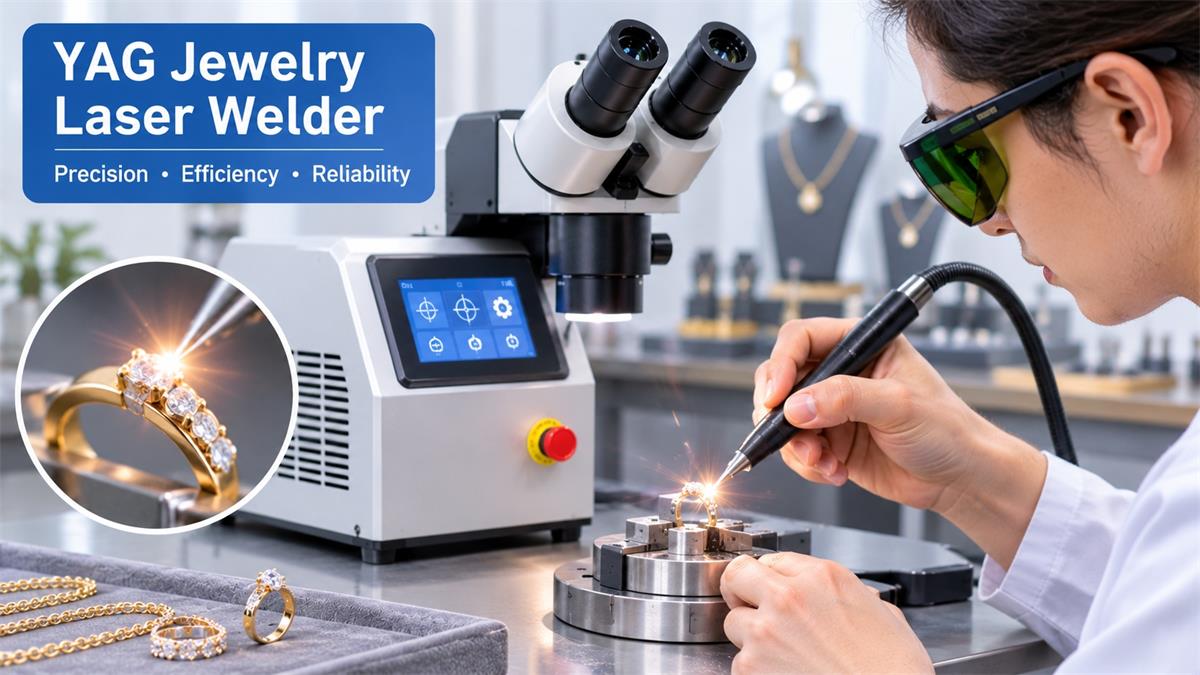
A YAG jewelry laser welder is widely used for precision welding and repairing gold, silver, platinum, and other compatible jewelry metals. Unlike traditional soldering methods, pulsed YAG laser welding concentrates energy on a small area, helping reduce heat transfer to surrounding materials. If you are comparing equipment for a jewelry workshop, Dowin offers several YAG jewelry laser welding machines with different power and configuration options.
1. What Is a YAG Jewelry Laser Welder?
YAG stands for Yttrium Aluminum Garnet, a crystal used as the laser medium in Nd:YAG laser systems. In jewelry welding machines, the system typically uses a xenon flash lamp to excite the crystal and generate pulsed laser energy at a wavelength of 1064nm.
The laser beam is focused onto a small welding area, melting and joining the metal locally. This makes the technology suitable for delicate jewelry components where controlling heat input is important.
Common applications include:
- Gold and silver chain repair.
- Ring joints and ring resizing.
- Prong restoration and stone-setting repairs.
- Welding small jewelry components.
- Repairing casting defects and small holes.
- Joining precious metal parts during jewelry manufacturing.
2. Why Do Jewelers Choose YAG Laser Welding?
For jewelry repair shops and manufacturers, welding precision is often more important than simply increasing laser power.
- Localized heat input: Concentrates energy on the welding point and helps reduce the heat-affected area.
- Fine spot control: Adjustable spot diameter allows operators to work on small components and delicate joints.
- Strong metal joints: Properly prepared and parameter-controlled welds can produce reliable joints.
- Reduced finishing: Accurate welding can minimize additional polishing and surface finishing.
- Flexible applications: Suitable for different jewelry metals and repair requirements.
However, welding results depend on material composition, joint preparation, pulse energy, and operator experience. Gemstones should be assessed before welding because localized heating does not eliminate the risk of heat damage.
3. What Specifications Should Buyers Check?
When purchasing a YAG jewelry laser welder, buyers should evaluate more than the rated power. Several technical parameters directly affect welding performance.
| Specification | Why It Matters |
|---|---|
| Laser power | Determines the machine’s overall power capability. |
| Pulse energy | Important for welding thicker materials and demanding repair jobs. |
| Pulse width | Controls the duration of each laser pulse and heat input. |
| Pulse frequency | Affects the number of laser pulses delivered per second. |
| Spot diameter | Determines the size of the focused welding area. |
| Observation system | A microscope or CCD system helps position the welding point accurately. |
| Cooling system | Helps maintain stable machine operation. |
One important purchasing detail: rated laser power and pulse energy are not interchangeable. A 200W machine with 80J pulse energy is different from a 200W machine with 180J pulse energy. Buyers should compare both specifications rather than choosing equipment based on wattage alone.
4. How to Choose the Right YAG Jewelry Laser Welder
Different jewelry businesses have different welding requirements. Consider the following options when comparing machines.
150W YAG Jewelry Laser Welder
A 150W machine can be suitable for many routine jewelry repair and manufacturing applications, including fine chain repairs, ring joints, and small metal components. It is worth considering for workshops that need a balance between equipment capability and daily workload.
200W YAG Jewelry Laser Welder
A 200W model offers a higher rated power configuration and can be suitable for more demanding jewelry welding applications. However, buyers should also check pulse energy, pulse width, and the actual welding results on their materials.
200W High-Pulse-Energy YAG Jewelry Welder
For applications involving thicker precious metals or higher energy requirements, a high-pulse-energy model may be more appropriate. For example, the Dowin 200W 180J YAG Pulsed Jewelry Laser Welder offers up to 180J pulse energy, a microscope and CCD observation system, and an electric lifting worktable.
5. Important Features of a Professional Jewelry Laser Welder
Besides laser specifications, the machine’s working configuration also affects daily operation.
- Microscope: Provides magnified observation for precise positioning of small welding points.
- CCD observation: Offers an additional visual positioning method for jewelry processing.
- Adjustable worktable: Makes it easier to position jewelry pieces of different sizes.
- Argon protection: Helps reduce oxidation around the welding area when properly configured.
- Stable cooling: Supports consistent operation during extended working periods.
For example, the Dowin DW-200AW YAG Desktop Jewelry Spot Welder features a microscope observation system, an adjustable laser welding spot, and argon gas protection.
6. What Should You Ask Before Buying?
Before placing an order, professional buyers should confirm the following details with the manufacturer:
- Can the machine weld your actual gold, silver, and platinum samples?
- What are the maximum pulse energy and adjustable pulse width?
- What is the adjustable welding spot diameter?
- Does the machine include a microscope, CCD, or both?
- What cooling system does the machine require?
- Are operator training, warranty, and technical support included?
Requesting a welding test with your own jewelry samples is one of the most reliable ways to evaluate a machine before purchasing.
7. Frequently Asked Questions
Q1: Can a YAG laser welder weld gold and silver?
Yes. Pulsed Nd:YAG laser welding machines are widely used for gold and silver jewelry repair and manufacturing. Welding parameters must be adjusted according to the metal composition and thickness.
Q2: What is the difference between YAG and fiber laser welding for jewelry?
Traditional Nd:YAG jewelry welders use a pulsed laser source and are designed for precision spot welding. Fiber laser welding systems use a different laser source and configuration. The best choice depends on the jewelry materials, joint structure, and required welding process.
Q3: Is 200W enough for jewelry welding?
A 200W YAG jewelry welder can handle many professional repair and manufacturing applications. However, pulse energy and pulse duration are also important when evaluating its ability to weld thicker materials.
Q4: Can a YAG laser welder repair jewelry near gemstones?
It can be used for some repairs near gemstones because the laser concentrates energy locally. However, the risk depends on gemstone type, setting structure, distance from the weld, and heat transfer. Some stones should be removed before welding.
Q5: Does YAG laser welding require filler wire?
Not every jewelry repair requires filler wire. Some joints can be welded directly, while gaps, missing material, or restoration work may require compatible filler material.
Conclusion
A YAG jewelry laser welder is a practical investment for jewelry repair shops and manufacturers that need precise welding on precious metals. When comparing machines, pay attention to pulse energy, spot diameter, microscope quality, cooling configuration, and actual welding performance. Choosing a machine based on your real jewelry samples and daily workload is more reliable than selecting it by rated power alone.
Post time: Nov-05-2026
