
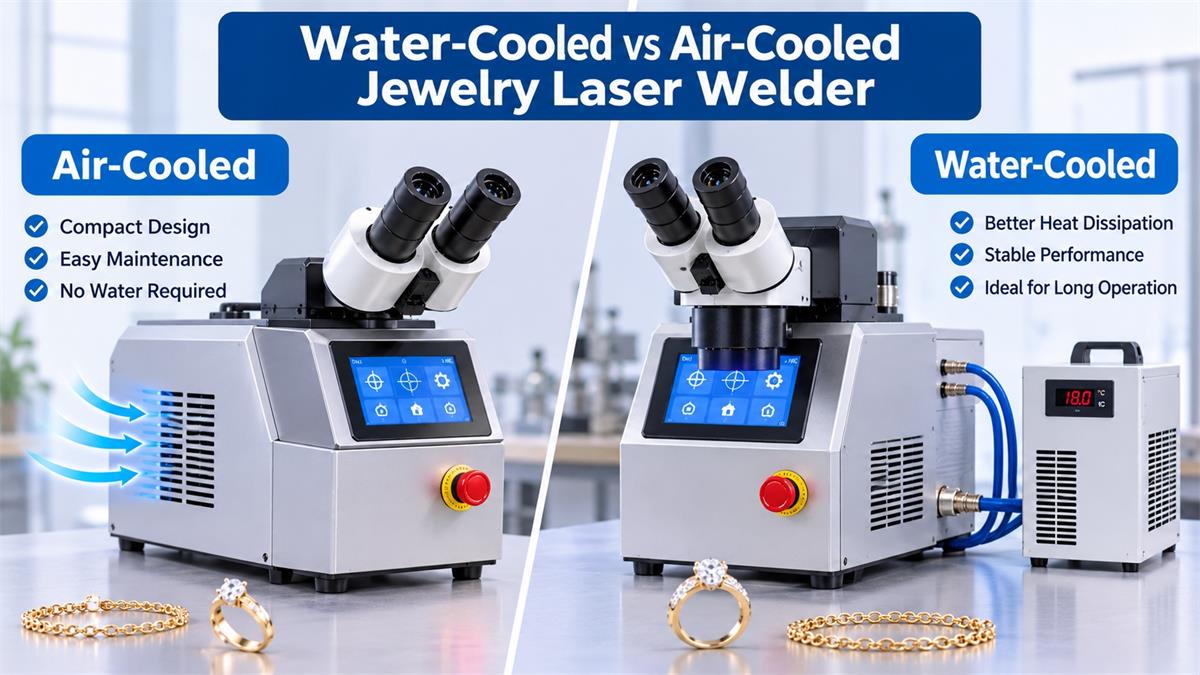
When choosing a jewelry laser welding machine, the cooling system is an important factor that buyers should not overlook. Air-cooled and water-cooled machines differ in heat dissipation, equipment structure, maintenance requirements, and suitability for continuous operation. Dowin offers several jewelry laser welding machines with different configurations, helping jewelry repair shops and manufacturers select equipment according to their workload and production requirements.
1. Why Does a Jewelry Laser Welder Need a Cooling System?
A pulsed YAG jewelry laser welder generates heat during operation. The laser source, electrical components, and optical system all require appropriate temperature control to maintain stable performance.
An effective cooling system helps:
- Maintain stable operating temperatures.
- Reduce the risk of overheating during extended operation.
- Protect important machine components.
- Support consistent laser output.
- Improve equipment reliability and service life.
The cooling configuration becomes particularly important for workshops that operate their jewelry welding machines for several hours every day.
2. What Is an Air-Cooled Jewelry Laser Welder?
An air-cooled jewelry laser welder uses airflow and heat-dissipation components to remove heat from the machine. Depending on the design, cooling fans and internal heat sinks help maintain the operating temperature.
Its main advantages include:
- Compact structure: No separate industrial water chiller is required.
- Easy installation: The machine generally needs fewer external connections.
- Convenient maintenance: No cooling water circulation or water-quality management is required.
- Space saving: Suitable for smaller jewelry workshops with limited floor space.
However, air cooling has limitations. Its heat-dissipation capacity depends on airflow, ambient temperature, and machine design. Buyers should check the manufacturer’s recommended working cycle and maximum operating conditions.
3. What Is a Water-Cooled Jewelry Laser Welder?
A water-cooled jewelry laser welder uses circulating cooling water to remove heat from the laser system. Many professional machines use an external water chiller to maintain a stable cooling temperature.
Compared with air cooling, water cooling can provide more effective heat removal for machines with higher thermal loads.
Main advantages include:
- Effective heat dissipation: Suitable for equipment generating substantial heat during operation.
- Temperature stability: Helps maintain consistent operating conditions.
- Continuous operation: Suitable for machine configurations designed for extended working periods.
- Thermal management: Helps protect the laser source and other heat-sensitive components.
Water-cooled machines also require additional attention. Operators need to maintain the water chiller, check coolant levels, inspect connections, and follow the manufacturer’s recommended maintenance schedule.
4. Air-Cooled vs Water-Cooled Jewelry Laser Welder: Comparison
| Comparison | Air Cooling | Water Cooling |
|---|---|---|
| Cooling method | Airflow and heat sinks | Circulating cooling water |
| Equipment structure | Generally more compact | May require a separate chiller |
| Installation | Generally simpler | Requires cooling connections |
| Maintenance | Fan and ventilation cleaning | Coolant, chiller, and connection inspection |
| Heat dissipation | Depends on airflow and thermal load | Suitable for higher thermal loads |
| Workspace | Usually requires less space | May require additional space for the chiller |
| Typical applications | Suitable air-cooled jewelry welding configurations | Higher thermal-load jewelry welding configurations |
Neither cooling method is automatically better for every jewelry welding application. The correct choice depends on the laser source, rated power, pulse energy, working frequency, and recommended duty cycle.
5. Which Cooling System Is Better for Different Jewelry Workshops?
Small Jewelry Repair Shops
For small jewelry stores and repair studios, an air-cooled machine can be attractive because of its compact structure and simpler installation. If the daily workload consists mainly of occasional chain repairs, ring joints, and small jewelry components, a suitable air-cooled configuration may be sufficient.
Professional Jewelry Repair Workshops
Workshops handling a larger number of repair jobs should consider the machine’s thermal management and recommended operating cycle. Water cooling may be preferable when the selected laser configuration produces a higher thermal load.
Jewelry Manufacturing Businesses
For jewelry manufacturers operating equipment for extended periods, water cooling can provide effective temperature management. A properly matched chiller helps maintain stable operating conditions during demanding production schedules.
6. Dowin Jewelry Laser Welder Cooling Options
Dowin provides different jewelry laser welding configurations for various workshop requirements. Buyers should compare the cooling system together with laser power and pulse energy rather than selecting a machine based on cooling type alone.
150W Desktop Jewelry Laser Welder
The Dowin DW-150AWPro Desktop Jewelry Laser Welder features an integrated desktop design, microscope and CCD observation, and an adjustable welding spot diameter of 0.2–2mm. Its air-cooled configuration is suitable for workshops looking for a compact jewelry welding station.
200W 180J YAG Jewelry Laser Welder
For applications requiring higher pulse energy, the Dowin DW-200W 180J YAG Pulsed Jewelry Laser Welder is another option.
This model offers:
- 200W rated laser power.
- Up to 180J pulse energy.
- Microscope and CCD dual observation system.
- Adjustable LED ring shadowless lighting.
- 160mm electric lifting worktable.
- Matched 1P water chiller.
- Support for extended continuous operation.
The higher pulse energy makes this configuration suitable for more demanding jewelry welding applications, including compatible pure gold, silver, and stainless steel jewelry components.
7. What Should Buyers Check Before Purchasing?
Before choosing an air-cooled or water-cooled jewelry laser welder, ask the manufacturer the following questions:
- What cooling system does the specific machine model use?
- What are the rated laser power and maximum pulse energy?
- How many hours can the machine operate under normal working conditions?
- Does the water-cooled model include a matching chiller?
- What coolant and maintenance procedures are recommended?
- What are the ambient temperature requirements?
- Can the manufacturer provide a real welding demonstration?
Most importantly, compare the cooling configuration with your actual workload. A machine with higher laser power does not necessarily require the same cooling system as another machine with similar rated power.
8. Frequently Asked Questions
Q1: Is an air-cooled jewelry laser welder better for small workshops?
It can be a practical choice because it generally has a compact structure and does not require a separate water chiller. However, buyers should confirm that its cooling capacity meets their daily welding requirements.
Q2: Does a water-cooled jewelry laser welder require regular maintenance?
Yes. Operators should inspect coolant levels, water quality, hoses, connections, and chiller performance according to the manufacturer’s instructions.
Q3: Can a water-cooled laser welder operate continuously?
Some water-cooled models are designed for extended or continuous operation. Actual operating capability depends on the laser system, chiller capacity, ambient conditions, and manufacturer’s specifications.
Q4: Is water cooling necessary for a 200W jewelry laser welder?
Not every 200W machine has the same cooling requirements. Pulse energy, operating frequency, thermal load, and machine design all influence the cooling configuration. Always follow the manufacturer’s specifications.
Q5: Does air cooling reduce welding quality?
Not necessarily. If the cooling system maintains the required operating temperature, an air-cooled machine can produce consistent welding results. Welding quality also depends on pulse energy, spot diameter, optical alignment, and operating parameters.
Conclusion
Air-cooled and water-cooled jewelry laser welders serve different equipment requirements. Air cooling offers a compact structure and convenient installation, while water cooling provides effective heat dissipation for machines with higher thermal loads and demanding operating schedules. Before purchasing, compare the actual machine specifications, cooling capacity, and recommended duty cycle to find the right solution for your jewelry workshop.
“`
Post time: Nov-06-2026
