
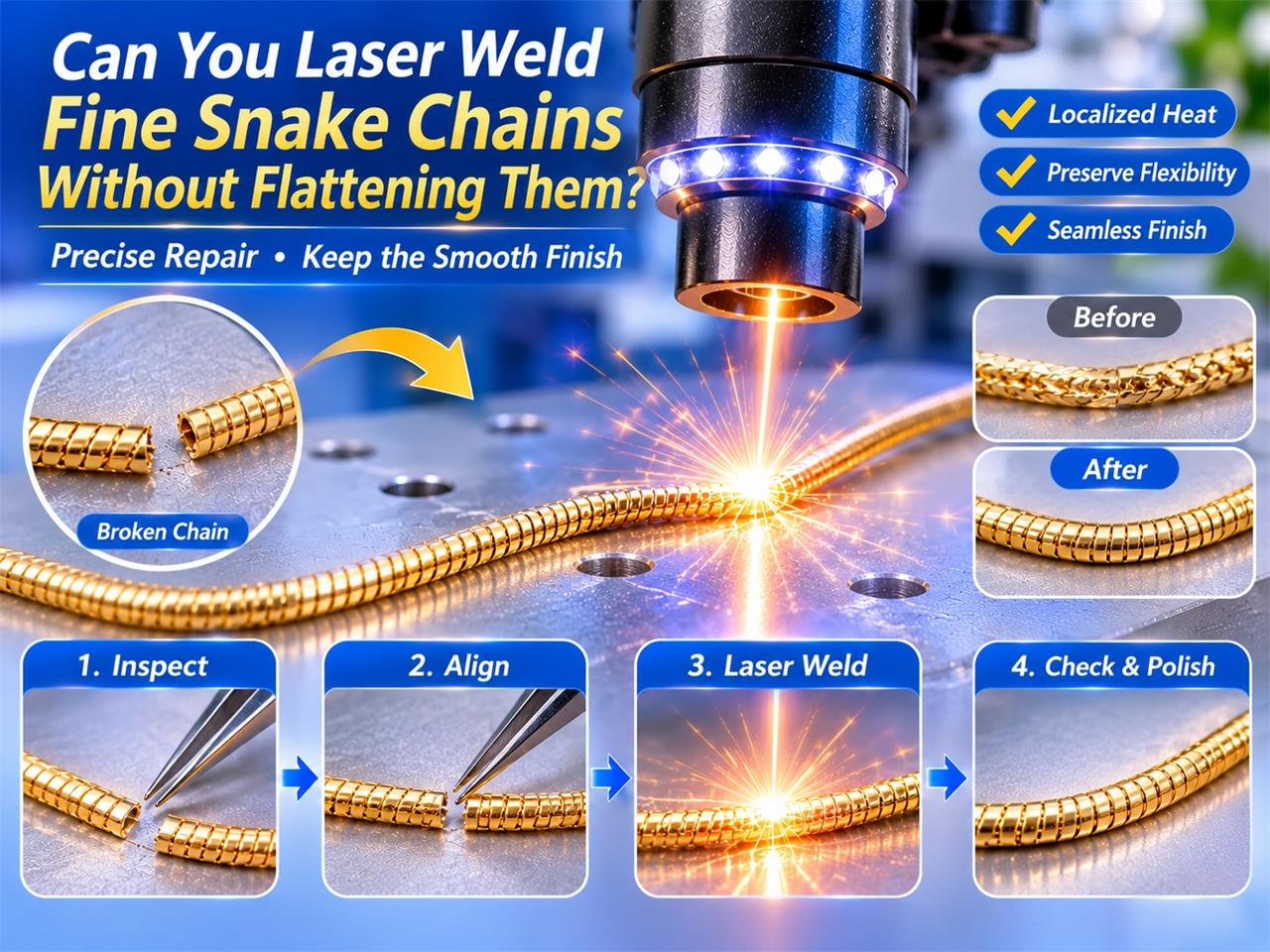
Fine snake chains are popular in gold necklaces because of their smooth surface, flexible structure, and elegant appearance. However, repairing a broken snake chain can be challenging. Its closely connected metal links leave little room for welding, and excessive pressure or heat can cause the chain to flatten, deform, or lose its original flexibility. A professional pulsed YAG jewelry laser welding machine provides localized heat input for repairing suitable snake chain connections. The key is to identify the damaged section, support the chain without crushing it, and control laser energy carefully throughout the repair.
1. Why Are Fine Snake Chains Difficult to Repair?
A snake chain has a distinctive construction consisting of closely connected, small metal links or curved plates. These components fit together to create a smooth, continuous surface that resembles the scales of a snake.
Unlike traditional cable chains, individual links are not easily accessible from the outside. The compact construction also means that deformation in one small section can affect the appearance and movement of surrounding links.
Common characteristics of fine snake chains include:
- Compact link construction: Individual metal components are tightly connected.
- Smooth outer surface: The finished chain has very little visible space between links.
- Limited welding access: The damaged metal may be difficult to reach without affecting neighboring sections.
- Flexible but sensitive structure: Excessive bending or compression can create permanent kinks.
- Thin metal sections: Lightweight designs may have limited material available for welding.
Some snake chains have round profiles, while others feature flatter cross-sections. Their internal construction can also differ depending on the manufacturer and design.
Before welding, a jeweler should determine whether the chain is solid, hollow, or constructed from particularly thin interlocking elements. This information affects the repair method and acceptable heat input.
2. What Causes a Fine Snake Chain to Flatten?
Flattening is one of the most frustrating problems when repairing fine snake chains. It can happen during everyday use or as a result of improper repair techniques.
Excessive Mechanical Pressure
Snake chains can become flattened when compressed by tools, pliers, or unsuitable holding fixtures.
Even when the chain does not break, excessive pressure can permanently change the cross-section and create a visible flat spot.
Improper Positioning During Welding
Using ordinary clamps to secure a delicate snake chain may compress the links before welding even begins.
Some repair technicians apply too much pressure because they want to prevent the chain from moving. However, this can damage the original structure.
Excessive Laser Energy
Laser welding concentrates heat on a small area, but excessive energy can still melt or weaken thin metal sections.
If the chain has hollow or very thin-walled components, excessive heating may cause local collapse or burn-through.
Incorrect Straightening Techniques
Trying to straighten a kinked snake chain by pulling or twisting it can make the deformation worse.
Before welding, determine whether the damaged section can be safely returned to its original shape. Severely kinked links may require replacement instead of further reshaping.
3. Can You Laser Weld a Broken Fine Snake Chain?
Yes. Many fine gold snake chains can be repaired using a pulsed jewelry laser welder, provided the damaged section has sufficient metal remaining and its original structure is still suitable for repair.
However, different types of damage require different approaches.
Clean Break at a Connection Point
This is generally one of the more suitable repair situations. If two metal sections have separated but retain their original shape, the operator may reconnect them using controlled laser pulses.
Small Crack in a Metal Section
A localized crack may also be repairable if the surrounding material remains structurally sound.
The operator must identify the actual crack rather than applying laser energy randomly to the surrounding surface.
Flattened or Kinked Section
This is more complicated. Laser welding cannot automatically restore a flattened chain to its original geometry.
If the metal is still intact, an experienced jeweler may carefully reshape it using suitable tools. However, if several links have collapsed or developed cracks, replacing the damaged section may be more reliable.
Missing Metal
If a small amount of material has been lost at the break, compatible gold filler wire may be necessary to rebuild the connection.
Excessive filler material should be avoided because it can make the repaired section bulky and reduce chain flexibility.
For additional repair techniques, read How to Repair Thin Gold Chains Without Soldering.
4. How to Laser Weld a Fine Snake Chain Without Flattening It
The repair process requires careful inspection, positioning, and energy control. The objective is to reconnect the damaged metal while preserving the original chain profile.
Step 1: Inspect the Chain Under a Microscope
Before welding, place the damaged section under magnification.
Check the following:
- Exact location of the broken connection.
- Whether the chain has a solid or hollow construction.
- Whether the surrounding links are already flattened.
- Whether there are additional cracks near the damaged area.
- Whether sufficient original metal remains for welding.
- The gold karat and alloy composition.
Do not begin welding until the original chain structure is clearly understood.
Step 2: Clean the Damaged Area
Remove dirt, oil, polishing compounds, and other surface contaminants.
If the chain has previously been repaired using solder, inspect the old joint and determine whether unsuitable or contaminated material needs to be removed.
A clean repair area improves welding consistency and makes it easier to observe the actual condition of the metal.
Step 3: Position the Chain Without Compressing It
This is one of the most important steps when repairing a fine snake chain.
Use a suitable jewelry fixture to support the chain near the damaged section. The fixture should prevent unwanted movement without squeezing the chain body.
Important positioning considerations include:
- Support the chain from underneath where possible.
- Avoid crushing the chain with ordinary metal clamps.
- Keep the original cross-sectional shape intact.
- Align the broken ends without forcing them together.
- Prevent twisting around the repair point.
The operator should be able to access the damaged metal while keeping the surrounding structure properly supported.
Step 4: Adjust the Laser Welding Parameters
Fine snake chains require careful laser parameter selection because their metal sections are often small and closely connected.
The most important parameters include:
- Pulse energy: Controls the energy delivered to the metal during each pulse.
- Pulse duration: Determines how long the laser interacts with the material.
- Pulse frequency: Influences heat accumulation during repeated welding.
- Spot diameter: Determines the size of the localized welding area.
The objective is to achieve sufficient metal fusion without unnecessarily heating the surrounding links.
There is no universal parameter setting for all snake chains. A thin 18K gold chain and a thicker 14K chain can require different conditions.
Begin with comparable test samples and adjust the parameters gradually. Avoid repeatedly applying high-energy pulses to the same location.
For more detailed technical guidance, see Can You Laser Weld Gold Jewelry or Silver Jewelry?.
Step 5: Apply Controlled Laser Pulses
Once the chain is correctly positioned, apply controlled pulses to the damaged metal.
For a clean break, direct laser fusion may be sufficient if the two ends fit properly.
If material is missing, compatible gold filler wire can be added gradually to rebuild the connection.
Avoid excessive overlap and unnecessary welding around the neighboring links. The repair should remain localized to the damaged section.
Step 6: Monitor the Chain Profile During Welding
After the initial weld, inspect the chain under magnification.
Check whether:
- The original round or flat profile remains unchanged.
- The repaired section has not developed a flat spot.
- The metal has not melted into neighboring links.
- The weld has sufficient fusion.
- There is no excessive filler material.
If the chain begins to deform, stop and reassess the parameters and positioning rather than adding more energy.
Step 7: Inspect Flexibility and Finish the Repair
After welding, allow the repaired area to cool under suitable conditions.
Inspect the connection for incomplete fusion, cracks, sharp edges, and excessive metal buildup.
Carefully polish the repaired section without removing too much original material.
Finally, check the chain’s flexibility. It should bend naturally without a stiff section or unusual resistance around the repair point.
5. How to Prevent Snake Chains from Becoming Stiff After Welding
Flattening is not the only concern when repairing fine snake chains. Excessive metal buildup or accidental fusion between neighboring components can also make the chain stiff.
Several practices help preserve flexibility.
Avoid Excessive Filler Material
Too much filler can create a bulky welding area that restricts the movement of neighboring links.
Use only the amount required to restore the damaged connection.
Do Not Weld Unnecessary Areas
Some operators apply additional welds around the damaged section to make the repair look stronger.
However, unnecessary welding can join components that were originally designed to move relative to each other.
Maintain the Original Chain Geometry
Before welding, make sure the chain has not been twisted or compressed. Accurate alignment helps preserve its natural movement after repair.
Control Heat Accumulation
Repeated pulses can gradually heat surrounding metal even when each individual pulse is relatively small.
Use a controlled welding sequence and inspect the repair area periodically.
For another useful comparison, read How to Repair Broken Gold Chains with a Laser Welder.
6. Laser Welding vs. Traditional Soldering for Fine Snake Chains
Both methods can be used in jewelry repair, but fine snake chains create special challenges because of their compact construction.
| Comparison | Laser Welding | Traditional Soldering |
|---|---|---|
| Heat concentration | Localized | Broader heating area |
| Fine chain repair | Precise welding position | Requires careful torch control |
| Thin metal sections | Adjustable energy delivery | Greater potential for excessive heating |
| Neighboring links | Less unnecessary heat exposure when properly operated | More surrounding metal may be heated |
| Filler material | Optional depending on the damage | Generally uses solder |
| Post-repair finishing | Can reduce excess material | May require more cleanup |
Laser welding does not automatically prevent chain deformation. Poor parameters or improper positioning can still damage a fine snake chain.
However, its localized heat delivery offers a useful advantage for repair jobs where the welding area is extremely small.
For a more comprehensive comparison, see Laser Welding vs. Soldering for Jewelry Repair: Which Is Better?.
7. Choosing a Jewelry Laser Welder for Fine Snake Chain Repair
For jewelry repair workshops handling delicate necklaces, fine snake chains, gold bracelets, and small metal connections, a pulsed YAG jewelry laser welder is worth considering.
The Dowin New 150W Desktop Laser Jewelry Welder is designed for precision welding of gold, silver, platinum, and other compatible metal components.
Its main specifications include:
- Maximum laser power: 150W/200W configurations.
- Laser wavelength: 1064 nm.
- Pulse frequency: 1–20 Hz.
- Adjustable pulse width: 0.2–10 ms.
- Spot adjustment range: 0.2–2 mm.
- Observation system: Microscope + CCD.
- Cooling method: Air cooling.
For fine snake chain repair, the microscope observation system and adjustable spot diameter are particularly useful. They help operators identify tiny defects and position the laser accurately.
The machine can also be used for:
- Fine gold chain repair.
- Box chain and rope chain repair.
- Broken necklace connections.
- Gold clasp and jump ring repair.
- Ring crack repair.
- Prong rebuilding.
- Small jewelry casting defects.
Explore the Dowin Jewelry Laser Welding Machine Collection to compare different machine configurations.
When selecting equipment, focus on parameter control, microscope visibility, and actual welding samples. The highest rated power is not necessarily the best choice for extremely fine chain repair.
Frequently Asked Questions
Can you laser weld a fine gold snake chain?
Yes. Many fine gold snake chains can be repaired using a pulsed YAG jewelry laser welder. The operator must identify the damaged structure, align the broken ends, and select suitable laser parameters according to the chain thickness and construction.
Why does a snake chain become flat after welding?
Flattening may result from excessive clamping pressure, unsuitable positioning, excessive heat, or an already weakened hollow structure. Proper support and controlled laser energy help reduce these risks.
Can you repair a kinked snake chain with a laser welder?
Laser welding can reconnect a broken section, but it cannot automatically restore a severely kinked chain. Minor deformation may be corrected through careful reshaping by an experienced jeweler. Severely damaged sections may require replacement.
What spot size is suitable for fine snake chain welding?
The appropriate spot size depends on the dimensions of the damaged area, metal thickness, and required penetration. A smaller spot can be useful for localized repairs, but the correct setting should be established through testing rather than selected by size alone.
Can laser welding make a snake chain stiff?
Yes. Excessive filler material or accidental fusion between neighboring links can restrict movement. Proper alignment, localized welding, and careful finishing help preserve the original flexibility.
Can you laser weld a hollow snake chain?
Some hollow snake chains can be repaired, but their thin metal walls require additional care. Excessive energy can cause burn-through or structural collapse. The operator should inspect the construction and test suitable parameters on comparable material.
Is a 150W jewelry laser welder suitable for fine snake chains?
A 150W pulsed YAG jewelry laser welder can be considered for suitable fine chain repairs. However, successful welding depends on adjustable pulse parameters, spot size, chain construction, and operator technique rather than rated power alone.
Conclusion
Laser welding fine snake chains without flattening them requires careful control over both mechanical pressure and heat input. The goal is not simply to reconnect broken metal, but to preserve the original chain profile, smooth surface, and natural flexibility.
Proper inspection, non-compressive positioning, suitable pulse parameters, and controlled filler application are essential. For severely flattened or weakened sections, replacing the damaged part may be more reliable than repeated welding.
For professional jewelry repair workshops, a pulsed YAG jewelry laser welder provides a practical solution for many delicate gold chain applications. Dowin offers desktop jewelry laser welding machines for gold and silver jewelry repair. Contact Dowin to discuss your chain materials and repair requirements.
Post time: Nov-27-2026
