
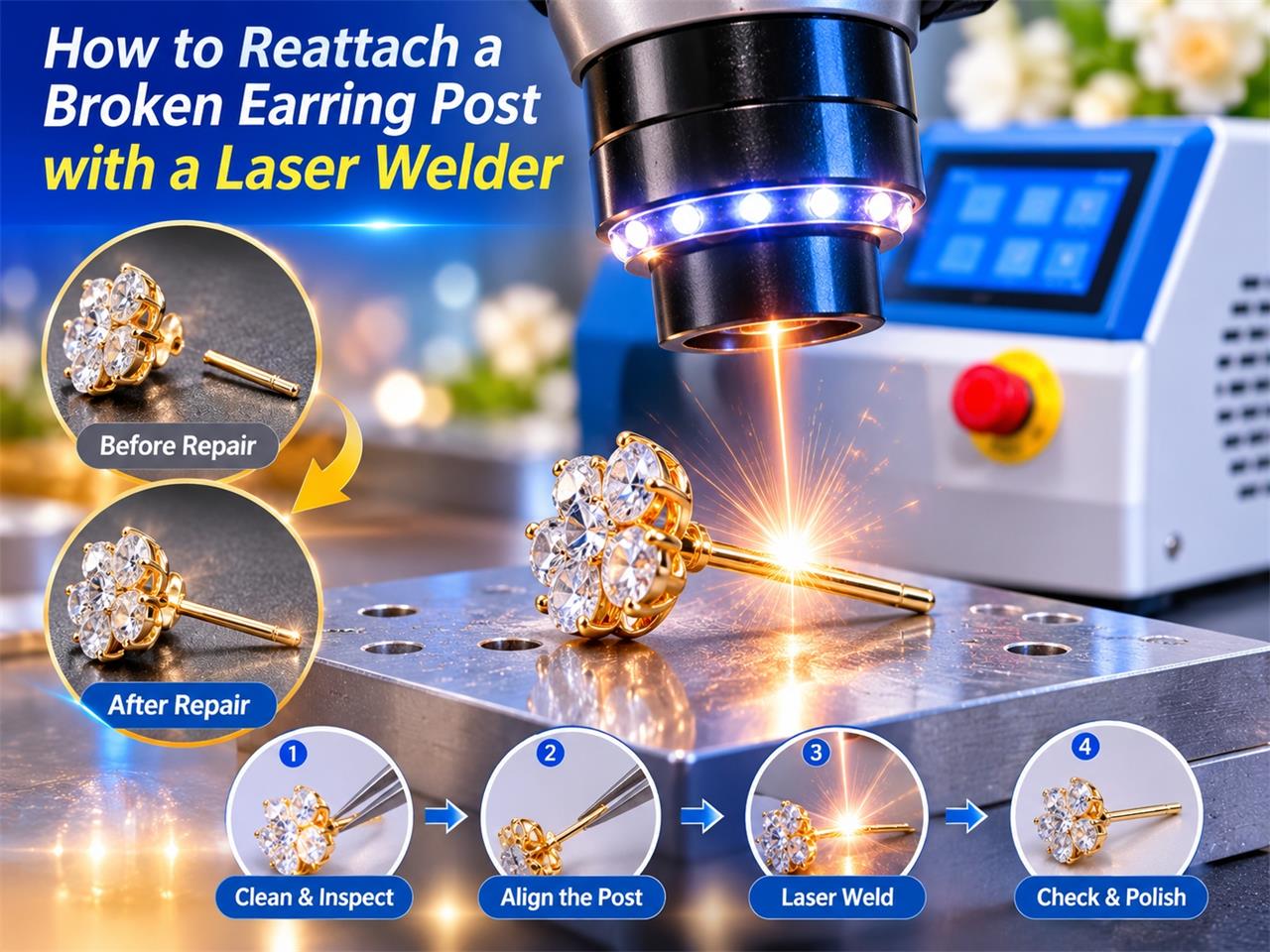
Spring ring clasps are widely used on gold necklaces, delicate bracelets, and fine jewelry chains. Because of their compact structure and internal spring mechanism, repairing a damaged clasp can be challenging. Excessive heat may deform the thin metal housing, damage the internal spring, or prevent the sliding gate from closing properly. A professional pulsed YAG jewelry laser welding machine provides localized heat input for repairing suitable metal sections of small clasps. However, successful repair requires understanding the clasp construction, identifying the damaged area, and controlling heat carefully.
1. Understanding the Structure of a Spring Ring Clasp
A spring ring clasp is a small circular metal fastener commonly found on gold necklaces, silver chains, and lightweight bracelets. Unlike a lobster clasp, it uses a spring-loaded sliding mechanism to open and close the circular ring.
Its main components include:
- Outer ring housing: The circular metal body that forms the main structure of the clasp.
- Sliding gate: The movable section that retracts when the release lever is operated.
- Internal spring: Provides the return force that automatically closes the gate.
- Release lever: Allows the user to open the clasp.
- Attachment loop: Connects the clasp to the necklace or bracelet.
These components are packed into a very small space. This is why spring ring clasp repair requires more precision than repairing an ordinary jump ring.
Before using a laser welder, identify whether the damage is located on the attachment loop, outer housing, sliding gate, or internal spring mechanism.
2. Which Spring Ring Clasp Problems Can Be Repaired?
Not every damaged spring ring clasp should be repaired by laser welding. The location and type of damage determine whether welding is appropriate.
Broken Attachment Loop
The attachment loop connects the clasp to the necklace chain. It may crack or separate after repeated pulling or mechanical stress.
This is generally one of the more straightforward repair situations. If the loop is a separate component, it may be possible to replace it or reconnect the broken metal using controlled laser welding.
Cracked Outer Ring Housing
A crack in the outer metal body may sometimes be repaired when it is located away from the sliding gate and internal spring assembly.
However, spring ring clasps often have thin-walled housings. Excessive laser energy may deform the circular body or cause molten metal to enter the sliding track.
The operator must carefully evaluate the wall thickness and internal clearance before deciding whether to weld.
Broken Sliding Gate
The sliding gate moves every time the clasp is opened. If it is bent, broken, or unable to return to its original position, laser welding may not be the best solution.
Rebuilding this component requires very precise positioning and sufficient clearance for movement. In many cases, replacing the complete clasp is more reliable.
Damaged Internal Spring
The internal spring is responsible for automatically closing the clasp. If it has lost its elasticity, broken, or become displaced, welding the outer housing will not solve the problem.
Directly applying laser energy to a tiny spring is generally not recommended. Heating can change its mechanical properties and reduce its return force.
For a damaged internal spring, component replacement or complete clasp replacement is usually the better choice.
3. Why Is Laser Welding Suitable for Tiny Jewelry Clasps?
Traditional torch soldering can be difficult when working on very small spring ring clasps. The outer housing, sliding gate, and internal spring are located close together, leaving little room for controlling heat.
A pulsed jewelry laser welder offers several advantages for suitable clasp repair applications.
Localized Heat Input
Laser energy is concentrated on a small welding area. This helps reduce unnecessary heating of nearby metal components compared with heating the entire clasp using a traditional torch.
However, the surrounding housing can still conduct heat toward the internal spring. Localized heating does not mean zero heat transfer.
Precise Welding Position
A microscope allows the operator to observe tiny cracks and attachment points clearly. This is particularly useful when repairing small gold components that are difficult to position accurately with ordinary tools.
Controlled Weld Size
With suitable spot diameter and pulse parameters, the operator can produce a localized weld without unnecessarily building up excess metal.
This is important because even a small amount of unwanted metal around a spring ring clasp can interfere with the sliding mechanism.
For more information, read How Spot Size Affects Jewelry Laser Welding.
4. How to Laser Weld a Tiny Spring Ring Clasp
The following workflow focuses on repairing a suitable external metal section or attachment loop while protecting the internal operating mechanism.
Step 1: Inspect the Clasp Under a Microscope
First, identify the exact location of the damage.
Check whether the clasp can still open and close normally. Inspect the internal spring response, sliding gate, circular housing, and attachment loop.
Also determine the metal composition. Gold, silver, brass, and plated components can require different welding conditions.
If the spring mechanism is already damaged, consider replacing the clasp rather than attempting to repair the housing.
Step 2: Clean and Prepare the Welding Area
Remove dirt, oil, oxidation, polishing compounds, and other contaminants from the repair location.
If the attachment loop is damaged, determine whether it should be replaced or reconnected. If the outer housing is cracked, assess whether the crack can be accessed without affecting the internal spring channel.
Do not attempt to weld over contamination or an unstable joint.
Step 3: Secure the Clasp in a Suitable Fixture
Because spring ring clasps are extremely small, stable positioning is essential.
Use suitable jewelry fixtures or tweezers to hold the clasp securely. The damaged area should face the laser while the moving gate remains free from accidental contact with the fixture.
Check the following before welding:
- The clasp cannot move during laser operation.
- The damaged metal surfaces are correctly aligned.
- The sliding gate is not trapped or obstructed.
- The internal spring is protected from unnecessary heat exposure.
- The welding location is accessible under microscope observation.
Step 4: Select Appropriate Laser Parameters
Spring ring clasps often have very thin metal walls. Therefore, parameter selection is particularly important.
The main parameters to consider are:
- Pulse energy: Must provide sufficient fusion without melting through the thin housing.
- Pulse duration: Influences the interaction time between laser energy and the metal.
- Spot diameter: Should match the dimensions of the repair area.
- Pulse frequency: Affects pulse spacing and heat accumulation during repeated welding.
There is no universal parameter setting for all spring ring clasps. The required settings depend on the metal alloy, wall thickness, joint geometry, and machine configuration.
Begin testing on comparable scrap material and adjust one parameter at a time. Avoid excessive pulse overlap because repeated heating can gradually raise the temperature of the entire clasp.
For more technical guidance, see Jewelry Laser Welding Parameters for Gold: A Practical Guide.
Step 5: Apply Controlled Laser Pulses
Once the clasp is properly positioned, apply controlled pulses to the external repair area.
For a broken attachment loop, the objective is to restore the connection while maintaining its original shape.
For a suitable crack in the outer housing, the operator must ensure that the molten metal does not enter the sliding track or close the clearance needed for the gate to move.
If material is missing, compatible filler wire may be necessary. Its composition should match the clasp material as closely as possible.
Avoid continuously welding around the entire circumference of the housing. The repair should remain localized to the damaged section.
Step 6: Allow Cooling and Inspect the Mechanism
After welding, allow the part to cool naturally under suitable working conditions.
Inspect the weld under magnification. Look for cracks, excessive metal buildup, deformation, or signs that the sliding gate has become restricted.
Do not force the gate open if it feels stuck. Determine whether the problem comes from metal deformation, contamination, or damage to the internal mechanism.
Step 7: Test the Clasp Before Polishing
The final functional test is essential.
- Pull the release lever and confirm that the gate opens smoothly.
- Release the lever and check that the spring returns the gate to its closed position.
- Repeat the opening and closing test several times.
- Inspect the attachment loop and repaired section for structural integrity.
- Check that polishing has not reduced the strength of the repaired area.
A clasp that looks perfect but cannot close securely is not a successful repair.
5. Common Problems When Laser Welding Spring Ring Clasps
Working with tiny spring ring clasps requires more attention to detail than many ordinary jewelry welding jobs.
| Problem | Possible Cause | Recommended Solution |
|---|---|---|
| Outer housing deforms | Excessive heat input or unsuitable positioning | Optimize pulse energy and use stable fixturing. |
| Sliding gate becomes stuck | Molten metal enters the sliding track | Keep the weld away from moving clearances and inspect under magnification. |
| Spring loses its return force | Heat exposure changes spring properties | Protect or replace the spring mechanism. |
| Weld joint is weak | Insufficient fusion or poor surface preparation | Improve cleaning, alignment, and parameter selection. |
| Visible spatter | Unsuitable energy density or contamination | Clean the surface and optimize pulse settings. |
| Clasp does not close completely | Gate deformation, spring damage, or excess weld material | Inspect the mechanism and determine whether replacement is necessary. |
Another important issue is repeated heat accumulation. Even when individual laser pulses are carefully controlled, closely spaced pulses may gradually heat the surrounding housing.
For additional guidance, read Laser Welding Frequency for Gold Jewelry.
6. Laser Welding vs. Traditional Soldering for Small Clasps
Both laser welding and traditional soldering remain useful in jewelry repair. The choice depends on the clasp construction and the location of the damaged section.
| Comparison | Laser Welding | Traditional Soldering |
|---|---|---|
| Heat concentration | Localized | Broader heating area |
| Small attachment loops | Suitable for precision repair | Requires careful heat control |
| Thin metal housing | Precise energy control is possible | Greater risk of heating surrounding areas |
| Near spring mechanisms | Requires careful heat management | Also difficult because of broader heat exposure |
| Small repair areas | Good positioning accuracy with a microscope | Depends heavily on operator technique |
| Internal spring replacement | Not a direct solution | Usually requires component replacement |
Laser welding does not eliminate the need for traditional jewelry repair techniques. It provides another option when a small, localized metal connection needs to be restored.
For more examples of precision chain repair, see How to Repair Broken Gold Chains with a Laser Welder.
7. Choosing a Jewelry Laser Welder for Tiny Clasp Repairs
For jewelry workshops handling small chain connections, spring ring clasps, jump rings, and delicate gold components, a pulsed YAG jewelry laser welder is worth considering.
The Dowin New 150W Desktop Laser Jewelry Welder is designed for precision repair and fabrication of gold, silver, platinum, and other compatible metal components.
Its main features include:
- Maximum laser power: 150W/200W configurations.
- Laser wavelength: 1064 nm.
- Pulse frequency: 1–20 Hz.
- Adjustable pulse width: 0.2–10 ms.
- Spot adjustment range: 0.2–2 mm.
- Observation system: Microscope + CCD.
- Cooling method: Air cooling.
For small clasp repairs, the microscope and adjustable spot diameter are particularly useful because they help operators observe and position tiny welding areas.
However, the machine’s rated power alone does not determine whether a specific spring ring clasp can be repaired. The actual metal thickness, internal construction, and joint accessibility must be evaluated first.
Other suitable applications in a jewelry repair workshop include:
- Fine gold chain repair.
- Broken jump ring repair.
- Gold necklace clasp connections.
- Bracelet link repair.
- Small cracks in gold jewelry.
- Ring and prong repair.
Explore the Dowin Jewelry Laser Welding Machine Collection to compare available desktop and portable models.
Frequently Asked Questions
Can you laser weld a broken spring ring clasp?
Yes, certain external metal sections and attachment loops can be repaired with a jewelry laser welder. However, the internal spring and sliding gate must be protected from heat and molten metal. Severely damaged mechanisms are usually better replaced.
Can laser welding damage the internal spring?
Yes. Heat conducted through the metal housing may affect the internal spring, even when the laser does not directly hit it. The operator must evaluate the distance between the welding area and the spring, as well as the expected heat input.
Can you repair a gold spring ring clasp without replacing it?
Sometimes. A broken external attachment loop or a suitable crack in the outer housing may be repairable. If the spring, sliding gate, or locking mechanism is damaged, replacing the complete clasp is generally more reliable.
What spot size is suitable for spring ring clasp repair?
A small spot diameter is generally useful for localized repairs on tiny clasps. The appropriate diameter depends on the joint size, wall thickness, and required penetration. Test the settings on comparable material before working on valuable jewelry.
Can silver spring ring clasps be laser welded?
Yes, suitable silver components can be laser welded. However, silver requires careful parameter optimization because of its high thermal conductivity. Thin silver housings are particularly sensitive to excessive energy input.
Is laser welding better than soldering for tiny spring ring clasps?
Laser welding offers more localized heat input and precise positioning, which can be advantageous for certain small external repairs. However, neither process can guarantee protection of an internal spring. The best method depends on the damage location and clasp construction.
Conclusion
Laser welding can be a useful repair technique for tiny spring ring clasps, particularly when the damage involves an external attachment loop or a suitable section of the metal housing.
The biggest challenge is protecting the internal spring and sliding mechanism. Proper inspection, stable positioning, suitable spot size, controlled laser pulses, and functional testing are all essential.
For professional jewelry repair shops, a pulsed YAG jewelry laser welder provides greater flexibility when handling delicate chains, small clasps, and other precision metal components.
Dowin offers jewelry laser welding machines for jewelry repair shops and manufacturers. Contact our team to discuss your repair applications and find a suitable machine configuration.
Post time: Nov-26-2026
