
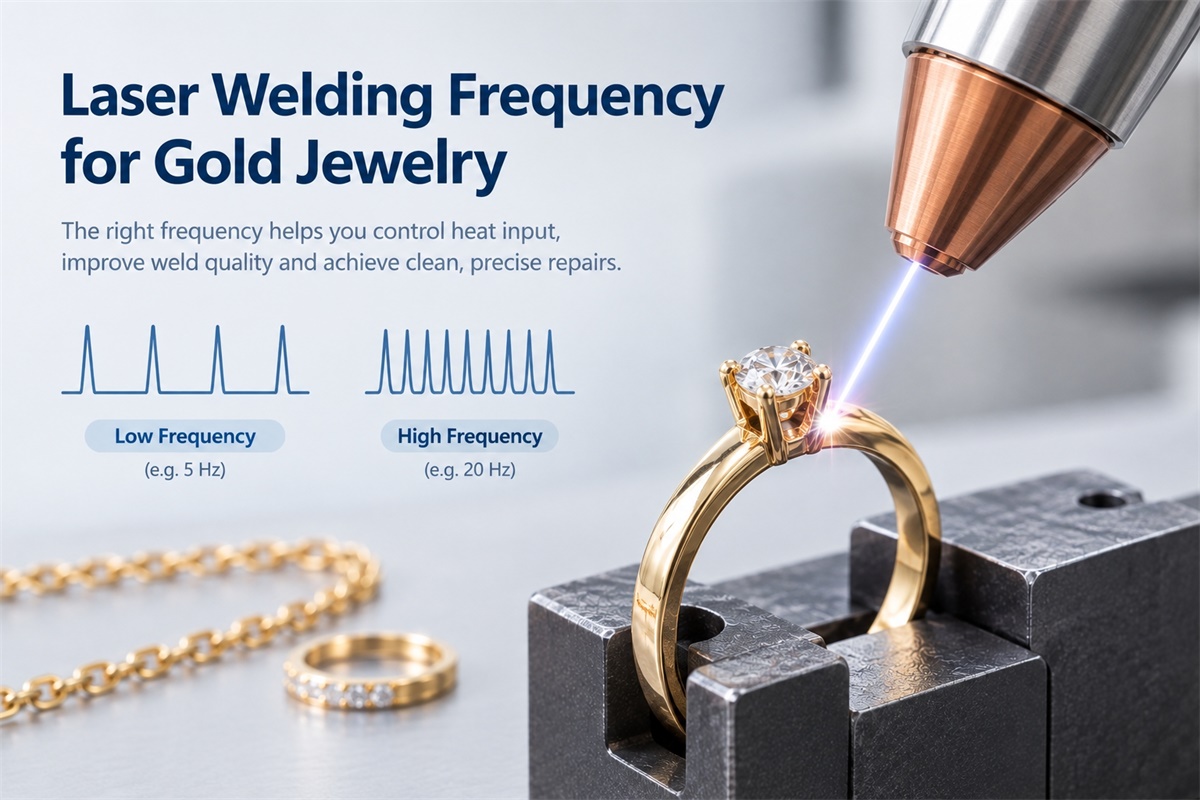
Laser welding frequency is an important parameter in gold jewelry repair and manufacturing. It determines how many laser pulses are delivered per second, influencing heat accumulation, weld consistency, and the appearance of the finished joint.
When repairing gold rings, chains, prongs, and other delicate components, selecting the appropriate frequency helps jewelers control the welding process and achieve reliable results. However, frequency should never be adjusted independently of pulse energy, pulse duration, spot size, and gold alloy composition.
For workshops using a pulsed YAG jewelry laser welding machine, understanding how frequency affects heat input is essential for producing clean, precise welds while minimizing unnecessary thermal damage.
1. What Is Laser Welding Frequency?
Laser welding frequency, measured in hertz (Hz), refers to the number of laser pulses emitted per second by a pulsed laser welding machine.
For example, a frequency of 5 Hz means the machine delivers five laser pulses per second, while 20 Hz means it delivers twenty pulses per second.
In gold jewelry welding, frequency affects how closely pulses are delivered in time. When welding a joint with repeated pulses, a higher frequency can create more closely spaced weld spots and increase the rate of heat accumulation.
However, frequency does not determine the energy of each pulse by itself. Pulse energy, pulse duration, spot size, and the machine’s output characteristics must also be considered. Research on gold alloy welding identifies frequency, pulse duration, pulse diameter, and voltage as important factors affecting weld quality.
2. How Frequency Affects Gold Jewelry Welding
Low Frequency: More Time Between Pulses
A lower frequency provides a longer interval between successive pulses. This can help reduce heat accumulation during repairs that require individual, carefully positioned welds.
Low-frequency settings may be useful for delicate gold chains, thin ring sections, and localized repairs where excessive heat could damage surrounding material.
However, a frequency that is too low for a particular welding task may reduce productivity or create discontinuous welds when a continuous seam is required.
High Frequency: Faster Pulse Delivery
A higher frequency delivers more pulses per second, which can improve welding speed and create more closely spaced weld spots during seam welding.
For gold jewelry manufacturing, this may be useful when joining longer sections or performing repeated welds along a joint.
However, higher frequency can increase cumulative heat input when pulse energy and other conditions remain unchanged. Excessive heat accumulation may lead to a larger heat-affected area, unwanted melting, or deformation.
The appropriate frequency depends on the required weld continuity, material thickness, pulse energy, and welding technique. Higher frequency is not automatically better for every gold jewelry application.
3. How to Choose Laser Welding Frequency for Different Gold Jewelry Applications
Different jewelry repairs require different combinations of pulse spacing, penetration, and heat control. The following are practical starting considerations, not universal frequency presets.
Gold Chain Repair
Fine gold chains contain small links and thin sections that can be easily damaged by excessive heat. A lower frequency can be useful when making individual repair welds, allowing the operator to control pulse placement and avoid unnecessary heat buildup.
Use carefully controlled pulse energy and a suitable spot size to prevent burn-through.
Gold Ring Welding
Gold ring repairs may require either isolated spot welds or a series of overlapping pulses, depending on the joint.
For localized cracks or small joints, a moderate or low frequency may provide sufficient control. For longer seams, a higher frequency may help create more continuous weld coverage, provided heat accumulation remains manageable.
Gold Prong and Claw Repair
Prong repair requires precise energy delivery near delicate settings. A lower frequency can help the operator control individual pulses and assess the molten area between shots.
Frequency alone cannot prevent gemstone damage. Pulse energy, spot size, positioning, and appropriate protection remain essential.
Gold Bracelet and Larger Jewelry Components
Thicker bracelet sections or larger joints may require more pulses or higher energy to achieve adequate fusion. Frequency should be selected according to the required weld depth and speed while monitoring cumulative heat input.
For larger repair areas, controlled multiple passes may be preferable to applying excessive energy in a single pass.
4. How to Set Laser Welding Frequency for Gold Jewelry
Step 1: Identify the gold alloy and repair type.
Determine whether the workpiece is yellow gold, white gold, or rose gold, and assess its karat, thickness, and joint geometry.
Step 2: Select a suitable starting frequency.
Use the machine manufacturer’s recommended settings for the material and application. Choose a conservative frequency for delicate, localized repairs and adjust according to the required weld continuity.
Step 3: Set pulse energy and pulse duration.
Frequency should be evaluated alongside pulse energy and duration. A higher frequency combined with high pulse energy may cause excessive heat accumulation.
Step 4: Test on matching scrap gold.
Use scrap with a similar alloy and thickness. Observe weld appearance, penetration, spatter, and any signs of unwanted melting.
Step 5: Adjust frequency gradually.
If the weld is discontinuous during seam welding, consider increasing frequency or adjusting pulse overlap. If excessive heat builds up, reduce frequency or reassess pulse energy and duration.
Step 6: Record the verified parameters.
Save the successful frequency, pulse energy, pulse duration, spot size, alloy, and repair type. These records can help improve consistency in future jewelry repairs.
Always verify parameter changes on scrap material before welding valuable jewelry.
5. Common Frequency Problems in Gold Jewelry Welding
|
Welding Problem |
Possible Cause |
Recommended Adjustment |
|---|---|---|
|
Excessive heat buildup |
High frequency combined with high pulse energy |
Reduce frequency or pulse energy |
|
Discontinuous weld seam |
Insufficient pulse overlap or unsuitable frequency |
Adjust frequency, pulse spacing, or welding speed |
|
Burn-through on thin gold |
Excessive energy concentration or cumulative heat |
Reduce pulse energy or frequency |
|
Uneven weld appearance |
Inconsistent pulse spacing or positioning |
Maintain consistent movement and pulse overlap |
|
Slow welding process |
Frequency too low for the required seam |
Increase frequency gradually and verify heat input |
These adjustments are starting points rather than guaranteed solutions. The cause of a welding defect should be identified before changing parameters.
6. Recommended Frequency Settings for Gold Jewelry Welding
There is no single frequency setting that works for every gold jewelry laser welding machine. Different YAG systems have different frequency ranges, pulse-energy capabilities, and control methods.
Some jewelry laser welders operate at low single-digit frequencies for individual spot welding, while other machines support higher frequencies for faster or more continuous welding. Manufacturer guidance and machine-specific testing should determine the actual operating range.
When selecting a jewelry laser welder, buyers should evaluate:
-
Adjustable pulse frequency range
-
Maximum single-pulse energy
-
Pulse duration adjustment
-
Spot-size control
-
Output stability
-
Availability of material-specific parameter presets
A machine with a wider frequency range provides greater flexibility, but the usable range and welding results depend on its complete output characteristics and the application.
7. Frequently Asked Questions
What frequency should I use for gold jewelry laser welding?
The appropriate frequency depends on the gold alloy, material thickness, joint geometry, and welding technique. Start with the machine manufacturer’s recommended settings and adjust frequency through controlled testing.
Is higher frequency better for gold laser welding?
Not always. Higher frequency can increase welding speed and pulse overlap, but it may also increase heat accumulation. The ideal frequency balances weld continuity, productivity, and heat control.
Does laser frequency affect gold weld strength?
Frequency can influence weld quality by changing pulse spacing and cumulative heat input. However, weld strength also depends on pulse energy, penetration, joint preparation, alloy composition, and other welding conditions.
What is the difference between laser frequency and pulse duration?
Frequency measures how many pulses are delivered per second, while pulse duration measures how long each pulse lasts. Frequency affects the interval between pulses, whereas pulse duration affects the time over which each pulse delivers energy.
Can I use the same frequency for 14K and 18K gold?
Not necessarily. Different gold alloys may respond differently to laser welding because of variations in composition and thermal properties. Frequency should be verified together with pulse energy, duration, and spot size for each alloy and repair.
Conclusion
Laser welding frequency plays an important role in controlling pulse spacing, heat accumulation, and welding speed during gold jewelry repair. Lower frequencies can provide greater control for individual spot welds, while higher frequencies may improve efficiency during repeated or overlapping welding.
The key is to select a frequency that matches the repair rather than simply choosing the highest available setting. By adjusting frequency alongside pulse energy, pulse duration, and spot size, jewelers can achieve more consistent welds while reducing unnecessary heat damage.
For jewelry workshops handling gold rings, chains, bracelets, and intricate precious-metal components, a pulsed YAG jewelry laser welding machine with adjustable frequency and precise pulse control offers flexibility for different repair requirements.
Looking for a jewelry laser welder for gold repair and manufacturing? Explore Dowin’s jewelry laser welding solutions to find a machine configuration suited to your materials, repair applications, and production needs.
Post time: Sep-24-2026
