
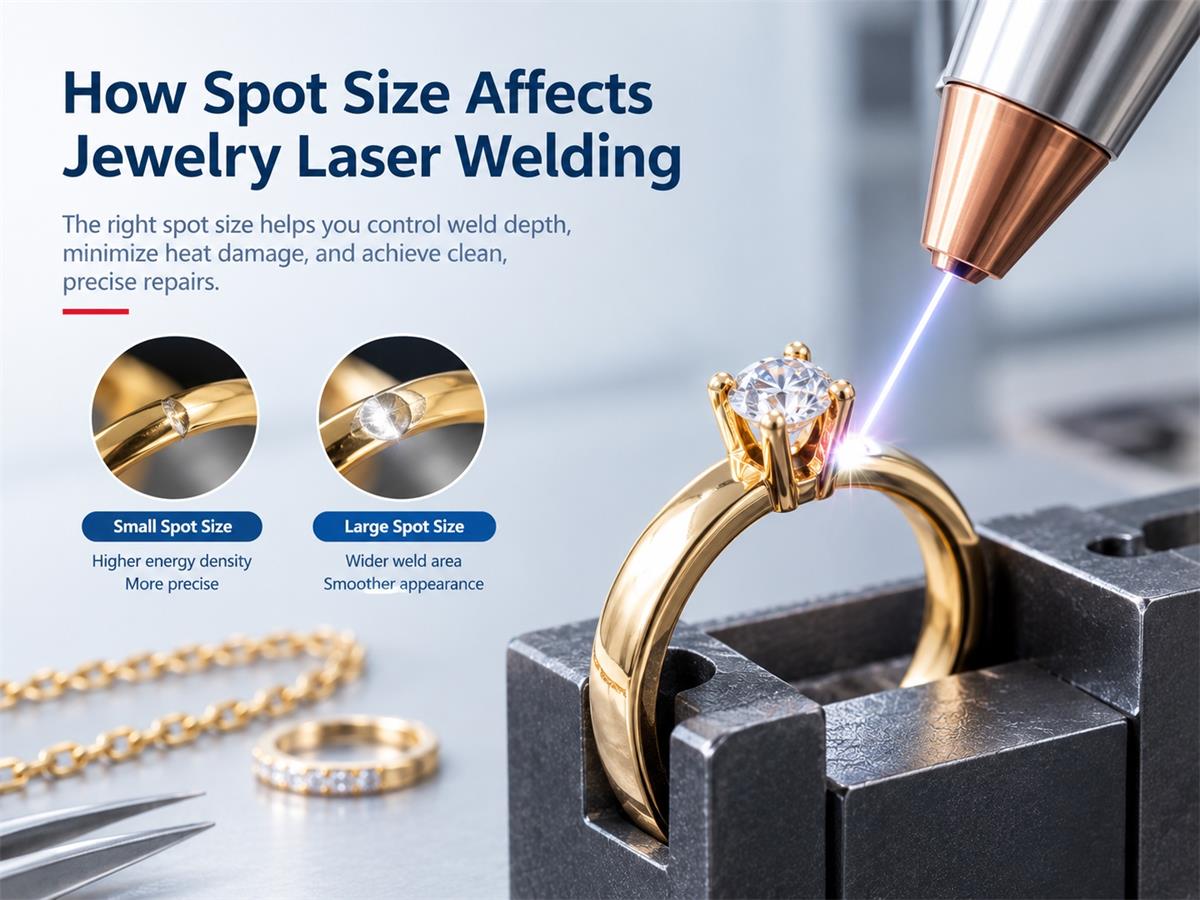
Spot size is an important parameter in jewelry laser welding because it determines how concentrated the laser energy is on the workpiece. Choosing the right spot size helps jewelers control weld depth, minimize heat damage, and achieve clean, precise repairs on gold, silver, platinum, and other precious-metal components.
A smaller laser spot concentrates energy into a localized area, making it suitable for fine, detailed repairs. A larger spot distributes energy over a wider area, which can be useful for broader welds and material buildup. However, spot size must be considered together with pulse energy, pulse duration, material thickness, and joint geometry.
For jewelry workshops, understanding how spot size affects the welding result is essential for improving repair quality and getting consistent performance from a pulsed YAG jewelry laser welding machine.
1. What Is Spot Size in Jewelry Laser Welding?
Spot size refers to the diameter of the laser beam at the workpiece surface. In jewelry laser welding, it determines how concentrated the laser energy is and how large the initial weld area can be.
Many pulsed YAG jewelry laser welding machines provide adjustable spot diameters, allowing operators to switch between fine, localized welding and broader material fusion.
A smaller spot concentrates the available pulse energy into a narrower area, generally increasing energy density. A larger spot spreads the same pulse energy over a wider area, generally reducing energy density.
Spot size does not independently determine the total pulse energy. Instead, it changes how that energy is distributed, affecting penetration, weld width, and the shape of the molten pool.
2. Small vs. Large Laser Spot Size: What Is the Difference?
Small Spot Size: Higher Precision for Fine Jewelry Repair
A smaller laser spot is useful for delicate jewelry applications where the welding area must remain highly localized.
Typical applications include repairing fine gold chains, closing small cracks in rings, rebuilding prongs, and welding near intricate jewelry details.
With the same pulse energy, a smaller spot generally produces higher energy density, which can help achieve localized melting and deeper penetration. However, excessive energy concentration may cause burn-through, spatter, or unwanted material loss.
Large Spot Size: Wider Coverage for Broader Welds
A larger spot distributes laser energy across a wider area. It can be useful for broader joints, filling worn sections, and rebuilding jewelry surfaces with filler material.
The wider spot may produce a broader molten pool, but energy density is generally lower when pulse energy remains unchanged. Depending on the material and welding conditions, penetration may decrease.
A larger spot is not automatically safer. If the operator increases pulse energy to compensate for reduced energy density, the total heat input may also increase.
3. How Spot Size Affects Weld Penetration and Heat Input
Spot size directly influences the relationship between laser energy concentration and weld penetration.
When pulse energy remains constant, reducing the spot diameter generally increases energy density. This can help the laser melt metal more deeply within a localized area.
Increasing the spot diameter generally spreads the energy over a wider area. The resulting weld may become broader and shallower, depending on pulse duration, material properties, and beam characteristics.
However, spot size alone does not determine the heat-affected zone (HAZ). Pulse duration, pulse energy, frequency, material thickness, and repeated pulse overlap also influence how heat spreads through the jewelry.
For this reason, operators should evaluate spot size together with other welding parameters rather than treating it as an independent setting.
4. How to Choose the Right Spot Size for Different Jewelry Applications
Gold Chain Repair
Fine gold chains often require a small spot size to target individual links without melting nearby sections. A tightly controlled spot can help minimize unnecessary heating, but pulse energy must be adjusted carefully to prevent burn-through.
Ring Crack Repair
For narrow cracks in gold or platinum rings, a small-to-medium spot may provide a balance between penetration and weld width. The ideal size depends on the crack dimensions and the thickness of the ring.
Prong and Claw Repair
Prong rebuilding and gemstone-setting repairs require localized energy delivery. A small spot helps target the worn or damaged area while reducing unnecessary melting of surrounding metal. Gemstones should still be assessed and protected against thermal damage.
Silver Jewelry Welding
Silver’s high thermal conductivity can make localized heat control challenging. A suitable spot size should be selected alongside pulse energy and duration to achieve adequate fusion without excessive heat spreading.
Jewelry Surface Buildup
When rebuilding worn edges or filling larger gaps with filler wire, a medium or larger spot may help create a wider molten pool. The operator should balance coverage, penetration, and heat input according to the repair geometry.
5. How to Adjust Spot Size on a Jewelry Laser Welding Machine
Step 1: Identify the repair area. Examine the damaged section, material thickness, and distance from gemstones or other heat-sensitive components.
Step 2: Select an appropriate starting spot size. Use a smaller spot for fine, localized repairs and consider a larger spot for broader weld areas.
Step 3: Test on matching scrap metal. Keep the alloy, thickness, and joint geometry as close as possible to the actual jewelry piece.
Step 4: Observe the weld result. Check the weld width, penetration, spatter, and surrounding material for signs of excessive heating.
Step 5: Adjust one parameter at a time. If the weld is too narrow, consider increasing spot size. If penetration is insufficient, evaluate pulse energy and duration before making large changes to the spot diameter.
Step 6: Record the successful settings. Save the spot size, pulse energy, duration, frequency, material, and repair type for future reference.
Always follow the machine manufacturer’s operating instructions and verify settings on scrap before working on valuable jewelry.
6. Common Spot Size Problems and Solutions
|
Welding Problem |
Possible Cause |
Recommended Adjustment |
|---|---|---|
|
Weld is too deep or narrow |
Spot too small for the selected energy |
Increase spot size or reduce pulse energy |
|
Weld is too wide |
Spot too large for the repair |
Reduce spot size |
|
Insufficient penetration |
Low energy density or poor focus |
Check focus and adjust pulse energy or spot size |
|
Burn-through on thin metal |
Excessive energy concentration |
Reduce pulse energy or increase spot size |
|
Excessive spatter |
High energy density or unsuitable pulse settings |
Reduce energy and reassess spot size |
|
Inconsistent weld appearance |
Unstable positioning or focus |
Check focal position and workpiece alignment |
These are troubleshooting starting points, not guaranteed fixes. A change in spot size can affect multiple aspects of the weld, so verify the result through controlled testing.
7. Frequently Asked Questions
Does a smaller laser spot always produce a stronger weld?
No. A smaller spot generally increases energy density at the same pulse energy, which can improve penetration. However, excessive concentration may cause spatter, burn-through, or material loss. Weld strength also depends on joint preparation, fusion quality, and material compatibility.
What spot size is suitable for jewelry laser welding?
The appropriate spot size depends on the repair. Fine chain links and prongs often benefit from smaller spots, while broader joints and surface buildup may require larger spots. Always consider the machine’s available spot-size range and the actual workpiece dimensions.
Does spot size affect the heat-affected zone?
Yes, spot size can influence how heat is distributed around the weld. A smaller spot can help localize energy, but it does not guarantee a smaller heat-affected zone under every condition. Pulse duration, energy, frequency, and material properties also matter.
Can I change spot size without adjusting laser power?
Yes, on machines with independently adjustable spot size, the spot diameter can be changed without directly changing the selected pulse energy. However, changing the diameter alters energy density and may require additional parameter adjustments to maintain weld quality.
Is a larger laser spot better for jewelry filler-wire welding?
A larger spot can be useful for broader material buildup because it can create a wider molten area. However, the appropriate spot size depends on the filler-wire diameter, base material, gap size, and required penetration.
Conclusion
Spot size plays a key role in controlling precision, penetration, and weld width in jewelry laser welding. A smaller spot is generally suitable for fine, localized repairs, while a larger spot can provide broader coverage for structural joints and material buildup.
For jewelry manufacturers and repair professionals, the goal is not simply to select the smallest or largest spot. It is to find the right balance between energy concentration, weld geometry, and heat input.
A pulsed YAG jewelry laser welding machine with adjustable spot size and precise pulse control gives operators greater flexibility when repairing gold, silver, platinum, and intricate jewelry components.
Understanding how spot size interacts with pulse energy and duration helps jewelers achieve cleaner welds, reduce unnecessary material damage, and improve repair consistency.
Looking for a jewelry laser welding machine for precision repair and precious-metal fabrication? Explore Dowin’s jewelry laser welding solutions to find a configuration suited to your workshop’s welding requirements.
Post time: Sep-23-2026
