
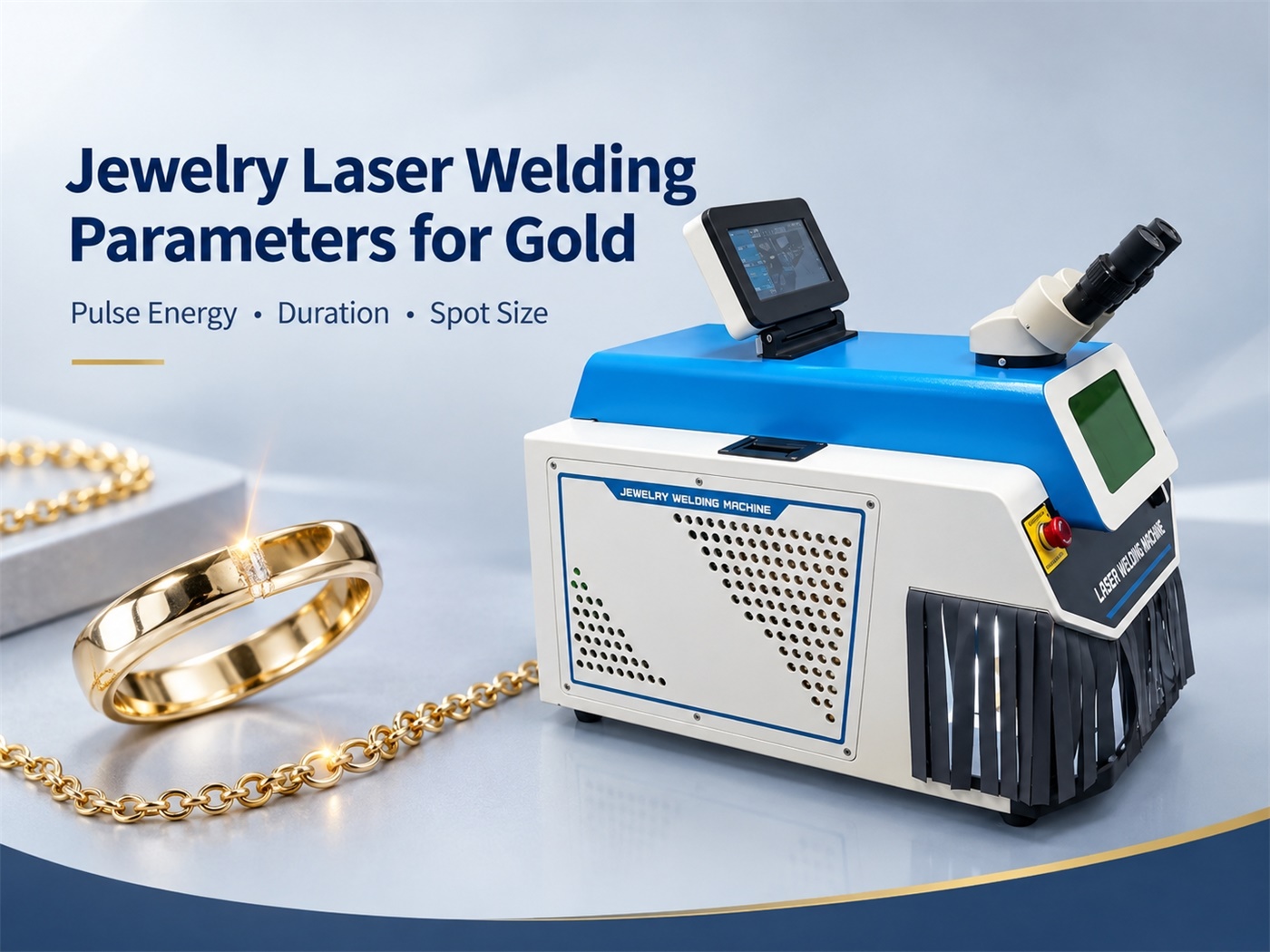
Gold jewelry laser welding requires precise control of pulse energy, pulse duration, frequency, and spot size. The right parameters help jewelry manufacturers and repair professionals achieve clean, strong welds while minimizing heat damage, discoloration, and material deformation.
Whether you are repairing a broken gold chain, resizing a gold ring, or joining delicate gold components, understanding gold laser welding parameters is essential for consistent results.
In this guide, we explain the key laser welding settings for gold, provide practical starting ranges, and discuss how to adjust parameters for different gold alloys and jewelry repair applications.
1. Key Jewelry Laser Welding Parameters for Gold
A pulsed YAG jewelry laser welding machine uses concentrated laser energy to melt and join small areas of gold. Welding quality depends on the interaction between several parameters.
Pulse Energy
Pulse energy, measured in joules (J), determines the energy delivered in each laser pulse. Higher pulse energy can improve penetration, but excessive energy may cause spatter, burn-through, or unwanted melting.
Pulse Duration
Pulse duration, measured in milliseconds (ms), controls how long the laser energy is applied. Shorter pulses can help localize heat, while longer pulses may increase heat input and penetration, depending on the energy level and spot size.
Spot Diameter
Spot diameter determines the area affected by the laser. A smaller spot concentrates energy into a narrow area, making it useful for fine chains, small joints, and delicate jewelry repair.
Pulse Frequency
Pulse frequency, measured in hertz (Hz), indicates how many laser pulses are delivered per second. Higher frequency can improve welding speed during continuous seam work, but excessive pulse overlap may cause heat accumulation.
These parameters should be adjusted together. Changing one setting can affect penetration, weld appearance, and the heat-affected zone.
2. Recommended Starting Parameters for Gold Jewelry Laser Welding
There is no universal parameter setting for every type of gold jewelry. Gold purity, alloy composition, workpiece thickness, joint design, and laser machine configuration all influence the welding result.
The following table provides practical trial ranges for pulsed YAG jewelry laser welding. These values are starting points for testing, not guaranteed production settings.
| Gold Material or Application | Pulse Duration | Parameter Adjustment |
|---|---|---|
| 14K yellow gold | 2–5 ms | Start with moderate energy and increase gradually |
| 18K yellow gold | 2.5–5 ms | Test penetration and surface finish |
| 18K white gold | 1.7–5 ms | Use controlled pulses and inspect weld color |
| Fine gold chain | 1–3 ms | Begin with low energy and a small spot |
| Gold ring repair | 2–5 ms | Adjust according to the ring thickness |
| Fine gold prongs | 1–3 ms | Use localized pulses to protect nearby areas |
Important: These pulse-duration ranges are approximate trial references, not verified universal presets. They do not specify pulse energy, which must be selected according to the machine and the workpiece. Always test on matching scrap material before welding valuable jewelry.
3. How Gold Purity and Alloy Composition Affect Laser Welding
Gold jewelry is usually manufactured from gold alloys rather than pure gold. The metals added to gold affect its melting behavior, thermal properties, and response to laser energy. As a result, different gold alloys may require different welding parameters.
14K Gold
14K gold contains a higher proportion of alloying metals than 18K gold. Its welding behavior depends on the specific alloy formulation. Start with controlled pulse energy and adjust gradually to achieve sufficient fusion without excessive melting.
18K Yellow Gold
18K yellow gold is widely used in fine jewelry. Its copper and silver content can vary depending on the manufacturer and alloy formulation. Proper parameter adjustment helps balance penetration, weld appearance, and heat input.
18K White Gold
White gold may contain nickel, palladium, or other alloying elements. These differences can affect weld pool behavior and the final weld appearance. Test the exact alloy before repairing visible joints, especially when the jewelry has a rhodium-plated surface.
24K Pure Gold
24K gold has a much higher gold content than common karat alloys. Its softness and material properties mean that settings developed for 14K or 18K gold should not be applied without testing. Begin with conservative settings and evaluate the weld carefully.
4. Gold Laser Welding Parameters for Different Jewelry Repairs
Welding Fine Gold Chains
Fine gold chains require careful energy control because their links are small and can easily melt through.
Start with a small spot diameter and relatively short pulse duration. Apply individual pulses to the joint and inspect the connection under magnification.
If the joint does not fuse properly, increase pulse energy in small increments. Avoid increasing multiple parameters simultaneously, as this makes it difficult to identify the cause of the welding result.
Repairing Gold Rings
Gold rings often have thicker sections than fine chains, so they may require greater penetration.
Begin with a moderate pulse duration and adjust energy according to the ring thickness and joint condition. Ensure that the two edges fit closely together before welding.
For gaps or missing material, compatible gold filler wire may help rebuild the joint. Select filler material that matches the base alloy as closely as possible to reduce color differences after finishing.
Welding Gold Prongs and Stone-Set Jewelry
When repairing prongs or jewelry near gemstones, minimizing heat transfer is particularly important.
Use a small spot, controlled pulse energy, and localized welds. Although laser welding concentrates heat in a small area, it does not guarantee that gemstones are protected from thermal shock or heat damage.
Always evaluate the gemstone, setting, and mounting materials before welding. Appropriate protection or stone removal may be necessary.
5. How to Optimize Gold Laser Welding Parameters
Finding the right settings requires systematic testing. The following process helps jewelry manufacturers and repair professionals establish repeatable welding parameters.
Step 1: Identify the Gold Alloy
Confirm the karat, color, and, when possible, the alloy composition. Clean the workpiece to remove oil, polishing compounds, and surface contaminants.
Step 2: Select the Spot Diameter and Pulse Duration
Choose a spot size appropriate for the joint. Begin with a conservative pulse duration based on the material and the laser machine manufacturer’s recommendations.
Step 3: Adjust Pulse Energy Gradually
Perform test welds on matching scrap gold. Increase pulse energy in small increments until adequate fusion is achieved without excessive spatter, deformation, or burn-through.
Step 4: Optimize Pulse Frequency
For multiple overlapping welds, adjust pulse frequency to balance working speed and heat accumulation. Allow sufficient cooling time when working on delicate components.
Step 5: Inspect the Weld
Examine the weld under magnification. Check for cracks, pores, incomplete fusion, excessive material loss, and unacceptable color changes.
Where necessary, perform an appropriate joint-strength test before applying the settings to valuable jewelry.
6. Common Gold Laser Welding Problems and Solutions
| Welding Problem | Possible Cause | Recommended Adjustment |
|---|---|---|
| Incomplete fusion | Insufficient energy or poor joint fit | Increase energy gradually and improve joint alignment |
| Burn-through | Excessive pulse energy | Reduce energy and reassess spot size |
| Excessive spatter | Excessive energy or unstable joint | Reduce energy and clean or secure the workpiece |
| Wide heat-affected zone | Excessive heat input | Reassess pulse duration and energy |
| Porosity | Surface contamination or unsuitable welding conditions | Clean the metal and review shielding conditions |
| Visible color mismatch | Different alloy composition or surface finish | Check filler compatibility and finishing requirements |
These are diagnostic starting points rather than guaranteed solutions. A welding defect may have multiple causes, so change one parameter at a time and compare the results.
7. Choosing a Jewelry Laser Welding Machine for Gold
A dedicated jewelry laser welding machine allows jewelers to control pulse energy, duration, and spot size for detailed metalwork.
Compared with conventional torch-based soldering, pulsed laser welding can concentrate heat in a localized area. This makes it useful for repairing fine chains, ring joints, prongs, and intricate gold components.
A microscope-equipped YAG jewelry laser welder provides a clear view of the welding point and supports precise work on small components.
When selecting a machine for gold jewelry repair or manufacturing, consider the following features:
-
Adjustable pulse energy and pulse duration
-
A suitable spot-size range for fine jewelry
-
Stable laser output for repeatable welding
-
Microscope visibility and operator ergonomics
-
Compatibility with the gold alloys and repair tasks you handle
For jewelry workshops handling different gold karats and designs, parameter flexibility is often more useful than relying on a single high-power setting.
8. Frequently Asked Questions About Gold Jewelry Laser Welding
What is the best laser power for welding gold jewelry?
There is no single best power setting for all gold jewelry. The required pulse energy depends on gold purity, alloy composition, material thickness, spot diameter, and joint design. Start with test welds on matching scrap gold and increase energy gradually.
What pulse duration is suitable for 18K gold laser welding?
A practical trial range for 18K yellow gold is approximately 2.5–5 ms, while 18K white gold may be tested around 1.7–5 ms. These are starting references rather than universal machine presets. Actual settings depend on pulse energy, alloy composition, and the welding application.
Can a jewelry laser welding machine weld gold without solder?
Yes. Laser welding can directly fuse compatible gold surfaces without conventional solder. However, filler wire may be useful when filling gaps, rebuilding missing material, or restoring a damaged joint.
Is laser welding suitable for delicate gold chains?
Yes. A pulsed jewelry laser welder can repair fine gold chains by applying localized energy to individual links. The correct settings depend on link thickness, alloy composition, and joint condition. Excessive energy can melt or deform the links.
Why does gold sometimes turn dark during laser welding?
Surface oxidation, contamination, excessive heat input, and alloy composition can contribute to discoloration. Clean the workpiece, optimize pulse energy, and evaluate the alloy before welding. Some discoloration may also be related to surface finishing rather than the weld itself.
Can laser welding damage gemstones in gold jewelry?
Yes. Although laser welding localizes heat, nearby gemstones may still be affected by thermal shock, heat conduction, or existing treatments. Assess the stone and setting before welding, and use appropriate protection or remove the stone when necessary.
Conclusion
Choosing the right jewelry laser welding parameters for gold requires balancing pulse energy, pulse duration, spot diameter, and frequency. Gold karat and alloy composition must also be considered to achieve consistent penetration, clean welds, and minimal heat damage.
For jewelry manufacturers and repair workshops, a flexible pulsed YAG jewelry laser welding machine can support a wide range of gold repair and manufacturing tasks. The key is to establish reliable parameter settings through controlled testing on the specific alloy and joint type.
Looking for a jewelry laser welding machine for gold repair and fine jewelry manufacturing? Explore Dowin Laser’s jewelry laser welding solutions to find a machine suited to your materials, repair requirements, and production needs.
Post time: Sep-22-2026
