
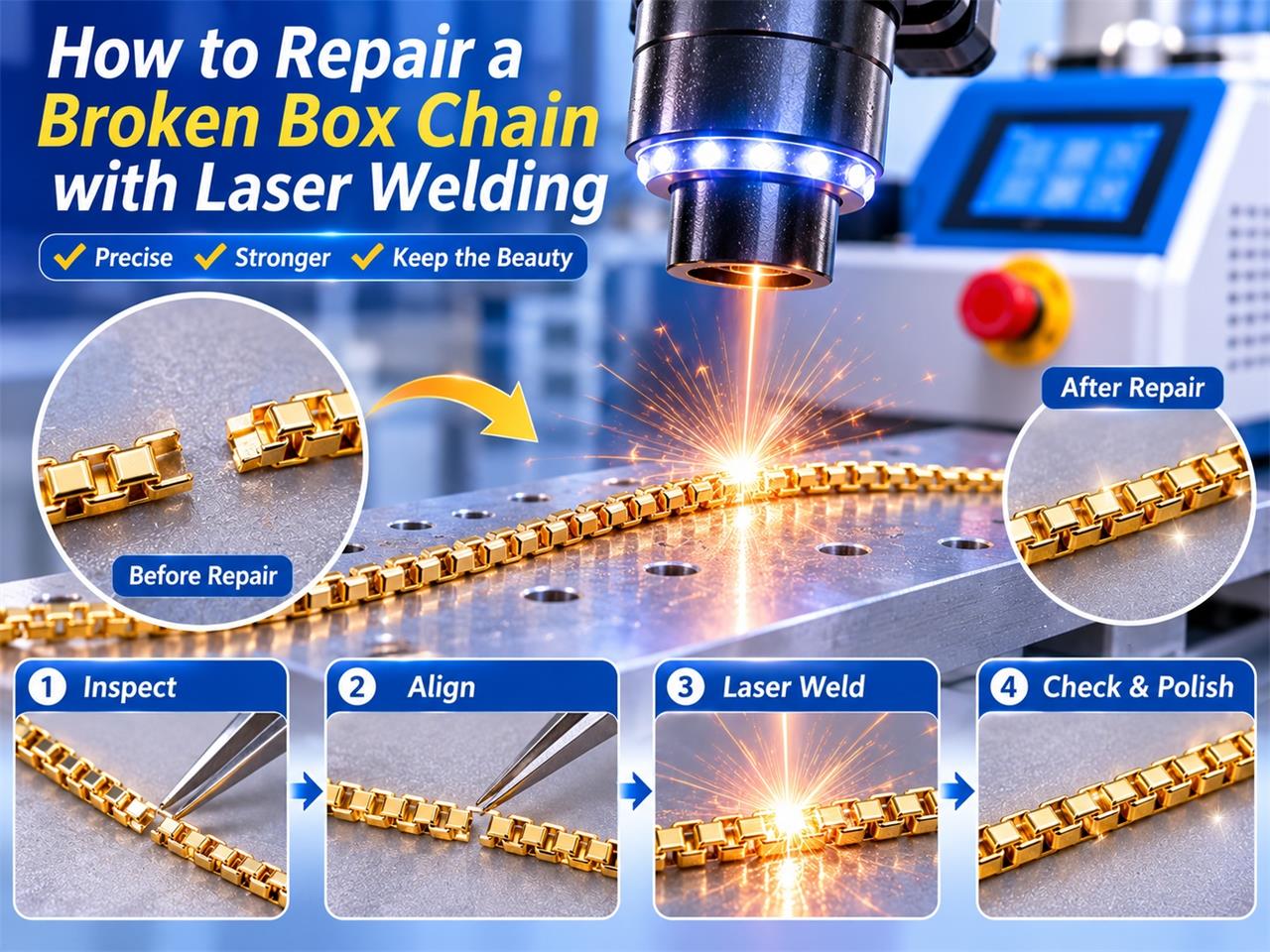
A broken box chain can be difficult to repair because of its tightly connected square-shaped links. Unlike ordinary round-link chains, box chains have small interlocking metal sections that must maintain their original shape and flexibility after repair. Traditional soldering can introduce unnecessary heat to neighboring links, increasing the risk of deformation. A professional jewelry laser welding machine provides a more localized way to reconnect damaged gold links. With proper positioning, suitable laser parameters, and careful finishing, jewelers can restore many broken box chains without replacing the entire necklace.
1. Why Are Box Chains Difficult to Repair?
A box chain, sometimes called a Venetian chain, consists of small square-shaped links connected to create a smooth and relatively uniform chain structure.
Unlike conventional cable chains, where individual oval links are clearly separated, box chains have tightly interlocking components. Their square geometry gives them a distinctive appearance but also creates specific repair challenges.
Common characteristics include:
- Small square links: Each link has limited welding space.
- Tight connections: Individual links are closely connected to neighboring sections.
- Uniform appearance: Even a small deformation can make one section look different.
- Limited flexibility at the repair point: Excessive welding material can prevent the chain from moving naturally.
- Thin metal sections: Some lightweight box chains have very little material available for repair.
For these reasons, repairing a box chain requires more than simply reconnecting two broken ends. The original link geometry and flexibility must also be restored.
2. Common Types of Box Chain Damage
Before selecting a repair method, identify exactly how the box chain has been damaged.
Broken Individual Link
This is a common situation. One square-shaped link cracks or separates, causing the chain to break.
If the original metal ends remain intact and can be accurately aligned, laser welding may reconnect the damaged section.
Deformed or Opened Link
Sometimes a box chain does not completely break. Instead, one link becomes stretched, bent, or partially separated from its neighboring links.
Simply welding the opening may not be sufficient. The operator must first restore the original square geometry and ensure that the neighboring links fit correctly.
Missing Metal Around the Broken Area
If a broken link has lost a small amount of material, bringing the two ends together may leave a gap.
In this situation, compatible gold filler wire may be required to rebuild the missing section and create a more reliable connection.
Multiple Damaged Links
Older box chains may have several weakened or damaged areas. If multiple neighboring links are severely worn, repairing only the most visible break may not restore the overall strength of the necklace.
Inspect the entire damaged section before deciding whether to repair individual links or replace a longer section of the chain.
3. Why Use Laser Welding to Repair a Box Chain?
Box chains are particularly sensitive to excessive heat because their links are small and closely connected.
A pulsed YAG jewelry laser welder offers several practical advantages.
Localized Heat Application
Laser welding concentrates energy on the targeted repair area rather than heating a large section of the necklace.
This helps reduce unnecessary heating of adjacent links and lowers the risk of changing the original chain geometry.
Precise Welding of Small Links
A microscope-assisted welding system allows the operator to observe the small square-shaped link and position the laser accurately.
This is particularly important when reconnecting a broken corner or a narrow section of a box chain link.
Less Unnecessary Finishing
With suitable welding parameters, the operator can create a localized connection with limited excess metal buildup.
This helps preserve the chain’s smooth appearance and reduces the amount of filing and polishing required after welding.
For a general overview of similar applications, see How to Repair Broken Gold Chains with a Laser Welder.
4. How to Repair a Broken Gold Box Chain with a Laser Welder
The following workflow describes a typical repair involving one broken link. The exact procedure depends on the chain construction, gold alloy, and amount of material remaining.
Step 1: Inspect the Broken Box Chain
Place the chain under a microscope or suitable magnification system.
Identify the exact location of the break and examine the surrounding links.
Pay attention to:
- Whether the break is located in the middle of a link or near its connection point.
- Whether the original link has lost any metal.
- Whether the square-shaped link is deformed.
- Whether adjacent links have become stretched or weakened.
- Whether the chain is solid or hollow.
- The gold karat and alloy composition.
Do not begin welding until the original link geometry and the condition of the surrounding chain are understood.
Step 2: Clean the Broken Area
Remove dirt, oil, polishing compounds, oxidation, and other contaminants from the damaged area.
Old solder or previous repair material may also need to be removed if it interferes with the new connection.
For very small box chain links, surface cleanliness is important because contamination can affect the consistency and appearance of the weld.
Step 3: Restore the Original Link Shape
Before applying laser energy, carefully reposition the broken link.
The two ends should meet as accurately as possible. If the link is bent or twisted, restore its original square-shaped geometry using suitable jewelry tools.
Check that:
- The two broken ends are correctly aligned.
- The link has not become unnecessarily enlarged.
- The neighboring links are not twisted or trapped.
- The chain remains flexible around the damaged area.
Correct alignment is essential. A poorly positioned box chain link may look acceptable immediately after welding but create an uneven appearance when the necklace hangs naturally.
Step 4: Select the Appropriate Laser Parameters
Box chains often contain thin metal sections, so excessive laser energy can melt through the link or damage nearby components.
The main parameters to consider include:
- Pulse energy: Determines how much energy reaches the metal during each pulse.
- Pulse duration: Controls how long the laser interacts with the material.
- Pulse frequency: Influences the spacing of successive pulses and heat accumulation.
- Spot diameter: Determines the size of the localized welding area.
There is no universal parameter setting for every box chain. A thin 18K gold chain and a thicker 14K chain may require different welding conditions.
Start with suitable settings based on the material and test them on comparable scrap samples. Adjust the parameters gradually to achieve sufficient fusion without excessive melting.
For more detailed information, read Jewelry Laser Welding Parameters for Gold: A Practical Guide.
Step 5: Tack Weld the Broken Link
Once the broken sections are properly aligned, apply small, controlled laser pulses to establish initial connection points.
Tack welding helps prevent the link from moving during the remaining repair process.
For small box chain links, avoid applying too much energy to one location. The objective is to gradually establish a stable connection while monitoring the shape of the link.
Step 6: Add Gold Filler Wire if Necessary
If the broken area contains a gap or missing material, compatible gold filler wire can be introduced to rebuild the damaged section.
The filler should match the original alloy as closely as practical.
Apply the filler gradually rather than depositing a large amount of metal in one operation.
Excessive filler material can make the repaired link bulky, change its dimensions, or interfere with the movement of adjacent links.
Step 7: Inspect and Polish the Repaired Chain
After welding, examine the repaired area under magnification.
Check for:
- Incomplete fusion.
- Cracks around the weld.
- Excessive metal buildup.
- Deformation of the square-shaped link.
- Unwanted fusion between neighboring links.
- Sharp edges that could catch on clothing.
Remove excess material carefully and polish the repaired area as necessary.
Finally, gently articulate the chain around the repaired link. It should move naturally without stiffness or unusual resistance.
5. How to Prevent Burn-Through on Thin Box Chains
Burn-through is one of the most important risks when laser welding delicate box chains.
Because some links have very thin walls, excessive localized energy can create a hole rather than a controlled weld.
Several factors can contribute to burn-through:
- Excessive pulse energy.
- Unsuitable spot diameter.
- Repeated pulses in the same location.
- Insufficient operator control.
- Very thin or hollow link construction.
- Pre-existing wear around the repair point.
To reduce these risks, operators should test the parameters on comparable materials, control pulse placement, and avoid unnecessary overlapping welds.
Hollow box chains require additional caution because their internal structures may collapse under excessive heat.
For more technical guidance, read How to Prevent Burn-Through When Laser Welding Jewelry.
6. Can You Repair a Hollow Gold Box Chain?
Yes, some hollow gold box chains can be laser welded, but they require more careful evaluation than solid chains.
The main challenge is the extremely thin metal wall. When the laser energy is too high, the material can melt through or collapse, making the original square structure difficult to restore.
Before repairing a hollow box chain, evaluate:
- Wall thickness.
- The location and size of the break.
- The internal construction.
- The amount of missing material.
- The condition of the neighboring links.
- The amount of energy required for sufficient fusion.
For extremely thin or heavily worn hollow chains, replacing the damaged section may be more reliable than attempting to rebuild a severely weakened link.
Our related guide How to Repair Thin Gold Chains Without Soldering provides additional information about repairing delicate gold chain structures.
7. Laser Welding vs. Traditional Soldering for Box Chains
Both methods can be used in jewelry repair, but box chains present specific challenges because of their tightly interlocking links.
| Comparison | Laser Welding | Traditional Soldering |
|---|---|---|
| Heat concentration | Localized | Broader heating area |
| Small link repair | Precise positioning | Requires careful torch control |
| Thin metal sections | Controlled energy with suitable settings | Greater risk of excessive heating |
| Link distortion | Can be minimized | Higher potential with improper heating |
| Filler material | Optional depending on damage | Usually required |
| Post-repair finishing | Often less material removal | May require additional finishing |
| Equipment investment | Higher | Generally lower |
Traditional soldering remains useful for many jewelry repairs. However, laser welding offers an important advantage when the damaged area is very small and excessive heat could affect neighboring links.
8. Choosing a Jewelry Laser Welder for Box Chain Repair
For jewelry workshops that regularly repair gold chains, necklaces, bracelets, and delicate metal components, a pulsed YAG jewelry laser welder is a practical equipment option.
The Dowin New 150W Desktop Laser Jewelry Welder is designed for precision repair and fabrication of gold, silver, platinum, and other compatible metal components.
Its main specifications include:
- Maximum laser power: 150W/200W configurations.
- Laser wavelength: 1064 nm.
- Pulse frequency: 1–20 Hz.
- Adjustable pulse width: 0.2–10 ms.
- Spot adjustment range: 0.2–2 mm.
- Observation system: Microscope + CCD.
- Cooling method: Air cooling.
For box chain repair, microscope observation and adjustable spot diameter are particularly useful because they help operators position small welding points accurately.
Besides box chain repair, the machine can also be used for:
- Fine gold chain repair.
- Rope chain and curb chain repair.
- Broken necklace and bracelet connections.
- Gold jump ring repair.
- Ring crack repair.
- Prong rebuilding.
- Small jewelry casting defects.
Explore the Dowin Jewelry Laser Welding Machine Collection to compare available configurations for different jewelry repair applications.
Frequently Asked Questions
Can you laser weld a broken gold box chain?
Yes. Many broken gold box chains can be repaired using a pulsed YAG jewelry laser welder. The operator must restore the original link alignment and select suitable laser parameters according to the metal thickness and chain construction.
Can a box chain be repaired without soldering?
Yes. Laser welding can reconnect suitable broken box chain links without conventional soldering. It uses localized laser energy to fuse the metal at the damaged point.
Can laser welding damage the neighboring box chain links?
Yes, if the laser parameters or welding position are unsuitable. Excessive energy and unwanted pulse overlap can melt or deform neighboring links. Proper alignment, microscope observation, and controlled heat input help minimize this risk.
Can you repair a hollow box chain with a laser welder?
Some hollow box chains can be repaired, but their thin walls make them more sensitive to excessive heat. The operator should evaluate the wall thickness and test suitable parameters before welding.
Do you need filler wire to repair a broken box chain?
Not always. If the broken ends fit together correctly and enough material remains, direct laser fusion may be sufficient. Compatible gold filler wire may be needed when material is missing or the damaged section requires rebuilding.
Will a repaired box chain remain flexible?
It should retain its normal flexibility when the repair is performed correctly. However, excessive filler material or accidental fusion between adjacent links can make the repaired section stiff. Always check the movement of the chain after welding.
What laser power is suitable for repairing gold box chains?
Both 150W and 200W pulsed jewelry laser welders can be considered for suitable box chain repair applications. The correct machine and parameter settings depend on the chain’s alloy, link dimensions, and solid or hollow construction.
Conclusion
Repairing a broken box chain requires more precision than reconnecting an ordinary chain link. The small square-shaped links must maintain their original geometry, and the repaired section must remain flexible enough for everyday use.
A pulsed YAG jewelry laser welder offers a practical solution for suitable box chain repairs by concentrating energy on the damaged link and reducing unnecessary heat exposure to surrounding sections.
Proper inspection, accurate alignment, controlled laser parameters, and careful finishing are essential for achieving a reliable result. For jewelry repair shops handling different chain styles, laser welding can expand repair capabilities and reduce unnecessary replacement of valuable jewelry.
Dowin provides professional jewelry laser welding machines for jewelry repair shops and manufacturers. Contact Dowin to discuss your gold chain repair requirements and find a suitable machine configuration.
Post time: Nov-27-2026
