
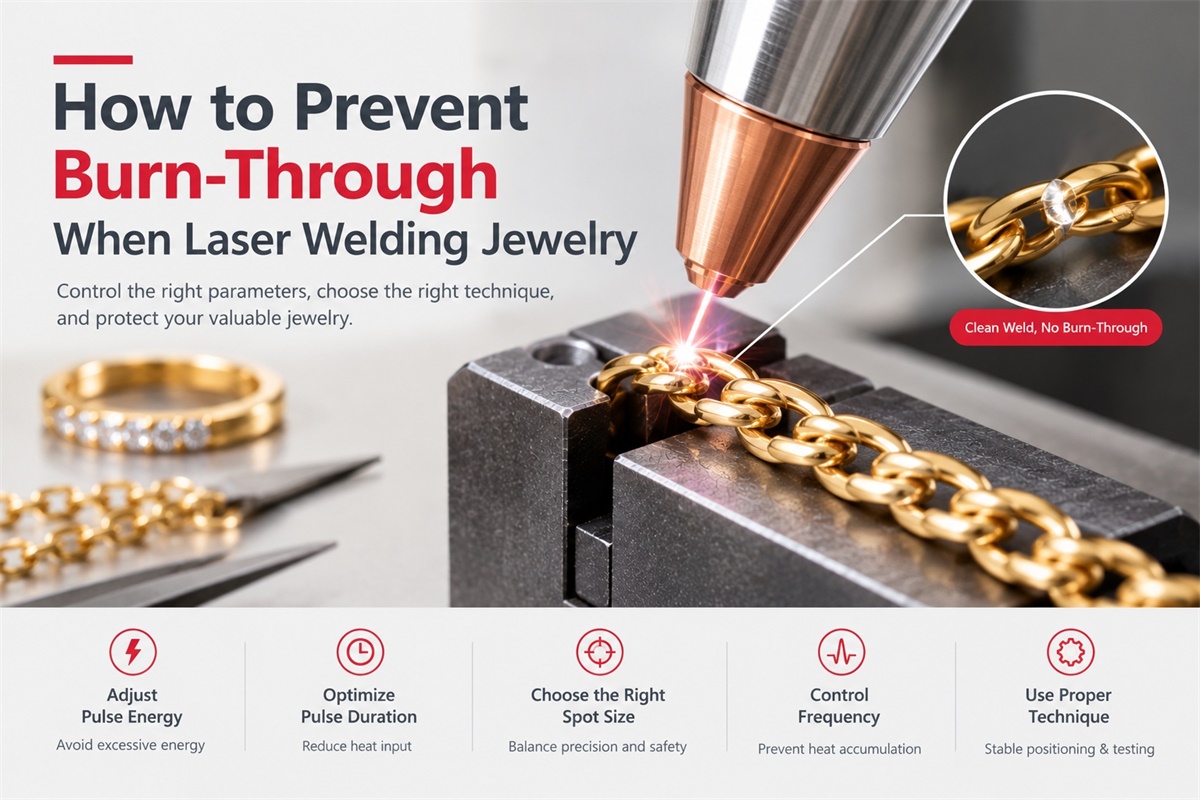
Burn-through is a common challenge in jewelry laser welding, especially when repairing thin gold chains, delicate ring sections, fine prongs, and other small precious-metal components. It occurs when excessive laser energy melts through the workpiece instead of creating a controlled weld.
For jewelry manufacturers and repair professionals, preventing burn-through is essential for protecting valuable materials, maintaining the original jewelry structure, and reducing rework.
The key is to control heat input without sacrificing weld quality. By adjusting pulse energy, pulse duration, spot size, and welding technique, operators can achieve reliable fusion while minimizing unwanted melting. A pulsed YAG jewelry laser welding machine offers precise energy control that can help manage these challenges.
1. Why Does Burn-Through Happen in Jewelry Laser Welding?
Burn-through usually occurs when the laser delivers more energy than the metal can withstand in a localized area. Several factors can contribute to this problem.
Excessive pulse energy can create an oversized molten pool, particularly when welding thin gold chains or narrow metal edges.
Long pulse duration can increase the time heat is applied to the workpiece, allowing heat to spread and potentially causing excessive melting.
An excessively small spot size can concentrate energy into a very narrow area, increasing energy density and the risk of penetrating thin material.
Repeated pulses in the same location can cause heat to accumulate, especially when the operator welds at a high frequency without allowing sufficient cooling.
Poor joint fit, gaps, or inconsistent material thickness can also make it difficult to achieve uniform fusion without melting through the workpiece.
Understanding these causes helps operators identify the correct parameter adjustments instead of simply lowering the machine’s power for every repair.
2. Adjust Pulse Energy to Prevent Burn-Through
Pulse energy is one of the first parameters to check when burn-through occurs. Excessive energy can cause the metal to melt too deeply, particularly in thin jewelry components.
Start with a conservative energy setting recommended for the material and workpiece thickness. Test the setting on scrap metal of the same alloy before welding the actual jewelry.
If burn-through occurs, reduce pulse energy gradually and inspect the resulting weld. The objective is to achieve sufficient fusion without creating an excessively large molten pool.
However, setting pulse energy too low can result in incomplete fusion or a weak joint. The correct setting should balance penetration and weld integrity rather than simply minimizing energy.
3. Optimize Pulse Duration for Thin Gold Jewelry
Pulse duration determines how long the laser energy is delivered during each pulse. It plays an important role in controlling the melting process.
For thin gold chains, delicate prongs, and fine jewelry components, an excessively long pulse may increase heat diffusion and cause unwanted melting.
Reducing pulse duration can help limit the time over which energy is delivered. However, shorter pulses may require different energy settings to maintain adequate penetration.
When adjusting pulse duration, test it together with pulse energy. Avoid making large changes to both parameters simultaneously, as this makes it harder to identify the cause of improvement or failure.
4. Choose the Right Spot Size
Spot size affects how laser energy is distributed across the jewelry surface.
A very small spot concentrates energy into a localized area. While this can be useful for precision welding, excessive energy density may cause burn-through on thin metal.
A slightly larger spot may distribute the energy over a wider area and reduce localized energy density when pulse energy remains unchanged.
For fine chains and thin ring sections, select a spot size appropriate to the joint dimensions. Do not assume that the smallest available spot is always the best option.
The ideal spot size depends on material thickness, pulse energy, joint geometry, and the required weld depth.
5. Control Pulse Frequency and Avoid Excessive Heat Accumulation
Laser frequency determines how many pulses are delivered per second. When multiple pulses are applied to the same area, higher frequency can increase heat accumulation.
This can be especially important when welding thin jewelry components, where excessive cumulative heat may cause deformation or burn-through.
To reduce this risk, avoid unnecessary repeated pulses in the same location. Adjust frequency according to the required weld continuity and allow sufficient cooling when working on heat-sensitive or delicate sections.
For individual spot repairs, controlled pulse placement may be more important than maximizing pulse frequency. For continuous seams, frequency should be balanced with welding speed and pulse overlap.
6. Use Proper Welding Technique
Even well-adjusted laser parameters can produce burn-through if the welding technique is inconsistent.
Maintain stable positioning and keep the laser focused on the intended weld area. Avoid repeatedly firing at the same point unless additional energy is necessary.
For thin chains, position the joint securely so that the laser targets the connection rather than an unnecessarily thin edge.
When repairing larger gaps or worn jewelry sections, use suitable filler wire and controlled buildup rather than attempting to fill the entire gap with one high-energy pulse.
If the jewelry contains gemstones, assess their heat sensitivity and use appropriate protection before welding. Laser welding reduces the heat affected area compared with many conventional methods, but it does not eliminate the risk of thermal damage.
7. Recommended Troubleshooting Guide
Problem: Laser burns through a thin gold chain.
Possible cause: Excessive pulse energy or energy concentration.
Solution: Reduce pulse energy, reassess spot size, and test on a similar chain link.
Problem: Ring edges melt or deform during welding.
Possible cause: Excessive heat input, repeated pulses, or poor workpiece positioning.
Solution: Reduce energy or pulse duration, improve positioning, and avoid unnecessary pulse overlap.
Problem: Burn-through occurs after several consecutive pulses.
Possible cause: Cumulative heat buildup.
Solution: Reduce pulse frequency or the number of repeated pulses, and allow cooling between welds when appropriate.
Problem: Welds are inconsistent across the same jewelry piece.
Possible cause: Variable thickness, inconsistent focus, or uneven pulse placement.
Solution: Check the workpiece alignment, maintain consistent focus, and adjust parameters for changes in geometry.
Problem: Reducing energy prevents burn-through but produces weak welds.
Possible cause: Energy has been reduced below the level required for adequate fusion.
Solution: Reassess pulse duration, spot size, joint fit, and welding technique. Gradually find a balanced parameter combination rather than continuing to reduce energy.
8. Frequently Asked Questions
What causes burn-through when laser welding gold jewelry?
Burn-through is commonly caused by excessive pulse energy, concentrated energy density, prolonged pulse duration, or repeated pulses that create excessive heat accumulation. Thin material and poor joint fit can increase the risk.
How do I stop a jewelry laser welder from burning through thin gold chains?
Start with conservative pulse energy, select a suitable spot size, and use controlled pulse placement. Test on matching scrap and adjust one parameter at a time until the weld achieves adequate fusion without melting through the chain.
Does lower laser power always prevent burn-through?
No. Lowering pulse energy can reduce the risk, but it may also produce incomplete fusion. Burn-through prevention requires balancing energy, pulse duration, spot size, frequency, and welding technique.
Is a smaller laser spot better for delicate jewelry welding?
A smaller spot can improve precision, but it also concentrates energy into a smaller area. On thin jewelry, excessive energy concentration may increase the risk of burn-through. Select a spot size that matches the joint and material thickness.
Can a YAG jewelry laser welding machine reduce burn-through?
A pulsed YAG jewelry laser welding machine with adjustable pulse energy, duration, and spot size gives operators greater control over localized heat input. However, preventing burn-through still depends on selecting appropriate settings and using proper welding techniques.
Conclusion
Preventing burn-through when laser welding jewelry requires careful control of energy delivery, especially when working with thin gold chains, delicate ring sections, and intricate precious-metal components.
By optimizing pulse energy, pulse duration, spot size, and frequency, jewelers can reduce excessive melting while maintaining reliable weld penetration. Proper positioning, controlled pulse placement, and testing on matching scrap further improve consistency.
For jewelry workshops, a pulsed YAG jewelry laser welding machine with precise, adjustable parameters can provide the flexibility needed for delicate repairs and detailed precious-metal fabrication.
The goal is not simply to use less laser energy, but to deliver the right amount of energy to the right location for a clean, strong, and controlled weld.
Post time: Sep-24-2026
