
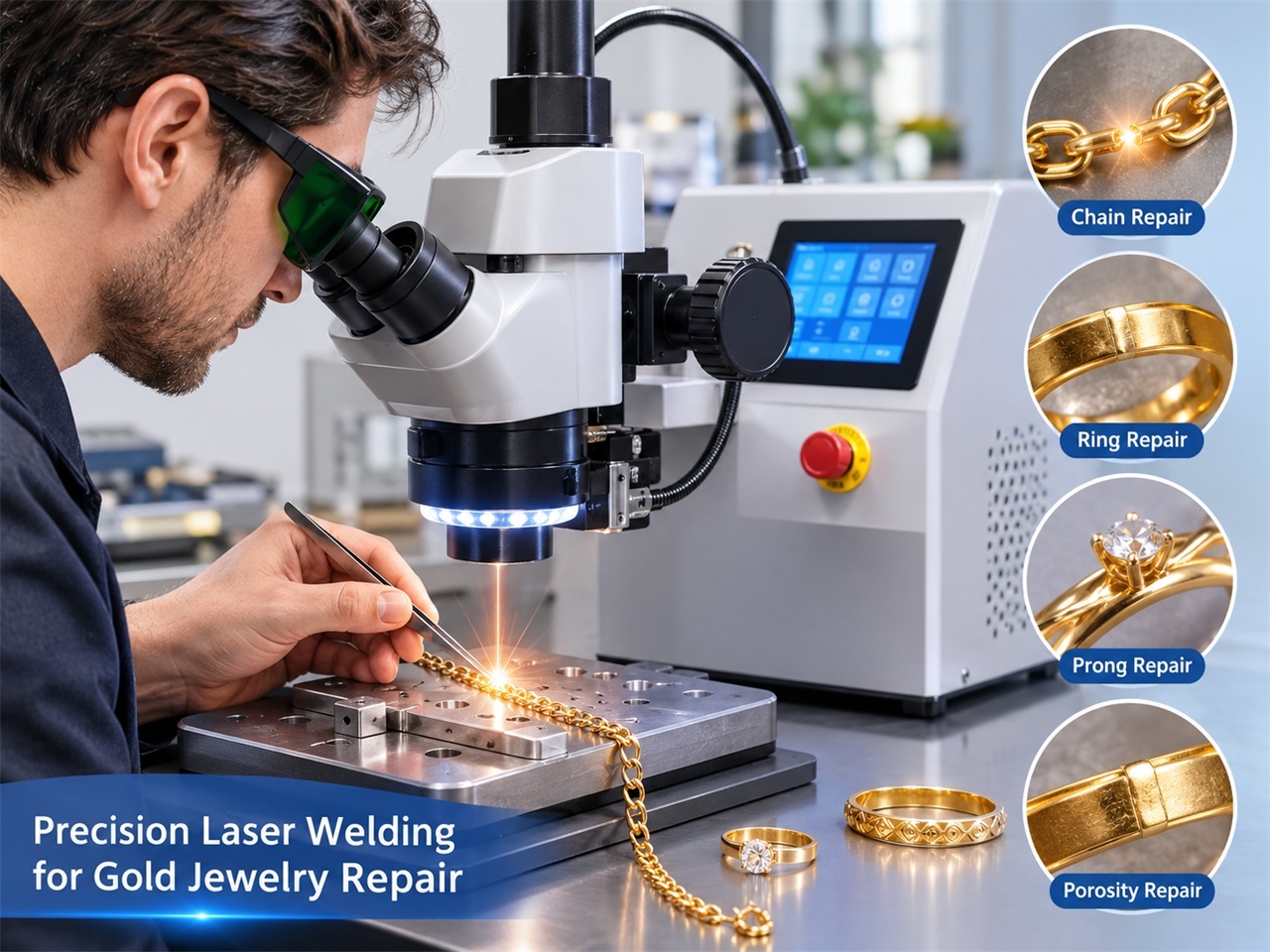
Choosing the right jewelry laser welder is an important investment for gold repair shops. Whether you regularly repair broken gold chains, resize rings, rebuild prongs, or fix casting defects, the machine needs to provide precise energy control and consistent welding results. A professional 150W desktop jewelry laser welding machine is worth considering for workshops that handle a wide range of gold jewelry repairs and need reliable precision for daily work. However, not every jewelry repair business has the same requirements. A small jewelry store handling occasional repairs may need different equipment from a professional workshop processing dozens of repair orders every day. This guide explains the key factors to consider before purchasing a jewelry laser welder.
1. Identify the Gold Repair Services You Handle
Before comparing laser machines, look at your actual repair workload. The type of jewelry and the size of the damaged areas directly affect the laser specifications you need. Common gold jewelry repair applications include:
- Gold chain repair: Reconnecting broken links, repairing fine chains, and fixing damaged clasps.
- Ring repair: Joining cracked ring shanks, resizing rings, and repairing damaged sections.
- Prong repair: Rebuilding worn or broken prongs on gold rings and gemstone settings.
- Bracelet repair: Repairing joints, connecting components, and fixing damaged links.
- Porosity repair: Filling small holes and surface defects in cast gold jewelry.
- Custom jewelry repair: Joining small components and correcting manufacturing defects.
For example, a workshop that mainly repairs thin gold chains needs excellent control over small welding spots. A business specializing in ring resizing or rebuilding missing metal may need more energy flexibility and the ability to work with suitable filler wire. Understanding your most frequent repair jobs will help you avoid purchasing a machine with unnecessary capacity or insufficient welding capability.
2. Choose the Appropriate Laser Power
Laser power is one of the first specifications buyers compare. Jewelry laser welders are available in different power configurations, commonly including 60W, 150W, and 200W models. The best choice depends on the thickness of the jewelry, the repair method, and the expected workload.
| Laser Power | Typical Buyer Requirements |
|---|---|
| 60W | Small jewelry stores, occasional repairs, and delicate micro-welding tasks. |
| 150W | Professional jewelry repair workshops handling chains, rings, clasps, and various daily repair jobs. |
| 200W | Workshops requiring greater energy capacity for more demanding repair and material rebuilding applications. |
These are general selection guidelines rather than guaranteed application limits. Actual welding performance also depends on pulse energy, pulse duration, spot diameter, metal thickness, and joint design. For many professional gold repair services, a 150W desktop jewelry welder provides a practical balance between precision and working flexibility. It is important not to choose a machine simply because it has the highest rated power. A machine with adjustable pulse parameters and stable output is often more useful for delicate jewelry work. For a more detailed comparison, see our guide: Jewelry Laser Welding Energy: How Many Joules Do You Need?
3. Pay Attention to Spot Size and Pulse Adjustment
Gold jewelry often contains very small components. A welding spot that is too large can damage nearby details, while insufficient energy may produce a weak joint. Two important specifications are spot diameter and pulse width. Spot diameter A smaller laser spot concentrates energy into a more localized area. This is particularly important for:
- Fine gold chain links
- Small ring joints
- Thin decorative components
- Prong tips and delicate settings
The Dowin 150W desktop jewelry laser welder offers a 0.2–2 mm spot adjustment range, giving operators flexibility when working with different jewelry structures. Pulse width Pulse width determines how long laser energy is applied during each pulse. Shorter and longer pulses produce different heating effects and penetration characteristics. For thin gold components, carefully controlled pulses help reduce unnecessary heat input. Thicker sections may require different pulse settings to achieve sufficient fusion. The Dowin desktop model provides an adjustable pulse width of 0.2–10 ms and a frequency range of 1–20 Hz. For workshops working with different gold alloys, learning how to adjust these settings is essential. Our article Jewelry Laser Welding Parameters for Gold explains how pulse energy, duration, frequency, and spot size affect welding results.
4. A Microscope Is Essential for Detailed Gold Repairs
When repairing valuable gold jewelry, accurate positioning is just as important as laser output. A professional jewelry laser welder should provide a clear optical viewing system that allows the operator to observe the welding point and position the laser precisely. A microscope is particularly useful when handling:
- Very thin chain links
- Small cracks in rings
- Broken earring posts
- Gold prongs and gemstone settings
- Small pores and casting defects
A camera or CCD viewing system can also improve visibility and positioning, depending on the machine configuration. The Dowin 150W desktop jewelry welder combines microscope observation with a CCD camera system, helping operators inspect small repair areas and position the welding point accurately. For a repair business, good visibility can reduce positioning errors and help maintain consistent weld quality.
5. Consider Different Gold Alloys and Repair Conditions
Gold jewelry is not made from pure gold alone. Most commercial jewelry contains different proportions of gold and other metals. Common materials include:
- 24K gold
- 22K gold
- 18K yellow gold
- 14K yellow gold
- 18K white gold
- Rose gold
Different alloys have different melting behavior, thermal conductivity, and welding characteristics. Therefore, the same laser parameters should not automatically be applied to every gold product. White gold and rose gold can be particularly challenging because their alloy compositions differ from traditional yellow gold. Before beginning production repairs, test representative samples and adjust the parameters according to the material. Read more: Can You Laser Weld Gold Jewelry or Silver Jewelry? Another consideration is filler material. When repairing missing metal or larger damaged sections, compatible gold filler wire may be necessary. Matching the filler alloy as closely as possible helps reduce visible differences after polishing.
6. Can the Laser Welder Handle Delicate Gold Chains and Gemstone Jewelry?
This is an important question for jewelry repair businesses because many customer orders involve expensive pieces with complicated structures. Gold chains have small links and relatively thin sections. Excessive energy can melt through a link or deform the surrounding structure. Laser welding allows the operator to concentrate heat on a specific joint instead of heating a much larger area. For example, when repairing a broken gold chain, the operator can position the damaged link under the microscope and apply controlled laser pulses to reconnect the metal. For gemstone jewelry, localized heating can help reduce thermal exposure to surrounding areas. However, laser welding does not eliminate the risk of gemstone damage. The stone type, distance from the weld, existing fractures, and mounting structure must all be evaluated. Some repairs can be completed with stones in place, while others require stone removal or additional protection. For more practical examples, read How to Repair Broken Gold Chains with a Laser Welder.
7. Look at Cooling, Machine Design, and Daily Operation
A jewelry laser welder is often used throughout the working day, so its cooling system and overall design should match the workshop environment. Consider the following factors:
- Cooling method: Air-cooled machines offer a convenient setup without a separate water-cooling system.
- Machine dimensions: A desktop structure is suitable for workshops with limited bench space.
- Control panel: An intuitive interface makes parameter adjustments easier.
- Optical protection: Appropriate laser protection features are important for operator safety.
- Maintenance: Ask about routine maintenance, consumables, technical support, and spare parts.
A suitable desktop machine should fit naturally into the existing jewelry repair workflow rather than requiring major changes to the workshop layout.
8. Test the Machine with Your Actual Gold Jewelry Samples
Specifications alone cannot guarantee that a machine is suitable for your repair business. Before purchasing, prepare several representative samples and ask the supplier to demonstrate welding results. A useful sample test should include:
- Repairing a thin gold chain link.
- Joining two gold components of different thicknesses.
- Repairing a small crack in a gold ring.
- Filling a small casting pore with compatible filler wire.
- Testing a repair area that requires minimal finishing.
Evaluate the weld penetration, joint strength, visible weld marks, surrounding material, and polishing requirements. Do not judge the result only by appearance. A weld should also have sufficient mechanical strength for its intended application. For a more complete purchasing checklist, see Best Laser Welder for a Jewelry Repair Shop.
9. Which Dowin Jewelry Laser Welder Is Suitable for Gold Repair Services?
For professional workshops looking for an all-around gold jewelry repair solution, the Dowin 150W desktop jewelry laser welder is a practical model to evaluate. < a href=”https://www.dowinlaser.com/new-150w-desktop-laser-jewelry-welder-product/” target=”_blank” rel=”noopener”>Dowin New 150W Desktop Laser Jewelry Welder Key specifications include:
- Maximum laser power: 150W (configuration options should be confirmed)
- Laser wavelength: 1064 nm
- Pulse width: 0.2–10 ms
- Frequency: 1–20 Hz
- Spot adjustment range: 0.2–2 mm
- Viewing system: Microscope + CCD
- Control system: LCD touch control panel
- Cooling method: Air cooling
The machine is designed for precision welding of gold, silver, platinum, and other compatible metals. It can be used for broken chain repair, ring joints, prong repair, small cracks, casting defects, and other detailed jewelry processing tasks. For businesses requiring a more compact portable solution, Dowin also offers a 60W Portable Jewelry Laser Welding Machine. You can explore the complete Dowin Jewelry Laser Welding Machine Collection to compare different models and configurations. The final selection should be based on your actual repair samples, expected workload, and required welding results.
Frequently Asked Questions
What power jewelry laser welder is best for gold repair?
For many professional gold repair workshops, a 150W jewelry laser welder is a practical starting point. It offers flexibility for repairing chains, rings, clasps, and other small gold components. However, the correct power depends on material thickness, repair requirements, and pulse energy.
Can a jewelry laser welder repair 14K and 18K gold?
Yes. Pulsed YAG jewelry laser welders can process many 14K and 18K gold alloys. However, different alloy compositions require suitable welding parameters and, when necessary, compatible filler material.
Is a microscope necessary for jewelry laser welding?
A microscope is highly recommended for professional jewelry repair. It helps operators position the laser accurately when working on fine chains, small joints, prongs, and other delicate components.
Can laser welding repair gold jewelry without removing gemstones?
Some repairs can be performed without removing gemstones because laser welding concentrates energy in a small area. However, gemstone protection is not guaranteed. The stone type, distance from the welding point, and mounting structure must be evaluated before welding.
Is a 150W jewelry laser welder suitable for a small repair shop?
Yes. A 150W desktop model can be suitable for a small or medium-sized repair shop handling different types of daily gold jewelry repairs. The important consideration is whether its adjustable parameters match the shop’s actual repair requirements.
What should I prepare before buying a jewelry laser welder?
Prepare samples of the gold chains, rings, jewelry components, and casting defects you commonly repair. Ask the supplier to demonstrate welding on these materials and evaluate the joint strength, appearance, and finishing requirements before making a purchase.
Conclusion
Choosing a jewelry laser welder for gold repair services requires more than comparing wattage and machine prices. Spot size, pulse adjustment, microscope visibility, cooling, and compatibility with different gold alloys all influence the final welding results. For repair workshops handling a variety of gold jewelry, a 150W desktop jewelry laser welder is a practical option to consider. Testing the machine with actual customer-type samples is the best way to confirm whether it meets your workshop’s requirements. Dowin provides different jewelry laser welding solutions for jewelry stores, repair studios, and jewelry manufacturers. Contact Dowin to discuss your materials, repair applications, and suitable machine configuration.
Post time: Nov-25-2026
