
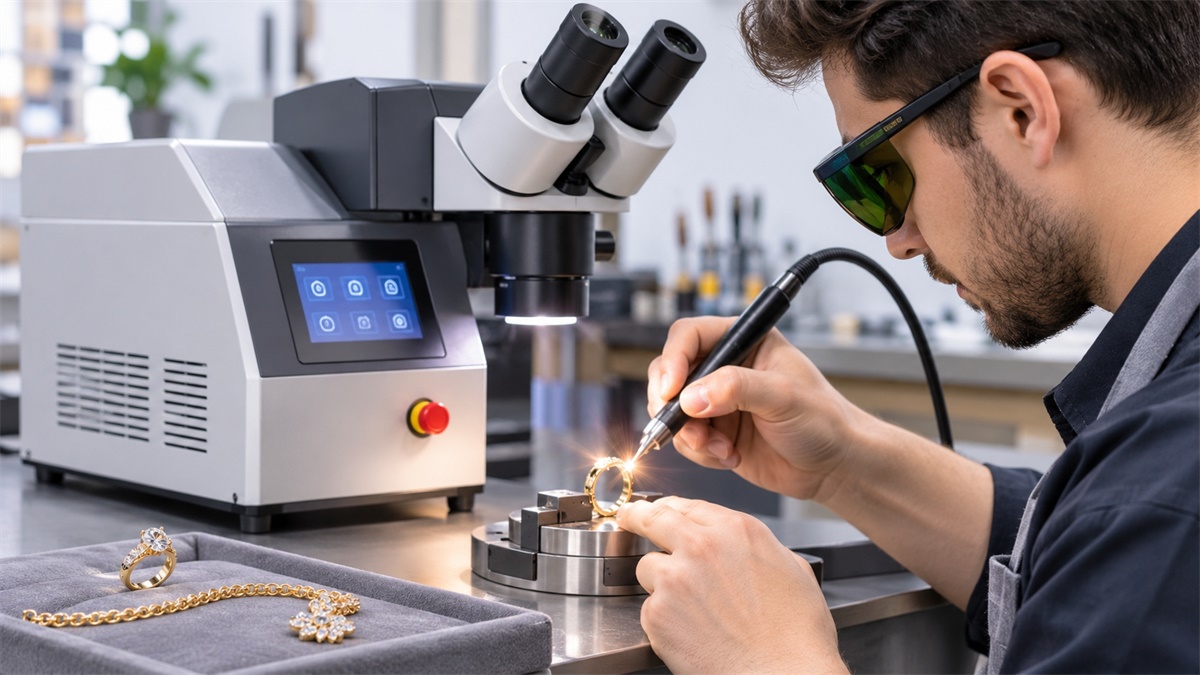
Choosing the best laser welder for a jewelry repair shop depends on the types of repairs you handle, the thickness of the metals, and your daily workload. A professional jewelry laser welding machine can help jewelers repair broken chains, ring joints, prongs, clasps, and other delicate components with localized heat and precise welding.
1. Why Do Jewelry Repair Shops Need a Laser Welder?
Traditional soldering is still widely used in jewelry workshops, but it can be difficult when repairing delicate pieces or working close to gemstones. Laser welding offers more localized heat input, making it suitable for many precision repair applications.
Its main advantages include:
-
Precise welding: Suitable for small joints, thin wires, and delicate jewelry components.
-
Localized heating: Helps reduce heat transfer to surrounding areas.
-
Less finishing work: Clean welds can reduce subsequent polishing and refinishing.
-
Versatile applications: Suitable for compatible gold, silver, platinum, and other jewelry metals.
-
Flexible operation: Adjustable welding parameters allow operators to handle different repair requirements.
For repair shops handling multiple types of jewelry, these capabilities can improve working efficiency and repair consistency.
2. What Specifications Should You Consider?
When buying a jewelry laser welder, do not focus on rated power alone. The following specifications are also important.
| Specification | What to Consider |
|---|---|
| Laser type | Pulsed YAG laser |
| Laser power | 60W, 150W, or 200W depending on applications |
| Spot diameter | Small, adjustable welding spot |
| Pulse energy | Adjustable for different metal thicknesses |
| Microscope | Clear magnification for precision work |
| Cooling system | Stable cooling for daily operation |
| Control system | Easy adjustment of welding parameters |
A good microscope and adjustable pulse parameters are particularly important for repairing small jewelry components.
3. 60W vs. 150W vs. 200W: Which One Should You Buy?
Different repair shops have different requirements. Here is a practical comparison.
| Laser Power | Suitable Applications |
|---|---|
| 60W | Small studios and lightweight jewelry repairs |
| 150W | Professional jewelry repair shops handling varied daily jobs |
| 200W | More demanding repairs requiring higher pulse energy |
For a professional repair shop handling broken chains, ring repairs, prong restoration, and various gold or silver components, a 150W machine is a practical choice.
A 60W machine may be sufficient for lighter workloads, while a 200W model is worth considering when the repair requirements involve thicker components or higher pulse energy.
4. Common Jewelry Repairs Using Laser Welding
A jewelry laser welder can be used for many everyday repair tasks:
-
Gold chain repair: Reconnecting broken links and delicate chain sections.
-
Ring resizing: Welding ring sections after adjusting the size.
-
Prong repair: Rebuilding worn or damaged stone-setting prongs.
-
Clasp repair: Repairing small joints and damaged clasp components.
-
Silver jewelry repair: Joining broken sections and repairing fine details.
-
Platinum jewelry repair: Performing localized welding with suitable parameters and filler materials.
The welding settings should be adjusted according to the metal composition, joint structure, and thickness. Gemstones should also be evaluated individually before welding.
5. Recommended Laser Welder for Jewelry Repair Shops
For professional jewelry repair businesses, the Dowin 150W Desktop Jewelry Laser Welder is worth considering.
Its main features include:
-
150W laser power configuration.
-
Adjustable laser spot diameter from 0.2 to 2 mm.
-
Microscope for precise positioning.
-
LED shadowless illumination.
-
Compact desktop structure.
-
Air cooling system.
For smaller workshops or businesses with lighter repair requirements, the Dowin 60W Portable Jewelry Welding Machine is another option.
Before purchasing, ask the manufacturer to test your actual jewelry samples. This is the most reliable way to evaluate welding quality and determine whether a machine meets your workshop’s requirements.
6. Frequently Asked Questions
Q1: Is a laser welder suitable for a small jewelry repair shop?
Yes. Compact desktop jewelry laser welders are suitable for small workshops because they require relatively little floor space and can handle many precision repair applications.
Q2: Can a jewelry laser welder repair gold and silver?
Yes. Pulsed YAG laser welding machines can be used for gold, silver, platinum, and other compatible jewelry metals.
Q3: Can laser welding damage diamonds or gemstones?
It can if heat reaches the stone or its setting. Localized laser welding can reduce this risk, but operators must evaluate the gemstone and joint position before starting.
Q4: Is 150W better than 60W for jewelry repair?
Not necessarily for every application. A 150W machine provides more capability for varied repair requirements, while 60W can be sufficient for smaller and lighter jobs.
Q5: What should I ask a laser welder manufacturer before ordering?
Ask about welding samples, adjustable pulse parameters, spot diameter, microscope quality, cooling requirements, warranty, and technical support.
Conclusion
The best laser welder for a jewelry repair shop should match the materials, repair types, and daily workload of the business. For shops handling a wide range of professional jewelry repairs, a 150W pulsed YAG desktop machine is a practical option. Testing real jewelry samples before purchasing will help ensure the selected machine meets your expectations.
Post time: Nov-05-2026
