
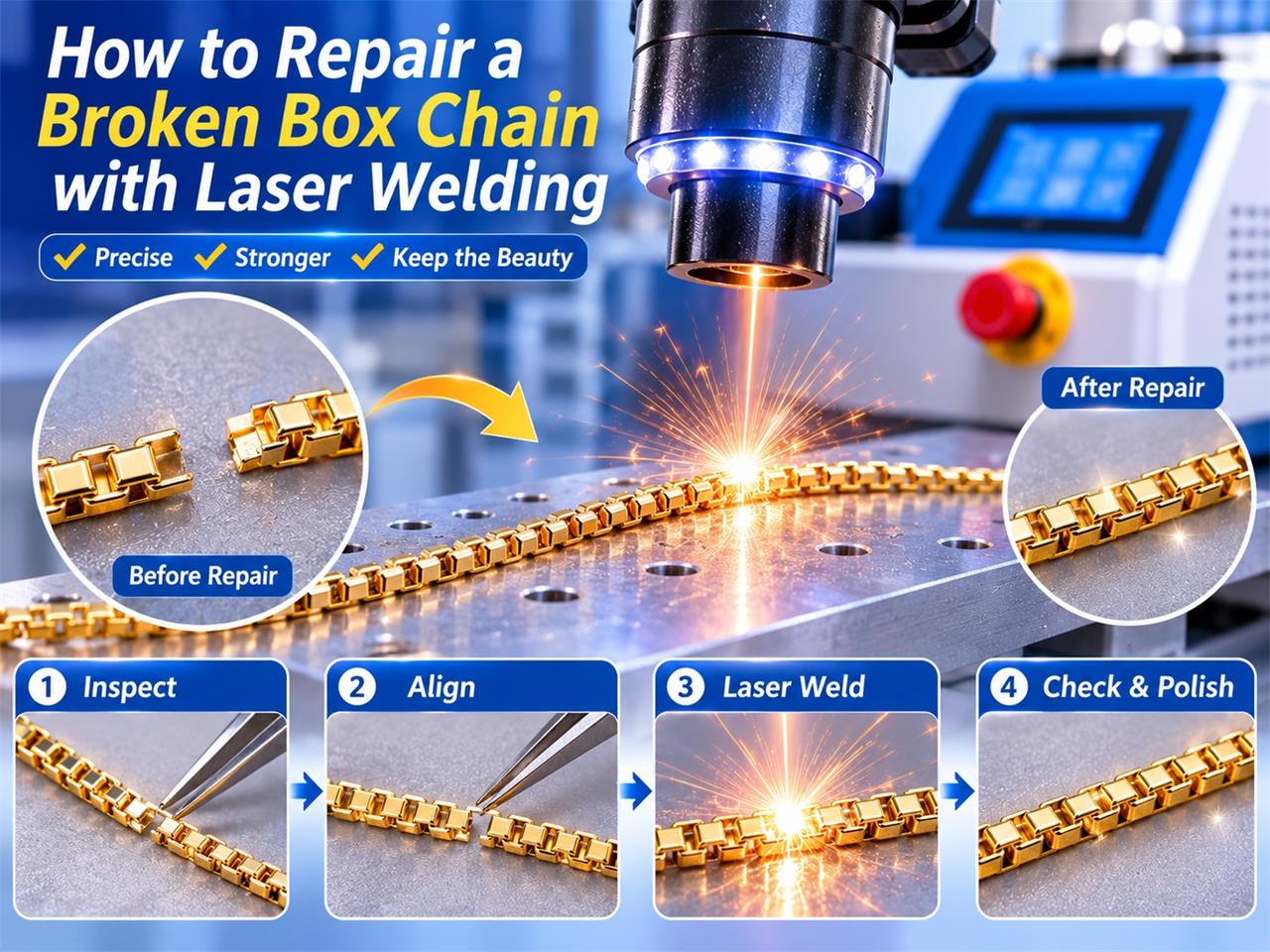
Hollow rope chains are among the more challenging types of gold jewelry to repair. Their twisted, interwoven link structure creates an attractive appearance while keeping the chain relatively lightweight. However, the thin metal walls can easily deform, flatten, or develop holes when exposed to excessive heat. Traditional soldering may heat a larger section than necessary, increasing the risk of damaging surrounding links. A pulsed YAG jewelry laser welding machine offers a more localized approach to repairing suitable hollow rope chains. The key is to control laser energy carefully, maintain the original link geometry, and avoid excessive heat accumulation during welding.
1. Why Are Hollow Rope Chains Difficult to Weld?
A rope chain is made from multiple interconnected metal sections arranged in a twisted pattern. The links create a rope-like appearance with a textured surface that reflects light from different angles.
Hollow rope chains are designed to reduce weight and material consumption. Depending on their construction, they may contain thin-walled sections or hollow internal structures.
These characteristics create several repair challenges:
- Thin metal walls: Limited material thickness makes the chain sensitive to excessive laser energy.
- Complex link structure: Multiple interwoven sections make it difficult to access the exact broken area.
- Limited welding space: The operator must locate the damaged metal without affecting neighboring links.
- Heat accumulation: Repeated welding pulses can gradually heat the surrounding chain.
- Risk of deformation: Excessive melting can flatten the hollow structure or change the original rope pattern.
The biggest challenge is not simply reconnecting the broken metal. It is restoring the connection while preserving the original three-dimensional structure of the chain.
2. Common Damage to Hollow Gold Rope Chains
Before choosing a welding method, identify the type of damage. Different problems require different repair approaches.
Broken Rope Chain Links
This is one of the most common repair situations. Repeated pulling, bending, or accidental snagging can cause one section of the chain to separate.
If the broken ends remain intact and can be correctly aligned, laser welding may reconnect the damaged metal.
Crushed or Flattened Links
Hollow rope chains can become flattened when compressed by heavy objects or subjected to excessive mechanical pressure.
This type of damage is more complicated than a simple break. The original hollow structure may already have collapsed, and welding alone cannot restore the missing internal volume.
If the deformation is minor, an experienced jeweler may be able to reshape the affected section using suitable tools before considering whether welding is necessary. Severely crushed links may need replacement.
Small Holes in Thin Metal Walls
A hollow rope chain may develop tiny holes because of wear, previous overheating, or accidental damage.
Small localized defects may sometimes be repaired by adding compatible filler material. However, if the surrounding metal has become extremely thin, additional welding may weaken the structure rather than improve it.
Twisted or Separated Chain Sections
Sometimes the rope pattern becomes uneven because several interconnected sections have moved out of position.
Before welding, the operator needs to restore the original alignment. Welding an incorrectly positioned section can permanently affect the chain’s appearance and flexibility.
3. Why Use Laser Welding for Hollow Rope Chain Repair?
Traditional torch soldering can be difficult when repairing lightweight hollow chains because the heat may spread into neighboring links.
A pulsed jewelry laser welder offers several practical advantages for suitable repair applications.
Localized Heat Input
Laser energy can be concentrated on the damaged area rather than heating a large section of the chain.
This helps reduce unnecessary thermal exposure and lowers the risk of deforming nearby hollow links.
Precise Welding Position
A microscope allows the operator to identify small cracks and position the laser accurately.
This is particularly important for rope chains because the twisted structure can make the actual break difficult to distinguish from neighboring decorative sections.
Controlled Filler Material
When metal is missing, compatible filler wire can be added gradually to rebuild a suitable repair area.
However, filler material should not be used to simply cover a severely collapsed or structurally weakened section.
Reduced Finishing Work
When the weld is properly positioned and controlled, the repair may require less excess material removal and polishing.
This helps preserve the original rope pattern and reduces the risk of further thinning the repaired area.
For more information, read Laser Welding Solutions for Broken Gold Chains.
4. How to Laser Weld a Hollow Gold Rope Chain
Repairing a hollow rope chain requires careful preparation. The following process focuses on a localized break where the surrounding links remain structurally sound.
Step 1: Inspect the Chain Structure
Place the damaged chain under a microscope and carefully examine the broken section.
Determine:
- Whether the chain is hollow or solid.
- Where the metal has separated.
- Whether the surrounding links are flattened or deformed.
- Whether there are additional cracks near the damaged area.
- Whether sufficient metal remains for a reliable connection.
- The gold karat and alloy composition.
Do not assume that every damaged rope chain can be repaired simply because the broken ends appear close together.
For more inspection and preparation techniques, see How to Repair Broken Gold Chains with a Laser Welder.
Step 2: Clean the Damaged Area
Remove dirt, oil, polishing compounds, oxidation, and other contaminants from the broken section.
If the chain has previously been repaired using solder, inspect the old material and determine whether it needs to be removed before laser welding.
A clean surface improves welding consistency and helps the operator see the condition of the original metal more clearly.
Step 3: Restore the Original Rope Chain Shape
Before welding, carefully align the broken ends and restore the original twisted pattern as much as possible.
Make sure the individual links are positioned correctly and that the surrounding sections are not twisted or trapped.
Pay particular attention to the following:
- Do not force a severely collapsed hollow link back into shape.
- Do not stretch the chain to close a gap.
- Ensure that the broken ends are correctly aligned.
- Avoid creating additional stress on neighboring links.
- Confirm that the chain can move naturally around the repair area.
If the damaged section has permanently lost its original hollow structure, consider replacing that section instead of attempting to rebuild it through repeated melting.
Step 4: Select Suitable Laser Welding Parameters
This is one of the most important steps when working with hollow rope chains.
The metal walls are thin, so excessive laser energy can quickly create holes or collapse the surrounding structure.
Four main parameters require attention:
- Pulse energy: Determines how much energy is delivered to the metal during each pulse.
- Pulse duration: Controls the time over which the laser energy interacts with the material.
- Pulse frequency: Influences heat accumulation when multiple pulses are applied.
- Spot diameter: Determines the size of the localized welding area.
For hollow chain repair, the objective is to achieve sufficient metal fusion with the lowest practical heat input for the joint.
There is no universal parameter setting for every hollow rope chain. The correct combination depends on wall thickness, gold alloy, break geometry, and the welding machine.
Start with test samples made from comparable materials and adjust the parameters gradually. Avoid repeated pulses at exactly the same location without checking the heat buildup.
For additional technical guidance, read Repairing a Fine Jewelry Chain with a 200W Laser Welder.
Step 5: Apply Controlled Laser Pulses
Once the chain is positioned correctly, apply controlled laser pulses to the damaged metal.
For a clean break, direct fusion may be sufficient if enough original material remains.
If the damaged section has a small gap, compatible gold filler wire may be introduced gradually.
Do not attempt to fill a large gap with excessive filler material. This can create a bulky repair area that looks different from the original rope chain and may interfere with its flexibility.
It is also important to avoid directing unnecessary laser energy toward neighboring hollow links.
Step 6: Monitor the Chain During Welding
After the initial weld, inspect the repaired area under magnification.
Check whether:
- The original rope pattern remains visible.
- The surrounding links retain their shape.
- The weld has sufficient fusion.
- No holes or excessive melting have appeared.
- The connection has not become unnecessarily thick.
If the metal begins to deform, stop and reassess the welding conditions rather than continuing to add energy.
Step 7: Finish and Test the Repaired Chain
Allow the repaired section to cool under suitable conditions. Inspect the weld for cracks, incomplete fusion, and excessive filler material.
Remove excess material carefully and polish the repair without reducing the wall thickness of the original chain.
Finally, gently move the chain around the repaired section.
A successful repair should maintain:
- Natural chain flexibility.
- A consistent rope pattern.
- A smooth surface without sharp edges.
- A secure metal connection.
- No visible flattening or unintended deformation.
5. How to Prevent Hollow Links from Collapsing During Laser Welding
Preventing deformation is more important than achieving a fast welding speed when repairing lightweight hollow jewelry.
Several practical considerations can help reduce the risk.
Use the Lowest Practical Energy Input
Do not automatically use high pulse energy simply because the machine has a high rated power.
Thin hollow walls require careful parameter matching. The laser should provide enough energy for the intended joint without unnecessarily melting the surrounding structure.
Choose an Appropriate Spot Diameter
The welding spot should match the dimensions of the repair area.
An unnecessarily large spot may affect more of the hollow link than required, while an unsuitable small spot may lead to insufficient fusion or repeated heating at one location.
Avoid Excessive Pulse Overlap
Repeated pulses delivered too closely together can increase the temperature of neighboring metal.
Use a controlled welding sequence and inspect the material between operations when necessary.
Use Stable Positioning
Small rope chains are easy to move accidentally during welding.
A suitable fixture helps maintain the original link alignment and reduces the possibility of inconsistent welding.
Do Not Overbuild the Joint
Excessive filler material can make the repaired section heavier and bulkier than the original chain.
Use compatible filler only when necessary and remove excess material carefully during finishing.
6. Can You Repair a Severely Collapsed Hollow Rope Chain?
Not every hollow rope chain can be restored successfully through laser welding.
There is an important difference between a broken metal connection and a permanently collapsed hollow structure.
Cases that may be suitable for laser repair:
- A localized break with sufficient metal remaining.
- A small crack in an otherwise intact link.
- A damaged connection between two structurally sound sections.
- A small opening where compatible filler material can restore the connection.
Cases where replacement may be more appropriate:
- Several neighboring links have collapsed.
- The hollow wall has become extremely thin.
- A large section has been flattened by mechanical pressure.
- Multiple cracks have developed around the damaged area.
- The original structure cannot be restored without extensive rebuilding.
Repeated welding on severely weakened metal may create more damage and reduce the reliability of the chain.
For extremely delicate chain repairs, our article How to Repair Thin Gold Chains Without Soldering provides additional guidance.
7. Laser Welding vs. Traditional Soldering for Hollow Rope Chains
Both techniques have applications in jewelry repair. However, hollow rope chains require careful heat management because their thin metal walls are sensitive to excessive heating.
| Comparison | Laser Welding | Traditional Soldering |
|---|---|---|
| Heat concentration | Localized | Broader heating area |
| Thin wall repair | Precise energy control is possible | Requires careful torch control |
| Neighboring links | Less unnecessary heat exposure when properly controlled | Greater potential for surrounding heat exposure |
| Filler material | Optional depending on the damage | Generally uses solder |
| Small repair areas | Microscope-assisted positioning | Depends on operator technique |
| Finishing | Can reduce excess material | May require additional cleanup |
| Equipment investment | Higher | Generally lower |
Laser welding is not automatically safer for every hollow chain. Poorly selected parameters can still cause burn-through and collapse. However, its localized energy delivery makes it a useful option for suitable precision repairs.
8. Choosing a Jewelry Laser Welder for Hollow Chain Repair
For jewelry repair workshops handling thin gold chains, hollow rope chains, box chains, necklaces, and bracelets, a pulsed YAG jewelry laser welder is worth considering.
The Dowin New 150W Desktop Laser Jewelry Welder is designed for precision welding of gold, silver, platinum, and other compatible metal components.
Its main specifications include:
- Maximum laser power: 150W/200W configurations.
- Laser wavelength: 1064 nm.
- Pulse frequency: 1–20 Hz.
- Adjustable pulse width: 0.2–10 ms.
- Spot adjustment range: 0.2–2 mm.
- Observation system: Microscope + CCD.
- Cooling method: Air cooling.
For hollow rope chain repair, adjustable pulse parameters and microscope observation are particularly useful. They allow the operator to examine small defects and control the welding process more carefully.
The machine can also be considered for other jewelry repair applications, including:
- Fine gold chain repair.
- Broken necklace connections.
- Gold jump ring repair.
- Clasp and attachment loop repair.
- Ring crack repair.
- Prong rebuilding.
- Small casting defects.
The actual suitability of a machine should be confirmed using samples of the customer’s chain material and construction. A high rated power does not automatically guarantee better results on thin hollow links.
Explore the Dowin Jewelry Laser Welding Machine Collection to compare available models and configurations.
Frequently Asked Questions
Can you laser weld a hollow gold rope chain?
Yes. Some broken hollow gold rope chains can be repaired using a pulsed YAG jewelry laser welder. The key is to evaluate the metal wall thickness and use suitable parameters to achieve fusion without collapsing the surrounding structure.
Why do hollow gold chains collapse during laser welding?
Collapse can occur when excessive energy melts or weakens the thin metal walls. Repeated overlapping pulses, poor positioning, and an unsuitable spot diameter can also contribute to deformation.
Can you repair a flattened hollow rope chain?
It depends on the degree of deformation. A slightly distorted section may be reshaped by an experienced jeweler if the metal remains intact. A severely collapsed or cracked hollow section may need replacement because welding cannot restore missing internal structure.
Do you need filler wire to repair a hollow rope chain?
Not always. If the broken ends fit correctly and enough original metal remains, direct laser fusion may be possible. Compatible gold filler wire can be used when a small amount of material is missing.
What laser power is suitable for hollow gold chain repair?
Both 150W and 200W pulsed jewelry laser welders can be considered for suitable hollow chain repairs. However, the correct parameter combination depends on the wall thickness, alloy, and joint geometry rather than rated power alone.
Can laser welding preserve the flexibility of a hollow rope chain?
Yes, provided the repair does not fuse neighboring links together or create excessive metal buildup. After welding, the operator should inspect the chain’s movement and confirm that the repaired area remains flexible.
Is laser welding better than soldering for hollow rope chains?
Laser welding offers more localized heat input, which can be advantageous when repairing thin hollow links. However, both methods require suitable techniques, and the choice depends on the chain construction and the operator’s experience.
Conclusion
Laser welding hollow rope chains requires careful control because their thin metal walls are sensitive to excessive heat. The goal is not simply to reconnect the broken section but to preserve the original rope structure, surface appearance, and chain flexibility.
Accurate inspection, correct link alignment, controlled pulse energy, suitable spot diameter, and careful finishing are essential for successful repair. Severely collapsed or structurally weakened sections may need replacement rather than repeated welding.
For professional jewelry repair shops, a pulsed YAG jewelry laser welder provides a useful solution for many delicate chain repair applications. Dowin offers desktop jewelry laser welding machines designed for precision gold and silver jewelry processing. Contact Dowin to discuss your chain materials and repair requirements.
Post time: Nov-27-2026
