
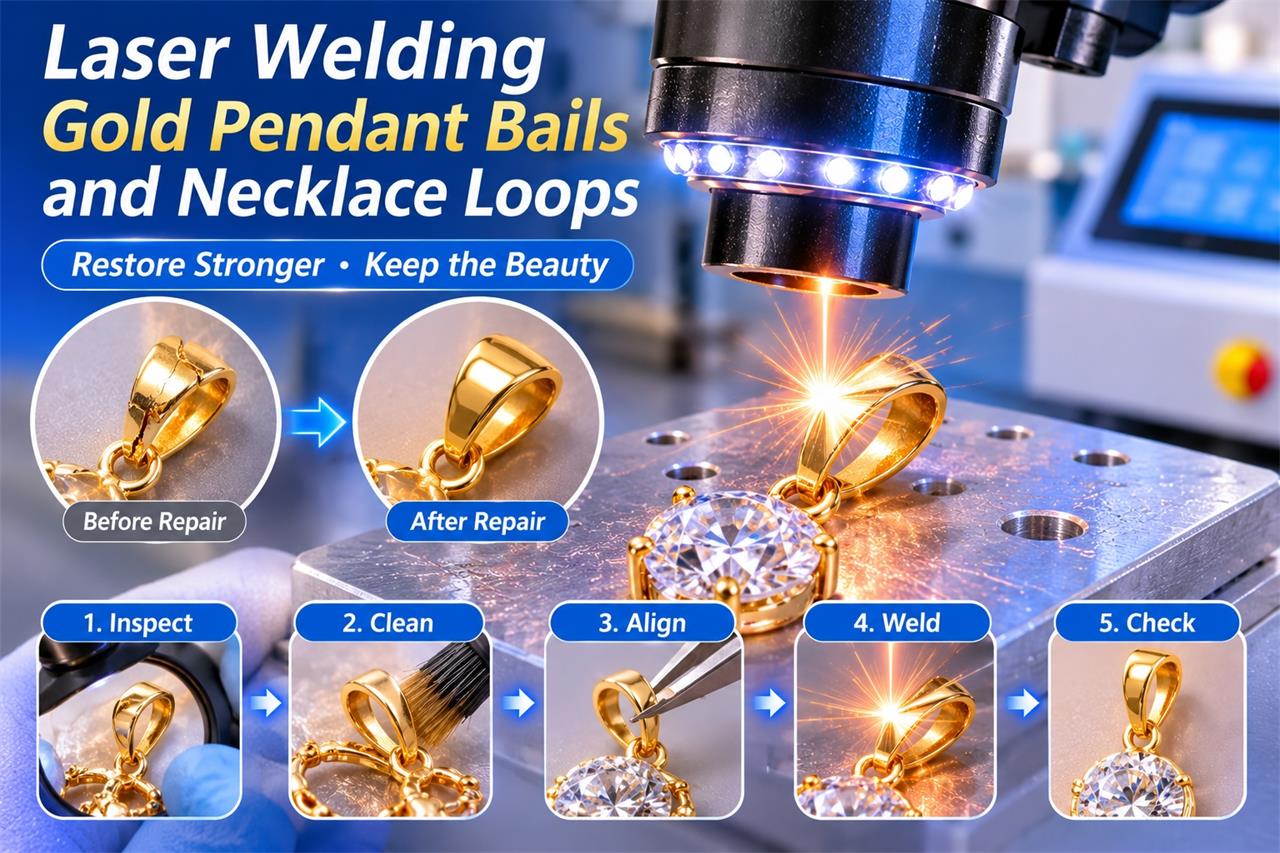
Gold pendant bails and necklace loops are small but important jewelry components. They connect pendants, charms, and decorative pieces to necklace chains, making them essential for both appearance and structural reliability. Over time, these connection points can crack, loosen, become worn, or break completely. For professional jewelry repair shops, a pulsed YAG jewelry laser welding machine provides a precise way to repair suitable gold loops and pendant connections while minimizing unnecessary heat exposure to surrounding jewelry. The main challenges are maintaining the original loop shape, achieving sufficient joint strength, and avoiding excessive material buildup.
1. Understanding Gold Pendant Bails and Necklace Loops
Although pendant bails and necklace loops serve similar purposes, their structures and repair requirements can be different.
Gold Pendant Bails
A pendant bail is the component that allows a pendant to hang from a necklace chain. Depending on the jewelry design, it may be attached directly to the pendant, hidden behind the decorative front, or designed as a separate component.
Common pendant bail types include:
- Fixed bail: A permanent metal loop attached to the pendant.
- Hidden bail: A concealed connection behind the decorative pendant.
- Hinged bail: A movable bail that opens and closes to accommodate different chains.
- Decorative bail: An ornamental component that contributes to the overall pendant design.
Each type presents different welding challenges. A fixed bail is often easier to repair than a hinged design because the latter contains moving parts that must remain functional.
Necklace Loops and Jump Rings
Necklace loops are smaller connecting components used between chains, clasps, pendants, and decorative elements.
Jump rings are particularly common. They provide a simple connection between two jewelry components but can become weak if the opening is not properly closed or the metal gradually wears down.
When repairing these components, the jeweler must restore the original circular shape and ensure that the connection does not create sharp edges or interfere with chain movement.
2. Why Do Gold Pendant Bails and Necklace Loops Break?
These small components experience repeated mechanical stress during everyday use. Even high-quality gold jewelry can develop cracks or structural weaknesses over time.
Common causes include:
- Repeated pulling: Pendants move against the necklace chain, creating stress around the attachment point.
- Metal fatigue: Repeated bending and movement can gradually weaken thin gold loops.
- Insufficient metal thickness: Lightweight decorative bails may not withstand heavy pendants.
- Previous poor repairs: Incomplete soldering or excessive polishing can weaken the connection.
- Wear and abrasion: Continuous contact between the chain and bail can gradually reduce metal thickness.
- Accidental impact: Pulling or catching the pendant on clothing can deform or break the connecting loop.
Before repairing a damaged connection, inspect the surrounding metal carefully. If the entire loop has become too thin, simply closing the crack may not restore sufficient strength. Adding compatible filler material or replacing the component may be necessary.
For similar chain connection problems, see Laser Welding Solutions for Broken Gold Chains.
3. Why Use Laser Welding for Gold Pendant Bails?
Traditional torch soldering is still widely used in jewelry manufacturing and repair. However, small pendant bails and necklace loops can be difficult to repair because of their limited dimensions and proximity to decorative components.
A pulsed YAG jewelry laser welder offers several practical advantages.
Localized Heat Input
Laser welding concentrates energy on a small repair area instead of heating the entire pendant or surrounding chain.
This helps reduce unnecessary thermal exposure to nearby decorative surfaces, gemstones, and delicate metal sections.
Precise Welding on Small Components
Small loops often have very narrow gaps and limited welding space. A microscope-assisted laser welding system allows the operator to position the welding point accurately.
Better Control over Metal Buildup
When a bail has lost some material, compatible gold filler wire can be added gradually. This allows the jeweler to rebuild the damaged area rather than simply covering the defect with excess solder.
Less Unnecessary Finishing
A properly controlled weld can reduce excess material and localized distortion, helping preserve the original jewelry design and minimize subsequent polishing.
For a broader overview of these applications, read Jewelry Laser Welding Applications: A Complete Guide.
4. How to Laser Weld a Broken Gold Pendant Bail
Repairing a broken pendant bail requires careful inspection and accurate positioning. The objective is not simply to reconnect the metal, but to restore the original shape and provide a reliable attachment for the pendant.
Step 1: Inspect the Pendant and Bail
Examine the pendant under a microscope or suitable magnification system.
Determine:
- Where the crack or separation occurred.
- Whether the bail is solid or hollow.
- Whether sufficient metal remains around the damaged area.
- Whether the pendant contains gemstones near the welding point.
- Whether the bail can be repaired without affecting its original design.
If the original bail is severely worn or deformed, replacing it may produce a more reliable result than attempting to repair the existing component.
Step 2: Clean the Damaged Area
Remove dirt, oil, polishing compounds, oxidation, and any remaining contaminants.
If previous soldering has been performed, inspect the old joint and determine whether the existing material needs to be removed before laser welding.
A clean welding surface helps improve consistency and reduces the possibility of contamination-related defects.
Step 3: Align the Broken Bail
Position the damaged metal sections carefully and restore the original shape.
For a broken circular bail, the two ends should meet accurately without creating an uneven opening or changing the internal diameter.
If metal is missing, determine whether compatible gold filler wire should be used.
For pendant bails, alignment also affects how the pendant hangs. An incorrectly positioned connection may cause the pendant to lean forward, backward, or sideways when worn.
Step 4: Select Suitable Laser Parameters
Laser parameters should be adjusted according to the gold alloy, material thickness, joint geometry, and amount of missing metal.
The main parameters include:
- Pulse energy: Determines the energy delivered to the repair area.
- Pulse duration: Controls the interaction time between the laser and the metal.
- Frequency: Influences the spacing between laser pulses and heat accumulation.
- Spot diameter: Determines the size of the localized welding area.
Small pendant bails generally require careful energy control because excessive heat can melt through thin metal or change the original shape.
There is no universal parameter setting for every gold pendant bail. Operators should establish suitable settings through testing on comparable materials before repairing valuable jewelry.
Our detailed guide Jewelry Laser Welding Parameters for Gold explains how to select suitable settings for different gold welding applications.
Step 5: Apply Controlled Laser Pulses
Once the damaged area is correctly positioned, apply controlled laser pulses to establish the connection.
For a clean break, direct fusion may be sufficient if enough material remains. When the bail has lost metal, compatible gold filler wire can be introduced gradually.
Do not apply excessive energy in a single location. Small, controlled welds allow the operator to monitor the joint and reduce unnecessary heat accumulation.
Step 6: Restore the Original Shape
After establishing the connection, inspect the bail’s geometry.
Check whether the loop remains round or oval as originally designed and whether the opening is suitable for the intended chain.
Remove excess metal carefully without reducing the wall thickness of the repaired section.
Step 7: Inspect the Finished Connection
Before polishing, examine the weld under magnification.
Check for:
- Incomplete fusion.
- Visible cracks.
- Excessive filler material.
- Deformation around the attachment point.
- Sharp edges or uneven surfaces.
Finally, check that the chain passes through the bail smoothly and that the pendant hangs in its intended position.
5. How to Laser Weld Small Necklace Loops and Jump Rings
Compared with larger pendant bails, necklace loops and jump rings can be even more challenging because of their smaller dimensions.
A typical repair involves reconnecting the two ends of a small metal ring. The operator needs to maintain the original diameter while creating a sufficient metal connection.
Position the Two Ends Correctly
Bring the two ends of the jump ring together until they meet properly. Avoid overlapping them or leaving a large gap.
A poor fit can result in an uneven weld or an unnecessarily enlarged connection.
Choose a Suitable Spot Diameter
The laser spot should match the dimensions of the connection area. A spot that is too large may affect the surrounding ring structure.
For smaller jewelry connections, precise spot adjustment is particularly valuable.
Use Filler Wire When Necessary
If the ring has lost material or the gap cannot be closed properly, compatible filler wire may help rebuild the connection.
However, excessive filler can make the repaired area bulky and interfere with the chain or pendant movement.
Check the Joint Before Returning the Jewelry
After welding, check whether the loop is fully closed and whether the repaired area has sufficient mechanical integrity.
For more detailed chain repair examples, read How to Repair Broken Gold Chains with a Laser Welder.
6. How to Avoid Distortion When Welding Thin Gold Loops
One of the biggest challenges in pendant bail and necklace loop repair is preventing deformation.
Small jewelry components can melt or change shape quickly if too much energy is applied.
Several practices help improve repair consistency.
Use Stable Fixtures
Small loops should be secured properly before welding. Movement during laser operation can produce uneven joints and inconsistent weld penetration.
Avoid Excessive Heat Accumulation
Repeated pulses delivered too closely together can gradually heat the entire component.
Use a controlled welding sequence and allow the part to cool appropriately when necessary.
Choose Compatible Filler Material
Filler material should match the original gold alloy as closely as practical. Differences in composition or color can create visible repair marks and affect the final appearance.
Pay Attention to Thin or Hollow Structures
Hollow pendant bails and thin decorative loops require additional caution. Excessive energy may create holes, collapse thin walls, or weaken the structure.
Testing on comparable material is particularly important before working on these designs.
7. Can You Laser Weld Pendant Bails Without Removing Gemstones?
In some cases, yes. The localized nature of pulsed laser welding can make it possible to repair a pendant near certain gemstones without removing them.
However, this depends on several factors:
- The type of gemstone.
- The distance between the gemstone and the welding location.
- The gemstone’s heat sensitivity and treatment history.
- The construction of the setting.
- The expected heat transfer through the pendant body.
Diamonds and some other gemstones may tolerate certain repair conditions better than heat-sensitive stones. Nevertheless, laser welding does not guarantee protection against thermal shock or damage to gemstone treatments and settings.
When the welding point is close to a sensitive gemstone, removing the stone may be the safer choice.
For more information, see Can a Laser Welder Repair a Ring Without Removing the Stone?.
8. Choosing a Jewelry Laser Welder for Pendant and Loop Repairs
For jewelry workshops handling pendant bails, jump rings, necklace connections, fine chains, and other small components, a pulsed YAG jewelry laser welder is a practical equipment option.
The Dowin New 150W Desktop Laser Jewelry Welder is designed for precision welding of gold, silver, platinum, and other compatible metal jewelry components.
Its main specifications include:
- Maximum laser power: 150W/200W configurations.
- Laser wavelength: 1064 nm.
- Pulse frequency: 1–20 Hz.
- Adjustable pulse width: 0.2–10 ms.
- Spot adjustment range: 0.2–2 mm.
- Observation system: Microscope + CCD.
- Cooling method: Air cooling.
The adjustable spot diameter is particularly useful for small connection points, while microscope observation helps operators position delicate metal components accurately.
The machine can also be used for other jewelry repair applications, including:
- Gold chain repair.
- Broken clasp repair.
- Ring crack repair.
- Prong rebuilding.
- Small casting defect repair.
- Fine jewelry component joining.
Explore the Dowin Jewelry Laser Welding Machine Collection to compare different models and configurations.
Frequently Asked Questions
Can you laser weld a broken gold pendant bail?
Yes. A broken gold pendant bail can often be repaired using a pulsed YAG jewelry laser welder when sufficient metal remains around the damaged area. Compatible filler wire may be necessary if material is missing.
Can laser welding repair a small gold jump ring?
Yes. Laser welding is suitable for many small gold jump ring repairs. The operator must align the two ends accurately and select suitable laser parameters according to the ring’s dimensions and alloy.
Will laser welding change the shape of a pendant bail?
It can if excessive energy is applied or the component is not secured properly. Careful positioning, controlled pulses, and suitable fixtures help preserve the original shape.
Can you weld a pendant bail while it is attached to a gemstone pendant?
Some repairs can be completed with the gemstone remaining in place. However, the stone type, setting design, and distance from the weld must be evaluated. Removing heat-sensitive gemstones may be necessary.
Do you need filler wire when repairing gold pendant loops?
Not always. If the broken metal ends fit together properly, direct laser fusion may be sufficient. Compatible gold filler wire is useful when material is missing or the connection needs to be rebuilt.
What laser power is suitable for gold pendant bail repair?
Both 150W and 200W pulsed jewelry laser welders can be considered for suitable pendant and necklace loop repairs. The correct choice depends on material thickness, joint design, pulse energy control, and the workshop’s other applications.
Conclusion
Gold pendant bails and necklace loops may be small components, but their structural reliability is essential for everyday jewelry use. Laser welding provides a precise repair option for suitable broken connections, worn loops, and damaged jump rings.
Successful repairs depend on accurate inspection, correct alignment, suitable pulse parameters, and careful control of filler material. For particularly thin or hollow components, testing and heat management are essential to avoid deformation.
For professional jewelry repair shops and manufacturers, a pulsed YAG jewelry laser welder can expand repair capabilities and support a wide range of delicate gold jewelry applications.
Dowin provides jewelry laser welding machines for professional workshops and jewelry manufacturers. Contact Dowin to discuss your pendant repair applications, material requirements, and suitable machine configuration.
Post time: Nov-26-2026
