
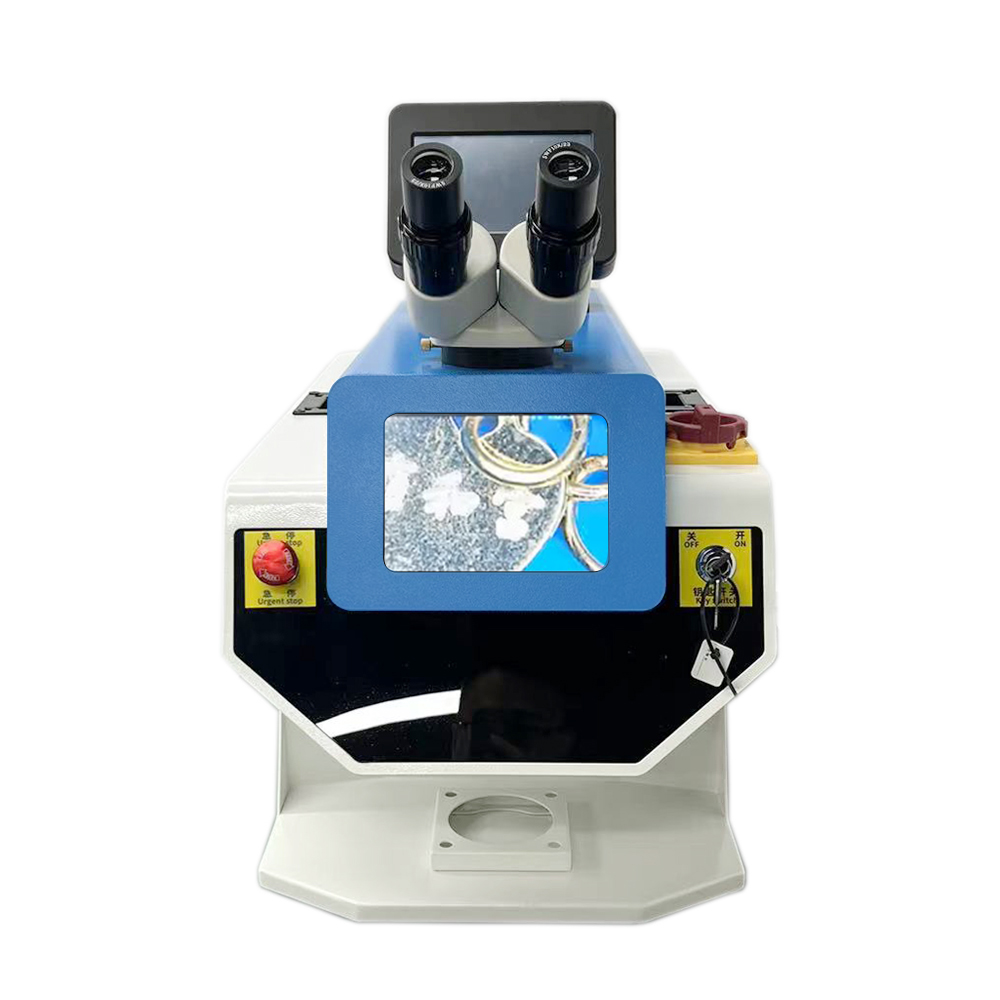
Yes, a laser welder can often repair a ring without removing the gemstone. This is one of the most important advantages of laser welding for jewelry repair.
Unlike traditional torch welding, which distributes heat over a relatively large area, a jewelry laser welder delivers concentrated energy to a precisely controlled point. This allows jewelers to repair damaged areas close to diamonds and other gemstones while minimizing heat transfer to the surrounding metal and stone.
However, “without removing the stone” does not mean that every gemstone and every repair can be laser welded safely. The type of stone, its condition, the location of the repair, and the laser parameters must all be considered.
Why Can Laser Welding Be Used Near Gemstones?
The main advantage is localized heat input.
A jewelry laser welding machine can focus the laser beam onto a very small area of the ring. Instead of heating the entire ring, the operator can target the damaged section and control the duration and energy of each laser pulse.
This is particularly useful when repairing:
-
Diamond rings
-
Platinum engagement rings
-
Gold rings with diamonds
-
Broken prongs
-
Worn settings
-
Cracked ring shanks
-
Bezels
-
Small gaps around settings
-
Fine jewelry components
Because less surrounding metal is heated, laser welding can reduce the risk of unwanted distortion and make repairs near mounted stones more manageable.
Which Ring Repairs Can Be Done Without Removing the Stone?
1. Broken or Worn Prongs
Prongs are among the most common applications for jewelry laser welding.
A worn prong can be rebuilt by adding compatible metal wire and precisely welding it onto the existing structure. The operator can concentrate the laser on the metal rather than heating the entire setting.
This is especially valuable for valuable diamond rings where removing and resetting the stone would add additional labor and risk.
2. Cracked Ring Shanks
A cracked or broken ring shank can often be laser welded while the gemstone remains mounted.
The damaged area is aligned, tack welded, and then gradually rebuilt using controlled laser pulses and, when necessary, compatible filler wire.
For platinum and gold rings, this technique can provide a clean repair while minimizing the amount of surrounding metal affected by heat.
3. Setting and Bezel Repairs
Laser welding can also be used to repair certain areas around bezels and settings.
Because the laser can be positioned very accurately through a microscope, the operator can work on small sections without unnecessarily heating adjacent areas.
4. Ring Resizing
Certain ring resizing operations can also be performed using laser welding.
The ring can be cut, adjusted to the desired size, and then laser welded back together. This can be particularly useful for rings containing stones that would be difficult or undesirable to remove.
Can You Laser Weld a Diamond Ring Without Removing the Diamond?
In many cases, yes.
Diamonds are relatively resistant to heat compared with many other gemstones, and the localized nature of laser welding makes it possible to perform certain repairs close to a mounted diamond.
Professional jewelry repair references have documented laser welding applications for platinum rings with diamonds remaining in the setting.
However, the operator must still avoid directing excessive laser energy toward the stone. The condition of the diamond and the specific repair geometry should be evaluated before welding.
A professional laser welder should therefore treat each ring individually rather than assuming that every diamond ring can be repaired in exactly the same way.
What About Other Gemstones?
This is where additional caution is necessary.
Different gemstones have very different thermal properties. Some stones can tolerate localized heat better than others, while certain treated, fractured, porous, or heat-sensitive gemstones may be damaged by laser welding.
Extra caution may be necessary with:
-
Emeralds
-
Opals
-
Pearls
-
Turquoise
-
Tanzanite
-
Some treated gemstones
-
Gemstones with existing fractures or inclusions
For these materials, removing the stone before welding may be the safer option.
The correct procedure depends on the stone’s identity, treatment history, condition, and distance from the welding area.
Laser Welding vs. Torch Repair for Rings With Stones
Traditional torch repair heats a much larger area of the jewelry. When a gemstone is already mounted, controlling this heat can become challenging.
Laser welding provides several advantages:
| Feature | Laser Welding | Torch Welding |
|---|---|---|
| Heat concentration | Highly localized | Broad |
| Heat-affected area | Small | Larger |
| Precision | Very high | Lower |
| Repair near stones | Often suitable | More difficult |
| Prong rebuilding | Excellent | More challenging |
| Fine jewelry repair | Excellent | Depends heavily on technique |
| Material control | Precise | Less localized |
The major advantage is not simply that a laser is “hotter.” It is that the operator can control where, how much, and how long energy is delivered.
How Does a Jewelry Laser Welder Protect the Stone?
The laser itself does not automatically protect the gemstone. Protection comes from proper parameter selection and welding technique.
A skilled operator can control several factors:
Pulse Energy
Lower energy can be used for delicate areas, while higher energy may be required for thicker sections.
Pulse Duration
Short, controlled pulses can limit unnecessary heat accumulation.
Spot Size
A smaller spot allows the operator to concentrate energy precisely where it is required.
Welding Position
The laser should be directed toward the metal repair area rather than toward the gemstone.
Heat Management
The operator can use controlled, intermittent pulses instead of continuously heating the area.
This combination allows the repair to be performed with significantly more localized heat than conventional torch methods.
What Types of Jewelry Laser Welders Are Suitable?
For ring and gemstone repair, a dedicated jewelry laser welding machine is generally the most practical choice.
Important features include:
-
High-magnification microscope
-
Adjustable pulse energy
-
Adjustable pulse duration
-
Variable spot diameter
-
Precise laser positioning
-
Stable laser output
-
Argon shielding gas
-
Filler wire feeding capability
-
Suitable working chamber for jewelry
A machine with precise parameter control is more important than simply choosing the highest laser power.
Is Laser Welding Safe for Every Ring?
No.
Before welding, a jeweler should inspect:
-
The gemstone type
-
Existing cracks or inclusions
-
Whether the stone has been treated
-
The distance between the repair and the stone
-
The ring’s metal and alloy
-
The thickness of the damaged area
-
The accessibility of the repair location
If the stone is particularly heat-sensitive or the repair requires excessive heat close to the gemstone, removing the stone may still be the appropriate solution.
Laser welding reduces thermal exposure; it does not eliminate it.
How to Repair a Ring With a Laser Welder
A typical repair process looks like this:
Step 1: Inspect the Ring
Identify the metal, gemstone, damage, and potential risks.
Step 2: Clean the Repair Area
Remove oils, polishing compounds, dirt, and other contaminants.
Step 3: Secure the Ring
Position the ring under the microscope so the damaged area can be accessed precisely.
Step 4: Select Laser Parameters
Choose the appropriate energy, pulse duration, frequency, and spot size according to the metal and thickness.
Step 5: Tack the Repair
Use small laser pulses to hold the damaged components in the correct position.
Step 6: Build the Weld
Continue welding gradually. Compatible filler wire can be added when material needs to be rebuilt.
Step 7: Inspect the Repair
Check the weld under magnification for penetration, cracks, alignment, and surface quality.
Step 8: Finish and Polish
File, polish, and restore the original appearance of the ring.
Frequently Asked Questions
Can a jeweler laser weld a ring with the stone still in it?
Yes. Many jewelry repairs can be performed while the stone remains mounted, particularly when the repair area is small and the gemstone can be adequately isolated from the laser’s heat.
Can you laser weld a diamond ring?
Yes. Laser welding is commonly used for precision repairs on diamond rings, including prong, shank, and setting repairs.
Can you laser weld gold rings with stones?
Yes. Gold rings with diamonds and other suitable gemstones can often be laser welded without removing the stone.
Can you laser weld platinum rings with diamonds?
Yes. Platinum is particularly suitable for precision laser welding, and certain platinum ring repairs can be performed with diamonds remaining in place.
Is laser welding better than soldering for stone-set jewelry?
For many precision repairs, laser welding offers better localized heat control than traditional torch soldering. However, the best method depends on the jewelry design, metal, gemstone, and specific repair.
Do all gemstones need to be removed before laser welding?
No. Some gemstones can remain in place during laser repair, while others may require removal because of their thermal sensitivity or condition.
Conclusion
A laser welder can often repair a ring without removing the stone, making it a valuable technology for modern jewelry repair.
Its biggest advantage is precise, localized energy delivery. With the right machine and an experienced operator, jewelers can repair prongs, shanks, settings, bezels, and other damaged areas while minimizing heat exposure to the surrounding jewelry.
However, gemstone identification and pre-repair inspection remain essential. The safest approach is to evaluate the stone, metal, repair location, and required laser energy before deciding whether the gemstone can remain in place.
For jewelry workshops handling frequent ring repairs, a precision jewelry laser welding machine can provide greater control, faster repair workflows, and more possibilities for working on stone-set jewelry without unnecessary disassembly.
Post time: Aug-18-2026
