
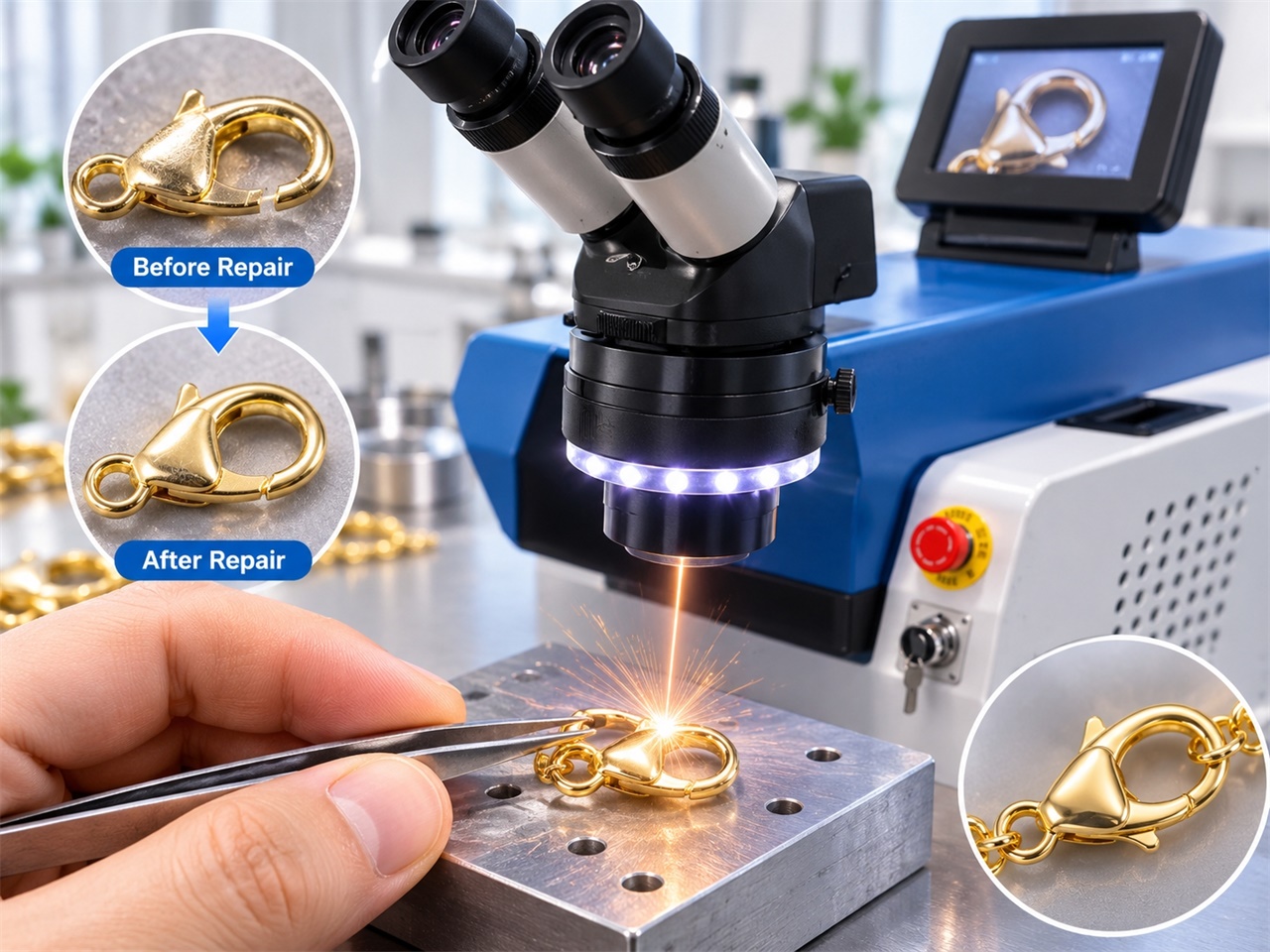
Yes, a broken lobster clasp can often be repaired with a jewelry laser welder, provided the damage is located on a weldable metal section and the internal spring mechanism is not damaged. For jewelry repair shops, a professional YAG jewelry laser welding machine offers precise heat control for repairing small gold components without unnecessarily heating the entire clasp. However, not every broken clasp should be welded. Understanding its internal structure is essential before starting the repair.
1. Understanding the Structure of a Lobster Clasp
A lobster clasp is a spring-loaded jewelry fastener commonly used on gold necklaces, bracelets, and chains. Its compact design makes it convenient, but repairing it can be more complicated than repairing a simple broken chain link.
A typical lobster clasp consists of several components:
- Main body: The outer metal housing that provides structural support.
- Moving gate: The small opening section that moves when the release lever is pressed.
- Internal spring: Provides the force needed to close the gate automatically.
- Hinge: Connects the moving gate to the main body.
- Attachment loop: Connects the clasp to the jewelry chain or jump ring.
Before deciding to use laser welding, identify exactly which component is damaged. A broken attachment loop is usually much easier to repair than a damaged spring or hinge mechanism.
2. Which Lobster Clasp Problems Can Be Repaired with Laser Welding?
Laser welding is suitable for certain structural defects in gold and other compatible metal clasps. The repair method depends on the damage location.
Broken Attachment Loop
This is one of the most straightforward repair situations. The small ring connecting the clasp to the chain may crack or separate after repeated pulling.
A jewelry laser welder can reconnect the broken metal ends or add compatible filler material when part of the metal is missing. The goal is to restore the attachment point without affecting the clasp’s opening mechanism.
Cracked Lobster Clasp Body
A crack in the outer housing may also be repairable when there is sufficient material around the damaged area.
The operator needs to inspect the crack, evaluate the remaining wall thickness, and determine whether the clasp can withstand welding and subsequent use.
Very thin or severely worn clasp bodies may not provide enough material for a reliable repair. Replacement is often a better option in these situations.
Damaged Hinge Connection
The hinge is a more challenging repair area because it is directly related to the movement of the gate.
If a small hinge attachment has separated from the body, laser welding may restore the connection. However, the operator must preserve the original hinge clearance and alignment.
Welding material must not enter the moving joint or prevent the gate from opening and closing properly.
Damaged Spring Mechanism
This is where laser welding has significant limitations.
The internal spring provides the return force that closes the lobster clasp. If the spring has broken, lost its elasticity, or become displaced, welding the outer housing will not solve the underlying problem.
Spring replacement or complete clasp replacement is generally more appropriate. Applying laser energy directly to a small spring can also change its mechanical properties or damage it.
3. Why Is Laser Welding Useful for Gold Lobster Clasp Repair?
Traditional torch soldering can be challenging when working with small lobster clasps because the body, hinge, spring, and other components are positioned very close together.
A pulsed jewelry laser welder offers several practical advantages.
Localized Heat Input
Laser energy can be concentrated on a small repair area. This helps reduce unnecessary heating of nearby components compared with heating the entire assembly using a torch.
Better Control over Small Welding Areas
Gold lobster clasps are often only a few millimeters in size. A microscope-assisted laser welding system helps the operator position the welding point accurately.
Less Unnecessary Finishing
When the joint is properly aligned and the laser parameters are suitable, the repaired area may require less grinding and polishing than a poorly controlled repair.
For more information about this technology, see our guide: Can You Laser Weld Gold Jewelry or Silver Jewelry?
4. How to Repair a Broken Gold Lobster Clasp with a Laser Welder
For a repairable structural break, the following workflow can help a professional jeweler achieve a more consistent result.
Step 1: Inspect the Clasp
Examine the clasp under magnification. Identify the broken section and check whether the spring, moving gate, and hinge are still functioning correctly.
Also determine whether the clasp is solid gold, gold-filled, gold-plated, or made from another metal. Plated and mixed-metal components require additional evaluation before welding.
Step 2: Clean the Repair Area
Remove dirt, oil, polishing compounds, and other surface contamination. A clean repair area improves welding consistency and makes it easier to inspect the joint.
Step 3: Protect the Moving Components
Make sure the spring and moving gate will not be exposed to unnecessary heat or accidental fusion. Where the construction allows, the internal mechanism should be safely isolated by a qualified jewelry technician before welding.
Check that the broken metal sections can be accessed without damaging the surrounding structure.
Step 4: Align the Broken Metal
Position the broken ends accurately using suitable jewelry repair tools. If material is missing, determine whether compatible gold filler wire is required.
Correct alignment is particularly important for attachment loops and hinge connections.
Step 5: Adjust the Laser Parameters
Laser energy, pulse duration, frequency, and spot diameter should be selected according to the gold alloy, metal thickness, and joint geometry.
For small clasp components, excessive energy can melt through thin sections or cause deformation. It is advisable to establish suitable settings using comparable test samples before repairing valuable jewelry.
Our detailed article Jewelry Laser Welding Parameters for Gold explains how to select suitable settings for different gold repair applications.
Step 6: Complete the Weld and Inspect the Joint
Apply controlled laser pulses to establish the metal connection. Avoid allowing molten material to enter the hinge or gate clearance.
After welding, inspect the joint under magnification. Confirm that there are no obvious cracks, excessive melting, or incomplete fusion.
Step 7: Test the Clasp Function
This step is essential. Operate the release lever several times and confirm that the gate opens smoothly and returns to its closed position.
Check the attachment loop and repaired body for structural integrity. Only after the clasp passes the appropriate mechanical inspection should final polishing and finishing be completed.
5. Laser Welding vs. Traditional Soldering for Lobster Clasp Repair
Both laser welding and traditional soldering have applications in jewelry repair. The better choice depends on the clasp construction and the location of the damage.
| Comparison | Laser Welding | Traditional Soldering |
|---|---|---|
| Heat concentration | Highly localized | Broader heating area |
| Small attachment loops | Very suitable | Requires careful heating |
| Thin gold sections | Good control with suitable settings | Higher risk of surrounding heat damage |
| Working near hinges | Possible with careful positioning | Requires additional heat protection |
| Internal spring repair | Generally not recommended | Spring replacement is usually preferable |
| Operator requirements | Laser welding skills | Traditional jewelry soldering skills |
Laser welding does not completely replace traditional jewelry soldering. However, it provides another useful option for repair shops handling delicate metal connections and small gold components.
For another practical example, read How to Repair Broken Gold Chains with a Laser Welder.
6. When Should You Replace a Broken Lobster Clasp Instead?
Not every broken clasp is worth repairing. In some situations, replacing the entire component provides a more reliable result.
Consider replacement when:
- The internal spring has lost its elasticity or broken.
- The moving gate is severely bent or deformed.
- The hinge structure is badly damaged.
- The clasp body is extremely thin from long-term wear.
- The metal is plated or made from an unsuitable mixed-metal construction.
- Previous repairs have weakened the surrounding material.
- The cost and time of repair exceed the value of a replacement clasp.
Jewelry repair professionals should prioritize the functional reliability of the clasp rather than simply making the broken area look attractive.
7. Choosing a Jewelry Laser Welder for Clasp Repair
For jewelry workshops that regularly handle gold chain repairs, lobster clasp repairs, ring joints, and other small components, a pulsed YAG jewelry laser welder is worth considering.
The Dowin YAG Desktop Jewelry Laser Welding Machine offers 150W and 200W configurations, microscope observation, and adjustable laser spot diameter. These features help operators handle different precision welding applications.
When evaluating a machine for clasp repair, pay particular attention to:
- Stable laser output for repeated small welds.
- Adjustable energy and pulse parameters.
- Suitable spot diameter for tiny metal components.
- Clear microscope observation.
- Reliable cooling and machine protection systems.
Do not select a machine based on wattage alone. The ability to control laser energy precisely is particularly important when repairing small jewelry components.
You can also explore the Dowin Jewelry Laser Welding Machine Collection to compare available configurations.
Frequently Asked Questions
Can you laser weld a gold lobster clasp?
Yes. A gold lobster clasp can often be laser welded when the damage is located on a suitable structural metal section, such as the outer body or attachment loop. The internal spring and moving mechanism must be protected.
Can you repair a lobster clasp without replacing it?
Yes, depending on the damage. A broken attachment loop or a small crack in the metal body may be repairable. A broken spring or severely damaged hinge usually requires component replacement or a new clasp.
Will laser welding damage the lobster clasp spring?
It can. Although laser welding concentrates heat in a small area, heat can still travel through the surrounding metal. Directly welding the spring is generally not recommended because excessive heating can change its mechanical properties.
Can a laser welder repair a broken gold chain clasp?
Yes. A jewelry laser welder can repair suitable broken connections between a gold chain and its clasp. The operator must evaluate the attachment loop, metal thickness, and clasp mechanism before welding.
Can you laser weld a gold-plated lobster clasp?
It depends on the base metal and plating construction. Laser welding may expose or damage the plating and may not produce a reliable joint between different metals. Solid gold or properly identified weldable gold-alloy components are generally more suitable candidates.
What laser power is suitable for jewelry clasp repair?
Both 150W and 200W pulsed YAG jewelry laser welders can be considered for suitable clasp repair applications. The actual result depends more on the selected pulse parameters, spot size, alloy, and material thickness than on rated power alone.
Conclusion
A broken lobster clasp does not always need to be replaced. When the damage is limited to a suitable metal section, precision laser welding can restore the connection while minimizing unnecessary heat exposure to surrounding components.
However, the internal spring, moving gate, and hinge must be carefully evaluated before repair. For jewelry repair shops, a pulsed YAG laser welder provides a useful solution for small gold components, chain connections, and delicate jewelry repairs.
Dowin offers jewelry laser welding machines for professional repair workshops and jewelry manufacturers. Contact our team to discuss your jewelry materials, repair applications, and suitable machine configuration.
Post time: Nov-26-2026
