
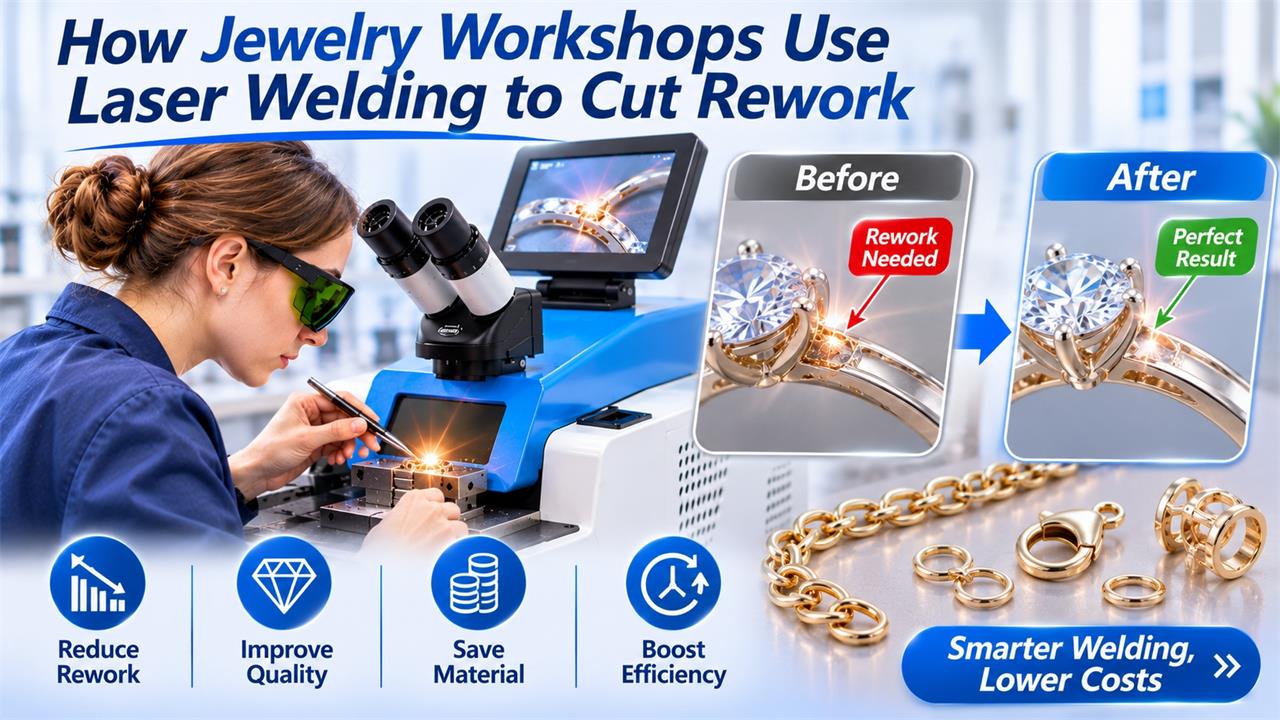
Rework is one of the hidden costs in jewelry manufacturing and repair. A poorly aligned joint, excessive solder, overheated metal, or damaged gemstone can turn a simple repair into several additional hours of work. For jewelry workshops handling gold, silver, platinum, and delicate components, improving first-time welding quality is essential for controlling production costs. This is one reason more professional jewelers are adopting laser welding technology. By concentrating energy on a small repair area and providing better control over the welding process, a jewelry laser welder can help reduce common welding defects and unnecessary finishing work. In this article, we explain how workshops can use the Dowin Jewelry Laser Welding Machine to improve repair consistency and reduce rework.
1. Why Does Rework Happen in Jewelry Workshops?
Rework occurs when a jewelry component does not meet the required quality standard after the initial manufacturing or repair operation. Sometimes the problem is immediately visible. In other cases, defects only appear during polishing, inspection, or final assembly.
Several common problems can increase rework in a jewelry workshop.
Excessive Heat During Soldering
Traditional torch soldering heats a relatively large area around the joint. When working with delicate jewelry, excessive heat can cause discoloration, deformation, or damage to nearby components.
The operator may then need to reshape the jewelry, remove additional material, polish the surface again, or repeat the repair.
Visible Solder Marks
Customers expect jewelry repairs to look natural. Excessive solder or poorly controlled solder placement can leave visible marks that require additional filing and polishing.
For high-value jewelry, even a small difference in surface appearance can result in additional finishing work or customer rejection.
Incomplete Welding or Weak Connections
A joint that is not properly fused may fail during inspection or subsequent handling.
In these cases, the operator must prepare the connection again and repeat the welding process. This wastes labor and can further damage thin metal components.
Gemstone and Component Damage
Heat-sensitive gemstones, delicate prongs, decorative details, and small mechanical components can be affected by unsuitable heating methods.
Repairing secondary damage can be more expensive than completing the original welding job.
Casting Defects Discovered During Finishing
Small pores, pinholes, pits, and incomplete metal sections sometimes become visible only after polishing.
These defects require additional repair before the jewelry can be delivered.
For a more detailed explanation, read Repairing Jewelry Casting Defects with a Laser Welder.
2. How Laser Welding Helps Reduce Jewelry Rework
Jewelry laser welding uses concentrated laser energy to melt and join metal at a selected location. Compared with conventional torch soldering, the energy can be concentrated into a much smaller working area.
This offers several potential advantages for workshop quality control.
More Precise Welding Locations
Laser welding allows operators to focus on a specific joint instead of heating a large surrounding area.
This is particularly useful for:
- Small chain connections.
- Thin ring bands.
- Delicate earring components.
- Fine prongs and gemstone settings.
- Small cracks and casting imperfections.
Accurate positioning helps reduce unwanted melting and improves control over the repair area.
Less Unnecessary Heat Exposure
A smaller heat-affected area can help reduce discoloration and deformation of surrounding metal.
This is valuable when repairing delicate gold and platinum jewelry, where unnecessary heating can create additional finishing requirements.
However, laser welding does not eliminate thermal damage risks. Incorrect pulse settings can still cause burn-through, cracking, or deformation.
More Controlled Material Addition
When a jewelry component has missing material, compatible filler wire can be added during laser welding.
Instead of applying excess solder over a large area, the operator can gradually rebuild the damaged section.
This is particularly useful for repairing small pores, missing edges, and worn prongs.
Reduced Finishing Work
A properly executed laser weld can produce a relatively small repair area with limited excess material.
This may reduce the amount of filing, grinding, and polishing required after welding.
For busy workshops, reducing unnecessary finishing operations can improve the number of jobs completed each day.
3. Five Common Jewelry Jobs Where Laser Welding Can Reduce Rework
The advantages of laser welding become easier to understand when looking at specific workshop applications.
1. Gold and Silver Chain Repairs
Fine chains contain small links that can easily melt or deform when excessive heat is applied.
Laser welding allows the operator to concentrate energy on the broken connection, helping preserve neighboring links and the original chain structure.
It is particularly useful for repairing delicate necklaces, bracelets, and small connecting loops.
2. Ring Resizing and Crack Repairs
Ring resizing requires cutting, adjusting, and reconnecting the metal band. If the joint is poorly aligned or excessive solder is applied, additional filing and polishing may be necessary.
Laser welding provides localized joining and can help create a more controlled connection.
For more complex ring repairs, it is important to inspect the material, thickness, and joint geometry before selecting the welding parameters.
3. Prong Rebuilding
Worn or damaged prongs can compromise gemstone security.
Laser welding can add compatible metal to rebuild suitable worn prongs, reducing the need to heat the entire jewelry setting.
For gemstone-mounted jewelry, the operator must assess the stone type, treatment, inclusions, and distance from the welding area. Some stones should be removed before repair.
4. Filling Casting Pores
Small pores and pinholes can become visible after polishing. If these defects are not corrected, the jewelry may fail the final appearance inspection.
Laser welding allows small quantities of compatible filler metal to be added directly to the defective area.
This can reduce unnecessary grinding and material removal compared with some conventional repair approaches.
5. Repairing Small Jewelry Components
Clasps, earring posts, jump rings, and decorative connectors often contain thin metal sections.
Laser welding provides a useful method for repairing suitable connections while minimizing unnecessary heating of nearby parts.
For workshops handling many small components, accurate positioning and repeatable parameter settings are especially important.
4. How to Improve First-Pass Welding Quality
Buying a laser welding machine does not automatically eliminate rework. The operator still needs a consistent working procedure.
Here are several practical methods for improving first-pass success.
Step 1: Identify the Metal Correctly
Before welding, determine whether the jewelry is made from gold, silver, platinum, or another metal alloy.
Different alloys have different melting and thermal characteristics. Using unsuitable settings may lead to incomplete fusion or excessive melting.
Step 2: Prepare the Joint
Remove oil, dirt, polishing compounds, and oxidation from the repair area using an appropriate cleaning procedure.
Make sure the two metal sections fit together properly before starting the welding process.
Poor joint preparation is a common reason for inconsistent welding results.
Step 3: Select Suitable Laser Parameters
Laser energy, pulse duration, frequency, and spot diameter should be adjusted according to the material thickness and joint design.
For thin jewelry components, excessive energy can cause burn-through. Insufficient energy may produce incomplete fusion.
Establish suitable settings through sample testing rather than copying the same parameters for every jewelry repair.
Step 4: Use Microscope Observation
A microscope allows operators to observe the exact repair location and position the laser accurately.
It is especially important when working on tiny chain links, prongs, and narrow metal connections.
Step 5: Inspect Before Finishing
After welding, inspect the connection before proceeding with polishing.
Check for:
- Incomplete fusion.
- Visible cracks or pores.
- Excessive weld material.
- Unwanted deformation.
- Incorrect alignment.
Identifying defects before polishing prevents additional labor from being spent finishing a repair that may need to be repeated.
5. Standardize Welding Parameters to Reduce Repeat Errors
One common source of rework in busy jewelry workshops is inconsistent machine operation between different employees.
For example, two operators may use different pulse energy or spot diameters when repairing identical gold chain components. The results may vary in weld appearance, penetration, and finishing requirements.
A parameter management system can help reduce this inconsistency.
Workshops should consider creating simple welding records that include:
- Metal type and alloy.
- Material thickness or wire diameter.
- Joint design and repair application.
- Laser energy and pulse duration.
- Pulse frequency and spot diameter.
- Filler wire type, when applicable.
- Inspection results after welding.
Once a reliable setting has been established through testing, it can become a reference for similar repair jobs.
This does not mean every component should use identical settings. Even jewelry made from the same alloy may require adjustments because of differences in geometry, previous repairs, and material condition.
6. How Much Can Rework Reduction Save a Jewelry Workshop?
To understand the business value of laser welding, workshop owners should calculate the total cost of rework rather than looking only at the cost of welding materials.
Rework may involve:
- Additional operator labor.
- Extra polishing and finishing time.
- Replacement gold or silver material.
- Additional inspection and testing.
- Delayed delivery and customer communication.
- Remaking or replacing damaged components.
Consider a simple example.
A workshop completes 200 repair or manufacturing jobs per month. If 10% require additional correction, that means 20 jobs need rework.
After standardizing its welding procedures and introducing suitable laser welding applications, suppose the workshop reduces its rework rate to 5%.
The number of jobs requiring rework would fall from 20 to 10 per month.
That represents 10 fewer rework cases each month.
This is an illustrative calculation, not a guaranteed result. Actual savings depend on the original defect rate, repair mix, operator experience, and the effectiveness of the new process.
To calculate your own results, use the following formulas:
Rework Rate = Number of Jobs Requiring Rework ÷ Total Completed Jobs × 100%
Monthly Rework Cost = Rework Labor + Additional Materials + Finishing + Replacement Costs
Compare the results before and after adopting laser welding to determine whether the equipment is creating measurable business value.
7. Why Laser Welding Is Especially Valuable for High-Value Jewelry
Rework becomes particularly expensive when a workshop handles custom jewelry, luxury pieces, and customer-owned gemstone-mounted products.
These items often contain expensive materials and intricate structures that cannot be easily replaced.
Traditional soldering may require additional disassembly, stone removal, or extensive surface finishing, depending on the repair.
Laser welding can help reduce some of these operations by concentrating heat on the intended repair location.
For example, jewelers may use laser welding for suitable:
- Diamond ring repairs.
- Platinum prong rebuilding.
- Custom gold jewelry assembly.
- Antique jewelry restoration.
- Delicate decorative structures.
The approach is particularly useful when preserving the original appearance is important.
Explore Jewelry Laser Welding for Custom and Luxury Pieces to understand how precision welding supports high-end jewelry manufacturing and repair.
8. Does Laser Welding Improve Overall Workshop Productivity?
Reducing rework is only one part of improving workshop productivity.
When fewer repairs need correction, operators spend less time repeating the same operations and can focus on new production tasks.
Other potential benefits include:
- More consistent repair quality.
- Less unnecessary material removal.
- Reduced polishing and correction work.
- Better scheduling and delivery control.
- Greater capacity for delicate repair jobs.
However, productivity also depends on workflow organization, employee training, machine availability, and the complexity of each order.
For a broader look at this topic, read How Jewelry Laser Welding Machines Increase Workshop Productivity.
Jewelry manufacturers combining laser welding with other precision processing methods can also improve assembly flexibility. Learn more in Jewelry Laser Welding Machines for Engraving and Joining.
9. Choosing a Jewelry Laser Welder for Better Quality Control
If your workshop regularly experiences welding defects, excessive finishing, or inconsistent repair quality, equipment selection should focus on precision and repeatability.
Important features to evaluate include:
Stable Laser Output
Consistent pulse output is important for producing repeatable welds across different repair jobs.
Adjustable Welding Parameters
Flexible pulse energy, duration, frequency, and spot diameter allow operators to adapt the process to different metal thicknesses and joint designs.
Microscope and CCD Observation
Clear observation helps operators locate the exact repair area and monitor the welding process.
Suitable Cooling System
A stable cooling configuration helps the laser system operate according to its designed working conditions.
Training and Technical Support
Even advanced equipment requires trained operators. Access to operating instructions, sample testing, parameter guidance, and after-sales support can help workshops establish a more consistent process.
For smaller businesses evaluating equipment investment, read Affordable Jewelry Laser Welding Machines for Small Workshops.
10. Frequently Asked Questions
Can laser welding completely eliminate rework in jewelry manufacturing?
No. Laser welding can help reduce certain welding defects, but it cannot eliminate every source of rework. Poor casting quality, incorrect material identification, unsuitable parameters, and operator mistakes can still cause problems.
Does laser welding reduce polishing time?
It can. A properly controlled localized weld may leave less excess material and cause less surrounding discoloration than some conventional repair methods. However, the actual finishing time depends on the joint design and final surface requirements.
Can laser welding reduce gold and silver material waste?
For suitable localized repairs, laser welding can help minimize unnecessary melting and material removal. When filler wire is required, operators can add compatible material in controlled amounts rather than applying excessive solder.
Is laser welding suitable for small jewelry workshops?
Yes. Dedicated desktop jewelry laser welders can support many applications in small repair shops and manufacturing studios. The investment should be evaluated against repair volume, common defects, and expected operating costs.
Does laser welding produce stronger jewelry joints?
Joint strength depends on material compatibility, penetration, joint preparation, and welding parameters. Laser welding can produce reliable connections when properly configured, but the results should be inspected and tested according to the application.
Can beginners operate a jewelry laser welding machine?
Yes, trained beginners can learn routine operation. However, understanding material properties, parameter adjustment, microscope positioning, and laser safety is essential before handling customer jewelry independently.
Conclusion
Rework costs jewelry workshops time, materials, and production capacity. Many common problems, including excessive heat damage, incomplete joints, visible weld marks, and unnecessary finishing, can be reduced through better welding processes.
Jewelry laser welding offers more localized energy delivery, accurate positioning, and controlled material addition. When combined with proper joint preparation, standardized parameters, and consistent inspection, it can help workshops improve first-pass quality and reduce repeated repair work.
For jewelry manufacturers and repair businesses looking to improve quality control, a dedicated laser welding machine can be a valuable addition to the workshop. Explore the Dowin Jewelry Laser Welding Machine Collection to compare available models and find a solution for your jewelry welding applications.
“`
Post time: Nov-25-2026
