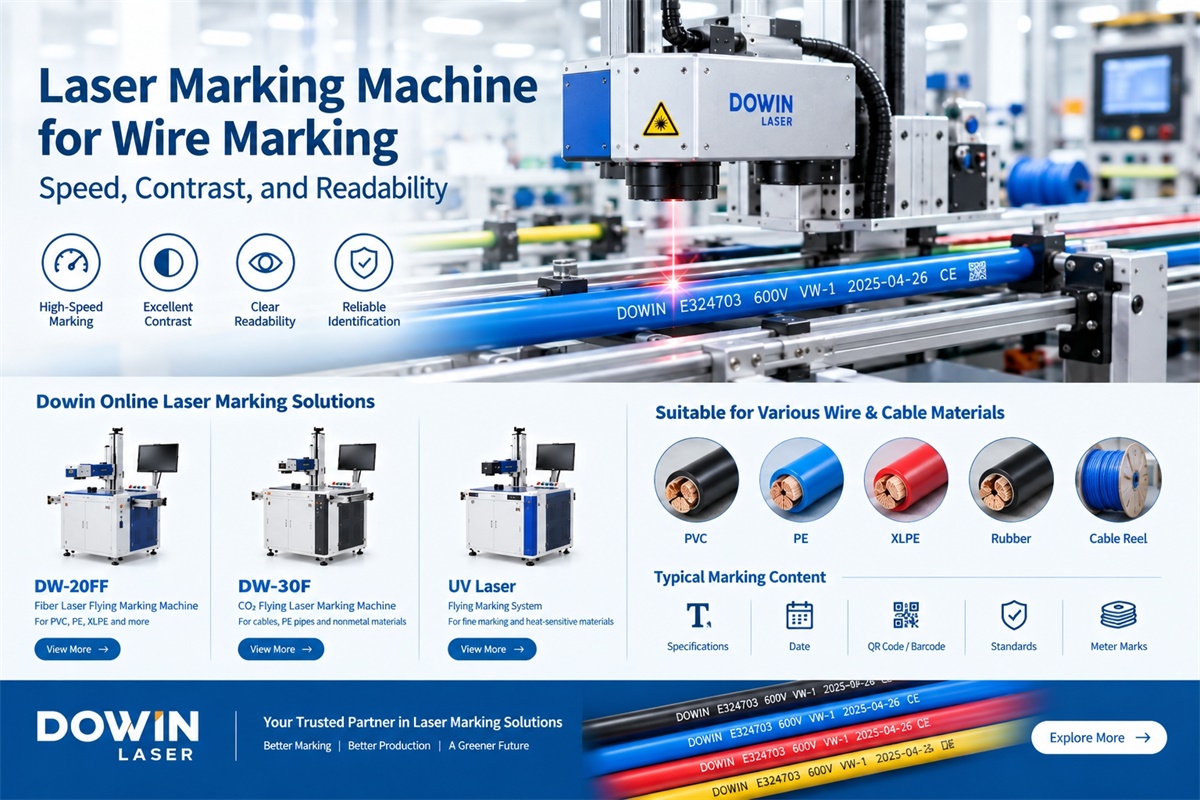
In wire and cable manufacturing, marking quality directly affects product identification, traceability, and production efficiency. Manufacturers need to print cable specifications, voltage ratings, company logos, production dates, and meter markings clearly on insulation surfaces.
However, wire marking presents several challenges. Production lines run continuously, cable diameters can be small, and different insulation materials produce different marking results. A mark that looks clear on a stationary sample may become difficult to read when production speed increases.
A laser marking machine for wire marking can address these challenges through high-speed scanning and automatic production-line synchronization. The key is finding the right balance between marking speed, contrast, and readability.
Dowin provides flying laser marking solutions for wire and cable manufacturers. Explore the Dowin laser marking machine collection for available configurations.
1. Why Speed Matters in Wire Laser Marking
Wire extrusion lines often operate continuously for long production runs. The marking system must keep pace with the moving wire without interrupting manufacturing.
A conventional stationary laser marking machine is not suitable for this type of application unless the production process stops or the wire is otherwise positioned for marking.
A flying laser marking machine solves this problem by marking the wire while it moves.
The system typically includes:
-
A laser source for generating the marking beam
-
A galvanometer scanner for high-speed beam movement
-
An encoder for measuring production-line speed
-
A sensor for detecting the wire or marking position
-
Flying marking software for synchronization
Dowin’s wire and cable flying laser marking solution uses encoder and detector integration to coordinate laser marking with production-line movement.
An important point: Maximum scanner speed is not the same as actual production capacity. The complete marking content, character size, cable speed, and required spacing determine whether the system can maintain readable results.
2. How to Achieve High Contrast on Different Wire Materials
Contrast is one of the most important factors in cable identification. If the printed information cannot be distinguished from the insulation surface, even a permanent mark has limited practical value.
Different cable materials respond differently to laser wavelengths.
PVC Wire and Cable
PVC is commonly used for electrical wires, power cables, and industrial cables.
Dowin’s wire and cable marking solution identifies 1064 nm fiber laser marking as an option for PVC and PPR materials, including a 50W fiber laser configuration.
The DW-20FF Fiber Laser Flying Marking Machine is a relevant option to evaluate.
PE and Other Polymer Insulation
PE and other polymer materials may require different laser parameters or wavelengths to achieve sufficient contrast.
CO2 lasers can be evaluated for compatible nonmetallic cable insulation. Dowin’s CO2 Flying Laser Marking Machine is designed for applications including cables and PE pipes.
Heat-Sensitive Cable Materials
Some cable insulation materials require careful control of thermal impact.
A UV laser operating at 355 nm can produce fine markings with limited thermal damage on compatible materials.
Dowin’s UV Laser Marking Machine range provides another option to evaluate. For suitable cable materials, Dowin also describes 5W and 10W UV flying configurations in its wire and cable marking solution.
The final choice should always be based on actual cable samples. Cable color, additives, surface composition, and required marking contrast can significantly influence the result.
3. Readability: More Than Just Making a Mark
A successful wire marking system must produce information that remains easy to identify throughout the production process and the product’s service life.
Several factors influence readability.
Character height: Cable diameters are often small, limiting the available marking area. Character height must be selected according to the cable diameter and viewing requirements.
Line spacing: Repeated specifications and meter markings should have consistent spacing to avoid overlapping or crowded information.
Marking contrast: The marking must be visually distinguishable from the cable insulation, especially on dark or colored surfaces.
Marking consistency: Variations in cable movement, laser focus, and parameter settings can cause differences between individual markings.
Code quality: If barcodes or QR codes are required, test their scanning performance rather than relying only on visual appearance.
For manufacturers producing several cable sizes, it is also important to test the smallest diameter. A marking layout that works on a large power cable may not remain readable on a thin electrical wire.
4. Fiber, CO2, or UV: Which Laser Should You Choose?
| Laser type | Main advantage | Application consideration |
|---|---|---|
| Fiber laser | Efficient marking on compatible materials | Suitable for tested PVC/PPR and other responsive formulations |
| CO2 laser | Versatile for nonmetal materials | Evaluate on compatible cable insulation |
| UV laser | Fine marking with limited thermal impact | Suitable for compatible heat-sensitive materials |
For wire marking, the laser source should not be selected simply because it has higher power or a faster scanner.
Dowin’s wire and cable marking experience provides a practical starting point:
-
Fiber laser: 1064 nm, with a 50W configuration recommended for PVC/PPR applications.
-
UV laser: 355 nm, with 5W and 10W flying configurations available for compatible materials.
-
CO2 laser: An alternative for suitable nonmetallic insulation materials.
Sample testing should establish the best balance between contrast, processing speed, and surface quality.
5. Dowin Laser Marking Machines for Wire Manufacturers
For manufacturers looking to upgrade from inkjet printing to online laser marking, I recommend evaluating the following Dowin solutions.
DW-20FF Fiber Laser Flying Marking Machine
This is one of the most relevant products for wire and cable marking.
Available laser power configurations include 20W, 30W, 50W, and 100W. The machine also supports different working areas, from 110 × 110 mm to 300 × 300 mm.
Listed technical specifications include:
-
Wavelength: 1064 nm
-
Maximum marking speed: 10,000 mm/s
-
Minimum character size: 0.15 mm
-
Minimum line width: 0.01 mm
-
Repeated positioning accuracy: ±0.01 mm
-
Air cooling
These are equipment specifications, not guaranteed production-line results. Actual marking performance depends on the cable material and marking pattern.
Dowin CO2 Flying Laser Marking Machine
View CO2 Flying Laser Marking Machine
This system is designed for continuous marking applications involving cables, PE pipes, and other compatible products.
Its sensor and encoder integration allows the marking software to adjust to production-line movement.
It is worth considering when the cable insulation responds better to CO2 laser marking than to fiber laser processing.
Dowin UV Flying Laser Marking Solution
Explore Dowin UV Laser Marking Machines
For applications requiring fine characters or reduced thermal impact, UV marking is another option.
Dowin’s wire and cable marking solution describes 5W and 10W UV flying configurations with high-speed scanning systems. The appropriate configuration depends on the material and required line speed.
For customized requirements, visit the Dowin wire and cable marking solution page.
6. How to Test Wire Marking Quality Before Purchasing
Before investing in an online laser marking machine, manufacturers should conduct a practical sample test.
I recommend checking five things:
-
Contrast: Is the marking clearly visible against the original insulation color?
-
Speed: Can the machine maintain the required quality at maximum production-line speed?
-
Character size: Are small specifications and meter numbers still readable?
-
Consistency: Does the marking remain uniform throughout continuous operation?
-
Durability: Does the marking remain readable after appropriate abrasion and environmental testing?
For barcode and QR code applications, perform actual scanning tests using the intended scanning equipment.
A proper test should use the customer’s real wire material, production speed, and complete marking content. This is much more useful than evaluating a demonstration mark on an unrelated sample.
Frequently Asked Questions
What is the best laser marking machine for wire marking?
The best machine depends on the insulation material and required marking result. Dowin’s DW-20FF fiber flying laser marking machine is a relevant option for compatible PVC and other responsive cable materials. UV and CO2 systems should also be evaluated where appropriate.
How fast can a flying laser marking machine mark wire?
The DW-20FF lists a maximum marking speed of 10,000 mm/s. Actual cable production speed depends on character size, marking content, cable movement, and the required spacing.
Can a laser marking machine print meter numbers on cables?
Yes. A properly configured flying laser marking system can print repeated meter markings, production dates, specifications, and batch numbers. Encoder synchronization helps maintain consistent marking intervals.
Is laser marking more durable than inkjet printing?
Laser marking can produce durable identification without relying on ink adhesion. However, durability depends on the cable material and marking process. Abrasion and environmental testing should be performed for demanding applications.
Can one machine mark different cable materials?
A customized system may handle multiple cable materials, but the laser source and parameters may need to change. Test each material and color before confirming the final configuration.
Conclusion
In wire manufacturing, high-speed marking alone is not enough. A successful laser marking solution must maintain sufficient contrast, readable characters, and consistent spacing while following the production line.
Dowin’s DW-20FF fiber flying marking machine, CO2 flying marking system, and UV flying marking solutions provide different options for cable manufacturers.
If you are planning to replace inkjet printing or upgrade your existing cable marking line, send Dowin your cable material, insulation color, production speed, and marking requirements. We can help evaluate the appropriate laser source and configuration.
Explore the Dowin Laser Marking Machine Collection for more industrial marking solutions.
Post time: Oct-30-2026
