
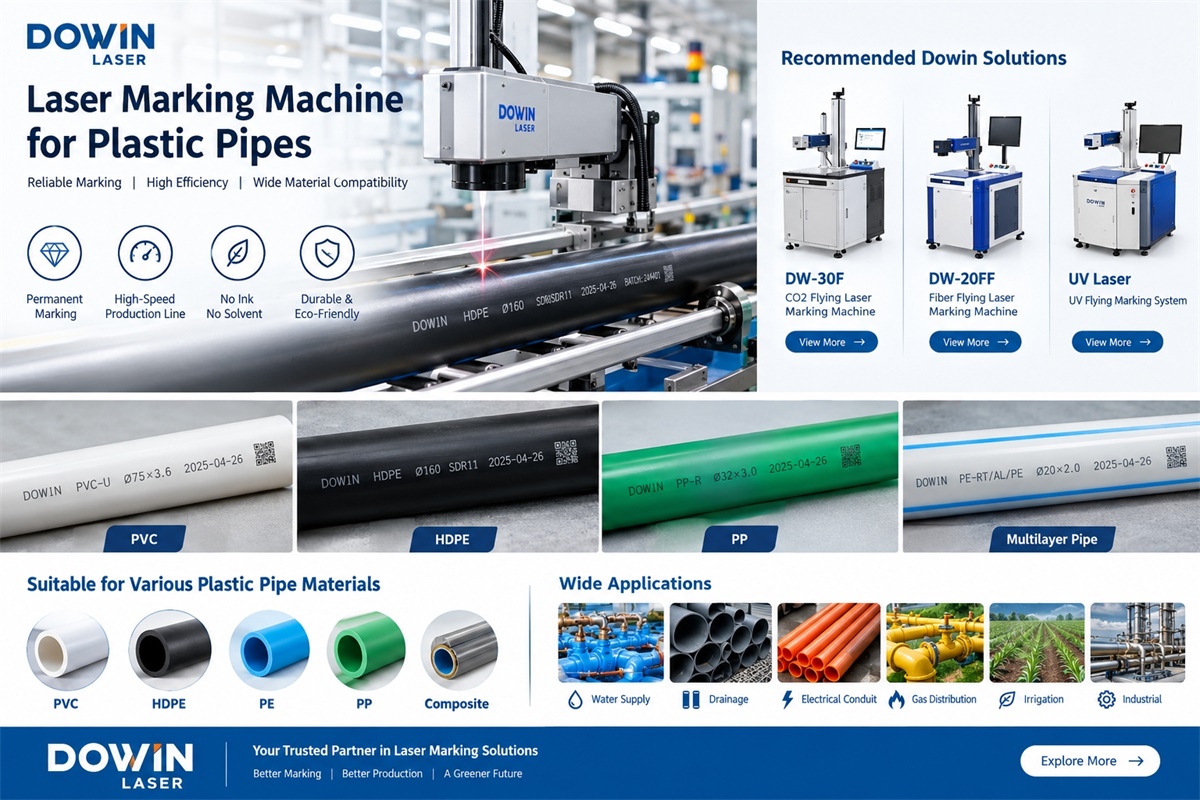
Plastic pipes are widely used in water supply, drainage, electrical conduit, gas distribution, irrigation, and industrial fluid transport. Manufacturers need to print product specifications, pipe dimensions, production dates, batch numbers, certification information, and company logos directly onto pipe surfaces.
A laser marking machine for plastic pipes offers a way to produce permanent, consistent identification without the ink and solvents used in conventional printing methods. However, not every plastic responds to the same laser wavelength in the same way. The best machine for a PVC pipe may not be the best choice for a PE, PP, or multilayer plastic pipe.
For manufacturers planning to automate pipe identification, the key is to match the laser source to the material and integrate the marking system with the extrusion line.
Dowin provides several laser marking options for industrial production. Explore the Dowin laser marking machine collection to compare fiber, CO2, UV, and customized laser marking systems.
1. Why Laser Marking Is Used for Plastic Pipes
Plastic pipe marking is more than a branding requirement. In many applications, the printed information helps installers, distributors, inspectors, and end users identify the correct product.
Typical marking information includes:
-
Manufacturer name, logo, and product series
-
Pipe diameter, wall thickness, and pressure rating
-
Material type, such as PVC, HDPE, PE, or PP
-
Production date, shift number, and batch code
-
Standard or certification reference
-
Barcode, QR code, or other traceability information
For an extrusion manufacturer, marking must remain consistent throughout a long production run. The system also needs to accommodate continuous pipe movement without slowing down the extrusion process.
Compared with inkjet printing, laser marking can eliminate routine ink and solvent consumption. It can also reduce the maintenance associated with conventional consumable-based printing, although actual maintenance requirements depend on the laser source and production environment.
The main consideration is that laser marking is not equally effective on every plastic. Material testing is essential before choosing a machine.
2. Which Plastic Pipe Materials Can Be Laser Marked?
Different polymers have different optical and thermal properties. Additives, pigments, surface treatments, and the natural color of the pipe can also change the marking result.
PVC Pipes
PVC pipes are commonly used in drainage, water supply, electrical conduit, and industrial applications.
A CO2 or UV laser may be suitable for certain PVC formulations, depending on the desired contrast and surface response. A fiber laser can also be evaluated for specific formulations, but it should not be assumed to work well on every PVC pipe.
Before selecting a machine, check whether the pipe contains laser-responsive additives and whether the laser can produce a readable mark without excessive melting, discoloration, or surface damage.
Recommended approach: Test the actual PVC formulation using the intended production speed and marking content. UV marking is worth evaluating when fine characters or a controlled marking process are important.
HDPE and PE Pipes
High-density polyethylene (HDPE) and other polyethylene pipes are widely used in water distribution, gas infrastructure, irrigation, and cable protection.
PE can be difficult to mark with some laser configurations because its response depends heavily on pigmentation and additives. A standard laser may produce insufficient contrast on an untreated or naturally colored surface.
For continuous production, a flying laser marking system is particularly useful because it can mark pipes while they move along the extrusion line.
Dowin offers the DW-20FF fiber laser flying marking machine, a system specifically presented for HDPE, PVC, plastic pipes, cables, and aluminum profiles. Its listed configurations include 20W, 30W, 50W, and 100W fiber laser options.
However, the presence of HDPE or PVC in the application description does not guarantee a satisfactory result on every formulation. Request a sample test before finalizing the laser source and power.
PP Pipes
Polypropylene (PP) pipes are used in plumbing, chemical handling, industrial fluid systems, and other applications.
PP is another material for which marking results depend on the exact formulation. Some pigmented or laser-modified grades can produce clear marks, while untreated surfaces may offer insufficient contrast.
UV lasers are worth considering when a fine mark is required with limited thermal impact. Fiber laser marking may also be evaluated for suitable formulations.
The correct choice should be based on the readability of the final marking, not simply on the material name.
Multilayer and Composite Plastic Pipes
Some pipes combine several polymer layers or incorporate reinforcing materials. Their surface layer may behave differently from the inner layers.
Testing should establish whether the laser affects only the outer surface or creates unwanted discoloration, deformation, or damage. If the pipe has a functional barrier layer or a strict surface-integrity requirement, marking depth and heat input deserve particular attention.
For these products, evaluate the actual finished pipe rather than a generic plastic sample.
3. CO2 vs. Fiber vs. UV Laser Marking for Plastic Pipes
The three main laser categories differ in wavelength and interaction with materials. Their suitability for pipe marking depends on the specific polymer formulation and the production requirements.
CO2 Laser Marking Machine
CO2 lasers operate at a much longer wavelength than fiber and UV lasers. They are widely used for marking and processing various nonmetallic materials, including selected plastics.
For pipe manufacturers, a CO2 flying system is worth considering when the material responds well to the laser and the required marking consists of production dates, batch numbers, logos, or similar information.
Dowin’s CO2 laser marking machine range includes flying marking equipment. The DW-30F CO2 flying laser marking machine is presented for plastic bottles, PE pipes, cables, and other moving production-line applications.
Best suited to: Pipe manufacturers whose specific plastic formulation produces the required marking quality with a CO2 laser.
Fiber Laser Marking Machine
Fiber lasers typically operate at a wavelength of approximately 1064 nm. They are particularly effective for metals, but certain plastics and additive-containing materials can also be marked.
Dowin’s DW-20FF fiber laser flying marking machine is a relevant option for manufacturers evaluating laser marking on plastic pipes, cables, and aluminum profiles.
The product page lists optional laser power from 20W to 100W, an optional marking field from 110 × 110 mm to 300 × 300 mm, and marking speeds of up to 10,000 mm/s. These specifications describe the equipment’s listed capabilities; actual production throughput depends on the marking content, material response, and line speed.
Best suited to: Applications where the pipe formulation responds well to fiber laser marking, particularly when the same system may also need to mark metal components or other compatible materials.
UV Laser Marking Machine
UV lasers commonly operate at 355 nm. Their shorter wavelength can produce fine, high-contrast marks on selected plastics with limited thermal impact compared with some other laser processes.
For manufacturers marking small characters, dense identification information, or materials that are sensitive to heat, UV is an important option to evaluate.
Dowin offers UV laser marking machines and UV laser marking machines with an all-in-one design. For continuous manufacturing, a UV flying configuration may be more appropriate than a standard stationary workstation.
Best suited to: Compatible plastic formulations that require fine detail, controlled heat input, or a marking result that other laser sources cannot achieve satisfactorily.
Which Laser Should You Choose?
| Requirement | Laser option to evaluate |
|---|---|
| Plastic pipe marking on a continuous extrusion line | Flying CO2, fiber, or UV system |
| PE or HDPE pipe identification | Test the DW-20FF fiber system and suitable alternatives |
| Fine characters on heat-sensitive plastic | UV laser marking |
| Plastic pipe marking with date and batch information | CO2 or another compatible flying laser |
| A single system for different pipe formulations | Test each material and select the appropriate source |
| High-speed production with changing line speeds | Flying system with suitable encoder and control integration |
The table is a starting point rather than a universal material-to-laser rule. Always confirm the marking result using the actual pipe material.
4. Why Flying Laser Marking Matters on Pipe Extrusion Lines
In continuous pipe manufacturing, the pipe moves through the production line immediately after extrusion. Stopping the line for every marking operation would reduce productivity.
A flying laser marking machine is designed to mark products while they are moving. Depending on the system configuration, a sensor detects the product and an encoder measures movement so the marking software can coordinate the laser with the production speed.
This arrangement is useful for:
-
Printing continuous product specifications along a pipe
-
Adding production dates and batch information
-
Marking company logos and identification codes
-
Supporting automatic marking during long extrusion runs
-
Reducing the need for manual handling at a separate marking station
Dowin’s DW-30F CO2 flying laser marking machine is described as a production-line solution using sensors and an encoder. The DW-20FF fiber flying laser marking machine also lists an encoder and sensor system for adjusting marking according to conveyor movement.
For a pipe extrusion line, the machine must be configured around the actual production process. Pipe speed, diameter, laser-head position, marking direction, character size, and the length of the repeated marking pattern all influence the result.
Before ordering, confirm whether the system can maintain the required character spacing and readability at the maximum production speed, including normal speed fluctuations.
5. How to Choose a Laser Marking Machine for Plastic Pipes
Choosing a machine based only on laser power or a product photograph is risky. A reliable selection process should address five practical questions.
Step 1: Identify the Exact Pipe Material
Provide the manufacturer with the polymer type, color, additives if known, and a physical sample.
For example, black HDPE, white PVC, and natural PP may respond differently even when the same laser source is used.
Step 2: Define the Required Marking Content
A short production date requires a different processing time from a long specification line containing a logo, multiple dimensions, and a QR code.
Prepare the exact text, logo, code format, character height, and required marking interval. This makes it possible to test the real application rather than an easier demonstration pattern.
Step 3: Measure the Production Speed
Determine the normal and maximum pipe speed in meters per minute. Also identify whether the line runs continuously or includes frequent speed changes.
A supplier should evaluate whether the required marking can be completed within the available time. Maximum scanner speed alone does not establish the achievable production rate.
Step 4: Confirm Marking Quality and Durability
Inspect the sample for contrast, edge definition, readability, and consistency. If the pipe will be exposed to sunlight, abrasion, moisture, chemicals, or outdoor service, conduct appropriate durability tests.
For pipe products carrying regulated identification or certification information, verify that the marking method meets the relevant industry and local requirements.
Step 5: Check Production-Line Integration
Confirm the encoder, sensor, control interface, mounting bracket, safety enclosure, and extraction requirements where applicable.
The final installation must suit the pipe diameter and available working space. If multiple pipe sizes or materials are processed on the same line, clarify what adjustments or recipes are required when changing products.
6. Recommended Dowin Laser Marking Solutions
Dowin’s product range includes several configurations worth evaluating for plastic pipe manufacturing. The best recommendation depends on the material test and line requirements.
Option 1: DW-30F CO2 Flying Laser Marking Machine
Product: DW-30F CO2 Flying Laser Marking Machine
This option is worth considering for manufacturers looking to mark compatible plastic pipes directly on a moving production line.
The product page identifies applications including PE pipes, cables, plastic bottles, and packaging. Its flying configuration is designed for automatic marking, including production dates, batch numbers, barcodes, QR codes, and logos.
Choose this option when the material test confirms a satisfactory CO2 marking result and the machine can meet the required production speed.
Option 2: DW-20FF Fiber Laser Flying Marking Machine
Product: DW-20FF Fiber Laser Flying Marking Machine
This model is specifically presented for HDPE and PVC plastic pipes, cables, and aluminum profiles. Its optional fiber laser configurations and encoder-based production-line integration make it a relevant candidate for industrial marking projects.
Before selecting the laser power, test the actual pipe color and formulation. Confirm the required contrast, marking depth if applicable, and throughput at the intended line speed.
Option 3: Dowin UV Laser Marking System
Products: Dowin UV Laser Marking Machine | Dowin UV Laser Marking Machine All-in-One
UV is worth evaluating when the pipe material requires finer marking or a more controlled thermal process. If the application involves a continuous extrusion line, ask Dowin about a suitable flying UV configuration rather than assuming that a standard desktop system is ready for inline operation.
The UV source should be selected only after confirming the marking contrast and speed on the intended pipe.
Which Dowin Model Is the Best Fit?
For a manufacturer producing PE or HDPE pipes continuously, I would start by comparing the DW-20FF fiber system with the DW-30F CO2 flying system. I would then include UV testing if the first two options fail to meet the contrast, detail, or material-integrity requirements.
This approach avoids choosing a machine based on the polymer name alone. It also gives the manufacturer a practical comparison of marking quality, line speed, and operating requirements before making a purchase.
To explore the complete product range, visit the Dowin laser marking machine catalog.
7. Common Problems in Plastic Pipe Laser Marking
The Mark Is Too Light
Possible causes include an unsuitable wavelength, insufficient material response, incorrect parameters, or a pipe surface that is difficult to mark.
Test the material with different appropriate laser sources and parameter settings before increasing power without a clear reason.
The Pipe Surface Melts or Discolors
Excessive heat input or an unsuitable parameter combination can damage the surface. Reduce the thermal impact through appropriate parameter adjustment or evaluate another laser wavelength.
The Marking Is Unreadable at High Speed
Long text, small characters, dense codes, and excessive line speed can reduce readability. Simplify the marking where possible and test the complete marking pattern at the maximum intended speed.
The Marking Position Changes Along the Pipe
Incorrect encoder settings, unstable pipe movement, or an unsuitable installation position can affect synchronization. Check the encoder, sensor, mounting arrangement, and production-line control settings.
The Mark Fades During Service
A mark that looks good immediately after processing may not remain readable under abrasion, weather exposure, or chemical contact. Test durability under the conditions the finished pipe will actually experience.
8. Frequently Asked Questions
Can a laser marking machine print on HDPE pipes?
Yes, certain HDPE formulations can be laser marked. The result depends on the material’s additives, pigmentation, laser wavelength, and processing parameters. Dowin’s DW-20FF is presented for HDPE and plastic pipe marking, but a sample test should confirm the result for your specific material.
Which laser is best for PVC pipe marking?
There is no universal answer. CO2, UV, and fiber lasers can be evaluated for compatible PVC formulations. Select the source that produces the required contrast and readability without unacceptable surface damage.
Can a laser mark pipes while they are moving?
Yes. A flying laser marking system can mark compatible products while they move along a production line. Encoder and sensor integration help synchronize the marking with line movement.
Can laser marking replace inkjet printing on plastic pipes?
For suitable materials and applications, laser marking can replace inkjet printing and reduce the need for printing consumables. However, the decision depends on material compatibility, marking quality, line speed, regulatory requirements, and initial equipment cost.
Does a higher-power laser always mark plastic pipes faster?
No. Higher power does not guarantee better contrast or higher production throughput. The wavelength, material response, marking pattern, scan settings, and line speed all influence the result.
What information should I provide when requesting a quotation?
Provide the pipe material, color, diameter, production speed, required marking content, marking interval, and any relevant durability or compliance requirements. Sample pipes and a representative marking design are especially useful for evaluating the correct machine.
Conclusion
Selecting a laser marking machine for plastic pipes requires more than matching a machine to a material name. PVC, HDPE, PE, PP, and composite pipes can respond differently depending on their formulations and surface characteristics.
For continuous pipe extrusion, a flying laser marking system can integrate product identification into the production process. Dowin’s DW-30F CO2 and DW-20FF fiber flying marking machines are two relevant options to evaluate, while UV marking provides another route for applications that require finer detail or a more controlled thermal process.
The most reliable next step is to test your actual pipe material and marking content at the intended production speed. This allows the manufacturer to compare marking quality and throughput before selecting the final configuration.
Explore the Dowin laser marking machine collection or contact Dowin with your pipe specifications to discuss a suitable laser marking solution.
Post time: Oct-29-2026
