
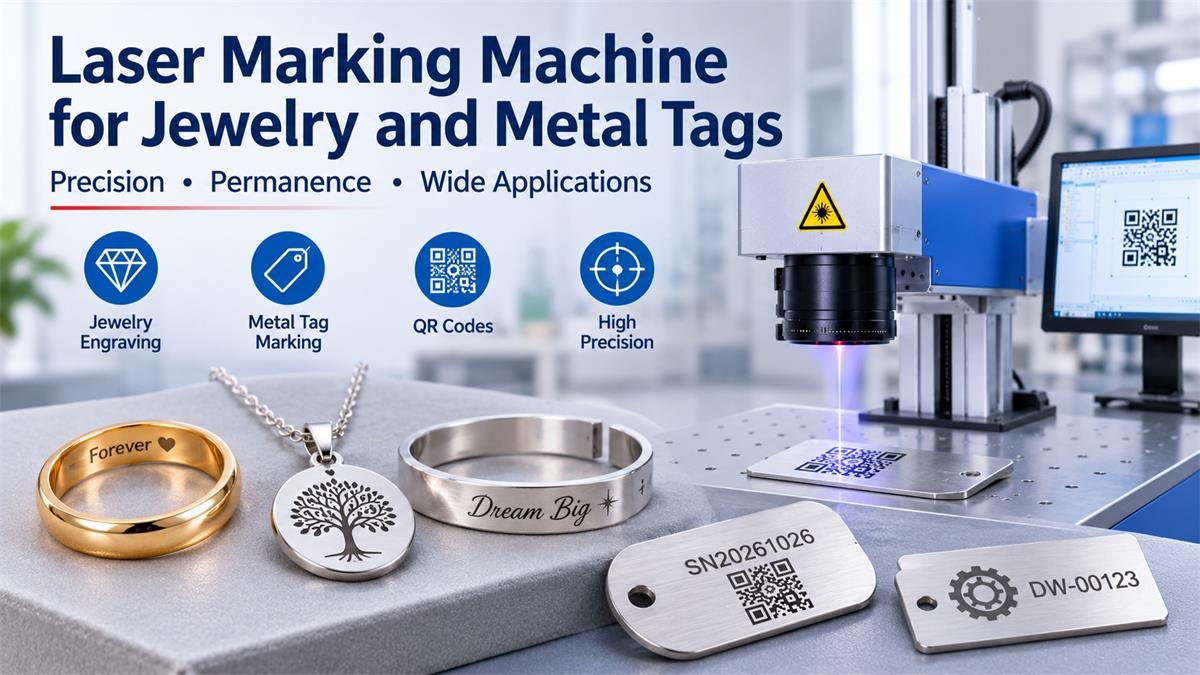
Laser marking machines are widely used in jewelry manufacturing and metal tag production. From engraving names and patterns on gold and silver jewelry to marking serial numbers, QR codes, and logos on stainless steel identification plates, laser technology provides a flexible solution for permanent metal identification and customization.
However, jewelry engraving and metal tag marking have different processing requirements. Jewelry manufacturers often prioritize fine details, small characters, decorative patterns, and curved-surface marking. Metal tag manufacturers are more concerned with marking speed, batch processing, readability, and consistent identification.
For most applications involving gold, silver, stainless steel, brass, and aluminum, a fiber laser marking machine is a practical choice. The appropriate configuration depends on the material, product dimensions, marking depth, and daily production volume.
This guide explains how to select a suitable laser marking machine for both applications and which configurations are worth considering.
1. Laser Marking Applications in Jewelry Manufacturing
Jewelry engraving is not limited to adding a company logo. Modern jewelry businesses use laser marking to provide personalization, product identification, and decorative finishing.
Common applications include:
-
Wedding rings and engagement rings.
-
Gold and silver bracelets.
-
Necklaces and pendants.
-
Stainless steel jewelry.
-
Jewelry nameplates.
-
Personalized gifts.
-
Jewelry logos and brand identification.
-
Serial numbers and custom text.
Engraving Names and Personalized Messages
Personalized engraving is one of the most common jewelry marking applications.
A laser marking machine can engrave names, dates, initials, and short messages on rings, pendants, bracelets, and other metal products.
The challenge is that jewelry often has very limited marking space. Small characters must remain clear and properly positioned.
For this application, buyers should pay attention to the minimum character size, laser spot quality, positioning accuracy, and fixture stability.
Engraving Logos and Decorative Patterns
Jewelry manufacturers also use laser marking to create company logos, decorative lines, geometric patterns, and customized graphics.
A fiber laser marking machine supports digital artwork and can reproduce different designs without requiring a new physical engraving tool for every order.
For businesses offering customized jewelry, this flexibility can reduce setup work and make short-run production more practical.
Marking Gold and Silver Jewelry
Fiber laser technology can mark gold and silver, including suitable precious metal alloys.
However, different alloys and surface finishes may produce different marking results.
For example, a polished gold ring and a brushed stainless steel bracelet may require different processing parameters.
Before purchasing equipment, manufacturers should test their actual jewelry materials to evaluate marking contrast, surface appearance, and engraving depth.
2. Laser Marking Applications for Metal Tags
Metal tags are used across industrial manufacturing, electrical equipment, machinery, automotive production, and asset management.
Unlike jewelry, metal tags usually focus on identification and traceability rather than decorative engraving.
Common applications include:
-
Stainless steel nameplates.
-
Aluminum equipment labels.
-
Brass identification plates.
-
Industrial asset tags.
-
Electrical identification tags.
-
Serial number plates.
-
QR code and Data Matrix tags.
-
Product specification plates.
-
Machinery identification labels.
Stainless Steel Tags
Stainless steel tags are widely used in industrial environments because of their durability and corrosion resistance.
Fiber laser marking can create permanent identification information, including serial numbers, logos, and product specifications.
Depending on the required appearance, manufacturers can use surface marking or deeper engraving.
For applications requiring dark markings on stainless steel, parameter optimization is important. Annealing-style marking and material-removal engraving are different processes and should not be confused.
Aluminum Tags
Aluminum tags are commonly used for equipment identification, machinery labels, and product information plates.
Anodized aluminum can produce high-contrast markings when the laser removes or modifies the anodized surface appropriately.
Bare aluminum may require different parameters depending on the desired contrast and marking appearance.
Brass and Copper Tags
Brass and copper are used in decorative plates, electrical identification, and customized metal products.
Fiber lasers can process these materials, but their reflective properties and thermal behavior require appropriate parameter testing.
For consistent results, the laser power and scanning settings should be selected according to the actual material and surface condition.
3. Which Laser Marking Machine Is Best for Jewelry and Metal Tags?
For most direct marking applications on metal, fiber laser technology is the first option worth evaluating.
Fiber laser marking machines commonly operate at a wavelength of 1064nm and are widely used for gold, silver, stainless steel, aluminum, brass, and other metals.
However, the ideal configuration depends on the application.
20W Fiber Laser Marking Machine
A 20W fiber laser is suitable for many general jewelry and metal tag marking applications.
Typical jobs include:
-
Names and dates on jewelry.
-
Small logos on gold and silver products.
-
Serial numbers on metal tags.
-
QR codes and identification information.
-
General surface marking on stainless steel.
-
Marking anodized aluminum.
For businesses mainly handling small customized orders, 20W can be a reasonable starting configuration.
30W Fiber Laser Marking Machine
A 30W configuration offers additional processing capacity for businesses handling a wider variety of metal marking jobs.
It is worth considering when the workshop needs to balance fine marking quality with production efficiency.
Typical applications include jewelry identification, metal logos, nameplates, and general engraving.
50W Fiber Laser Marking Machine
A 50W fiber laser is worth considering when engraving depth, material removal, or production speed becomes more important.
Typical applications include:
-
Deeper engraving on metal tags.
-
Industrial identification plates.
-
More demanding metal engraving.
-
Batch marking of metal components.
However, a higher-power laser does not automatically produce finer jewelry engraving. For small characters and delicate patterns, optical quality, spot size, focus, and parameter control are equally important.
Power Selection Comparison
| Laser Power | Suitable Applications |
|---|---|
| 20W | Personalized jewelry and standard metal tags |
| 30W | General jewelry engraving and metal identification |
| 50W | More demanding engraving and higher production efficiency |
| 60W–100W | Specialized deep engraving applications |
The final choice should be based on actual sample results rather than laser power alone.
4. Why Does Jewelry Engraving Need a Rotary Attachment?
One important consideration when purchasing a jewelry laser marking machine is whether the machine needs a rotary attachment.
A standard fiber laser marking machine uses a flat working platform. This is suitable for flat metal tags, plates, and components.
However, rings, cylindrical bracelets, and other curved products require additional positioning solutions.
A rotary attachment rotates the workpiece during marking, allowing the laser to process the required surface area.
Typical applications include:
-
Wedding rings.
-
Finger rings.
-
Cylindrical pendants.
-
Metal bracelets.
-
Round jewelry components.
-
Cylindrical metal accessories.
When Should You Buy a Rotary Attachment?
If your business mainly engraves flat pendants, metal plates, and identification tags, a standard flat marking configuration may be sufficient.
If you regularly process rings or cylindrical products, a compatible rotary attachment is worth considering.
Before purchasing, check the maximum workpiece diameter, fixture compatibility, rotary axis control, and available working space.
For highly curved surfaces or products with complex geometries, ordinary rotary marking may not be sufficient. Additional positioning or specialized marking configurations may be required.
5. How to Improve Jewelry and Metal Tag Marking Quality
A good laser marking result depends on more than the machine itself.
Several processing factors influence character clarity, marking contrast, and engraving consistency.
Select the Correct Marking Parameters
Important parameters include:
-
Laser power.
-
Scanning speed.
-
Pulse frequency.
-
Hatch spacing.
-
Number of passes.
-
Focus position.
Different materials respond differently to laser energy.
For example, gold alloys, silver, stainless steel, and anodized aluminum cannot necessarily share the same marking parameters.
Develop separate processing recipes for different materials and surface finishes.
Use the Correct Lens
The marking lens determines the available working field and influences the focused laser spot.
A 110 × 110mm lens is suitable for many small jewelry pieces and metal tags.
Larger marking areas may be necessary for bigger identification plates, but a larger field can affect spot size and marking detail.
For fine jewelry engraving, the smallest possible field is not automatically the best choice either. The required working area and minimum character size should be evaluated together.
Maintain Accurate Positioning
Jewelry products are often small and difficult to position consistently.
A suitable fixture helps keep rings, pendants, and bracelets in the correct position.
For metal tags, a multi-position fixture can improve batch processing efficiency by allowing several tags to be marked in one setup.
Test Marking Contrast Before Production
A marking that looks good on one material may produce a different result on another.
Before starting a large production order, check:
-
Character clarity.
-
Logo details.
-
Marking contrast.
-
Engraving depth.
-
Surface finish.
-
Repeatability across multiple workpieces.
For industrial metal tags containing QR codes or Data Matrix codes, verify the actual code readability with an appropriate scanner.
6. Desktop vs Portable Fiber Laser Marking Machine
Jewelry and metal tag manufacturers often need to choose between desktop and portable marking equipment.
Both configurations can use similar fiber laser technology, but their structures serve different working conditions.
| Feature | Desktop Machine | Portable Split Machine |
|---|---|---|
| Structure | Integrated workstation | Separate marking head and control unit |
| Workspace | Compact | More flexible |
| Small jewelry | Suitable | Suitable |
| Flat metal tags | Suitable | Suitable |
| Larger workpieces | Limited by enclosure | More flexible positioning |
| Rotary attachment | Optional, model dependent | Optional, model dependent |
| Main advantage | Enclosed workstation | Flexible positioning |
Desktop Fiber Laser Marking Machine
A desktop machine is suitable for jewelry workshops and businesses that process small products at a fixed workstation.
It offers a compact structure and convenient positioning for repeated small-part marking.
For example, a desktop enclosed configuration is practical for engraving rings, pendants, small metal tags, and personalized products.
Portable Fiber Laser Marking Machine
A portable split configuration is worth considering when the workpieces are larger or difficult to place inside a desktop enclosure.
The separate marking head provides more positioning flexibility.
It can be useful for marking larger metal plates, machinery identification tags, and irregular metal components.
The main purchasing consideration is the size and shape of the products you actually process, not simply whether one machine is more powerful than another.
7. Dowin Laser Marking Machines for Jewelry and Metal Tags
Dowin offers fiber laser marking configurations for jewelry engraving and metal identification applications.
The following recommendations are based on the specific requirements of each application.
Option 1: DW-20FDE Desktop Fiber Laser Marking Machine
Product: <a href=”https://www.dowinlaser.com/desktop-small-enclosure-model-fiber-laser-marking-machine-product/” target=”_blank” rel=”noopener”>DW-20FDE Desktop Fiber Laser Marking Machine</a>
Recommended for: Small jewelry workshops, personalized jewelry engraving, and small metal tags.
Relevant specifications:
-
Model: DW-20FDE.
-
Laser power: 20W, optional 30W and 50W.
-
Laser source: Raycus.
-
Wavelength: 1064nm.
-
Standard marking area: 110 × 110mm.
-
Optional marking areas: 150 × 150mm and 175 × 175mm.
-
Cooling: Air cooling.
-
Software: EZCAD.
Why recommend this model?
The main advantage is its compact enclosed structure, which makes it suitable for jewelry workshops and small-part marking.
The available power configurations also allow buyers to select a suitable system according to their engraving requirements.
A rotary attachment is optional, making the configuration worth considering for compatible ring and cylindrical jewelry applications.
For jewelry manufacturers primarily processing small items, this is a more relevant choice than purchasing a large industrial marking system.
Option 2: Dowin Portable Fiber Laser Marking Machine
Product: <a href=”https://www.dowinlaser.com/portable-fiber-laser-marking-machine-product/” target=”_blank” rel=”noopener”>Dowin Portable Fiber Laser Marking Machine</a>
Recommended for: Metal tag manufacturers, equipment identification, and larger metal workpieces.
Available configurations include:
-
Laser power: 20W, 30W, and 50W.
-
Wavelength: 1064nm.
-
Standard marking area: 110 × 110mm.
-
Optional larger marking areas.
-
Air-cooled fiber laser configuration.
Why recommend this model?
The separate marking head and control unit provide greater flexibility when positioning larger metal workpieces.
For example, a manufacturer marking equipment identification plates or industrial metal tags may find a portable split structure more convenient than a compact enclosed desktop machine.
It is also worth considering for workshops that handle different metal product dimensions.
Option 3: Dowin Jewelry Laser Processing Solutions
Product: <a href=”https://www.dowinlaser.com/solutions/jewelry/” target=”_blank” rel=”noopener”>Dowin Jewelry Laser Processing Solutions</a>
Recommended for: Jewelry manufacturers requiring different laser processing operations.
This page covers more than jewelry marking and engraving. It also introduces jewelry laser cutting and welding applications.
It is useful for manufacturers who want to evaluate different laser processes for jewelry production rather than purchasing a marking machine alone.
For additional fiber laser configurations, visit the <a href=”https://www.dowinlaser.com/laser-marking-machine/” target=”_blank” rel=”noopener”>Dowin Laser Marking Machine Collection</a>.
8. Frequently Asked Questions
1. Can a fiber laser marking machine engrave gold and silver jewelry?
Yes. Fiber laser marking machines can process suitable gold and silver alloys. The marking result depends on the alloy composition, surface finish, laser parameters, and desired appearance.
2. Can a laser marking machine engrave inside wedding rings?
Yes. A suitable fiber laser marking system with a compatible rotary attachment can engrave text and patterns on the inner or outer surfaces of many rings. The ring dimensions and rotary fixture must be checked before purchasing.
3. What laser power is best for jewelry engraving?
A 20W or 30W fiber laser is sufficient for many jewelry engraving applications involving names, dates, and logos. A 50W configuration may be more appropriate when deeper engraving or higher processing efficiency is required.
4. Can a fiber laser mark stainless steel nameplates?
Yes. Fiber laser marking is widely used for stainless steel nameplates, including serial numbers, logos, QR codes, and product specifications.
5. Can a laser marking machine engrave QR codes on metal tags?
Yes. Fiber laser marking machines can produce QR codes and Data Matrix codes on suitable metal surfaces. Code size, contrast, module dimensions, and surface quality should be tested to ensure reliable scanning.
6. Is a desktop laser marking machine suitable for jewelry businesses?
Yes. Desktop fiber laser marking machines are suitable for many small jewelry workshops because they offer a compact structure and convenient operation. Optional rotary accessories can extend their applications to suitable cylindrical products.
7. Can one fiber laser marking machine process both jewelry and metal tags?
Yes. A suitable fiber laser marking machine can process both applications if the materials, working dimensions, and marking requirements fall within its capabilities. Different fixtures and parameter settings may be necessary.
Conclusion
A fiber laser marking machine is a practical choice for businesses producing personalized jewelry and metal identification tags.
For jewelry workshops, the most important considerations are fine marking details, small character readability, positioning accuracy, and rotary compatibility.
For metal tag manufacturers, working area, batch processing efficiency, marking contrast, and identification code readability are more important.
A 20W or 30W desktop fiber laser is a reasonable starting point for many small jewelry businesses, while a portable split fiber laser may offer more flexibility for larger metal tags and irregular workpieces. Higher-power configurations should be considered when deeper engraving or greater processing efficiency is genuinely required.
Before purchasing, test actual gold, silver, stainless steel, aluminum, or brass samples to confirm the marking result and select the correct machine configuration.
Post time: Nov-04-2026
