Wire and cable manufacturers need to print product specifications, cable sizes, manufacturer names, production dates, batch numbers, and certification information directly onto cable insulation. On a high-speed extrusion line, this information must remain clear and consistent without slowing production.
A laser marking machine for cable production provides an automated alternative to conventional inkjet coding. It can reduce consumable costs and support permanent product identification, provided the cable material responds appropriately to the selected laser.
For manufacturers planning to upgrade their coding process, the key is choosing the right laser source and integrating it with the existing production line.
Explore the Dowin laser marking machine collection for fiber, CO₂, UV, and flying laser marking solutions.
1. Why Use Laser Marking for Cable Production?
Traditional inkjet printers are widely used in cable manufacturing, but they require ink and solvent replenishment. On long, continuously running production lines, these consumables can become a significant operating expense.
Laser marking offers several advantages:
-
Reduced consumable costs: No marking ink or solvent is required for the laser marking process.
-
Permanent identification: Properly produced laser marks can resist fading better than conventional surface printing, depending on the material and marking method.
-
Online production: Flying laser systems mark cables while they move through the production line.
-
Automatic traceability: Production dates, batch numbers, specifications, and compatible barcodes or QR codes can be integrated into the marking process.
-
Consistent marking: Automated controls help maintain repeatable marking quality during long production runs.
Laser marking is not automatically suitable for every cable jacket. Material compatibility, required contrast, and surface integrity must be verified before replacing an existing printing system.
2. Which Laser Is Best for Wire and Cable Marking?
The best laser depends on the insulation material, color, production speed, and required marking result.
Fiber Laser Marking Machine
Fiber lasers operate at approximately 1064 nm and are widely used for metal marking. They can also mark certain plastics, particularly formulations with suitable pigments or laser-responsive additives.
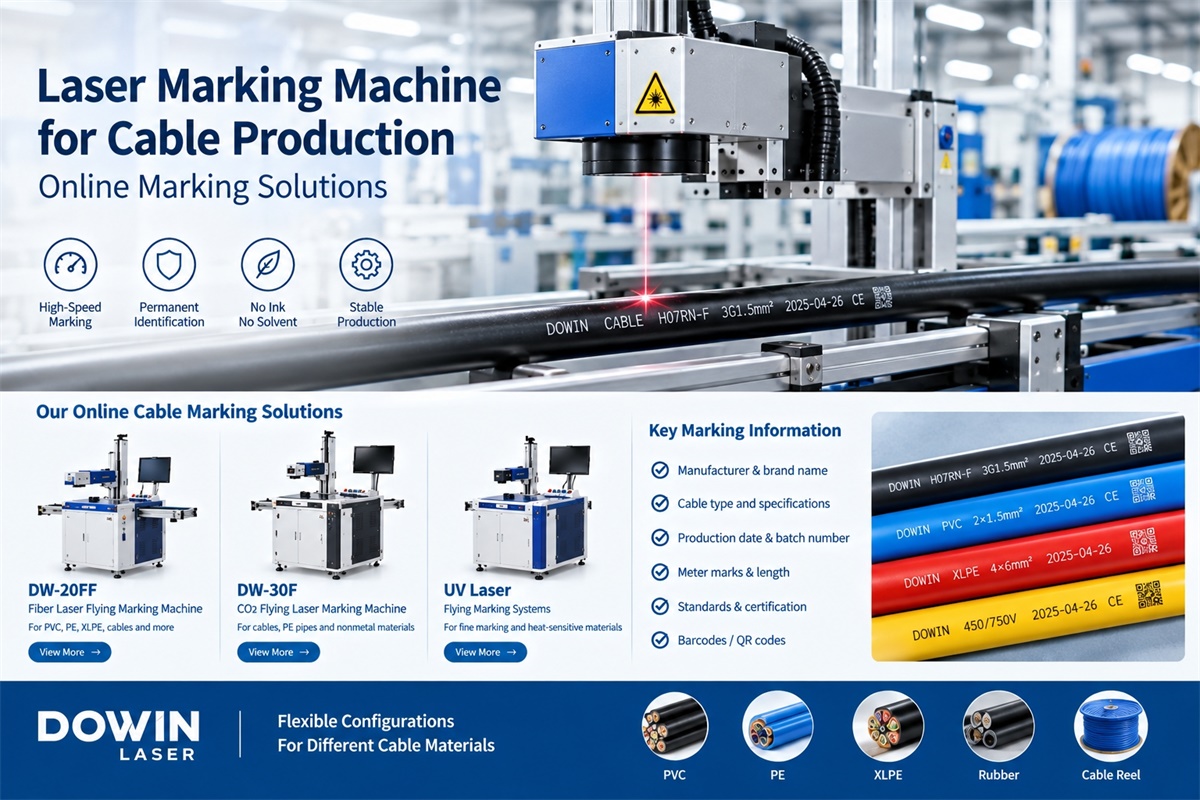
Dowin’s DW-20FF Fiber Laser Flying Marking Machine is designed for applications including PVC pipes, HDPE pipes, cables, and aluminum profiles.
The listed configurations include 20W, 30W, 50W, and 100W laser power options, with encoder-based production-line integration.
Best for: Cable materials that produce sufficient contrast with a fiber laser and applications requiring continuous automatic marking.
CO₂ Laser Marking Machine
CO₂ lasers are widely used for nonmetallic materials. They are worth evaluating for compatible cable insulation and other polymer surfaces.
Dowin’s DW-30F CO₂ Flying Laser Marking Machine is designed for moving production lines and applications including cables and PE pipes.
Best for: Cable manufacturers whose insulation materials respond well to CO₂ laser marking and who need automatic coding during production.
UV Laser Marking Machine
UV lasers operate at approximately 355 nm. Their shorter wavelength can provide fine marking with limited thermal impact on compatible materials.
For cable insulation that is sensitive to heat or requires small, detailed characters, UV laser marking is worth testing. Dowin offers UV laser marking machines, with the appropriate flying configuration selected according to the production-line requirements.
Best for: Compatible cable materials requiring fine details or a controlled thermal marking process.
3. How Does Online Cable Laser Marking Work?
An online laser marking system is installed alongside the cable extrusion line. Instead of stopping the cable for each marking operation, the laser marks the moving cable as it passes the marking station.
A typical system includes:
-
Laser source: Generates the laser beam appropriate for the cable material.
-
Galvanometer scanner: Directs the beam to create characters, numbers, and graphics.
-
Detection sensor: Detects the cable or marking position when required by the system design.
-
Encoder: Measures line movement and helps synchronize marking with cable speed.
-
Marking software: Controls the content, spacing, and marking parameters.
Dowin’s wire and cable marking solution describes flying marking systems using sensors and encoders to coordinate marking with production-line movement.
Before purchasing, confirm the maximum cable line speed, minimum character height, marking interval, and required readability. Scanner speed alone does not determine actual production throughput.
4. What Information Can Be Marked on Cables?
A laser marking machine can produce different identification formats, depending on the material and system configuration.
Common applications include:
-
Cable manufacturer and brand name
-
Cable diameter, type, and specifications
-
Voltage rating and applicable standards
-
Production date and batch number
-
Meter marks and length identification
-
Serial numbers, barcodes, and QR codes
For continuous cable production, repeated text and meter markings require particular attention. The system must maintain consistent spacing even when line speed changes.
Small cable diameters may also limit the available marking area. Test the complete marking content on the actual cable rather than evaluating a short sample word alone.
5. How to Choose the Right Online Cable Marking Machine
Before selecting a system, evaluate these four factors.
Cable insulation material: PVC, PE, XLPE, and other polymer formulations can respond differently to laser wavelengths. Cable color and additives also affect contrast.
Production-line speed: Confirm that the laser can complete the full marking pattern at the maximum operating speed.
Marking readability: Test character height, contrast, spacing, and durability under the intended service conditions.
Integration requirements: Check mounting space, cable position, encoder compatibility, sensor placement, and communication with the existing line controls.
For manufacturers producing multiple cable types, test each major material and color combination. One laser source may not provide equally good results across every product.
6. Recommended Dowin Laser Marking Solutions
For cable manufacturers, I recommend starting with these two systems.
DW-20FF Fiber Laser Flying Marking Machine
This is a practical candidate for manufacturers working with compatible cable insulation, PVC pipes, HDPE pipes, and other listed applications. Its available laser powers allow the configuration to be evaluated against different marking requirements.
DW-30F CO₂ Flying Laser Marking Machine
This system is worth comparing when marking nonmetallic cable materials on a moving production line. The final selection should depend on sample marking results and achievable throughput.
If neither option provides the required contrast or material compatibility, consider testing a suitable UV flying laser marking system.
For customized production-line requirements, visit Dowin’s laser marking machine collection or cable marking solution page.
Frequently Asked Questions
Can a laser marking machine mark cable insulation continuously?
Yes. A flying laser marking system can mark compatible cable insulation while the cable moves through the production line. Sensors and encoders can help synchronize the marking process.
Can laser marking replace inkjet coding in cable factories?
It can replace inkjet coding in suitable applications. The decision depends on material compatibility, marking contrast, production speed, initial investment, and operating costs.
Which laser is best for PVC cable marking?
Fiber, CO₂, and UV lasers may be suitable for different PVC formulations. Test the actual cable insulation to determine which source produces the required contrast without unacceptable surface damage.
Can a laser mark meter numbers on cables?
Yes. A properly configured system can produce repeated meter markings and other identification information. The required marking interval and line speed must be confirmed during testing.
Conclusion
A laser marking machine for cable production can improve identification consistency and reduce dependence on inkjet consumables. For online marking, the most important considerations are insulation compatibility, line speed, marking readability, and encoder synchronization.
Dowin’s DW-20FF fiber and DW-30F CO₂ flying laser marking machines are practical starting points for comparison. Send Dowin your cable material, insulation color, production speed, and required marking content to identify a suitable configuration.
Post time: Oct-29-2026
