
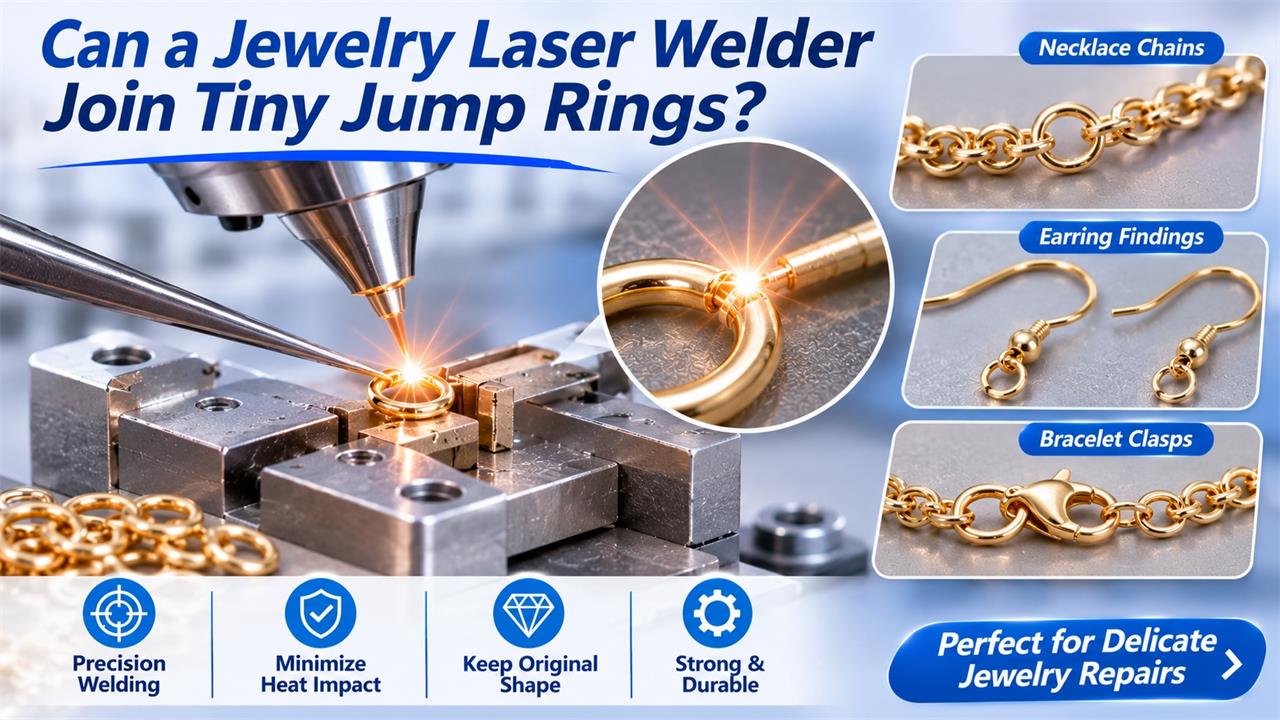
Tiny jump rings are among the smallest and most frequently used components in jewelry manufacturing and repair. They connect necklace chains, bracelet clasps, pendants, charms, and earring components. However, repairing these small rings can be challenging because their metal wires are often extremely thin. Too much heat can melt through the ring, while insufficient energy may produce a weak connection. Can a jewelry laser welder join tiny jump rings successfully? Yes. With proper positioning, suitable laser parameters, and good joint preparation, laser welding can create reliable connections on many small gold and silver jump rings. In this guide, we explain the process and show how a Dowin Jewelry Laser Welding Machine can support precision jewelry repair applications.
1. Why Are Tiny Jump Rings Difficult to Weld?
A jump ring is a small metal ring used to connect different jewelry components. Unlike a solid metal joint, it normally has an opening that allows the jeweler to attach chains, clasps, or decorative parts.
When a jump ring becomes damaged or needs to be permanently closed, the operator must join two small metal ends without changing the original ring shape.
Several factors make this process challenging:
- Very thin wire: Small jump rings contain limited metal material, making them vulnerable to excessive melting.
- Small welding area: The connection point may be only a fraction of a millimeter wide.
- Limited positioning space: The ring is small and can easily move during welding.
- Heat accumulation: Repeated pulses in the same location may cause unwanted deformation.
- Mechanical requirements: The connection must withstand normal movement and handling without reopening.
Traditional soldering can also be used for jump rings, but heating a very small component with a torch requires considerable control.
Laser welding provides another option by concentrating energy directly on the connection point.
2. How Does Laser Welding Join a Tiny Jump Ring?
Laser welding joins metal by delivering concentrated energy to the area where two metal ends meet.
For a typical jump ring repair, the process involves several steps:
- Open or inspect the damaged jump ring and identify the two metal ends.
- Align the ends so they fit closely together without unnecessary gaps.
- Position the connection point under the microscope.
- Select appropriate laser welding parameters according to the wire thickness and alloy.
- Apply controlled laser pulses to fuse the metal ends.
- Inspect the completed connection for fusion quality and excessive melting.
When the joint is properly prepared, the laser melts the adjoining metal surfaces and forms a fused connection as the molten area solidifies.
If material is missing or the gap cannot be closed properly, compatible filler wire may be required.
The objective is not to create a large weld deposit. It is to achieve adequate fusion while preserving the original circular shape of the jump ring.
3. What Size Jump Rings Can a Jewelry Laser Welder Join?
The answer depends on the machine configuration, laser spot size, wire diameter, alloy composition, and joint design.
There is no universal minimum jump ring diameter that applies to every laser welding machine.
For example, a small gold jump ring with a thin wire requires a different approach from a larger silver jump ring with a thicker cross-section.
When evaluating whether a laser welder is suitable, consider three measurements:
- Outer diameter: The total diameter of the jump ring.
- Wire diameter: The thickness of the metal wire forming the ring.
- Weld gap: The distance between the two ends before welding.
Wire diameter and joint geometry are particularly important. A very small outer diameter does not necessarily mean the ring is difficult to weld if its wire is relatively thick and the joint is accessible.
Before purchasing a machine, ask the manufacturer to test your actual jump rings rather than relying only on advertised laser power.
4. Which Metals Can Be Used for Laser-Welded Jump Rings?
Jump rings are manufactured from different metals and alloys. Their welding characteristics vary, so the operator must identify the material before choosing parameters.
14K and 18K Gold Jump Rings
Gold jump rings are common in fine jewelry manufacturing and repair.
A jewelry laser welder can join suitable 14K and 18K gold jump rings by applying localized energy to the connection point.
However, different gold alloys contain different proportions of silver, copper, and other metals. Their melting and welding behavior can vary.
Use compatible filler material when necessary, and test each alloy before establishing production settings.
Sterling Silver Jump Rings
Sterling silver is also widely used for necklace and bracelet connections.
Because silver has high thermal conductivity, heat can spread quickly through thin jump ring wires.
Laser welding can provide concentrated energy, but pulse energy and duration must be carefully controlled to prevent the ring from melting through.
Platinum Jump Rings
Platinum components can also be laser welded with suitable equipment and parameters.
However, platinum has different thermal and melting characteristics from gold and silver. It requires material-specific settings and appropriate welding experience.
Gold-Plated and Gold-Filled Jump Rings
These components require additional attention because the surface layer and underlying metal may react differently during welding.
Exposed base material, coating damage, discoloration, and inconsistent weld appearance can become problems.
Confirm the actual material structure and test a sample before attempting a customer repair.
5. How to Prevent Tiny Jump Rings from Melting During Welding
One of the biggest concerns when welding tiny jump rings is burn-through. Because the wire is thin, an unsuitable laser setting can melt the entire connection instead of creating a controlled weld.
Here are five practical ways to reduce this risk.
1. Start with Conservative Pulse Energy
Do not use the same settings for a tiny jump ring and a thick jewelry component.
Start with a conservative setting based on a tested material sample. Increase the energy gradually until satisfactory fusion is achieved.
Avoid increasing several parameters at the same time because it becomes difficult to identify which adjustment caused the change.
2. Choose a Suitable Spot Diameter
A smaller welding spot can help concentrate energy on the narrow connection between the two ends.
However, an excessively small spot may concentrate too much energy in one location.
Spot diameter should be selected together with pulse energy and pulse duration.
Read more: How Spot Size Affects Jewelry Laser Welding.
3. Ensure the Two Ends Fit Properly
Before welding, make sure the ends of the jump ring meet correctly.
A large gap may require additional filler material and more welding energy. Poor alignment can also produce an irregular connection.
For tiny rings, precise joint preparation is often more important than simply increasing laser power.
4. Avoid Excessive Overlapping Pulses
Repeatedly applying pulses to the same location can cause heat accumulation and enlarge the molten area.
Use only the necessary number of pulses and inspect the joint between welding operations when appropriate.
5. Practice on Identical Samples
Before repairing valuable jewelry, test the welding settings on jump rings with the same material, wire diameter, and geometry.
This helps establish a repeatable process without risking customer property.
For more practical advice, read How to Prevent Burn-Through When Laser Welding Jewelry.
6. How to Make Sure a Laser-Welded Jump Ring Is Strong Enough
A jump ring may look completely closed after welding, but visual appearance alone cannot confirm joint strength.
This is especially important for necklace and bracelet connections that experience repeated movement and pulling forces.
Consider the following inspection steps:
Check the Welded Surface
Use microscope observation to inspect the connection.
Look for incomplete fusion, visible cracks, pores, excessive weld deposits, and signs of burn-through.
Check the Original Ring Shape
Make sure the jump ring remains circular or maintains its original intended geometry.
Excessive deformation may affect how the ring connects to other jewelry components.
Perform Mechanical Testing
Test sample jump rings using an appropriate mechanical test or controlled pull test.
The joint should withstand the loads expected during normal use.
For production applications, establish a consistent inspection procedure based on the intended jewelry design and service requirements.
Check the Surrounding Metal
Sometimes the weld itself remains intact while the adjacent wire becomes the weakest point.
If the jump ring has already been worn down, cracked, or thinned through repeated use, replacing it may be more reliable than welding it.
7. Laser Welding vs Soldering Tiny Jump Rings
Both laser welding and traditional soldering can be used for jump ring connections. Each method has advantages depending on the application.
| Comparison | Laser Welding | Traditional Soldering |
|---|---|---|
| Heat application | Concentrated on a selected area | Broader surrounding heating |
| Small connection points | Suitable for precision welding | Requires careful torch control |
| Thin gold jump rings | Can provide localized energy control | Greater risk of heating adjacent areas |
| Filler material | Compatible welding wire when needed | Solder alloy |
| Equipment investment | Generally higher | Generally lower |
| Additional applications | Chains, clasps, prongs, and small metal repairs | Conventional jewelry joining and fabrication |
Laser welding is particularly attractive when a workshop frequently handles tiny metal components and requires accurate control over the repair area.
However, traditional soldering remains useful for many conventional jewelry applications. The two methods can complement each other.
8. Which Jewelry Laser Welder Is Suitable for Tiny Jump Rings?
For workshops that frequently repair gold and silver chains, the most important machine features are stable pulse output, adjustable parameters, a suitable spot size, and accurate observation.
A dedicated YAG jewelry laser welder is designed for precision spot welding applications.
Dowin’s 150W desktop jewelry laser welder offers several useful features:
- 150W YAG laser source: Designed for fine jewelry welding and repair.
- Adjustable spot diameter: The applicable desktop model supports approximately 0.2–2 mm spot adjustment.
- Microscope observation: Helps operators position the laser accurately on tiny connections.
- CCD observation: Provides an additional viewing method for the welding area on the applicable configuration.
- Adjustable pulse parameters: Allows settings to be adapted to different jewelry materials and thicknesses.
- Air-cooled design: Suitable for the specified desktop configuration.
For jewelry repair shops handling small jump rings, chain connectors, earring findings, and other delicate components, this type of machine can support a broad range of precision welding tasks.
View the Dowin Jewelry Laser Welding Machine for specifications and application details.
9. Common Mistakes When Laser Welding Tiny Jump Rings
Even experienced jewelry repair operators can encounter problems when working with extremely small components.
Some mistakes are particularly common:
- Using excessive power: Can melt through the thin wire instead of forming a controlled joint.
- Ignoring material differences: Gold and silver require different welding approaches.
- Leaving a large joint gap: Makes complete fusion more difficult and may require additional filler.
- Poor microscope positioning: Can cause the laser to miss the intended connection.
- Skipping strength tests: A visually closed ring may still have incomplete fusion.
- Repairing heavily worn rings: Welding cannot restore the full strength of surrounding metal that has become too thin.
A successful repair requires both good welding technique and proper evaluation of the original component.
10. Frequently Asked Questions
Can a 150W jewelry laser welder weld tiny gold jump rings?
A 150W YAG jewelry laser welder is designed for precision jewelry applications and may be suitable for many tiny gold jump rings. Actual suitability depends on the wire diameter, alloy composition, joint condition, spot size, and pulse settings. Test representative samples before repairing valuable jewelry.
Can laser welding permanently close a jump ring?
Yes. Laser welding can fuse the two ends of a suitable metal jump ring, creating a permanent welded connection. This differs from leaving a mechanically openable jump ring that can be repeatedly opened and closed.
Can I laser weld silver jump rings?
Yes. Silver jump rings can be laser welded with suitable equipment and parameters. However, silver’s high thermal conductivity makes careful heat control especially important.
Do tiny jump rings need filler wire?
Not always. If the two ends fit together closely, direct fusion may be sufficient. If material is missing or the gap is too large, compatible filler wire may be necessary.
Will laser welding change the shape of a jump ring?
It can if excessive energy is applied or the ring is not positioned correctly. Appropriate pulse settings, stable positioning, and proper joint preparation help preserve the original shape.
How can I test the strength of a welded jump ring?
Inspect the joint under magnification and perform an appropriate mechanical test on sample rings. The test should reflect the actual intended use and should check the surrounding wire as well as the welded connection.
Can laser welding replace soldering for all jump rings?
No. Laser welding is an additional precision repair method, not a universal replacement. The best choice depends on ring size, material, joint design, equipment availability, and repair requirements.
Conclusion
A jewelry laser welder can successfully join many tiny jump rings used in necklaces, bracelets, earrings, and other jewelry products. Its main advantage is the ability to concentrate energy on a small connection point, helping operators control the welding process without unnecessarily heating the entire component.
However, achieving reliable results requires more than selecting a laser machine with sufficient wattage. Wire thickness, alloy composition, joint alignment, spot diameter, pulse energy, and mechanical inspection all affect the final connection.
For jewelry workshops regularly repairing fine chains and small metal components, a dedicated YAG jewelry laser welder can expand precision repair capabilities.
Explore the Dowin Jewelry Laser Welding Machine to learn more about available equipment for jump ring welding and other delicate jewelry repairs.
“`
Post time: Nov-24-2026
