
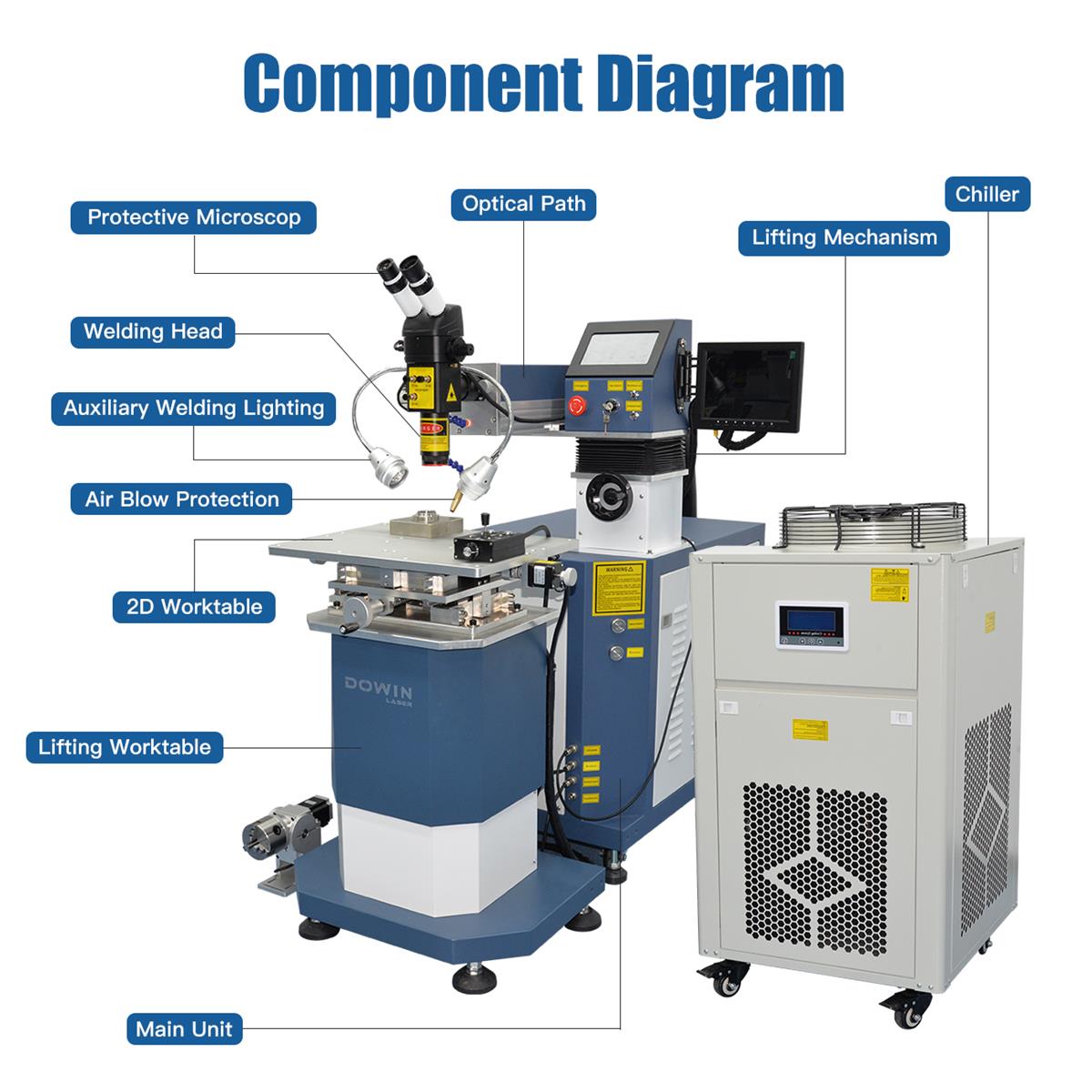
Mold repair is a critical part of injection molding, die casting, stamping, and tooling production. A damaged mold does not always need to be replaced. Cracks, worn surfaces, chipped edges, machining marks, and small cavities can often be restored through precision welding.
Traditional repair methods such as TIG welding and conventional cold welding can work for certain applications, but they may introduce excessive heat, distortion, or additional machining work. Mold repair laser welding machines provide a more controlled alternative by concentrating laser energy into a small area and allowing technicians to add material precisely where it is needed.
This guide explains how mold laser welding works, which parameters matter when choosing a machine, what types of mold damage can be repaired, and how to evaluate a reliable manufacturer for long-term cooperation.
What Is a Mold Repair Laser Welding Machine?
A mold repair laser welding machine uses a focused laser beam to melt the surface of the damaged mold together with a compatible filler wire or powder. The laser creates a small molten pool, while the operator controls the welding position, pulse parameters, and filler material to rebuild the damaged area.
A typical repair process can be understood as:
Laser source → focused laser beam → localized melting → filler wire addition → solidification → grinding/polishing → restored mold surface
Compared with conventional welding, the laser concentrates energy into a much smaller area. This helps reduce unnecessary heat input and makes it possible to repair relatively small or delicate areas without affecting the surrounding mold surface as much.
Common Types of Mold Laser Welding Machines
Different mold repair operations require different machine configurations.
Handheld laser welding machines are suitable for flexible repair work and are easy to move between workstations. They can be useful for general mold repair, maintenance, and small-to-medium repair areas.
Tabletop mold laser welding machines provide a more stable working platform and are commonly used for precision repair where positioning and repeatability are important.
Automatic wire-feeding laser welding machines combine laser welding with controlled filler-wire delivery. They are particularly useful when the repair requires continuous material addition or a more consistent welding process.
What Materials Can Be Laser Welded?
Depending on the laser source, parameters, and filler material, mold laser welding can be applied to a wide range of metals, including:
-
Tool steels
-
Stainless steels
-
Carbon steels
-
Aluminum alloys
-
Copper alloys
-
Die-casting mold materials
-
Certain powder-metallurgy materials
Material compatibility should always be verified through an actual welding test before purchasing a machine, especially for specialized mold steels or heat-treated components.
Why Choose Laser Welding for Mold Repair?
The biggest advantage of laser welding is precision. Mold damage is often localized, and repairing only the damaged section is preferable to heating a large surrounding area.
Laser Welding vs. TIG vs. Cold Welding
| Feature | Laser Welding | TIG Welding | Cold Welding |
|---|---|---|---|
| Heat-affected area | Very small | Relatively large | Very small |
| Welding precision | Very high | Medium | High |
| Risk of distortion | Low when properly parameterized | Higher | Low |
| Small-area repair | Excellent | Limited | Good |
| Filler-wire control | Precise | Manual/continuous | Usually manual |
| Post-welding machining | Often reduced | Often required | Usually required |
| Repair of fine edges | Excellent | More difficult | Good |
| Operator learning curve | Moderate | Moderate | Moderate |
The exact results depend on mold material, thickness, laser power, welding parameters, and operator experience. Laser welding does not eliminate post-processing, but its localized heat input can significantly reduce the amount of material affected during repair.
In practical repair applications, reducing unnecessary buildup and heat-affected material can also reduce subsequent grinding and machining work. Some repair operations have reported 30%–50% reductions in subsequent machining time, although actual savings vary considerably by mold geometry, damage type, and repair process.
5 Key Parameters to Consider When Buying a Mold Laser Welder
Choosing a machine based only on laser power is a common mistake. A reliable mold repair solution depends on the interaction between laser power, spot size, wire feeding, cooling, and control software.
1. Laser Power: 200W, 300W, or 500W?
Laser power should be selected according to the size, depth, and material of the repair.
200W laser welding machines are generally suitable for fine and relatively small repairs where precision is more important than high deposition speed.
300W laser welding machines provide a useful balance between precision and productivity. They are suitable for many common mold repairs, including chipped edges, cracks, worn surfaces, and localized material rebuilding.
500W laser welding machines provide greater energy and deposition capability for larger repair areas and deeper material buildup. They can be particularly useful for production environments where repair efficiency is important.
Higher power does not automatically mean better results. Excessive energy can increase the risk of overheating or damaging a delicate workpiece, so the machine should match the actual repair requirements.
2. Adjustable Laser Spot Size
Spot-size adjustment is particularly important for mold repair.
A smaller spot allows the operator to concentrate energy on tiny cracks, corners, edges, and precision areas. A larger spot can cover a wider repair area and improve efficiency during material buildup.
A machine with a flexible spot-size range gives the operator greater control over different types of mold damage.
3. Automatic Wire Feeding
Automatic wire feeding can make a significant difference when rebuilding worn or missing material.
Depending on the machine configuration, mold welding systems may support fine filler wires such as 0.2–0.8 mm. The appropriate wire diameter depends on the repair area and the required deposition rate.
A controlled wire-feeding system helps maintain a more consistent supply of filler material, particularly during longer welding operations.
4. Cooling System: Air Cooling vs. Water Cooling
Cooling directly affects machine stability and operating conditions.
Air-cooled systems are generally compact and convenient for lower-power applications and mobile work.
Water-cooled systems can provide stronger thermal management for higher-power machines or extended operating periods. They are often preferred for demanding industrial applications.
When comparing machines, consider not only the cooling method but also the expected daily operating hours and ambient working conditions.
5. Control Interface and Parameter Management
A modern mold laser welder should make parameter adjustment straightforward.
Useful features may include:
-
Touchscreen control
-
Adjustable pulse width
-
Adjustable pulse frequency
-
Laser power control
-
Spot-size adjustment
-
Wire-feeding control
-
Parameter storage
-
Preset parameter libraries
A well-designed interface can reduce setup time and make it easier for operators to reproduce successful welding parameters.
Common Mold Repair Applications
Mold laser welding can be used for many types of localized damage encountered during mold maintenance.
Die-Casting Mold Crack Repair
Die-casting molds can experience cracking because of repeated thermal cycling and mechanical stress. Laser welding can be used to rebuild localized damaged areas while limiting unnecessary heat exposure to the surrounding mold.
After welding, the repaired section can be machined, ground, or polished to restore the required geometry.
Injection Mold Edge and Corner Repair
Chipped edges and corners are common problems in injection molds. Even a relatively small amount of missing material can affect part geometry.
Laser welding allows filler material to be deposited precisely onto the damaged section. The rebuilt area can then be machined back to the original dimensions.
Stamping Die Cutting-Edge Repair
Stamping dies depend heavily on accurate cutting edges and working surfaces. Wear or localized damage can reduce production quality.
Laser welding can rebuild worn sections before subsequent grinding or machining restores the required profile.
Mold Surface Wear and Material Rebuilding
Beyond cracks and chipped edges, laser welding can also be used to rebuild worn surfaces, repair machining mistakes, restore undersized areas, and correct localized dimensional problems.
Manufacturer Direct Supply vs. Trading Company: Which Is Better?
When purchasing a mold repair laser welding machine, the supplier behind the equipment matters almost as much as the machine itself.
More Competitive Pricing
Buying directly from a manufacturer can reduce some intermediary costs. This can be particularly important when purchasing multiple machines or establishing a regional distribution business.
However, price should not be evaluated independently. Laser source quality, optical components, cooling systems, control systems, warranty coverage, and technical support all affect the actual cost of ownership.
OEM and ODM Support
Direct manufacturers are generally better positioned to provide customized configurations.
Depending on production capability, customization may include:
-
Laser power
-
Working platform
-
Wire-feeding system
-
Laser source
-
Control software
-
Machine appearance
-
Branding
-
Electrical configuration
This is particularly useful for distributors who want to develop their own product line.
Faster Technical Support
A direct manufacturer can communicate with customers and distributors at the engineering level instead of passing every technical question through several intermediaries.
Remote parameter assistance, troubleshooting, spare parts, machine training, and welding support can therefore be handled more efficiently.
Looking for Mold Laser Welding Distributors?
Manufacturers with established production and technical teams can also provide support for international distributors.
Potential distributor support may include:
-
Product training
-
Welding demonstrations
-
Sample testing
-
Marketing materials
-
Technical documentation
-
Machine demonstrations
-
OEM/ODM services
-
Spare-parts support
-
Regional distributor cooperation
If you are planning to sell mold laser welding machines in your market, ask the manufacturer about territory policies, training, sample testing, demonstration machines, and expected technical support before signing a distribution agreement.
How to Choose a Reliable Mold Laser Welding Machine Manufacturer
Not every laser welding supplier has the same manufacturing capability. Before placing an order, evaluate the manufacturer systematically.
Check Manufacturing and Quality Standards
Ask about the manufacturer’s production facilities, quality-control procedures, component sourcing, and relevant certifications.
ISO certification can be useful evidence of established quality-management processes, but it should not be treated as the only indicator of machine quality.
Request an Actual Welding Test
This is one of the most important steps.
Send the manufacturer a sample of your actual mold material or provide detailed photos and information about the damage. Ask the supplier to perform a welding test and provide clear photos or videos of:
-
The original damaged area
-
Welding in progress
-
The repaired surface
-
Machining or polishing results
-
The final repaired component
An actual sample test provides much more useful information than a specification sheet alone.
Review Real Customer Applications
Look for manufacturers that can strate actual mold repair applications rather than relying entirely on generic product photographs.
&lgt;Useful evidence includes customer videos, repair samples, machine demonstrations, and case studies involving similar mold materials.
Confirm Warranty and Training
Before purchasing, clarify:
-
Warranty period
-
Laser-source warranty<t;
-
Replacement-part availability
-
Remote technical support
-
Operator training
-
Installation support
-
Software support
-
Response time for technical issues
A lower purchase price may not be economical if technical support and spare parts are difficult to obtain.
Frequently Asked Questions
Will a Mold Laser Welder Cause Mold Deformation?
Laser welding generally produces a much smaller heat-affected area than conventional TIG welding because the laser energy can be concentrated precisely on the repair zone.
However, no welding process can guarantee zero deformation under every condition. Material type, laser power, pulse parameters, welding sequence, repair depth, and operator technique all affect thermal behavior.
For precision molds, appropriate parameters and controlled welding procedures are essential.
Can You Laser Weld Aluminum Molds?
Yes, aluminum alloys can be laser welded, but the correct laser parameters and filler material must be selected according to the specific alloy.
Aluminum has high thermal conductivity and different laser absorption characteristics compared with many tool steels. Therefore, an actual sample welding test is strongly recommended before processing production molds.
Do Operators Need Professional Qualifications?
The specific legal requirements depend on the country, workplace, laser classification, and local occupational-safety regulations.
From a practical standpoint, operators should receive appropriate training covering laser safety, machine operation, material preparation, welding parameters, filler-wire selection, and emergency procedures.
Can I Send Samples for Welding Tests?
Many professional laser-welding manufacturers can provide sample welding tests before purchase.
When requesting a test, provide the actual damaged mold component whenever possible. If shipping the component is impractical, provide detailed information about the material, hardness, damage type, dimensions, and desired repair result.
A sample test can help determine whether the proposed laser power and welding configuration are suitable for your application.
What Are the Requirements to Become a Mold Laser Welding Distributor?
Distributor requirements vary between manufacturers.
Common factors may include:
-
Local sales capability
-
Industrial customer resources
-
Technical-support capability
-
Marketing experience
-
Demonstration equipment
-
Sales targets
-
After-sales service capability
If you are an established machinery distributor, ask the manufacturer whether they offer regional protection, distributor pricing, product training, demo-machine support, and marketing assistance.
Conclusion: Choose the Right Laser Welder for More Efficient Mold Repair
A mold repair laser welding machine is not simply a replacement for TIG welding. Its main value lies in controlled heat input, precise material deposition, localized repair, and reduced impact on surrounding areas.
For small precision repairs, a 200W system may provide sufficient control. A 300W machine can offer a practical balance between precision and productivity, while a 500W system may be more appropriate for larger or deeper repair work.
The best machine ultimately depends on the mold material, damage type, repair dimensions, production volume, and required finish.
Before purchasing, compare the laser power, spot-size range, wire-feeding system, cooling method, control interface, sample welding results, warranty, and technical support rather than choosing solely according to price.
If you are looking for a mold repair laser welding machine, send your mold sample or repair requirements for a welding test. A professional manufacturer can evaluate the material, recommend suitable laser parameters, and demonstrate the expected repair result before you make a purchasing decision.
For distributors and industrial equipment suppliers, direct manufacturer cooperation can also provide opportunities for OEM/ODM production, technical training, sample testing, demonstration support, and regional distribution partnerships.
Post time: Aug-17-2026
