
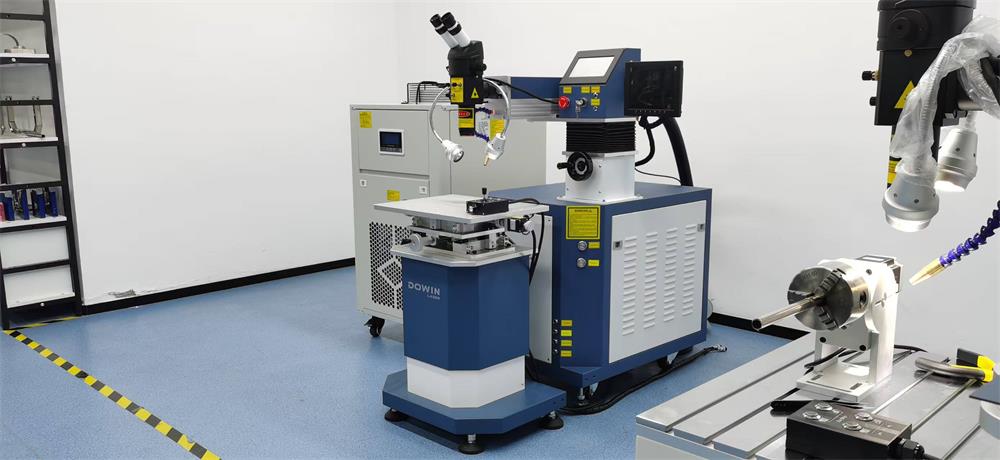
Mold repair is an essential part of manufacturing in industries such as plastic injection molding, die casting, stamping, and precision tooling. Over time, molds develop cracks, worn edges, chipped corners, and surface defects that must be repaired to maintain production quality and extend tool life.
Two of the most common repair methods are mold laser welding and TIG (Tungsten Inert Gas) welding. While both processes can restore damaged molds, they differ significantly in terms of precision, heat input, repair quality, and operating efficiency.
This article compares mold laser welding and TIG welding to help manufacturers choose the most suitable repair method.
What Is Mold Laser Welding?
Mold laser welding uses a highly concentrated laser beam to melt the filler wire and the base material simultaneously, creating a precise metallurgical bond. Because the laser energy is focused on a very small area, only the damaged section of the mold is heated.
Mold laser welding is commonly used for:
- Injection mold repair
- Die casting mold restoration
- Stamping die repair
- Mold modification
- Edge rebuilding
- Crack repair
- Cavity restoration
Its high precision makes it especially suitable for expensive molds with complex structures.
What Is TIG Welding?
TIG welding uses an electric arc generated between a non-consumable tungsten electrode and the workpiece. Shielding gas protects the weld pool from contamination while filler wire is added manually when necessary.
TIG welding is widely used for:
- General metal fabrication
- Structural welding
- Large mold repairs
- Equipment maintenance
- Steel component repair
Although TIG welding provides strong welds, its larger heat input makes it less suitable for repairing highly precise mold components.
1. Welding Precision
Precision is one of the biggest differences between the two processes.
Mold Laser Welding
Advantages include:
- Micron-level welding accuracy
- Extremely narrow weld seams
- Precise repair of small defects
- Easy access to complex cavities and corners
Laser welding is ideal for repairing:
- Small cracks
- Sharp edges
- Fine engraving
- Precision mold cavities
TIG Welding
TIG welding generally produces:
- Wider weld beads
- Larger molten areas
- Less precise heat control
- Greater dependence on operator skill
For detailed mold repair, TIG welding is more difficult to control.
2. Heat-Affected Zone (HAZ)
Heat management directly affects mold quality.
Mold Laser Welding
The laser concentrates energy into a very small area, resulting in:
- Minimal heat-affected zone
- Low thermal stress
- Minimal distortion
- Better preservation of mold hardness
TIG Welding
TIG welding produces significantly more heat, which may cause:
- Mold deformation
- Dimensional changes
- Reduced hardness in surrounding material
- Additional stress after repair
This is one reason why laser welding has become the preferred method for precision mold repair.
3. Surface Quality After Repair
A high-quality repair minimizes the need for additional finishing.
Mold Laser Welding
Produces:
- Smooth weld surfaces
- Minimal spatter
- Small weld beads
- Less grinding and polishing
This reduces repair time and helps restore the original mold geometry.
TIG Welding
Often requires:
- Extensive grinding
- Surface polishing
- Additional machining
Because the weld bead is larger, more finishing work is typically necessary.
4. Repairing Small and Complex Areas
Modern molds often include intricate structures and narrow spaces.
Laser Welding Advantages
Laser welding can repair:
- Deep cavities
- Fine ribs
- Thin walls
- Tiny cracks
- Precision corners
The focused laser beam allows repairs that are difficult or impossible with conventional welding.
TIG Welding Limitations
The larger welding arc makes it challenging to repair:
- Small cavities
- Narrow grooves
- Detailed mold textures
Access can also be limited in confined areas.
5. Repair Speed and Production Downtime
Reducing downtime is essential for manufacturers.
Mold Laser Welding
Benefits include:
- Faster localized repairs
- Less post-processing
- Shorter maintenance cycles
- Quicker return to production
TIG Welding
Although the welding process itself may be fast for larger repairs, additional finishing often increases total repair time.
6. Suitable Mold Materials
Both welding methods can repair common mold steels.
Laser welding performs well on:
- H13 tool steel
- P20 mold steel
- S136 stainless mold steel
- SKD61
- NAK80
Because of its controlled heat input, laser welding better preserves the mechanical properties of hardened mold steels.
7. Equipment Investment and Operating Costs
Mold Laser Welding
Advantages:
- Higher repair quality
- Longer mold service life
- Lower long-term maintenance costs
- Reduced material waste
The initial equipment investment is higher, but many manufacturers recover the cost through improved productivity and fewer mold replacements.
TIG Welding
Advantages:
- Lower equipment cost
- Simple operation
- Widely available equipment
However, higher labor requirements and increased finishing work can lead to greater long-term operating costs.
Comparison Table
| Feature | Mold Laser Welding | TIG Welding |
|---|---|---|
| Welding precision | Excellent | Good |
| Heat-affected zone | Very small | Larger |
| Risk of mold deformation | Very low | Higher |
| Surface finish | Smooth | Requires more finishing |
| Repair of small defects | Excellent | Limited |
| Post-processing | Minimal | More extensive |
| Equipment cost | Higher | Lower |
| Long-term operating cost | Lower | Higher |
| Best application | Precision mold repair | General mold repair |
When Should You Choose Mold Laser Welding?
A mold laser welding machine is the better choice if you need to:
- Repair expensive molds
- Restore precision mold cavities
- Minimize thermal deformation
- Reduce polishing time
- Improve repair quality
- Extend mold service life
- Increase production efficiency
TIG welding remains a practical option for larger repairs where extremely high precision is not required.
Conclusion
Both mold laser welding and TIG welding have important roles in mold maintenance, but they are designed for different applications. TIG welding remains an economical solution for general repairs, while mold laser welding offers superior precision, lower heat input, minimal distortion, and higher repair quality.
For manufacturers working with high-value injection molds, die casting molds, and stamping dies, investing in a mold laser welding machine can significantly reduce downtime, extend mold life, and improve overall production efficiency.
Post time: Jul-13-2026
