
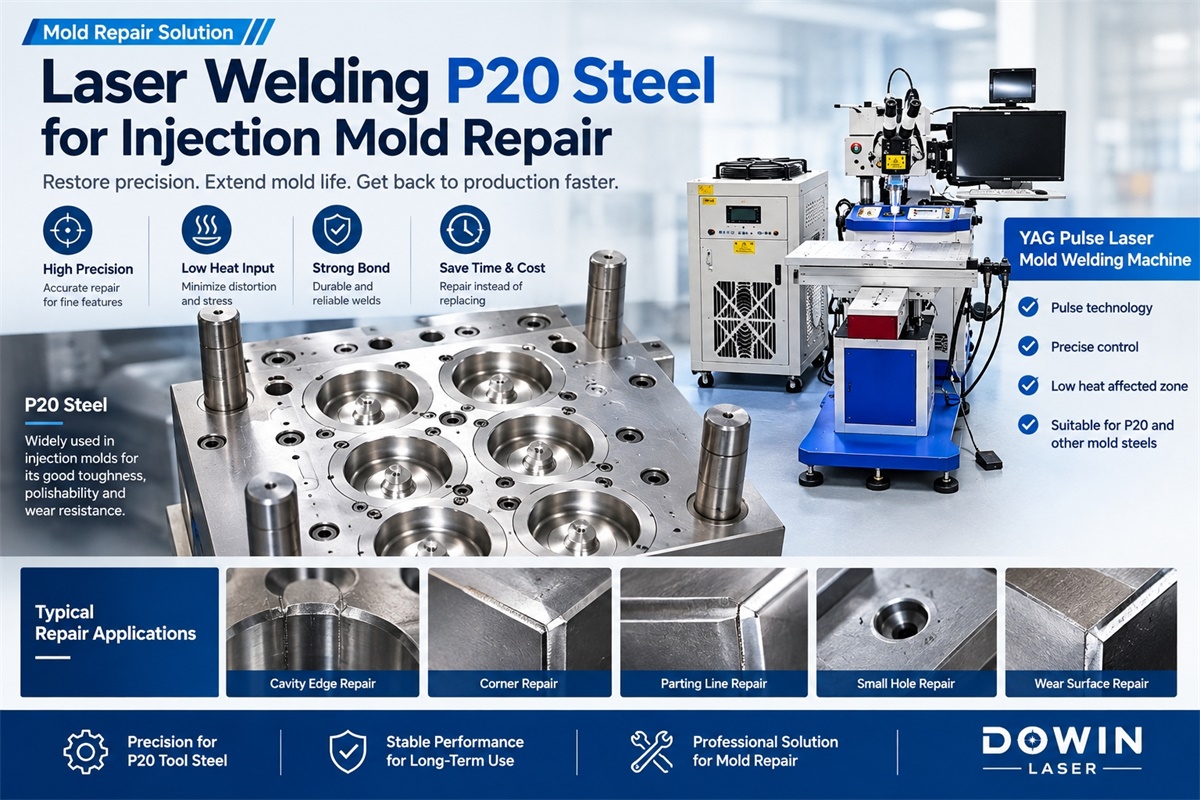
P20 steel is widely used for injection molds because it offers a good balance of hardness, machinability, toughness, and cost. However, repeated molding cycles can eventually cause scratches, dents, worn edges, cracks, or other localized damage.
Instead of replacing an entire mold component, laser welding P20 steel can restore the damaged area by precisely adding compatible filler material.
For injection mold repair, laser welding is particularly useful when the damaged area is close to a precision cavity, parting line, corner, or other feature where excessive heat could cause distortion.
Why Use Laser Welding for P20 Steel?
P20 mold steel can be repaired using several welding methods, but laser welding provides precise control over the repair area and heat input.
With a suitable laser mold welding machine, we can deposit filler material directly onto the damaged section while minimizing unnecessary heating of the surrounding mold.
Key advantages include:
-
Precise material deposition
-
Small heat-affected area
-
Reduced risk of mold distortion
-
Suitable for localized repairs
-
Good control of repair depth
-
Suitable for fine mold features
-
Easier machining and polishing after welding
This makes laser welding a practical solution for extending the service life of P20 injection molds.
What P20 Mold Damage Can We Repair?
Our laser mold welding machines can be used for many common P20 mold repair applications.
Scratches and Dents
Small scratches and dents on the mold cavity can affect the appearance or dimensions of molded parts.
We can fill these defects with a controlled amount of filler material and then machine or polish the repaired area.
Worn Edges and Corners
Repeated production can gradually wear parting lines, shut-off areas, and other critical edges.
Laser welding allows us to rebuild the missing material before restoring the original geometry through machining.
Chipped Mold Features
Corners, ribs, edges, and other small features can sometimes become damaged during production or mold handling.
Because the laser beam can be focused on a small area, we can rebuild these features layer by layer with good dimensional control.
Local Cracks
Localized cracks can also be repaired after the damaged area has been properly inspected and prepared.
The crack should be completely identified and prepared before welding rather than simply welding over the visible surface.
P20 Laser Welding Process
A typical P20 injection mold laser repair process includes several steps.
1. Inspect the Damaged Area
First, we determine the defect type, repair depth, mold geometry, and material condition.
The repair requirements can vary considerably between a shallow scratch and a deep chipped section.
2. Clean and Prepare the Mold
Oil, grease, oxidation, coolant, and other contaminants should be removed before welding.
Depending on the defect, the damaged area may also need to be machined or ground to remove defective material.
3. Select Compatible Filler Wire
The filler wire should be matched to the P20 substrate and the required properties of the repaired area.
We consider factors such as:
-
Hardness
-
Wear resistance
-
Machinability
-
Polishing requirements
-
Compatibility with the mold material
The filler material is especially important when the repaired cavity will later require precision polishing.
4. Set the Laser Parameters
The appropriate parameters depend on the P20 material condition and the size and depth of the repair.
Important parameters include:
-
Laser power or pulse energy
-
Pulse duration
-
Pulse frequency
-
Spot size
-
Welding speed
-
Filler-wire diameter
-
Wire feeding speed
For precision mold repair, we normally aim for sufficient fusion with controlled heat input rather than simply using maximum laser power.
5. Build Up the Damaged Area
Filler material is deposited gradually onto the damaged section.
For deeper repairs, multiple thin layers can provide better control over heat and deposition than attempting to fill the defect in one operation.
6. Machine and Finish the Repair
After welding, excess material can be removed through machining, grinding, or EDM, depending on the mold design.
The repaired area can then be polished to restore the required cavity surface.
Can Hardened P20 Steel Be Laser Welded?
Yes, P20 molds can be laser welded, but the welding procedure should take the material’s actual hardness and heat-treatment condition into account.
Different P20 molds may have different material conditions, and the same laser parameters should not automatically be applied to every mold.
For this reason, we recommend testing the actual mold material before establishing production parameters.
P20 Laser Welding vs TIG Welding
TIG welding remains a useful repair method for many metal components. However, injection mold repair often involves small and highly localized defects.
| Feature | Laser Welding | TIG Welding |
|---|---|---|
| Heat input | Highly localized | Generally higher |
| Repair precision | Very high | Good |
| Heat-affected area | Small | Larger |
| Fine mold features | Very suitable | More challenging |
| Localized repair | Excellent | Good |
| Distortion control | Better | More difficult |
| Filler deposition | Precise | Manual |
The biggest advantage of laser welding is the ability to concentrate energy exactly where the repair is needed.
Which Laser Welding Machine Is Suitable for P20?
For precision P20 mold repair, we recommend considering the complete machine configuration rather than laser power alone.
Important features include:
Pulsed Laser Control
A pulsed laser system can provide precise control over energy input, which is useful for small defects and fine mold features.
Microscope Viewing System
Clear magnification allows the operator to accurately observe the repair area and control the laser and filler wire.
Stable Positioning
An accurate X/Y/Z positioning system helps maintain consistent laser positioning during precision repair.
Filler-Wire Feeding
Depending on the application, manual or automatic wire feeding can be selected according to the required deposition rate and production volume.
How Much Laser Power Is Needed for P20 Repair?
There is no universal laser power for every P20 repair.
A small scratch may require very little energy, while rebuilding a large chipped section requires greater material deposition and productivity.
When selecting a machine, we recommend considering:
Defect size + repair depth + filler wire + required productivity + mold geometry
rather than choosing a machine simply because it has a higher wattage.
For example, 200W, 300W, and 400W pulsed laser welding machines can serve different mold repair requirements. The best configuration should be confirmed through an actual welding test.
Why Choose Our Laser Mold Welding Machine?
As a laser mold welding machine manufacturer, we can test P20 mold steel and help customers determine a suitable machine configuration before purchase.
We can evaluate:
-
P20 material condition
-
Repair dimensions
-
Filler-wire requirements
-
Laser parameters
-
Welding results
-
Machining performance
-
Final surface finish
This allows us to recommend a machine based on the customer’s actual mold repair requirements rather than relying only on general specifications.
Frequently Asked Questions
Can P20 steel be repaired with laser welding?
Yes. Laser welding is suitable for many localized P20 injection mold repairs, including scratches, dents, worn edges, chipped corners, and certain cracks.
Can laser welding repair P20 injection mold cavities?
Yes. Its localized heat input and precise filler deposition make laser welding suitable for many cavity repair applications.
Will laser welding distort P20 molds?
Laser welding can significantly reduce unnecessary heat input compared with conventional welding methods, helping minimize distortion. However, correct laser parameters and welding techniques are still essential.
Can the repaired P20 area be polished?
Yes. With suitable filler material and welding parameters, the repaired area can be machined, ground, and polished to restore the mold surface.
Should we test our P20 mold before buying a laser welder?
Yes. We strongly recommend a sample welding test using your actual P20 material and repair defect. This is the most reliable way to evaluate welding quality and determine the appropriate machine configuration.
Final Takeaway
Laser welding P20 steel is an effective solution for localized injection mold repair. It allows damaged material to be rebuilt precisely while keeping heat input under control.
For P20 injection molds with scratches, dents, worn edges, chipped features, or localized damage, a suitable laser mold welding machine can help restore the mold and extend its service life.
As a direct manufacturer, we can test your P20 mold samples and recommend the appropriate laser power, welding configuration, and filler-wire solution for your specific repair application.
Post time: Sep-07-2026
