
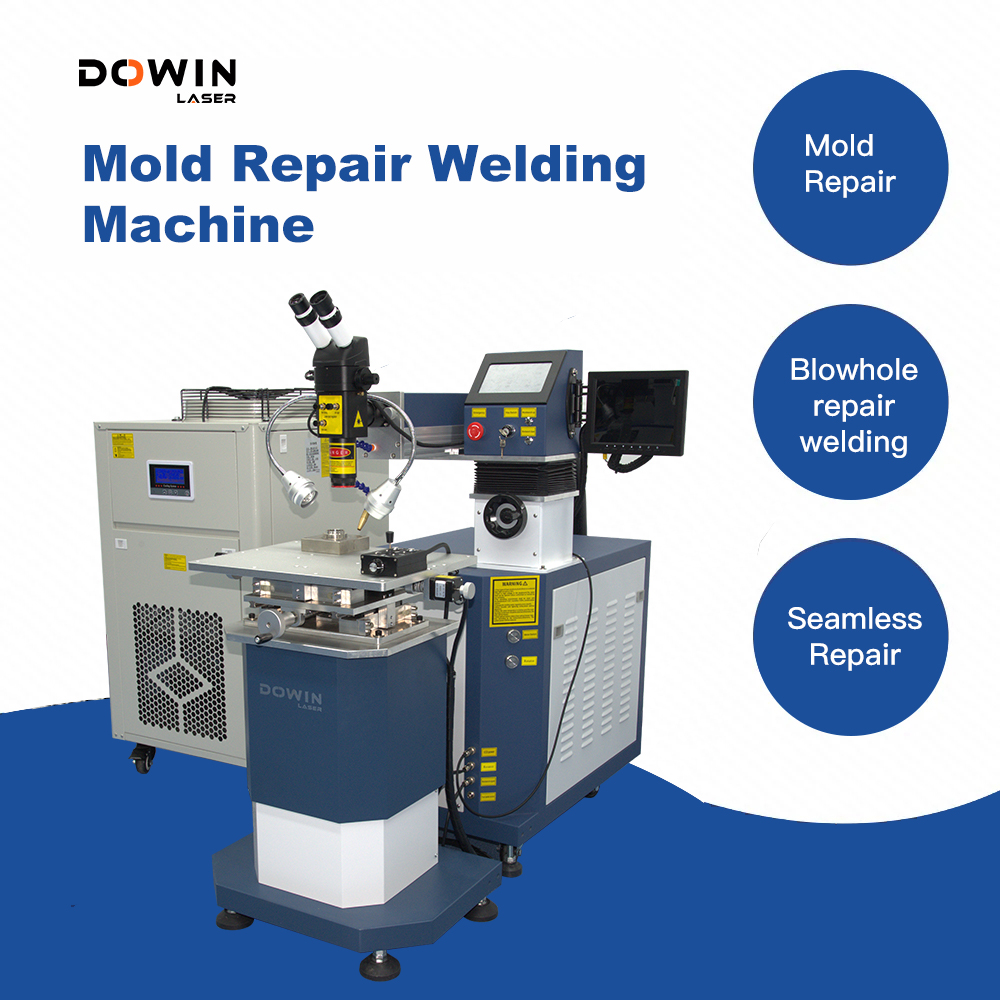
Thin mold edges and sharp corners are among the most challenging areas to repair during mold maintenance. Even a small amount of excess material, overheating, or dimensional deviation can affect the final molded product. Traditional welding methods may introduce excessive heat, cause edge deformation, or require extensive grinding and polishing afterward. Laser welding for thin mold edges and sharp corners offers a more controlled repair method, helping mold makers restore damaged edges, rebuild missing material, and maintain the original geometry of precision molds.
For mold repair workshops, choosing the right laser welding machine is only part of the solution. Laser power, pulse duration, spot diameter, filler wire size, and welding technique all influence the final result. Understanding how these parameters interact is essential for repairing thin edges without creating additional damage.
Why Are Thin Mold Edges and Sharp Corners Difficult to Repair?
Mold edges and corners often serve as functional features rather than simple surface boundaries. Their geometry directly affects parting lines, product dimensions, surface appearance, and the quality of molded components.
Several factors make these areas particularly sensitive during repair.
1. High Risk of Edge Melting
Thin edges contain less material than the surrounding mold body. When too much heat is concentrated in a small area, the edge can melt away, round off, or lose its original profile.
This is especially problematic when repairing precision injection molds, stamping dies, and molds with narrow ribs or fine projections.
2. Heat Accumulation at Corners
Sharp corners can be difficult to weld consistently because the laser spot may overlap adjacent surfaces. Repeated passes can concentrate heat near the corner, increasing the risk of excessive melting or dimensional changes.
A controlled welding strategy is therefore necessary to rebuild the corner gradually rather than depositing too much material in one pass.
3. Limited Repair Space
Some mold edges are located in narrow grooves, deep cavities, or confined areas. Conventional welding torches may not provide sufficient access or visibility.
Laser welding allows the operator to focus energy on a relatively small area, making it useful for localized repairs where access and precision are important.
4. Difficult Post-Weld Finishing
Excessive material deposition can change the original edge angle or corner radius. Removing the excess material may require additional grinding, machining, or polishing, increasing repair time and potentially affecting dimensional accuracy.
The objective is not simply to fill the damaged area. It is to restore the original geometry while minimizing the amount of finishing work required.
How Does Laser Welding Repair Thin Mold Edges?
Laser mold welding uses concentrated laser energy to melt the surface of the mold material and, when required, compatible filler wire. The molten material solidifies to form a metallurgical bond with the base material.
For thin edges and sharp corners, a pulsed YAG laser welding machine is commonly considered because its energy can be delivered in controlled pulses. The operator can adjust the welding parameters to suit the material thickness, damage depth, and required deposition amount.
A typical repair process involves the following steps:
-
Inspect the damaged edge. Identify the location, depth, and extent of the damage. Check whether the original edge profile can be restored without extensive material removal.
-
Clean the repair area. Remove oil, rust, release agents, and other contaminants that could affect weld quality.
-
Select suitable filler material. Match the filler wire to the mold steel and the required hardness, wear resistance, and finishing characteristics.
-
Set the laser parameters. Adjust pulse energy, pulse duration, frequency, and spot diameter according to the repair requirements.
-
Deposit material gradually. Apply small, controlled weld deposits instead of trying to rebuild the entire edge in one pass.
-
Restore the original geometry. Inspect the repaired profile and perform precision grinding, polishing, or other finishing operations as needed.
For high-precision molds, a microscope-assisted laser welding setup helps the operator observe the melt pool and position the filler material accurately.
Recommended Laser Welding Parameters for Thin Edges
There is no single parameter setting that works for every mold edge. The correct setup depends on the mold steel, edge thickness, damage depth, filler wire diameter, and machine characteristics.
The following table provides practical starting considerations rather than universal machine settings.
| Parameter | Recommended approach | Why it matters |
|---|---|---|
| Laser type | Pulsed YAG laser | Allows localized energy delivery |
| Pulse energy | Start conservatively and increase as needed | Helps prevent excessive melting |
| Pulse duration | Use shorter pulses when appropriate for thin features | Limits heat input per pulse |
| Spot diameter | Use a small spot suitable for the repair area | Improves control over the weld location |
| Filler wire | Select a compatible grade and suitable diameter | Supports controlled material deposition |
| Welding technique | Apply small deposits in controlled stages | Reduces the risk of rounding edges |
| Cooling between passes | Allow sufficient cooling when needed | Limits cumulative heat buildup |
Important: Shorter pulses do not automatically guarantee better results. The pulse energy and duration must be considered together, and the settings must provide sufficient melting and bonding without damaging the surrounding material. Actual parameters should be established through testing on representative material or a suitable sample.
Best Practices for Welding Thin Mold Edges
Use Small, Controlled Weld Deposits
When rebuilding a thin edge, avoid depositing too much filler material at once. Excessive deposition can create a rounded profile that is difficult to restore.
Instead, add material in small increments and inspect the shape frequently. This approach gives the operator better control over the final edge height and angle.
Avoid Excessive Heat Input
Thin sections can lose their shape quickly when exposed to excessive heat. Use an appropriate pulse setting and avoid unnecessary overlap between successive weld spots.
If the edge begins to melt away or the surrounding surface shows signs of overheating, stop and reassess the parameters rather than continuing with the same settings.
Choose the Correct Filler Wire
Filler wire selection affects the strength, hardness, machinability, and polishing behavior of the repaired area.
The wire should be compatible with the mold material and the intended service conditions. A filler material that is too hard or difficult to finish may create problems during subsequent polishing, while an unsuitable material may compromise wear resistance.
Maintain a Stable Viewing Position
Accurate positioning is essential when repairing narrow edges. A microscope-assisted workstation can help the operator monitor the weld pool, control filler wire placement, and avoid depositing material outside the intended repair zone.
Stable workholding and consistent movement also help improve repeatability.
How to Restore Sharp Mold Corners Without Rounding Them
Sharp corners require a different approach from broad, flat surfaces. The goal is to rebuild the missing material while preserving the original intersection between the two surfaces.
First, identify the original corner geometry. Determine whether the corner was originally a sharp intersection, a small-radius corner, or a precisely machined feature. Not every visually sharp corner should be rebuilt with a zero-radius profile.
Second, deposit material close to the damaged boundary. Avoid creating a large weld bead that extends far beyond the original geometry. Excess material increases the amount of finishing required.
Third, control heat at the corner intersection. Because the laser may affect both adjacent surfaces, carefully manage spot placement and overlap. Use short, controlled welding sequences where appropriate, allowing cooling between passes if heat begins to accumulate.
Finally, finish the corner according to its functional requirements. Depending on the mold design, this may involve precision grinding, hand stoning, polishing, or profile inspection. If the corner affects a sealing surface, parting line, or critical dimension, verify it against the original drawing or an appropriate reference.
Laser welding can rebuild missing material, but it does not eliminate the need for accurate finishing when the original geometry is critical.
Which Mold Welding Machine Is Suitable for Thin Edges?
A pulsed YAG mold repair laser welding machine is worth considering for repairing thin edges, narrow ribs, sharp corners, and localized surface damage. However, the appropriate machine depends on the scale of the repair and the material involved.
Pulsed YAG Mold Repair Laser Welder
A pulsed YAG system is suitable for precision repairs requiring localized heat input and controlled material deposition. It is commonly used for repairing injection molds, die-casting molds, stamping dies, and other tooling components.
When evaluating a machine, pay attention to:
-
Pulse energy and pulse-width adjustment range
-
Stability at low-energy settings
-
Spot size and optical magnification
-
Compatibility with the required filler wire
-
Worktable accessibility and operator ergonomics
-
Cooling performance during extended repair work
For workshops handling fine mold details, a machine with flexible pulse control and clear microscope viewing may be more useful than one selected solely for its maximum power rating.
Why Machine Power Is Not the Only Consideration
A higher-power machine is not necessarily the best choice for thin mold edges. Maximum output power alone does not determine the minimum controllable heat input or the quality of a small weld deposit.
Operators should evaluate pulse energy, pulse duration, spot size, and the machine’s ability to produce stable results at the settings required for precision repair.
Before purchasing a machine, test it on representative mold steel with similar edge thickness and damage geometry. Examine the repaired profile, bonding quality, heat-affected area, and finishing requirements.
For workshops that also repair deeper cracks or rebuild larger damaged areas, a machine offering a sufficiently broad operating range may provide greater versatility.
Common Mistakes When Laser Welding Thin Mold Edges
Several avoidable mistakes can turn a small repair into a more complicated restoration job.
| Common mistake | Potential result | Better approach |
|---|---|---|
| Using excessive pulse energy | Edge melting or profile distortion | Reduce energy and test the settings |
| Depositing too much filler at once | Rounded edges and excessive finishing | Build the profile gradually |
| Using incompatible filler wire | Poor finishing or unsuitable mechanical properties | Match filler to the mold steel and application |
| Overlapping weld spots excessively | Localized heat accumulation | Control spot placement and sequence |
| Ignoring the original geometry | Incorrect corner angle or edge height | Inspect drawings or undamaged reference features |
| Skipping final inspection | Undetected dimensional deviations | Verify the profile and required tolerances |
The most reliable repairs combine appropriate equipment, compatible materials, controlled welding technique, and careful post-weld inspection.
Frequently Asked Questions
Can laser welding repair a very thin mold edge?
Yes, laser welding can repair many thin mold edges when the material, damage geometry, and welding parameters are suitable. The achievable result depends on the remaining edge thickness, steel grade, filler material, and the operator’s ability to control heat input. Extremely thin or severely damaged features may require a different repair strategy.
Is pulsed YAG laser welding suitable for sharp mold corners?
Pulsed YAG laser welding is suitable for many localized corner repairs because it allows controlled energy delivery. However, preserving the original corner profile also requires careful filler deposition and precision finishing.
How can I prevent a thin mold edge from melting during welding?
Use an appropriate pulse energy and duration, select a suitable spot diameter, and deposit material gradually. Avoid excessive overlap and repeated heating of the same area. Always validate the settings on representative material before repairing a critical mold.
Does laser welding eliminate grinding and polishing?
No. Laser welding can reduce the amount of excess material and help limit the repair area, but finishing is often still necessary. The amount of grinding or polishing depends on the required surface finish, dimensional tolerance, and original mold geometry.
What filler wire should I use for mold edge repair?
Choose a filler material compatible with the mold steel and its operating requirements. Consider hardness, wear resistance, crack sensitivity, and post-weld finishing. The correct grade depends on the specific mold material, so confirm compatibility with the material supplier or conduct a suitable welding test.
Is a 200W or 400W mold laser welding machine better for precision repairs?
Neither rating is automatically better for thin edges. A 200W machine may be sufficient for many localized repairs, while a 400W machine may offer advantages for other repair requirements, depending on its pulse characteristics and operating range. Compare controllable pulse energy, stability, and test results rather than relying on rated power alone.
Conclusion
Laser welding for thin mold edges and sharp corners requires more than a high-output laser. The key is to deliver enough energy for reliable bonding while maintaining control over the amount of deposited material and the original mold geometry.
A pulsed YAG mold repair laser welding machine can be an effective solution for rebuilding damaged edges, restoring corners, and repairing localized defects. For mold repair workshops, the most practical approach is to evaluate the machine using actual mold materials and representative damage samples before making a purchase.
If your workshop regularly repairs thin edges, narrow ribs, or sharp corner defects, choose a mold laser welding machine based on pulse control, precision, and repeatable repair quality—not maximum power alone.
Post time: Oct-23-2026
