
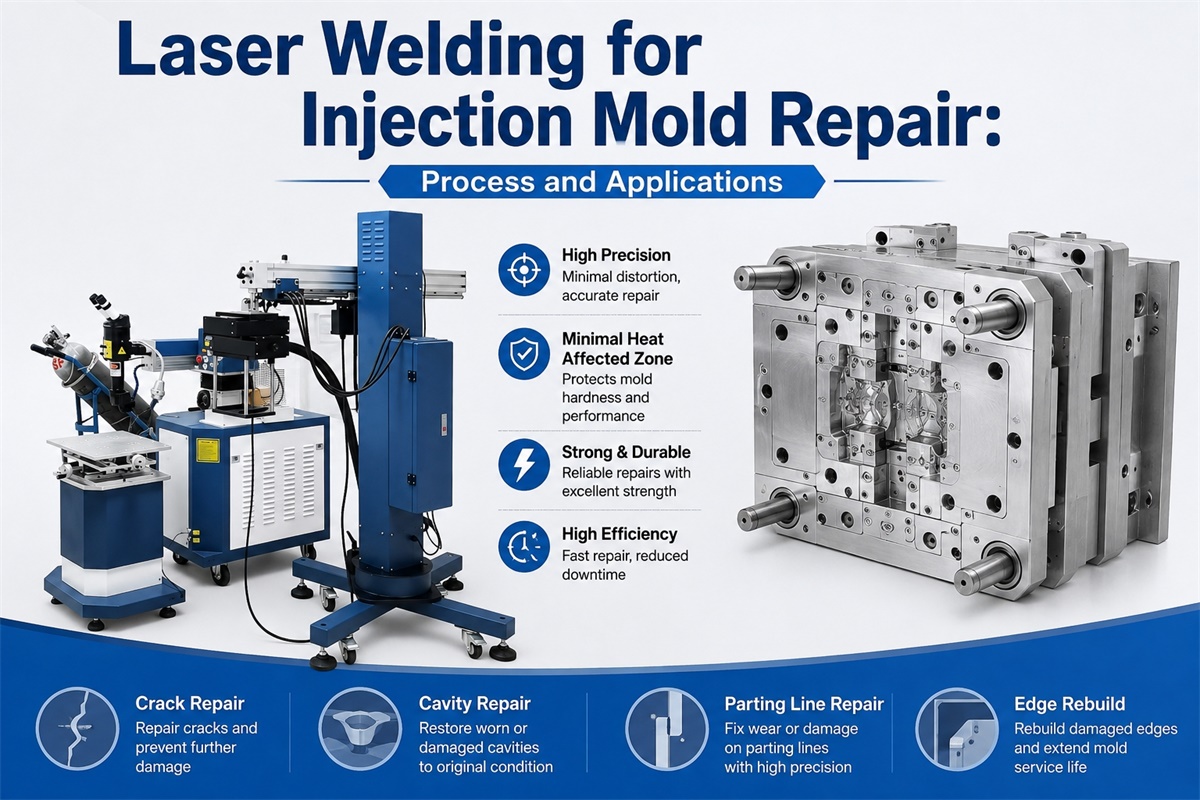
Injection molds are exposed to repeated heating, cooling, pressure, friction, and mechanical stress. Over time, mold surfaces can develop cracks, scratches, worn edges, dents, or damaged cavities. Replacing the entire mold can be expensive, while conventional welding may introduce excessive heat and distortion.
Laser welding for injection mold repair provides a precise way to rebuild damaged areas with controlled heat input. It is widely used for repairing localized mold defects while preserving the surrounding geometry and surface finish.
Why Use Laser Welding for Injection Mold Repair?
Injection molds often contain precision features that are difficult to repair with conventional welding.
A laser mold welding machine concentrates energy into a small area, allowing the operator to add compatible filler material precisely where it is required.
Key advantages include:
-
Small heat-affected area
-
Low risk of mold deformation
-
Precise material deposition
-
Suitable for small and localized defects
-
Good control of welding depth
-
Reduced damage to surrounding surfaces
-
Suitable for hardened mold steels
-
Easier post-welding machining and polishing
This makes laser welding particularly useful when the damaged area is close to a cavity, parting line, corner, rib, or other precision feature.
What Injection Mold Defects Can Be Repaired?
Laser welding can be used for many localized injection mold defects.
Cracks and Fractures
Small cracks can occur around corners, inserts, cooling areas, or high-stress sections of an injection mold.
After properly preparing the damaged area, laser welding can fill the crack with compatible filler material. The repair is then machined and finished to restore the original geometry.
Worn Edges and Corners
Repeated mold opening, closing, and part ejection can gradually wear critical edges.
Laser welding allows the operator to rebuild the missing material layer by layer instead of replacing the entire component.
Scratches and Dents
Minor damage on cavity or core surfaces can affect the appearance and dimensional accuracy of molded parts.
A laser welder can deposit a controlled amount of material into the damaged area, which can subsequently be machined or polished.
Dimensional Corrections
Laser welding is also useful when a mold requires a localized dimensional modification.
Instead of replacing the complete mold component, material can be added precisely to the area that needs correction.
Laser Welding Process for Injection Mold Repair
A typical injection mold laser repair process involves several stages.
1. Inspect the Mold
The first step is to identify the location and extent of the damage.
The technician should determine:
-
Defect type
-
Repair depth
-
Affected area
-
Mold steel type
-
Surface hardness
-
Required final dimensions
For precision molds, accurate inspection is important because unnecessary material removal can make the repair more complicated.
2. Clean and Prepare the Damaged Area
Oil, grease, oxidation, coatings, and other contaminants should be removed before welding.
Depending on the defect, the damaged material may also need to be lightly machined or ground to create a suitable repair area.
Good surface preparation helps improve weld quality and reduces the risk of contamination.
3. Select Compatible Filler Wire
The filler material should be compatible with the mold steel and the required final properties.
Factors to consider include:
-
Mold material
-
Hardness
-
Wear resistance
-
Machinability
-
Polishing requirements
-
Corrosion resistance
Using an unsuitable filler wire can make subsequent machining or polishing more difficult.
4. Set the Laser Parameters
Laser parameters must be matched to the mold material and repair geometry.
Important parameters include:
-
Pulse energy or laser power
-
Pulse duration
-
Welding frequency
-
Spot size
-
Welding speed
-
Filler-wire diameter
-
Wire feeding speed
For precision mold repair, excessive heat should be avoided. The goal is to achieve sufficient fusion while minimizing the heat-affected area.
5. Deposit Material Layer by Layer
The technician gradually adds filler material to the damaged area.
For deeper repairs, building the material in multiple layers provides better control than trying to fill the entire defect in one pass.
The operator can adjust the laser position, filler wire, and parameters according to the weld pool and repair geometry.
6. Machine the Repaired Area
After welding, excess material is removed through machining, grinding, EDM, or other suitable finishing processes.
The repaired area can then be restored to the required dimensions.
7. Polish and Inspect
For injection molds that produce high-quality cosmetic surfaces, polishing is an important final step.
The technician should inspect the repaired area for:
-
Cracks
-
Porosity
-
Incomplete fusion
-
Excessive penetration
-
Dimensional errors
-
Surface defects
The final goal is not simply to create a weld, but to return the mold to its required production condition.
Applications of Laser Welding in Injection Mold Repair
Injection mold laser welding is used across a wide range of manufacturing applications.
Automotive Injection Molds
Automotive plastic components often require large, complex molds with high dimensional requirements.
Laser welding can repair localized damage to cavity surfaces, edges, inserts, and other precision areas without replacing the complete mold component.
Electronics and Consumer Products
Molds used for electronic housings, connectors, switches, and consumer products often contain small features and fine details.
The precision of laser welding makes it suitable for repairing localized defects while minimizing damage to surrounding areas.
Medical Plastic Molds
Medical components can require tight dimensional tolerances and high-quality mold surfaces.
Laser repair can be used for small defects where maintaining the original geometry is important.
Precision Injection Molds
Molds with fine ribs, corners, textures, and small cavities can benefit from the localized heat input of laser welding.
This is one of the areas where laser welding can provide an advantage over broader-heat welding methods.
Laser Welding vs Conventional Mold Repair
Traditional TIG welding can repair many metal components, but injection molds can be particularly sensitive to heat.
Laser welding offers more localized energy delivery, which can help reduce unnecessary heating of the surrounding mold.
| Feature | Laser Welding | TIG Welding |
|---|---|---|
| Heat input | Highly controlled | Higher |
| Heat-affected area | Small | Larger |
| Precision | Very high | Moderate |
| Fine mold features | Excellent | More difficult |
| Localized repair | Excellent | Good |
| Distortion control | Better | More challenging |
| Filler deposition | Precise | Manual |
| Post-welding finishing | Generally easier | Application dependent |
The appropriate technology still depends on the mold material, defect size, repair requirements, and available equipment.
Why Pulsed Laser Welding Is Popular for Mold Repair
For precision injection mold repair, pulsed Nd:YAG laser welding machines are commonly considered because their pulse energy and duration can be carefully controlled.
Short laser pulses can deliver energy to a localized area while limiting heat transfer to the surrounding mold.
This is especially useful when repairing:
-
Thin edges
-
Small cavities
-
Fine corners
-
Hardened steel
-
Small cracks
-
Precision surfaces
For larger repair areas or higher-speed applications, fiber laser welding may also be considered depending on the material and process requirements.
How to Choose a Laser Welding Machine for Injection Molds
When purchasing a laser welding machine for mold repair, don’t focus only on laser power.
Consider the complete system:
Laser Parameters
Check pulse energy, pulse duration, frequency, spot size, and output stability.
Microscope and Optical System
A clear viewing system is essential for accurately positioning the laser on small defects.
Motion System
A stable X/Y/Z positioning system can improve welding accuracy and make repetitive repair operations easier.
Wire Feeding
Automatic or assisted wire feeding can improve consistency, especially for larger buildup repairs.
Mold Material Compatibility
Ask the supplier to test your actual mold steel and filler wire before purchasing.
After-Sales Support
Parameter guidance, operator training, spare parts, and technical support can be important when introducing laser mold repair into a workshop.
Frequently Asked Questions
Can laser welding repair injection molds?
Yes. Laser welding can repair many localized injection mold defects, including cracks, scratches, dents, worn edges, broken corners, and dimensional defects.
Can laser welding repair hardened injection molds?
Yes, depending on the mold steel and its condition. Proper laser parameters and compatible filler material are important for achieving a reliable repair.
Will laser welding deform an injection mold?
Laser welding has a relatively small heat-affected area, which can help minimize deformation. However, incorrect parameters or excessive heat input can still cause distortion.
Can the repaired mold be polished?
Yes. With suitable filler material and welding parameters, the repaired area can generally be machined, ground, and polished to restore the required mold surface.
Is laser welding suitable for plastic injection mold cavities?
Yes. Its localized heat input and precise material deposition make laser welding particularly useful for repairing small defects on cavity and core surfaces.
Final Takeaway
Laser welding for injection mold repair is a precision repair process designed to restore damaged mold surfaces while minimizing unnecessary heat and material removal.
The basic workflow is straightforward: inspect → clean → prepare → select filler → set laser parameters → weld layer by layer → machine → polish → inspect.
For injection mold manufacturers and repair shops, the right laser welding machine can extend mold service life, reduce replacement costs, and restore damaged areas that would otherwise require extensive machining or replacement.
For the best results, always test the machine with your actual injection mold steel, filler wire, and repair defect before making a purchasing decision.
Post time: Sep-04-2026
