
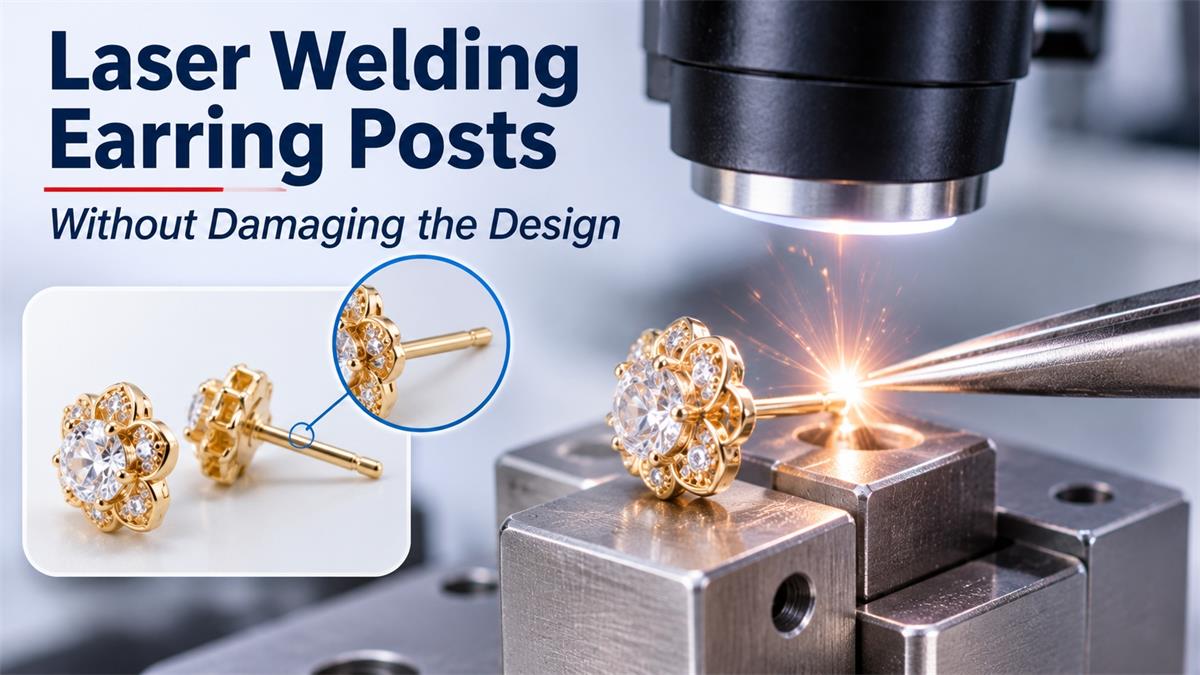
Repairing a broken earring post requires more than simply joining two metal parts. The welding point is usually close to the decorative front, which may contain gemstones, intricate patterns, or polished surfaces. Using a precision jewelry laser welding machine allows jewelers to concentrate heat on the connection area, helping preserve the original appearance of the earring when the correct welding parameters are used.
1. Why Is Earring Post Repair Difficult?
An earring post is a small metal pin attached to the back of an earring. Although the component is relatively simple, repairing it can be challenging because the welding area is close to the finished jewelry design.
Common problems include:
- Heat damage: Excessive heat can discolor or affect the decorative surface.
- Gemstone sensitivity: Some gemstones cannot tolerate high temperatures, especially when mounted close to the welding point.
- Visible welding marks: Poorly controlled welding may leave marks around the connection.
- Post misalignment: An incorrectly positioned post can make the earring uncomfortable or difficult to wear.
- Weak connections: Insufficient fusion may cause the post to break again during use.
For these reasons, controlling the welding position, pulse energy, and heat input is essential.
2. Why Use Laser Welding for Earring Posts?
Pulsed YAG laser welding is widely used for precision jewelry repair because it delivers concentrated energy to a small welding area.
Compared with conventional soldering, laser welding offers several practical advantages:
- Localized heating: Helps reduce heat transfer to surrounding decorative components.
- Precise positioning: Allows operators to target the connection between the post and earring body.
- Small welding spots: Suitable for delicate jewelry components and narrow joints.
- Reduced finishing: Properly controlled welding can minimize additional grinding and polishing.
- Flexible operation: Adjustable pulse parameters allow different metals and joint structures to be processed.
However, laser welding does not guarantee that gemstones will remain unaffected. The stone type, mounting method, distance from the weld, and heat transfer must all be evaluated before repair.
3. How to Laser Weld an Earring Post
A typical earring post repair involves several important steps.
Step 1: Clean the Welding Area
Remove dirt, oil, oxidation, and old solder from the broken post and the back of the earring. Clean metal surfaces help achieve a more consistent weld.
Step 2: Position the Earring and Post
Place the earring in a suitable fixture and align the replacement post with the original connection point. Make sure the post is straight and correctly positioned before welding.
Step 3: Adjust Laser Parameters
Set the pulse energy, pulse width, frequency, and spot diameter according to the metal type, thickness, and joint structure. Start with test pieces or suitable sample settings rather than applying maximum power immediately.
Step 4: Perform Localized Welding
Direct the laser onto the joint between the post and the earring body. Use controlled pulses to achieve sufficient fusion without unnecessarily heating the surrounding decorative area.
Step 5: Inspect the Finished Joint
Check the post alignment, weld appearance, and mechanical strength. Remove any excess material and perform necessary finishing while preserving the original jewelry design.
4. What Type of Jewelry Laser Welder Is Suitable?
For earring post repair, a pulsed YAG jewelry laser welder with a microscope and adjustable welding parameters is a practical choice.
The Dowin DW-150AWPro 150W Desktop Jewelry Laser Welder is designed for precision jewelry processing and small-component repairs.
Its main specifications include:
- Maximum laser power: 150W/200W.
- Laser wavelength: 1064nm.
- Pulse frequency: 1–20Hz.
- Adjustable pulse width: 0.2–10ms.
- Adjustable spot diameter: 0.2–2mm.
- Observation system: Microscope + CCD.
- Cooling system: Air cooling.
The adjustable spot diameter and dual observation system help operators position the welding point when working on small jewelry components. Actual suitability should be confirmed through tests using the specific earring materials and post dimensions.
5. Which Jewelry Materials Can Be Used?
Earring posts and decorative components can be made from different metals. The correct welding process depends on the material composition of both parts.
| Material | Welding Considerations |
|---|---|
| Gold | Check karat, alloy composition, and color matching. |
| Silver | Control heat input and consider oxidation. |
| Platinum | Use suitable pulse parameters and compatible filler material if needed. |
| Stainless steel | Confirm compatibility between the post and earring body. |
| Brass | Test alloy composition and welding behavior before production. |
One important consideration is that the post and earring body should have compatible metal compositions. Welding dissimilar metals may require special preparation and process testing.
6. How to Avoid Damaging the Original Earring Design
To achieve clean repairs, jewelers should pay attention to several details:
- Keep the welding spot as close to the actual joint as possible.
- Use a suitable fixture to prevent movement during welding.
- Adjust pulse energy according to the thickness of the post.
- Avoid unnecessary repeated pulses on the same area.
- Evaluate gemstones and decorative coatings before welding.
- Test welding parameters on similar materials before repairing valuable jewelry.
For earrings with heat-sensitive stones, adhesives, coatings, or delicate settings, additional protection or disassembly may be necessary.
7. Frequently Asked Questions
Q1: Can a laser welder reattach a broken earring post?
Yes. A pulsed YAG jewelry laser welder can reattach compatible metal earring posts by creating a localized weld between the post and the earring body.
Q2: Can laser welding damage diamonds on earrings?
Diamonds are relatively heat resistant, but the surrounding setting and other components may still be affected by heat. The welding position and thermal conditions should be carefully evaluated.
Q3: What laser power is suitable for earring post repair?
Both 60W and 150W jewelry laser welders may be suitable for different repair requirements. The correct choice depends on post thickness, metal composition, pulse energy, and spot size rather than rated power alone.
Q4: Does earring post welding require filler wire?
Not always. If the original post fits properly against the earring body, direct welding may be possible. If there is a gap or missing material, compatible filler wire may be required.
Q5: Can gold earring posts be welded to silver earrings?
Joining dissimilar metals is more challenging than welding matching alloys. Compatibility, joint design, and the risk of brittle intermetallic formation should be evaluated before attempting the repair.
Conclusion
Laser welding is a practical solution for repairing broken earring posts while maintaining the original jewelry design. The key is to control heat input, position the post accurately, and select suitable welding parameters for the metal and joint structure. For jewelry repair shops handling delicate earrings and small components, a pulsed YAG jewelry laser welder with microscope positioning is worth considering.
Post time: Nov-06-2026
