
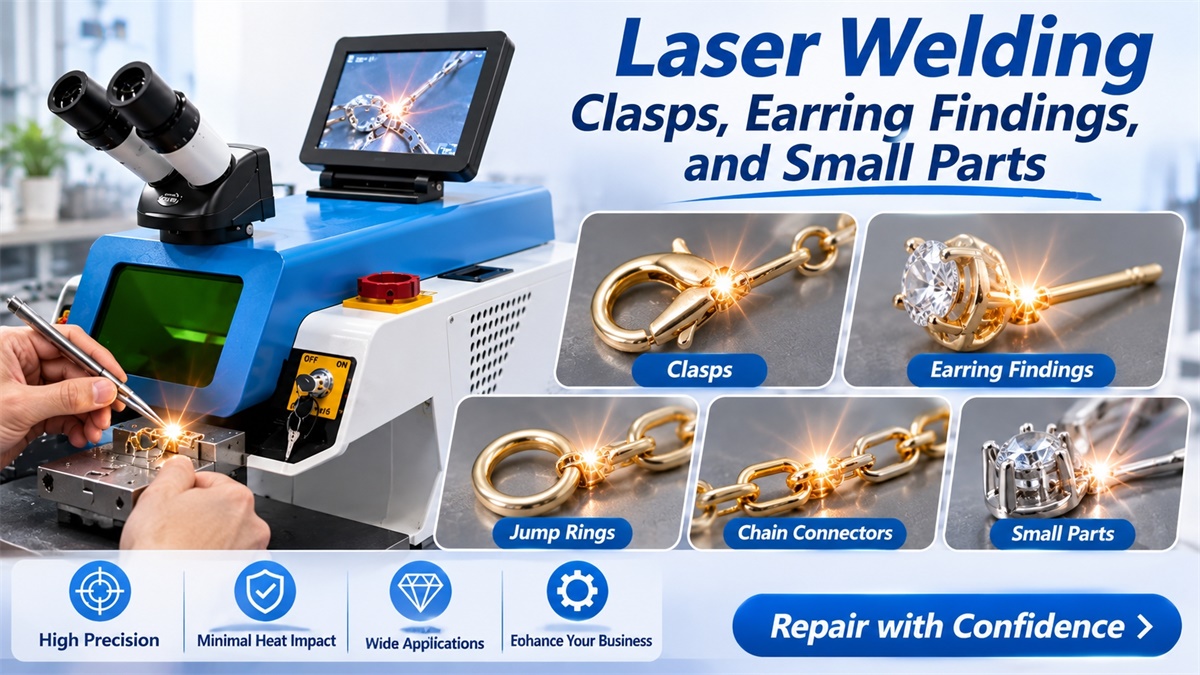
Jewelry clasps, earring findings, jump rings, and other small components are among the most frequently repaired parts in a jewelry workshop. Although these components are small, repairing them can be surprisingly difficult. A broken lobster clasp, detached earring post, or damaged chain connector often requires accurate positioning and careful heat control. Traditional soldering may introduce unnecessary heat to nearby components, especially when working with delicate jewelry. Laser welding offers a more localized approach, making it a practical solution for many small jewelry repair applications. In this article, we explain how to laser weld clasps, earring findings, and small metal parts, and what equipment is suitable for these jobs. Explore the Dowin Jewelry Laser Welding Machine for precision jewelry repair applications.
1. Why Small Jewelry Parts Are Difficult to Repair
Small jewelry components often have complicated shapes, thin metal sections, and narrow connection points. Even a small amount of excessive heat can change their shape or damage nearby decorative elements.
Several common problems make these repairs challenging:
- Limited working space: Small components leave very little room for positioning welding tools.
- Thin metal sections: Excessive heat can cause burn-through or deformation.
- Delicate connections: Some components have narrow joints that require accurate welding.
- Surface finishes: Plating and polished surfaces may be affected by heat.
- Nearby moving parts: Springs and mechanical components inside clasps can be damaged by excessive heating.
Laser welding concentrates energy on a selected repair location. With suitable parameters, it can help join small metal sections while reducing unnecessary heating of the surrounding material.
2. Laser Welding Jewelry Clasps
Clasps are essential components of necklaces, bracelets, and other jewelry products. They are repeatedly opened and closed, making them vulnerable to mechanical wear and damage.
Common clasp-related repair jobs include the following.
Repairing a Broken Lobster Clasp Connection
A lobster clasp usually connects to a chain through a small jump ring or connecting loop. Over time, this connection may become damaged or separate.
For suitable metal components, laser welding can reconnect a broken attachment point. The operator should first inspect the clasp and determine whether the damaged area is a fixed metal joint or part of the moving mechanism.
If the spring or internal locking mechanism is broken, replacing the clasp is generally more appropriate than attempting to weld the mechanism itself.
Repairing a Spring Ring Clasp
Spring ring clasps contain a small internal spring that allows the mechanism to open and close. Although the outer ring may appear simple, its internal construction makes repair more complicated.
Laser welding may be suitable for certain external metal attachments, such as a broken connection loop. However, welding near the spring housing can damage the spring or interfere with its movement.
For this reason, operators should distinguish between structural metal damage and mechanical failure before choosing a repair method.
Repairing Box Clasps
Box clasps are commonly used in bracelets and necklaces. Their construction includes a receiving box and a metal tongue that locks into position.
Laser welding can be useful for repairing certain cracked connections or detached external components. However, the locking surfaces must remain correctly aligned, and welding should not obstruct the insertion or movement of the tongue.
3. Laser Welding Earring Findings
Earring findings include posts, backs, hooks, hoops, and other small components used to attach earrings to the wearer.
Because these components are often thin and lightweight, precision welding is particularly important.
Welding Broken Earring Posts
Broken earring posts are a common repair request in jewelry stores. A post may become detached from the decorative front because of repeated use, impact, or a weak original connection.
Laser welding can reconnect compatible metal posts to suitable earring components. The operator needs to position the post correctly and control the energy to avoid excessive melting.
For small earring parts, microscope observation makes it easier to align the post with the original connection point.
Repairing Earring Hooks
Fishhook earrings and other wire-style findings may become bent or broken near their connection points.
Laser welding can repair certain broken metal joints when the material and geometry are suitable. However, a severely bent wire may be better replaced than welded.
Repairing Hoop Earring Connections
Hoop earrings often use small hinges, pins, or connecting loops. Damage near these areas can prevent the earring from closing properly.
Laser welding can be used for selected metal attachment repairs, but care is needed around moving joints. The operator must avoid filling gaps or creating excess material that interferes with the closing mechanism.
4. Other Small Jewelry Parts Suitable for Laser Welding
Beyond clasps and earring findings, a jewelry laser welder can handle many additional small-component repair applications.
| Component | Common Problem | Potential Laser Welding Application |
|---|---|---|
| Jump Rings | Open or broken connections | Closing or reconnecting suitable metal joints |
| Chain Connectors | Detached connecting loops | Reconnecting metal attachments |
| Earring Posts | Detached or broken posts | Reconnecting posts to compatible metal components |
| Bracelet Clasps | Cracked external attachments | Repairing selected structural joints |
| Decorative Settings | Small metal cracks | Localized welding and material buildup |
| Small Pendant Loops | Broken suspension points | Reconnecting suitable metal loops |
| Metal Connectors | Separated components | Joining compatible metal sections |
Not every damaged component should be welded. Small springs, mechanical locks, severely worn parts, and components with insufficient remaining material may require replacement.
5. Why Laser Welding Is Useful for Tiny Jewelry Components
When working with small jewelry parts, controlling the welding area is often more important than simply increasing the welding power.
Laser welding offers several practical advantages.
Precise Energy Delivery
The laser beam can be focused on a selected location, allowing the operator to work on narrow joints and small metal connections.
This is particularly useful when repairing a detached earring post or a small jump-ring connection.
Reduced Surrounding Heat Exposure
Unlike many traditional torch-soldering operations, laser welding concentrates energy on a small area. This can reduce unnecessary heating of nearby components.
However, heat can still spread through thin metal parts. Sensitive springs, coatings, and decorative elements may still require removal or protection.
Microscope-Assisted Positioning
Small jewelry components are difficult to position accurately with the naked eye. A microscope helps the operator observe the connection point and direct the laser more precisely.
Controlled Filler Material
For certain damaged joints, compatible filler wire can be added to rebuild missing material or improve the connection.
The filler material should match the base metal as closely as practical in terms of alloy compatibility and finishing requirements.
6. What Welding Parameters Are Important for Small Jewelry Parts?
Small jewelry components require careful parameter adjustment. Using the same settings for a thick bracelet clasp and a very thin earring post can produce inconsistent results.
Four important parameters should be considered.
1. Pulse Energy
Pulse energy determines how much laser energy is delivered during each pulse. Very small components generally require careful energy control to prevent excessive melting or burn-through.
2. Pulse Duration
Pulse duration affects how long the metal is exposed to laser energy. A suitable pulse duration helps balance metal melting and heat distribution.
3. Pulse Frequency
Frequency determines how many pulses are delivered per second. It can affect the welding process when multiple overlapping pulses are needed.
4. Spot Diameter
The laser spot diameter influences the size of the area receiving energy. A smaller spot can be useful for tiny connections, while larger spots may be more suitable for wider joints.
For example, Dowin’s desktop YAG jewelry laser welder offers an adjustable spot diameter of approximately 0.2–2 mm on the applicable model. This range can support different small jewelry welding applications.
Actual settings should always be established through sample testing according to the metal alloy, thickness, and joint design.
7. How to Laser Weld a Small Jewelry Component: A Practical Workflow
Although individual repairs require different techniques, a general workflow can help jewelry workshops improve consistency.
Step 1: Inspect the Damaged Component
Identify the damaged area and determine whether the component can be repaired through welding.
For clasps, check whether the problem involves an external connection or an internal spring mechanism. For earrings, inspect the post, hook, and decorative attachment.
Step 2: Identify the Metal
Determine whether the component is made of gold, silver, platinum, stainless steel, or another compatible metal.
Pay attention to plating and coatings because they may affect weld quality and appearance.
Step 3: Clean and Prepare the Surface
Remove oil, dirt, polishing compounds, and other contamination from the repair area using a suitable cleaning procedure.
Clean metal surfaces help improve the consistency of the welding process.
Step 4: Position the Component
Place the component securely in the working area and use the microscope to align the repair location.
Make sure that nearby moving parts and heat-sensitive materials are removed or adequately protected.
Step 5: Select Welding Parameters
Choose suitable pulse energy, duration, frequency, and spot diameter based on previously tested settings for the material and geometry.
Perform a sample test when working with an unfamiliar alloy or component design.
Step 6: Complete the Welding
Apply controlled laser pulses to the selected joint. Avoid unnecessary overlapping or excessive energy that could deform the component.
Step 7: Inspect and Finish
Inspect the weld for incomplete fusion, cracks, porosity, and excessive material buildup.
Test the mechanical function of the clasp or earring component and perform suitable finishing or polishing when necessary.
8. What Jewelry Laser Welder Is Suitable for Small Parts?
For jewelry workshops regularly repairing clasps, earring findings, and small components, a dedicated jewelry laser welder with accurate positioning and adjustable welding parameters is a practical equipment choice.
Dowin offers a desktop YAG jewelry laser welding machine designed for precision jewelry repair.
Important features of its 150W desktop configuration include:
- 150W YAG laser source: Designed for fine jewelry spot welding applications.
- 0.2–2 mm spot adjustment: Provides flexibility when working with different repair areas.
- Microscope observation: Helps position the laser on small components.
- LED shadowless lighting: Improves visibility during detailed repair operations.
- Air-cooled configuration: Avoids the need for a separate external water chiller.
- Compact desktop design: Approximately 23 kg, suitable for many jewelry workshop environments.
For workshops that repair different types of jewelry components, this type of equipment can support more applications than a machine intended only for basic chain connections.
Learn more about the Dowin 150W Jewelry Laser Welding Machine.
9. Common Mistakes When Welding Clasps and Earring Findings
Even with a precision laser welder, several mistakes can affect the repair result.
Using Too Much Laser Energy
Small components have limited material thickness. Excessive energy can cause burn-through, deformation, or oversized weld deposits.
Welding Near Springs Without Protection
Many clasps contain internal springs. Heating these areas may damage their mechanical properties or prevent the clasp from functioning correctly.
Ignoring the Original Metal Composition
Gold-plated, gold-filled, and solid-gold components do not necessarily respond the same way during welding. Identify the actual material structure before selecting parameters.
Poor Component Positioning
If the two metal sections are not aligned correctly, the final connection may be weak or visually uneven.
Skipping Mechanical Testing
A weld that looks clean is not automatically strong enough for daily use. Test the completed component and verify that clasps and moving parts function correctly before returning the jewelry to the customer.
10. Frequently Asked Questions
Can a jewelry laser welder repair a broken lobster clasp?
Yes, it can repair suitable broken metal connections on lobster clasps, such as damaged external attachment loops. However, a broken internal spring or locking mechanism usually requires replacement or specialized mechanical repair.
Can I laser weld a detached earring post?
Yes. A laser welder can reconnect a compatible metal post to an earring front. Accurate positioning and suitable pulse settings are essential because earring posts are often very thin.
Can laser welding repair small jump rings?
Yes. Small jump rings are suitable for many laser welding applications. The operator must control the energy carefully to achieve complete fusion without melting or deforming the ring.
Can I weld gold and silver jewelry findings with the same machine?
A suitable YAG jewelry laser welder can work with both gold and silver components. However, different alloys require different welding parameters. Material-specific sample testing is recommended.
Is a 150W jewelry laser welder suitable for small jewelry parts?
A 150W YAG jewelry laser welder is designed for precision spot welding and can handle many small jewelry repair applications. Actual suitability depends on component thickness, alloy composition, joint geometry, and parameter adjustment.
Can laser welding damage the clasp mechanism?
Yes. Excessive heat can damage springs or interfere with moving parts. Operators should identify the internal construction of the clasp and avoid welding directly on sensitive mechanical components.
Does laser welding leave visible marks on jewelry findings?
Laser welding creates a localized weld area. With correct parameters and finishing, the repair can often be made less noticeable. The final appearance depends on the metal, repair design, and operator skill.
Conclusion
Laser welding is a practical solution for many small jewelry repair applications, including clasps, earring posts, hooks, jump rings, and metal connectors.
Its main advantage is the ability to concentrate energy on a specific repair location, making it useful for delicate components that require accurate positioning and controlled heat input.
For jewelry repair shops handling a wide variety of small components, a dedicated jewelry laser welder can expand repair capabilities and improve control over precision welding tasks.
Explore the Dowin Jewelry Laser Welding Machine to learn more about its specifications and applications for professional jewelry repair.
“`
Post time: Nov-24-2026
