
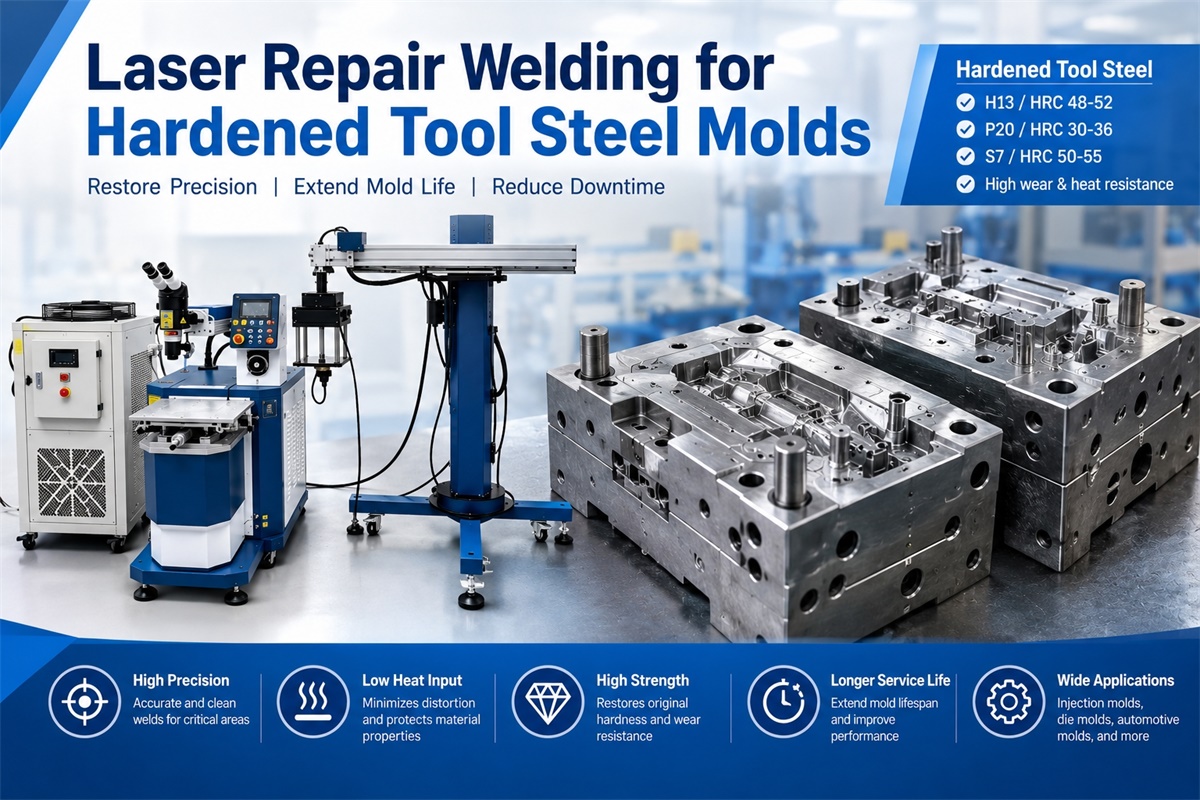
Hardened tool steel molds are designed for demanding production conditions, but even high-quality tooling can develop cracks, worn edges, chipped corners, scratches, and dimensional defects after repeated use.
Repairing hardened steel is more challenging than repairing softer metals because excessive heat can affect hardness, create thermal stress, or cause distortion.
Laser repair welding provides a precise method for rebuilding damaged areas while keeping heat input highly localized. This makes it particularly suitable for repairing hardened injection molds, die-casting dies, and other precision tooling.
Why Use Laser Welding for Hardened Tool Steel?
Hardened tool steels are selected for their hardness, wear resistance, toughness, and dimensional stability. During conventional welding, however, the relatively large heat-affected area can create problems around the repair.
Laser welding delivers concentrated energy to a small area. With suitable parameters, it allows filler material to be deposited precisely where the material has been lost.
The main advantages include:
-
Low and highly controlled heat input
-
Small heat-affected area
-
Precise material deposition
-
Reduced risk of mold distortion
-
Suitable for small repair areas
-
Good control of repair depth
-
Suitable for fine mold features
-
Easier post-welding machining and polishing
For expensive hardened molds, these advantages can help extend tool life without replacing the entire component.
What Hardened Tool Steel Molds Can Be Repaired?
Laser repair welding can be used with many types of hardened tooling, depending on the material condition and repair requirements.
Common examples include:
-
H13 tool steel
-
Hardened P20 steel
-
S136 stainless mold steel
-
SKD11 tool steel
-
718 mold steel
-
Other hardened tool and die steels
The actual welding procedure should always be matched to the specific steel grade, hardness, heat-treatment condition, and filler material.
What Damage Can Laser Welding Repair?
Cracks
Localized cracks can sometimes be repaired by laser welding after the damaged material has been properly identified and prepared.
Simply welding over the visible crack is not recommended. The crack should be removed or prepared to provide a sound welding area.
Worn Edges
Parting lines, shut-off surfaces, and other high-contact areas can gradually wear during production.
Laser welding can rebuild the missing material before machining restores the original dimensions.
Chipped Corners
A chipped mold corner may affect parting, sealing, or the final geometry of the molded component.
Laser welding allows the missing material to be rebuilt in controlled layers.
Scratches and Dents
Small surface defects can be filled with a limited amount of filler material and subsequently ground or polished.
This is particularly useful when removing a large amount of surrounding steel would affect the original mold dimensions.
Dimensional Corrections
Laser welding can also add material where a mold requires a localized dimensional correction.
Instead of remanufacturing an entire mold component, only the required area needs to be rebuilt.
Laser Repair Welding Process
A typical hardened tool steel repair process includes several steps.
1. Inspect the Damage
First, determine the type, depth, and location of the defect.
The technician should also identify the tool steel grade, hardness, and heat-treatment condition.
2. Prepare the Repair Area
The damaged or cracked material may need to be removed through grinding, machining, or another suitable preparation method.
The repair area must be clean and free from oil, grease, oxidation, and other contaminants.
3. Select the Filler Material
Filler wire should be selected according to the substrate and the properties required after repair.
Important considerations include:
-
Hardness
-
Toughness
-
Wear resistance
-
Machinability
-
Polishing performance
-
Compatibility with the base material
For hardened molds, filler selection is particularly important because the repaired area may need to match the surrounding material as closely as practical.
4. Set the Laser Parameters
Laser parameters must be carefully controlled.
Depending on the machine and application, important parameters include:
-
Laser power
-
Pulse energy
-
Pulse duration
-
Pulse frequency
-
Spot size
-
Welding speed
-
Wire diameter
-
Wire feeding speed
For precision hardened-steel repair, using excessive energy can increase heat input and potentially affect the surrounding material.
5. Deposit the Filler Layer by Layer
The operator gradually rebuilds the damaged area.
For deeper defects, multiple thin layers are generally easier to control than attempting to fill the entire repair in a single operation.
A microscope or optical viewing system allows the operator to accurately observe the repair area during welding.
6. Machine the Repaired Area
After welding, excess filler material can be removed by machining, grinding, EDM, or other appropriate methods.
The repaired area is then returned to the required mold dimensions.
7. Polish and Inspect
For precision injection molds, the final surface may need grinding and polishing.
The repaired section should be inspected for:
-
Cracks
-
Porosity
-
Incomplete fusion
-
Dimensional errors
-
Surface defects
-
Hardness variation
The objective is to restore the mold’s function, dimensions, and surface quality, rather than simply filling the damaged area.
Can Hardened H13 Tool Steel Be Laser Welded?
Yes. H13 is one of the important tool steels used in mold and die applications and can be repaired using laser-based welding processes.
However, hardened H13 requires appropriate process control because its existing hardness and heat-treatment condition affect its response to welding.
Factors such as:
-
Initial hardness
-
Repair depth
-
Heat input
-
Cooling conditions
-
Filler material
-
Welding parameters
can influence the final repair quality.
This is why we recommend testing the actual H13 material before establishing production parameters.
Pulsed YAG vs Fiber Laser for Hardened Mold Repair
Both pulsed YAG and fiber laser systems can be used for tooling applications, but their characteristics differ.
| Feature | Pulsed YAG Laser | Fiber Laser |
|---|---|---|
| Fine repair | Excellent | Excellent |
| Pulse control | Excellent | Depends on system |
| Small defects | Excellent | Good to excellent |
| Heat control | Excellent | Good |
| High-speed welding | Moderate | Excellent |
| Fine mold features | Very suitable | Application dependent |
| Larger repair areas | Moderate | Better suited |
For small, precision-critical repairs on hardened molds, a pulsed YAG laser welding machine is a strong choice because the operator can precisely control the energy delivered to each pulse.
For larger repair areas or applications where welding speed is more important, fiber laser technology can provide advantages.
How Much Laser Power Is Needed?
There is no universal laser power for hardened tool steel repair.
The required capacity depends on:
Material + hardness + defect size + repair depth + filler wire + required productivity
For example, repairing a small scratch on a hardened mold requires a very different process from rebuilding a large missing corner.
For this reason, simply choosing the highest-power machine is not necessarily the best approach.
For precision mold repair, energy control, spot size, optical visibility, and positioning accuracy can be more important than maximum power.
Laser Welding vs TIG for Hardened Tool Steel
TIG welding can repair tool steels, but it generally introduces more heat into the surrounding area.
Laser welding provides a more localized energy source, which can be advantageous when repairing hardened precision molds.
| Feature | Laser Welding | TIG Welding |
|---|---|---|
| Heat input | Highly localized | Generally higher |
| Heat-affected area | Small | Larger |
| Precision | Very high | Good |
| Fine features | Excellent | More difficult |
| Localized repair | Excellent | Good |
| Distortion control | Better | More challenging |
| Material deposition | Highly controlled | Manual |
The choice should ultimately be based on the actual repair requirements, but laser welding is particularly attractive when precision and heat control are critical.
How to Choose a Laser Welding Machine for Hardened Molds
When selecting a machine, look beyond the advertised wattage.
We recommend evaluating:
Laser Control
The machine should provide stable and precise control of power or pulse energy.
Spot Size
A small and adjustable spot is valuable for repairing fine mold features and localized defects.
Microscope System
Clear magnification allows the operator to position the laser and filler wire accurately.
Positioning Accuracy
A stable X/Y/Z system helps maintain accurate laser positioning during repair.
Filler-Wire System
Depending on the application, manual or automatic wire feeding can be selected.
Material Testing
The most important step is to test the machine using your actual hardened tool steel and filler material.
Why Choose Our Laser Mold Welding Machine?
As a laser mold welding machine manufacturer, we can help customers evaluate their actual mold repair requirements before purchasing.
We can test:
-
H13 and other hardened tool steels
-
Different mold hardness conditions
-
Various defect sizes
-
Different filler wires
-
Different laser parameters
-
Post-welding machining and polishing
This allows us to recommend a suitable machine configuration based on the actual application rather than simply recommending a higher-power laser.
Frequently Asked Questions
Can laser welding repair hardened tool steel molds?
Yes. Laser welding can repair many localized defects in hardened tool steel molds, including cracks, scratches, worn edges, chipped corners, and dimensional defects.
Can hardened H13 be repaired by laser welding?
Yes, but the welding parameters and filler material should be matched to the actual H13 hardness and heat-treatment condition.
Will laser welding soften hardened tool steel?
The thermal cycle can affect the microstructure and hardness around a weld. Proper laser parameters and thermal control are therefore important when repairing hardened tooling.
Can laser-welded mold repairs be polished?
Yes. With suitable filler material and welding conditions, the repaired area can be machined, ground, and polished to restore the required mold surface.
Is YAG laser welding suitable for hardened molds?
Yes. Pulsed YAG laser welding is particularly suitable for precision mold repair because it provides fine control over pulse energy and localized heat input.
Final Takeaway
Laser repair welding is a highly precise solution for repairing hardened tool steel molds.
By concentrating laser energy on the damaged area, we can rebuild worn, cracked, chipped, or undersized sections while minimizing unnecessary heating of the surrounding mold.
For hardened H13, P20, S136, SKD11, and other tool steels, the key to a successful repair is not simply choosing a high-power laser. Material condition, filler wire, pulse energy, spot size, heat input, and post-welding finishing all need to be considered together.
If you are repairing hardened molds, we recommend sending us your mold material and repair sample for testing. We can then help determine the appropriate laser welding configuration and parameters for your application.
Post time: Sep-07-2026
