
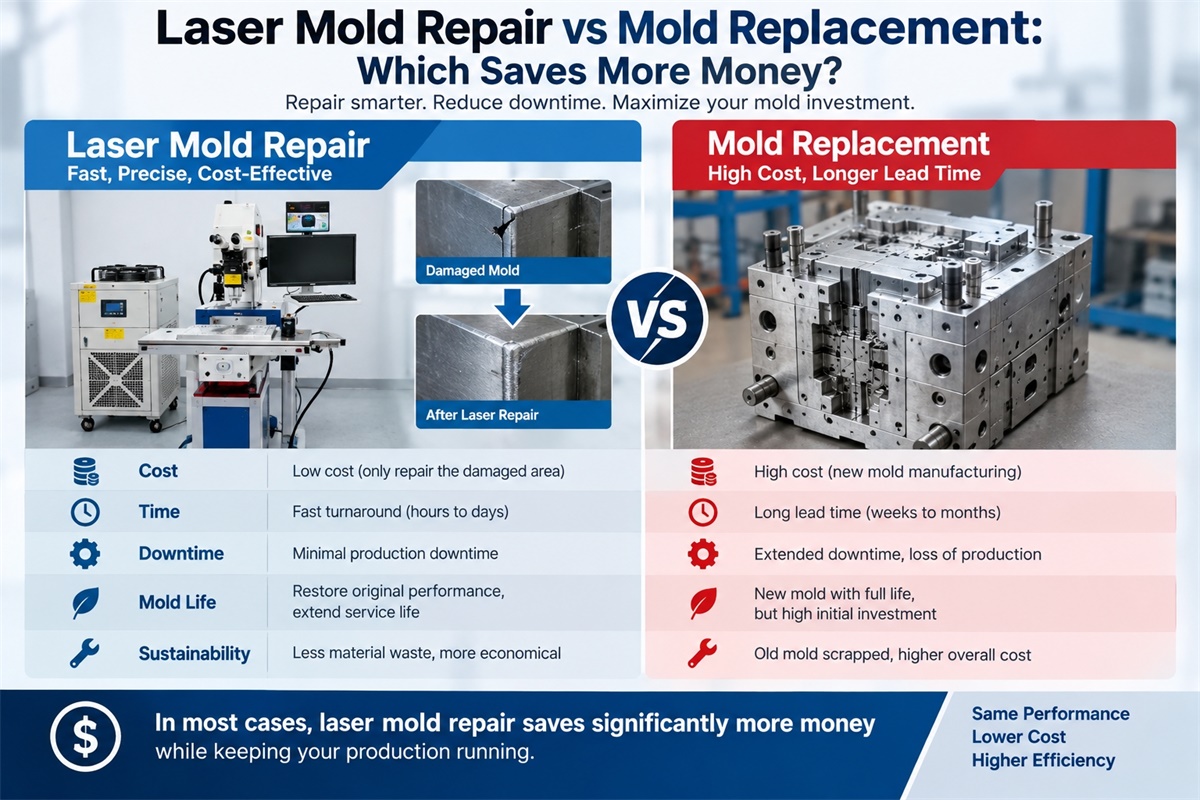
When an injection mold develops wear, cracks, chipped edges, scratches, or localized damage, manufacturers usually face two choices: repair the mold or replace it.
For many damaged molds, laser mold repair can be considerably more economical than manufacturing or purchasing a replacement mold. However, the best choice depends on the mold’s condition, repair area, production requirements, and expected remaining service life.
GotoUrl: https://www.dowinlaser.com/200w-400w-yag-spot-laser-mold-repairing-welding-machine-product/
What Does Mold Replacement Really Cost?
Replacing a mold is not simply the price of a new mold.
A replacement can involve:
-
New mold design or engineering
-
Material and machining costs
-
CNC machining and EDM
-
Heat treatment
-
Surface finishing and polishing
-
Mold assembly and testing
-
Transportation
-
Production downtime
For a complex injection mold, these costs can quickly become significant.
There is also an important hidden cost: lost production time.
If a damaged mold is removed from production and a new mold must be manufactured, the production line may remain idle while waiting for the replacement.
Why Can Laser Mold Repair Cost Less?
Laser mold repair focuses on the damaged area instead of manufacturing the entire mold again.
A typical repair may involve:
Cleaning → Damage Inspection → Laser Welding → Machining → Polishing → Mold Testing
The laser welding machine deposits compatible filler material precisely onto the worn or damaged section.
This means that most of the original mold structure can remain intact.
For localized defects, repairing only the damaged area can therefore require much less material, machining, and processing time than producing a completely new mold.
Laser Repair Can Reduce Production Downtime
For manufacturers, downtime can sometimes cost more than the repair itself.
Consider a mold with a chipped corner or a worn sealing surface. If the rest of the mold remains in good condition, replacing the entire mold may not be economically reasonable.
Laser repair can restore the damaged section and allow the mold to return to production without starting the entire manufacturing process again.
This is particularly valuable for:
-
Injection molds
-
Die-casting molds
-
Stamping dies
-
Precision tooling
-
High-value molds
-
Molds with long manufacturing lead times
Laser Mold Repair vs Mold Replacement
| Factor | Laser Mold Repair | Mold Replacement |
|---|---|---|
| Initial cost | Usually lower for localized damage | Usually higher |
| Material usage | Limited to damaged area | Entire mold |
| Production downtime | Potentially shorter | Usually longer |
| Existing mold preserved | Yes | No |
| Suitable for localized damage | Excellent | Often unnecessary |
| Complex mold reproduction | Not required | Required |
| Machining required | Usually localized | Extensive |
| Economic value | High for repairable molds | Better for severely damaged molds |
When Is Mold Repair the Better Choice?
Laser repair is often worth considering when the mold has localized damage but remains structurally sound.
Typical repair applications include:
Worn Mold Surfaces
Repeated production can gradually wear critical mold surfaces. Laser welding can rebuild the affected area before machining it back to the required dimensions.
Chipped Edges and Corners
Small chips do not necessarily mean that the entire mold needs to be replaced. Laser welding can precisely add material to damaged edges and corners.
Scratches and Small Defects
Fine surface damage can sometimes be repaired by controlled laser deposition followed by machining and polishing.
Dimensional Corrections
If a mold surface needs material added back to restore its original dimensions, laser welding can provide localized material deposition.
When Is Replacement Better?
Laser repair is not the answer to every mold problem.
Replacement may make more sense when the mold has extensive cracking, severe structural damage, major deformation, or has reached the end of its usable service life.
The key question is not simply:
“Can this mold be welded?”
Instead, ask:
“Is repairing this mold more economical than reproducing it?”
A professional inspection and repair test can help answer that question.
What About H13 and P20 Molds?
H13, P20, and other commonly used mold steels can be repaired using suitable laser welding processes and compatible filler materials.
However, welding parameters should be selected according to the actual steel condition, hardness, defect depth, filler material, and required surface properties.
For hardened tool steel molds, controlling heat input is particularly important because excessive thermal effects can increase the risk of cracking, distortion, or changes in the heat-affected area.
This is one reason why pulsed YAG laser welding machines are widely considered for precision mold repair applications where controlled, localized heat input is important.
How Much Money Can Laser Mold Repair Save?
There is no universal percentage because every mold is different.
A small repair on an expensive precision mold can have a very different cost structure from repairing a large area of a low-cost mold.
A better way to calculate the economics is:
Repair Cost = Laser Welding + Filler Material + Machining + Polishing + Downtime
Compare this with:
Replacement Cost = New Mold + Machining + Heat Treatment + Finishing + Testing + Downtime
If the mold is valuable and the damage is localized, laser repair can often provide a strong economic advantage.
FAQ
Is laser mold repair cheaper than replacing a mold?
For many localized defects, yes. Laser repair only rebuilds the damaged area, which can reduce material, machining, and production costs compared with manufacturing a new mold.
How much can laser mold repair save?
The savings depend on the mold value, damage size, repair difficulty, and downtime cost. A professional comparison of repair and replacement costs is more reliable than using a fixed percentage.
Can hardened molds be repaired with laser welding?
Yes. Hardened tool steels such as H13 can be repaired with appropriate laser welding processes. Welding parameters, filler material, and thermal control must be selected carefully.
Is laser mold repair suitable for injection molds?
Yes. Laser welding is commonly used for repairing worn surfaces, chipped edges, cracks, scratches, and dimensional defects on injection molds.
When should I replace a mold instead of repairing it?
Replacement may be more appropriate when the mold has extensive structural damage, severe deformation, widespread cracking, or is approaching the end of its service life.
How can I know whether my mold is worth repairing?
The best approach is to evaluate the mold condition, damaged area, steel type, hardness, required repair depth, and replacement cost. At Dowin, we can also evaluate your repair requirements and test suitable laser welding parameters on your sample.
Conclusion
Laser mold repair can save more money than mold replacement when the damage is localized and the remaining mold structure is in good condition.
Instead of reproducing an entire mold, laser welding allows us to rebuild only the damaged area and then restore the required dimensions through machining and polishing.
For high-value injection molds and hardened tool steel molds, this can reduce both repair costs and production downtime.
At Dowin, we manufacture YAG pulse laser mold repair welding machines for precision mold repair. If you have a damaged mold, send us the mold details, photos, material information, and repair requirements. We can help evaluate whether laser repair is a practical alternative to replacement.
Post time: Sep-10-2026
