
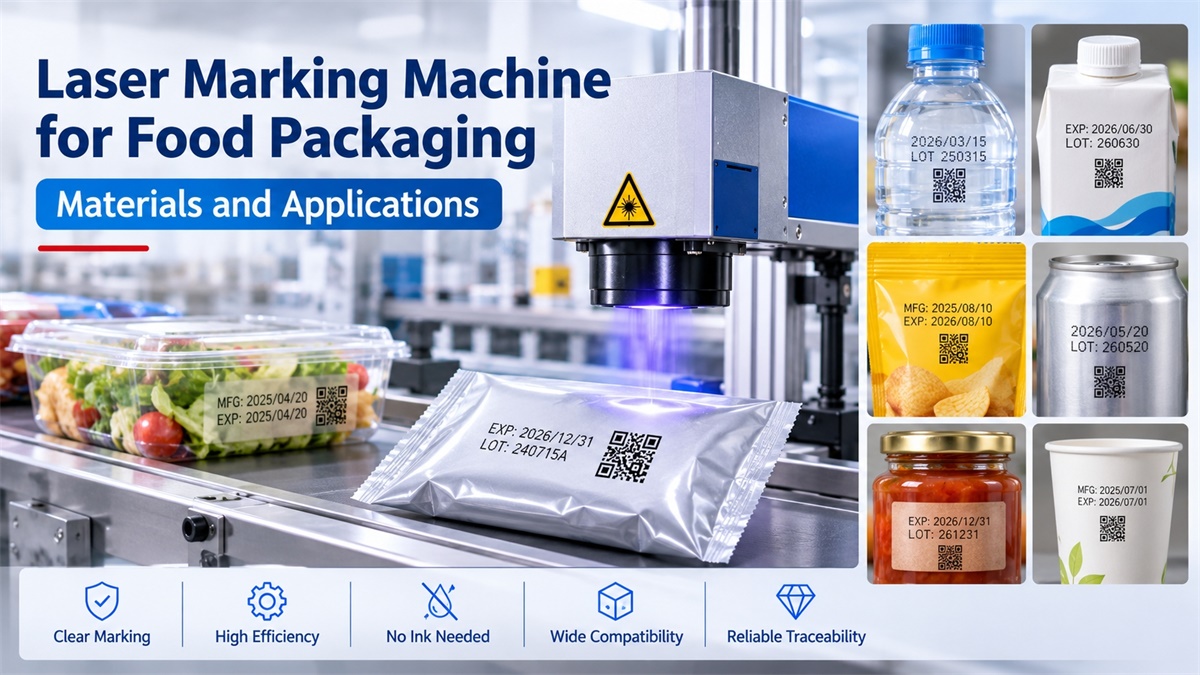
Food packaging manufacturers need clear, consistent product identification throughout the production process. Production dates, expiration dates, batch numbers, QR codes, and barcodes all play an important role in product traceability and quality control.
A laser marking machine for food packaging can apply this information directly to compatible packaging materials without using traditional printing ink or ribbons. When integrated with a conveyor or packaging line, an online laser marking system can mark products automatically as they move through production.
However, not every packaging material responds to the same laser wavelength. Flexible packaging film, plastic bottles, paper cartons, glass containers, and metal cans each have different marking requirements. Choosing the right laser technology requires understanding the material, the desired marking result, and the production environment.
1. Common Food Packaging Materials for Laser Marking
Before selecting a laser marking machine, manufacturers should identify the exact material and surface that need to be marked. Packaging may contain several layers, coatings, labels, or printing treatments, all of which can affect the result.
Flexible Plastic Packaging Film
Flexible packaging is widely used for snacks, frozen food, coffee, meat products, and other consumer goods.
Common materials include:
-
PE (Polyethylene)
-
PP (Polypropylene)
-
PET (Polyester)
-
BOPP (Biaxially Oriented Polypropylene)
-
Laminated multilayer films
Laser marking can be considered for production dates, batch numbers, and other identification information on suitable films. CO2 and UV lasers are potential options, depending on the film structure, coating, color, and required contrast.
For multilayer packaging, testing is particularly important. A laser may affect the outer layer without producing a readable mark, or excessive energy may damage the packaging structure.
The goal is to create a clear code without weakening the film, affecting its barrier properties, or compromising the sealing area.
Plastic Bottles and Caps
Plastic bottles are common in bottled water, beverages, cooking oil, sauces, and liquid food products.
Typical materials include PET, HDPE, PP, and other packaging plastics. Laser marking applications may include:
-
Production dates and expiration dates
-
Batch and lot numbers
-
QR codes and barcodes
-
Product identification information
CO2 and UV laser marking machines are both worth evaluating for compatible plastic packaging. The best option depends on the bottle material, color, surface condition, and required marking contrast.
For high-speed bottle production, a flying laser marking system can apply codes while bottles move along the conveyor.
See Dowin’s CO2 Flying Laser Marking Machine for Plastic Water Bottles for an example of an online marking configuration.
Paper and Cardboard Packaging
Paper cartons, cardboard boxes, and paper labels are widely used for food packaging and secondary packaging.
Common applications include marking:
-
Manufacturing and expiration dates
-
Batch numbers
-
Product codes
-
Barcodes and QR codes
CO2 laser marking is commonly considered for compatible paper-based materials. It can create visible marks without ink, but the result depends on paper composition, surface coating, color, and laser settings.
Manufacturers should check whether the marking process causes excessive discoloration, burning, or damage to the packaging.
Glass Bottles and Containers
Glass packaging is used for sauces, beverages, oils, preserves, and premium food products.
Laser marking may be used for product identification, batch information, or decorative and traceability-related markings. However, glass marking requires careful evaluation because the result depends on glass composition, surface treatment, container geometry, and the desired appearance.
A laser configuration suitable for plastic packaging should not automatically be assumed suitable for glass bottles. Sample testing is necessary to determine whether the required contrast and durability can be achieved without unacceptable surface damage.
Aluminum Cans and Metal Packaging
Aluminum cans, metal lids, and other metal packaging components may require production codes, batch numbers, or traceability information.
Fiber laser technology is commonly used for metal marking. However, the suitability of a fiber laser depends on the metal surface, coating, lacquer, printing layer, and whether the marking must be applied before or after packaging.
For coated or printed metal packaging, testing is needed to confirm that the laser creates the intended mark without damaging the protective layer or affecting product quality.
2. Which Laser Technology Is Suitable for Food Packaging?
The three main laser technologies to evaluate are CO2, UV, and fiber lasers. Their suitability depends on how the laser wavelength interacts with the packaging material.
| Laser Type | Typical Material Applications | Common Packaging Uses |
|---|---|---|
| CO2 Laser | Compatible paper, cardboard, and selected plastics and films | Cartons, labels, plastic bottles, packaging film |
| UV Laser | Selected plastics and materials requiring fine marking | Plastic bottles, caps, selected food packaging |
| Fiber Laser | Compatible metals and selected other materials | Aluminum components, metal lids, metal packaging |
CO2 Laser Marking Machine
CO2 lasers are widely used for processing non-metallic materials. In food packaging, they are worth considering for compatible paper, cardboard, labels, and selected plastic packaging.
Typical applications include:
-
Date marking on suitable plastic bottles
-
Coding on cardboard cartons
-
Marking on compatible packaging films
-
Production information on labels
For manufacturers handling large quantities of packaging, a CO2 flying laser marking machine can be integrated into an automated production line.
Dowin’s CO2 Flying Laser Marking Machine is designed for production-line applications such as marking dates, batch numbers, QR codes, and barcodes on compatible packaging materials.
UV Laser Marking Machine
UV laser marking is often considered when manufacturers need fine marking on selected plastics or materials where a lower thermal impact is desirable.
Potential applications include:
-
Plastic bottles and caps
-
Selected food packaging materials
-
Fine text and small identification codes
-
QR codes and barcodes on compatible surfaces
UV laser marking uses a 355 nm wavelength. Its interaction with a material differs from that of a CO2 or fiber laser, which can make it suitable for certain plastic marking applications.
Dowin’s Food Package Flying UV Laser Marking Machine is an example of a UV system configured for online marking. The machine uses a product sensor and production-line synchronization to mark moving products.
Fiber Laser Marking Machine
Fiber lasers are mainly associated with metal marking and selected compatible non-metal materials.
In food packaging, potential applications include:
-
Aluminum packaging components
-
Metal lids and caps
-
Metal identification plates
-
Certain coated or treated surfaces
Fiber laser marking is not automatically suitable for every aluminum can or metal package. The surface coating and required marking effect must be checked before selecting the machine.
For manufacturers working with multiple packaging materials, it is better to evaluate each material separately rather than assume that one laser source can handle every application.
3. Common Applications of Laser Marking in the Food Packaging Industry
Laser marking is primarily used for product identification and traceability. The exact application depends on the packaging format and production process.
Production Date and Expiration Date
Production dates and expiration dates are among the most common marking requirements in food manufacturing.
Laser marking can apply these details to compatible bottles, cartons, films, caps, and other packaging surfaces.
For production lines handling large volumes, online marking helps reduce manual coding operations and keeps the marking process connected to packaging production.
Batch and Lot Number Marking
Batch numbers allow manufacturers to identify products from a particular production run.
They are important for quality management, inventory tracking, and product recall procedures.
A laser marking system can receive or process variable information so that different batches receive the correct identification codes.
QR Code and Barcode Marking
QR codes and barcodes help connect physical products with digital traceability systems.
They may be used for:
-
Product identification
-
Batch tracking
-
Warehouse management
-
Supply chain information
-
Product authentication
The code must have sufficient contrast, suitable dimensions, and consistent positioning. Manufacturers should verify readability using the actual scanners and reading conditions used in their production or distribution process.
Logo and Product Information
Some food manufacturers also use laser marking to apply logos, short product information, or identification symbols.
This application is more dependent on the packaging material and the required visual appearance. It should not be confused with conventional full-color packaging printing.
4. Online Laser Marking for Food Packaging Production Lines
Food packaging production often involves continuous conveyor systems, filling machines, sealing machines, labeling equipment, and automatic inspection systems.
A laser marking machine can be integrated into this process to mark products without requiring operators to position each item manually.
A typical online laser marking system includes:
-
Laser source
-
Galvanometer scanning head
-
Marking controller and software
-
Photoelectric sensor
-
Conveyor or production-line interface
-
Encoder when conveyor-speed synchronization is required
The sensor detects the product and triggers the marking process. When products continue moving during marking, an encoder can provide movement information to help synchronize the laser with the conveyor.
There are two common operating methods.
Flying laser marking: The laser marks products while they continue moving. This is suitable for production lines where stopping each product would affect throughput.
Stop-and-go marking: The product moves to a defined position and pauses briefly while the laser applies the code. The product then continues to the next production stage.
The right configuration depends on product spacing, conveyor speed, code size, and the available marking time.
5. How to Choose a Laser Marking Machine for Food Packaging
Choosing a machine based only on laser power or advertised marking speed can lead to poor results. Manufacturers should evaluate the complete packaging and production requirements.
Identify the Exact Packaging Material
Provide the supplier with the actual packaging samples, including details about:
-
Material type and grade
-
Surface coating or printing
-
Color and transparency
-
Single-layer or multilayer construction
-
Surface finish
-
Packaging thickness, where relevant
A PET bottle, a laminated PET film, and a coated plastic container may respond differently even though they contain similar material names.
Define the Required Marking Content
Prepare the information that needs to be marked.
For example:
-
Short production date
-
Expiration date
-
Batch number
-
Serial number
-
QR code
-
Barcode
-
Logo
A short date code and a complex QR code require different marking time and space. The marking field and laser configuration should match the actual content.
Confirm the Production Line Speed
The required production speed is a key factor when selecting an online laser marking machine.
Do not evaluate the system only by the scanning speed listed in a technical specification. The actual production capacity depends on the complete marking content, product spacing, conveyor movement, and synchronization method.
Ask the supplier to test representative samples at the expected production speed.
Check Marking Contrast and Durability
A code that looks clear immediately after marking may not remain readable under actual packaging and distribution conditions.
Check the mark after exposure to relevant conditions, such as:
-
Handling and friction
-
Moisture or condensation
-
Cleaning processes
-
Storage and transportation
-
Other conditions specific to the product
For traceability codes, verify that the finished mark can be read consistently by the intended scanning equipment.
Consider Food Packaging Safety
Laser marking on packaging must be evaluated as part of the complete packaging process.
The marking position should not compromise the packaging seal, barrier performance, or product protection. Where packaging is intended for direct food contact, manufacturers should assess the applicable material and regulatory requirements.
Direct laser marking on food itself is a separate application and requires its own safety and process validation. A machine suitable for marking packaging should not automatically be treated as suitable for marking food products.
6. Laser Marking vs. Traditional Inkjet Coding
Laser marking and inkjet coding are both used for date and batch information in food packaging. Neither method is universally better.
| Comparison | Laser Marking | Inkjet Coding |
|---|---|---|
| Consumables | No printing ink required | Requires ink and may require solvent |
| Marking method | Alters or removes a compatible surface layer | Deposits ink onto the surface |
| Material compatibility | Depends on laser-material interaction | Depends on ink formulation and surface |
| Marking durability | Can produce permanent marks on suitable materials | Depends on ink adhesion and resistance |
| Color printing | Generally not intended for conventional full-color printing | Can support different ink colors |
| Maintenance | Requires optical and system maintenance | Requires ink-system maintenance |
| Production-line use | Available in online and flying configurations | Widely used in automated production lines |
Laser marking is worth considering when the packaging material is compatible and manufacturers want to reduce ink-related consumables.
Inkjet coding may be more practical when the production line handles many different substrates, requires colored codes, or needs a printing method that can accommodate a wider range of packaging materials with suitable ink formulations.
The most reliable comparison is a sample test using the actual packaging, marking content, and production speed.
7. Dowin Laser Marking Solutions for Food Packaging
Dowin provides CO2, UV, and fiber laser marking machine options for different industrial marking applications.
For food packaging manufacturers, the selection should start with the packaging material and the required production process.
CO2 flying laser marking machine
Suitable for evaluating date and batch marking on compatible plastic bottles, cartons, packaging films, and other non-metallic packaging materials.
Product reference: Dowin CO2 Flying Laser Marking Machine
UV flying laser marking machine
Worth considering for fine marking on selected plastic packaging materials and automated production-line applications.
Product reference: Dowin Food Package Flying UV Laser Marking Machine
To compare different laser marking configurations, visit the Dowin Laser Marking Machine Collection.
For a more specific packaging application, see Dowin’s Laser Marking Solutions for the Packaging Industry.
8. Frequently Asked Questions
Which laser is best for food packaging?
There is no single best laser for every type of food packaging. CO2 lasers are commonly considered for compatible paper, cardboard, and selected plastics. UV lasers are worth evaluating for selected plastics and fine marking. Fiber lasers are mainly used for compatible metal packaging components.
Can a laser marking machine print expiration dates on plastic packaging?
Yes, laser marking machines can apply expiration dates and other variable information to compatible plastic packaging. The correct laser source depends on the plastic type, color, surface treatment, and required contrast.
Can a laser mark food packaging film?
Yes, certain packaging films can be laser marked. However, multilayer films and coated materials require careful testing to ensure that the marking does not damage the packaging structure or affect its barrier and sealing performance.
Can a laser marking machine work with a food packaging production line?
Yes. A laser marking system can be integrated with a conveyor, product sensor, and encoder when required. It can operate in flying mode or stop-and-go mode, depending on the production process.
Does laser marking require ink?
No. Laser marking does not use printing ink or ribbons. It creates a mark through the interaction between the laser beam and a compatible material surface. However, the system still requires routine maintenance and may need suitable fume extraction.
Is laser marking suitable for aluminum food cans?
It can be suitable for certain aluminum surfaces and packaging configurations. The coating, lacquer, printing layer, and required marking result must be evaluated before choosing a fiber or other laser system.
What information should I provide when requesting a laser marking machine quotation?
Prepare the packaging material and samples, marking content, product dimensions, marking position, conveyor speed, and expected production capacity. If possible, provide photos or videos of the production line. These details help the supplier recommend a suitable laser source and online marking configuration.
Conclusion
A laser marking machine for food packaging should be selected according to the actual packaging material, marking requirements, and production-line conditions.
CO2, UV, and fiber lasers each have different application ranges. The correct choice is not determined by laser power alone, but by material compatibility, marking contrast, code readability, and production speed.
For manufacturers planning to introduce laser coding into food packaging production, testing actual packaging samples is the most reliable first step. It helps confirm the marking quality and avoid choosing a machine that cannot meet the requirements of the real production process.
Post time: Nov-02-2026
