
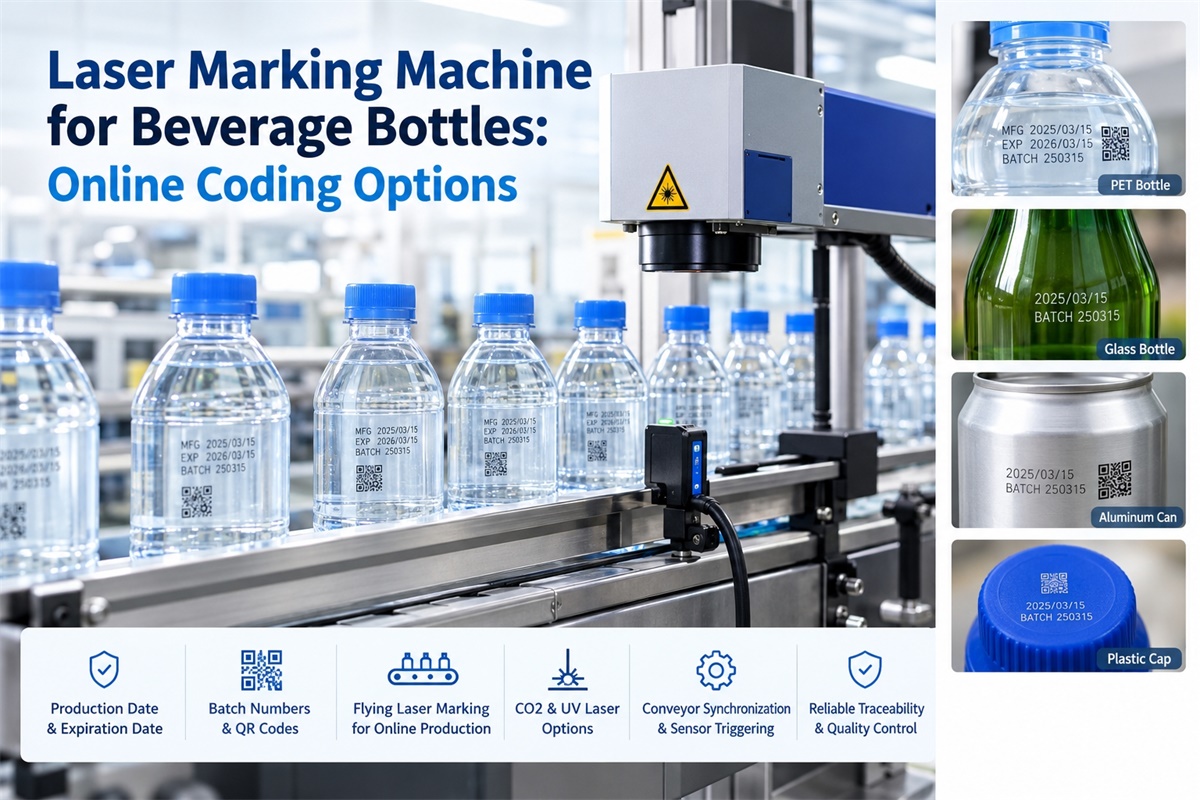
Beverage manufacturers need reliable coding solutions to print production dates, expiration dates, batch numbers, and traceability information on bottles moving along high-speed production lines. As packaging automation becomes increasingly important, a laser marking machine for beverage bottles offers an alternative to traditional inkjet coding.
Unlike conventional marking equipment that requires products to remain stationary, an online laser coding system can mark bottles while they move along a conveyor. Depending on the packaging material, CO2 and UV laser technologies are two important options to consider.
This guide explains how online bottle coding works, which laser technology is suitable for different beverage packaging materials, and what manufacturers should consider when selecting an industrial laser marking system.
1. Why Beverage Manufacturers Use Online Laser Coding
Beverage production lines operate continuously, and every bottle needs accurate product identification before packaging and distribution. Production dates, expiration dates, batch numbers, barcodes, and QR codes are essential for product traceability and quality management.
Traditional inkjet printing is widely used for bottle coding, but it requires regular ink replenishment and maintenance. Laser coding offers another approach by creating marks directly on suitable packaging surfaces without ink or ribbons.
A laser marking machine for beverage bottles is designed to work with a moving production line rather than requiring operators to stop and position every bottle individually.
An online configuration typically includes:
-
Laser marking source: Generates the beam required to mark the bottle surface.
-
Galvanometer scanning head: Directs the laser beam across the marking area.
-
Photoelectric sensor: Detects the arrival of each bottle.
-
Encoder: Tracks conveyor movement and provides speed information.
-
Control system: Coordinates marking content, timing, and movement compensation.
When a bottle passes the detection point, the sensor triggers the marking process. The encoder provides conveyor-speed feedback, allowing the marking system to coordinate the laser with moving products.
This makes flying laser marking suitable for automated beverage packaging lines where continuous operation and consistent code positioning are important.
2. Which Laser Is Suitable for Different Beverage Bottles?
The most important factor when choosing a laser coding machine is not simply the type of beverage, but the actual packaging material and surface condition.
PET bottles, glass bottles, plastic caps, and aluminum cans have different optical and thermal characteristics. A laser source that performs well on one material may not produce satisfactory results on another.
| Packaging Material | Laser Technology to Evaluate | Typical Application |
|---|---|---|
| PET plastic bottles | CO2 / UV | Production dates and batch codes |
| HDPE / PP bottles | UV / CO2, subject to testing | Identification and traceability |
| Glass bottles | CO2 / UV | Date and batch marking |
| Plastic bottle caps | UV / CO2 | Date codes and QR codes |
| Aluminum beverage cans | Fiber | Metal surface coding |
| Paper labels and cartons | CO2 / UV | Production and expiration information |
These are application directions, not universal compatibility guarantees. Actual results depend on material formulation, color, coating, surface treatment, and required contrast.
CO2 Laser Marking for PET Beverage Bottles
CO2 laser marking is an important option for PET beverage bottle coding. It is widely used for marking suitable plastic packaging, cartons, and other non-metallic materials.
For bottled water manufacturers, a CO2 flying laser marking machine can be configured to print:
-
Manufacturing dates
-
Expiration dates
-
Production batch numbers
-
Product identification codes
-
Barcodes and QR codes
One advantage of CO2 laser coding is that it does not require ink cartridges or printing ribbons. This can reduce recurring consumable costs and eliminate ink-related interruptions.
However, PET formulations and bottle colors vary. Transparent, colored, and specially treated bottles may respond differently. Sample testing is necessary to confirm marking contrast and readability.
For manufacturers looking for an established online configuration, Dowin offers a dedicated CO2 flying laser marking machine for plastic water bottle marking.
UV Laser Marking for Beverage Packaging
UV laser marking is another option, particularly when manufacturers need fine characters, compact codes, or controlled marking on selected plastic materials.
With a 355 nm wavelength, UV lasers can interact with certain materials through photochemical and low-thermal-impact processes. This makes them useful for applications where conventional thermal marking may produce excessive discoloration or unwanted surface effects.
Typical applications include:
-
Fine production date marking on selected plastic bottles.
-
Small QR codes and traceability information.
-
Marking on selected packaging films and containers.
-
Applications requiring fine details and controlled marking quality.
UV is not automatically better than CO2 for every plastic bottle. The correct choice depends on the actual material, desired contrast, marking speed, and code dimensions.
Dowin’s UV flying laser marking machine with conveyor is a relevant configuration to evaluate for online packaging applications.
What About Glass Bottles and Aluminum Cans?
Glass bottles and aluminum beverage cans should not be treated as identical applications to PET bottle coding.
Glass requires testing for marking contrast, surface quality, and the possibility of unwanted thermal stress. CO2 and UV technologies can both be evaluated depending on the glass composition and required result.
Aluminum cans are a different case. Fiber lasers are commonly used for direct marking on suitable metal surfaces. However, can coatings, surface treatments, curvature, and production speed all affect the final result.
For both applications, a machine should be selected only after testing the actual container and intended marking position.
3. How Does a Flying Laser Marking Machine Work on a Beverage Production Line?
A flying laser marking machine works differently from a conventional desktop laser marker.
A desktop machine normally marks a stationary object. An online laser coding system must complete the marking operation while the bottle continues moving along the conveyor.
The typical process involves five steps.
Step 1: Bottle Transportation
Beverage bottles move along the conveyor at a controlled production speed.
Step 2: Bottle Detection
A photoelectric sensor detects the approaching bottle and sends a trigger signal to the control system.
Step 3: Speed Synchronization
An encoder monitors conveyor movement and provides real-time speed feedback.
Step 4: Laser Marking
The galvanometer scanning head directs the laser beam onto the bottle surface. The software coordinates the marking operation with the movement of the production line.
Step 5: Code Inspection
The marked bottle continues to the next production stage. Depending on production requirements, an additional vision inspection system can verify code readability and positioning.
The key advantage is that bottles do not need to stop for individual marking operations.
However, successful online coding depends on more than laser power. Conveyor stability, bottle spacing, trigger accuracy, code complexity, and the available marking window all influence the final result.
4. What Information Can Be Marked on Beverage Bottles?
A beverage bottle laser coding system can handle different types of variable information.
| Marking Content | Purpose |
|---|---|
| Production date | Identifies the manufacturing date |
| Expiration date | Provides shelf-life information |
| Batch number | Supports production tracking |
| Serial number | Identifies individual products |
| QR code | Connects products with digital information |
| Barcode | Supports scanning and logistics |
| Product identification | Distinguishes product variants |
For most beverage factories, date and batch coding are the primary requirements.
QR codes and other machine-readable codes require additional attention. Their module size, contrast, quiet zone, marking position, and scanning distance must be considered together.
A code that looks clear to the human eye is not necessarily readable by an industrial scanner.
For this reason, I recommend testing the final code with the same type of scanner or vision equipment used in the actual production environment.
5. Important Factors When Choosing an Online Laser Coding Machine
Choosing a beverage bottle laser marking machine requires evaluating the entire production process, not just comparing laser wattages.
1. Production Line Speed
First, determine the actual conveyor speed and the number of bottles passing the marking station per minute.
A higher conveyor speed means less available marking time for each bottle.
The required marking speed also depends on the number of characters, code dimensions, and complexity of the content.
A simple date code and a detailed QR code cannot be treated as the same marking task.
2. Bottle Shape and Marking Position
Beverage bottles have different shapes, diameters, and surface curvatures.
Common marking positions include:
-
Bottle body
-
Bottle shoulder
-
Bottle neck
-
Bottle base
-
Bottle cap
The selected marking position affects the installation height, laser-head angle, focal distance, and code readability.
For curved bottle surfaces, sample testing should confirm that the complete code remains within the effective marking area.
3. Conveyor Synchronization
This is one of the most important considerations for an online laser coding system.
A machine without proper movement synchronization may produce stretched, compressed, or inconsistent codes when conveyor speed changes.
An encoder-based flying marking system helps coordinate marking with conveyor movement.
Dowin’s CO2 and UV flying configurations include encoder and sensor-based online marking features. These are worth evaluating when integrating laser coding into an existing bottling line.
4. Marking Contrast and Readability
The purpose of a production code is not simply to create a visible mark.
It must remain readable throughout the product’s distribution and storage process.
Testing should include:
-
Contrast under actual factory lighting.
-
Code readability after packaging.
-
Performance on wet or condensation-prone bottles.
-
Resistance to handling and abrasion.
-
Barcode and QR code scanning performance.
If the bottle surface is frequently wet, the actual marking location and production conditions must be evaluated carefully.
5. Installation Space and Laser Safety
A production line may have limited space between filling, capping, labeling, and packaging stations.
Before purchasing equipment, confirm the installation position, conveyor clearance, mounting structure, electrical supply, and extraction requirements where applicable.
Laser safety guarding and interlocks must also be considered as part of the complete installation.
6. Dowin Online Laser Marking Solutions for Beverage Bottles
For beverage manufacturers looking for an automated bottle coding solution, Dowin provides several laser marking configurations that can be evaluated according to packaging material and production requirements.
CO2 Flying Laser Marking Machine
Suitable for evaluating production date and batch coding on PET water bottles and other compatible non-metallic packaging.
View Dowin CO2 Flying Laser Marking Machine for Plastic Water Bottle Marking.
UV Flying Laser Marking Machine
A configuration to evaluate for selected plastic packaging, fine codes, and applications requiring controlled marking.
View Dowin UV Flying Laser Marking Machine with Conveyor.
For other material requirements, including metal marking and different industrial configurations, visit the complete Dowin Laser Marking Machine Collection.
My recommendation: If your primary application is PET bottled water coding, start by evaluating the Dowin CO2 flying laser marking machine. If you are marking selected plastic materials that require finer details or lower thermal impact, compare the UV configuration.
Do not select a laser source based on material name alone. Actual sample testing and production-line verification should determine the final configuration.
7. What Information Should You Provide When Requesting a Quotation?
To avoid receiving a generic machine recommendation, prepare the following information before contacting a supplier:
-
Bottle material: PET, HDPE, PP, glass, or another material.
-
Bottle color: Transparent, white, green, or other colors.
-
Production speed: Bottles per minute.
-
Conveyor speed: Meters per minute.
-
Marking content: Date, batch number, QR code, or barcode.
-
Marking position: Bottle body, neck, cap, or bottom.
-
Existing production line: Conveyor dimensions and available installation space.
Providing a sample bottle and a clear picture of the required marking content will make the equipment evaluation more accurate.
8. Frequently Asked Questions
1. Can a laser marking machine print production dates on moving PET water bottles?
Yes. A CO2 or UV flying laser marking system can mark suitable PET bottles while they move along a conveyor. A sensor detects the bottle, while an encoder tracks conveyor movement to coordinate the marking process.
2. Which laser is better for PET bottle marking, CO2 or UV?
Both can be suitable, depending on PET formulation, bottle color, surface treatment, and required marking quality. CO2 is an established option for PET bottle coding, while UV is worth evaluating when finer marking or lower thermal impact is required.
3. Can a flying laser marking machine print QR codes on beverage bottles?
Yes. It can mark QR codes, provided the laser configuration, marking speed, code dimensions, and surface contrast are suitable. The finished code should be verified using an actual QR code scanner.
4. Does online laser coding require stopping the conveyor?
No. A flying laser marking system is designed to mark products during continuous movement. Sensor triggering and encoder feedback help synchronize the marking process with conveyor speed.
5. Can one laser marking machine handle different bottle sizes?
In many cases, yes. Different bottle sizes can be accommodated through adjustments to the laser-head position, focal distance, marking parameters, and production-line settings. However, each bottle format should be tested before production.
6. Is laser coding better than inkjet printing for beverage bottles?
Laser coding eliminates ink and ribbon consumables and can produce permanent marks on suitable materials. Inkjet remains useful for certain wet surfaces, difficult packaging materials, and applications requiring flexible ink colors. The better choice depends on the packaging material, operating environment, production speed, and total operating cost.
7. Can the laser marking machine be integrated into an existing bottling line?
Yes. Online laser marking systems can be integrated into existing conveyor systems. Installation normally requires consideration of conveyor speed, sensor position, encoder connection, mounting structure, and laser safety protection.
Conclusion
A laser marking machine for beverage bottles is not simply a standard laser marker placed beside a conveyor. It is an online coding solution that must coordinate laser performance, bottle movement, detection signals, and marking requirements.
For PET bottled water production, CO2 flying laser marking is a practical starting point. UV laser marking offers another option for selected plastic packaging applications, while glass bottles and aluminum cans require separate material-specific evaluation.
The right equipment should be selected according to actual bottle samples, production speed, marking content, and integration requirements rather than laser power alone.
Post time: Oct-30-2026
