
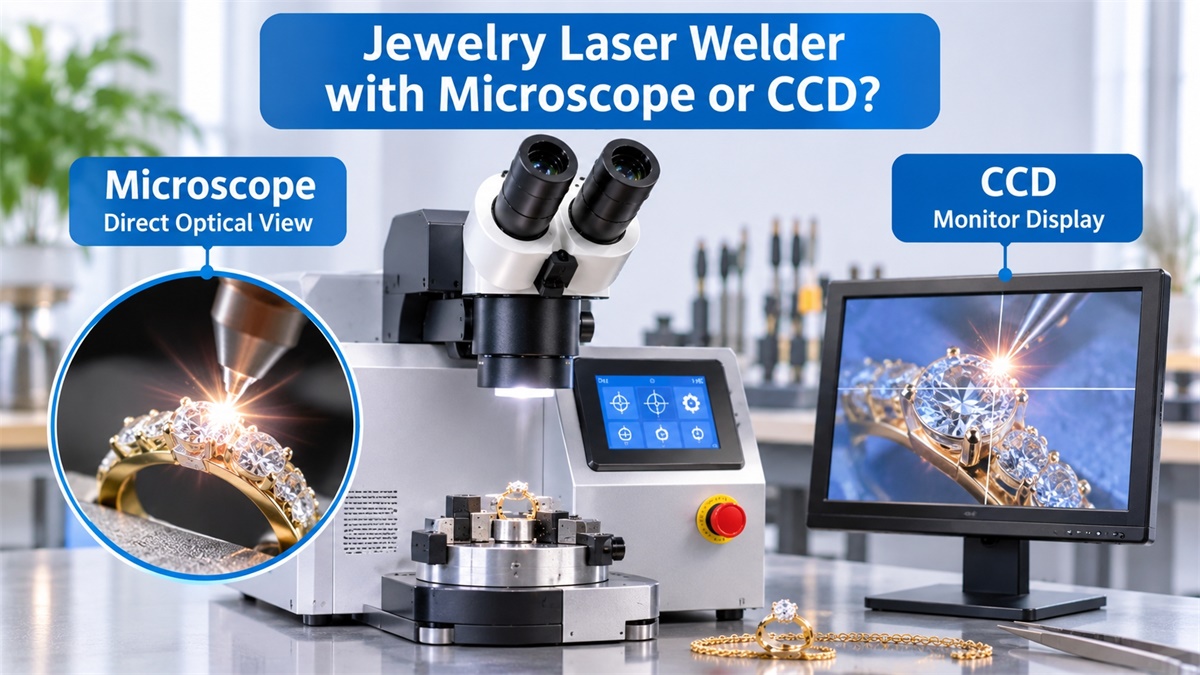
When buying a jewelry laser welding machine, one important question is whether to choose a microscope, a CCD camera system, or both. The observation system directly affects how operators position small jewelry components and monitor the welding process. Dowin offers several jewelry laser welding machines with microscope and CCD configurations to meet different workshop requirements.
1. What Does a Microscope Do on a Jewelry Laser Welder?
A microscope provides direct optical magnification of the welding area. The operator looks through the eyepieces to inspect the jewelry component and position the laser precisely.
This is particularly useful when working with small jewelry parts, such as:
- Fine gold and silver chains.
- Ring joints and narrow welding gaps.
- Small prongs and stone settings.
- Delicate metal components.
- Tiny cracks, holes, and casting defects.
The main advantage of a microscope is its direct optical observation. Operators can clearly inspect the welding point and control the positioning of small components.
2. What Does a CCD System Do?
A CCD system uses a camera to capture the working area and display the image on a screen. Instead of looking directly through microscope eyepieces, the operator can observe the welding position through a monitor.
Its main advantages include:
- Screen observation: Operators can monitor the working area on a display.
- Convenient positioning: The camera image helps operators identify the welding location.
- Improved working ergonomics: Screen observation can reduce the need to maintain a fixed viewing position through microscope eyepieces.
- Shared visibility: Other people can view the displayed working area during demonstrations or training.
However, CCD image quality depends on the camera, lens, magnification, lighting, and display configuration. Buyers should check the actual image quality rather than judging the system by the word CCD alone.
3. Microscope vs CCD: What Is the Difference?
| Comparison | Microscope | CCD System |
|---|---|---|
| Observation method | Direct optical viewing | Camera image displayed on screen |
| Magnification | Optical magnification | Camera and lens dependent |
| Working position | Looking through eyepieces | Looking at a display |
| Image presentation | Direct optical view | Electronic image |
| Best suited for | Direct inspection and precision positioning | Screen-based observation and demonstrations |
Neither system is automatically better in every situation. A microscope offers direct optical observation, while CCD provides a convenient screen-based view. The best choice depends on operator preference and the type of jewelry repair work.
4. Should You Choose a Microscope, CCD, or Both?
Choose a Microscope if:
- You prefer direct optical observation.
- You frequently repair tiny jewelry components.
- You want to inspect the welding point through magnified eyepieces.
- Your workshop mainly performs traditional precision spot welding.
Choose CCD if:
- You prefer observing the welding area on a screen.
- You want a more flexible viewing position.
- You frequently demonstrate machine operation to customers or train operators.
- Your preferred working method is screen-based positioning.
Choose Both if:
For professional jewelry repair workshops, a dual observation system can provide greater flexibility. Operators can use the microscope for direct optical inspection and the CCD display for screen-based observation.
This combination is particularly useful when different operators have different viewing preferences or when the machine is used for both production and training.
5. Recommended Jewelry Laser Welders with Microscope and CCD
If you prefer a machine equipped with both observation systems, consider the following Dowin models.
Dowin 150W Desktop Jewelry Laser Welder
The Dowin DW-150AWPro Desktop Jewelry Laser Welder features a microscope and CCD visual system.
Its main specifications include:
- Maximum laser power: 150W/200W.
- Laser wavelength: 1064nm.
- Adjustable spot diameter: 0.2–2mm.
- Pulse frequency: 1–20Hz.
- Pulse width: 0.2–10ms.
- Observation: Microscope + CCD.
- Cooling: Air cooling.
Dowin 200W 180J YAG Jewelry Laser Welder
For workshops requiring higher pulse energy, the Dowin DW-200W 180J YAG Pulsed Jewelry Laser Welder is another option.
It features:
- Maximum laser power: 200W.
- Maximum pulse energy: 180J.
- Standard microscope and CCD dual observation system.
- Adjustable LED ring shadowless lighting.
- 160mm electric lifting worktable.
- Optional D69 rotary fixture.
- Matched 1P water chiller.
These two models provide both microscope and CCD observation, allowing buyers to compare their machine structure, laser specifications, and working requirements.
6. What Should Buyers Check Before Ordering?
Before purchasing a jewelry laser welder, do not simply ask whether the machine has a microscope or CCD. Check the following details:
- What is the actual optical magnification of the microscope?
- Is the CCD image clear enough to identify small welding points?
- Does the machine support both observation methods simultaneously?
- Is the lighting sufficient to inspect reflective gold and silver surfaces?
- Can the observation system clearly show the welding area at different working positions?
- Can the manufacturer provide a real operating video?
Requesting a demonstration video of actual jewelry welding is a practical way to evaluate the observation system before placing an order.
7. Frequently Asked Questions
Q1: Is a microscope necessary for a jewelry laser welder?
A microscope is highly useful for precision jewelry welding because it allows operators to inspect small components and position the welding point accurately. It is particularly valuable for chain repairs, prong restoration, and fine jewelry work.
Q2: Can a CCD camera replace a microscope?
A CCD system can provide screen-based observation, but it does not necessarily offer the same optical viewing experience as a microscope. Some professional machines provide both systems to give operators more flexibility.
Q3: Is a dual microscope and CCD system worth buying?
For workshops with frequent precision welding jobs, a dual system can be worthwhile. It provides direct optical observation as well as screen-based viewing, making the machine more adaptable to different operators.
Q4: Does CCD improve welding accuracy?
CCD can help operators identify and position the welding area through a screen. However, actual welding accuracy also depends on laser spot size, optical alignment, machine stability, and operator experience.
Q5: Which observation system is better for gold jewelry repair?
Both systems can be used for gold jewelry repair. A microscope is suitable for direct inspection of fine welding points, while CCD provides convenient screen observation. For professional workshops, a combination of both is a practical option.
Conclusion
When choosing a jewelry laser welder, the microscope and CCD systems should be evaluated according to your working habits and repair requirements. A microscope provides direct optical magnification, while CCD offers screen-based observation. For professional jewelry workshops, a machine equipped with both systems can provide greater operating flexibility. Always check the actual image quality and test the machine with real jewelry samples before purchasing.
Post time: Nov-05-2026
