
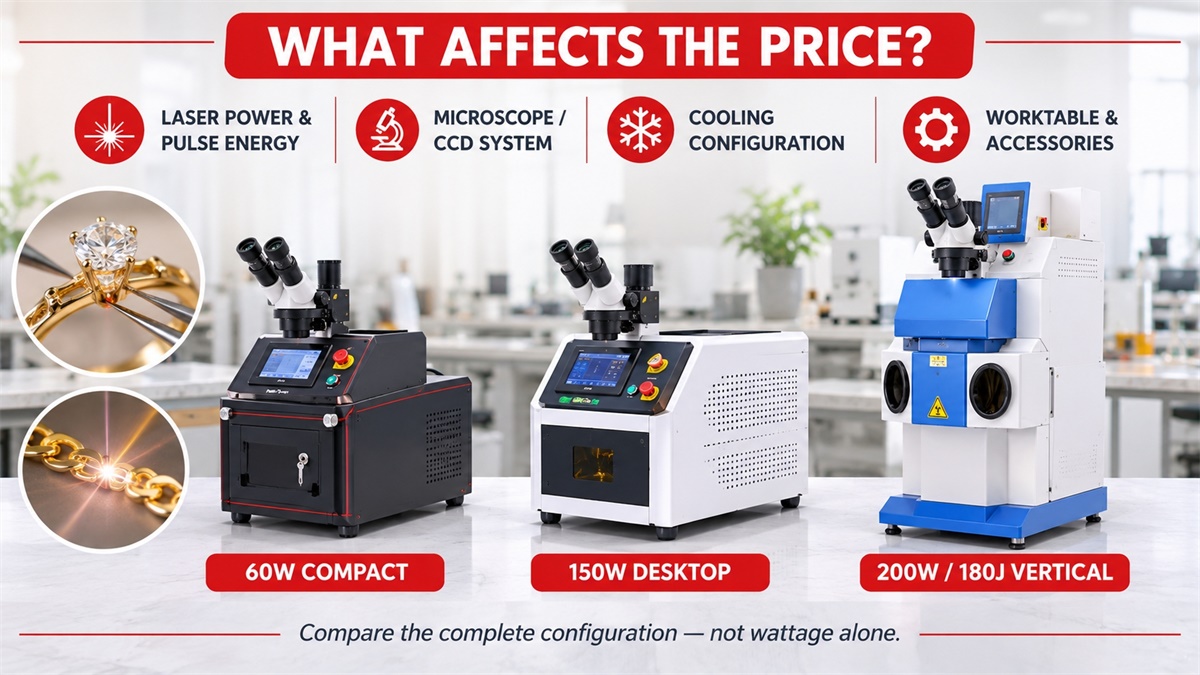
When searching for a jewelry laser welder, buyers often find that different suppliers offer significantly different prices, even for machines with similar power ratings. Why does a 100W jewelry laser welder cost less than some 150W or 200W models? And does a higher price always mean better welding performance? Before purchasing, it is important to understand the factors behind the cost. This guide explains what affects the price of a jewelry laser welding machine and what features are worth paying for.
1. Laser Power and Pulse Energy
Laser power is one of the first specifications buyers compare. Jewelry laser welders commonly come in different power configurations, such as 60W, 100W, 150W, and 200W.
Generally, higher-power machines offer greater flexibility for demanding welding applications, but rated power alone does not determine the final price or actual welding capability.
Buyers should also pay attention to pulse energy, pulse width, and pulse frequency. These parameters determine how laser energy is delivered to the metal during welding.
- 60W: Suitable for selected fine jewelry repair tasks and small workshops requiring a compact solution.
- 100W: A practical option for small jewelry repair shops handling delicate components and everyday repair work.
- 150W: Offers a wider application range for jewelry workshops handling chains, rings, prongs, and other repair jobs.
- 200W: Worth considering for more demanding applications, including thicker metal sections and higher-energy welding requirements.
For example, Dowin offers a 60W portable jewelry laser welder for delicate repair applications, as well as higher-power desktop and professional models.
One important point: Two machines rated at 200W may have very different pulse energy capabilities. Compare the complete laser parameters rather than purchasing based on wattage alone.
2. Laser Source and Optical System Quality
The laser source and optical components have a direct influence on the machine’s manufacturing cost.
A jewelry laser welder needs to deliver stable, controllable energy to a very small working area. Inconsistent energy output can make it difficult to maintain uniform welding results, especially when repairing valuable jewelry.
Important components include:
- YAG laser rod and laser cavity.
- Ceramic or metal reflective condenser cavity.
- Laser power supply and energy control system.
- Optical components and focusing system.
- Cooling and temperature control components.
Higher-quality optical components and a stable laser energy control system can increase manufacturing costs, but they are also important considerations for businesses that operate their machines every day.
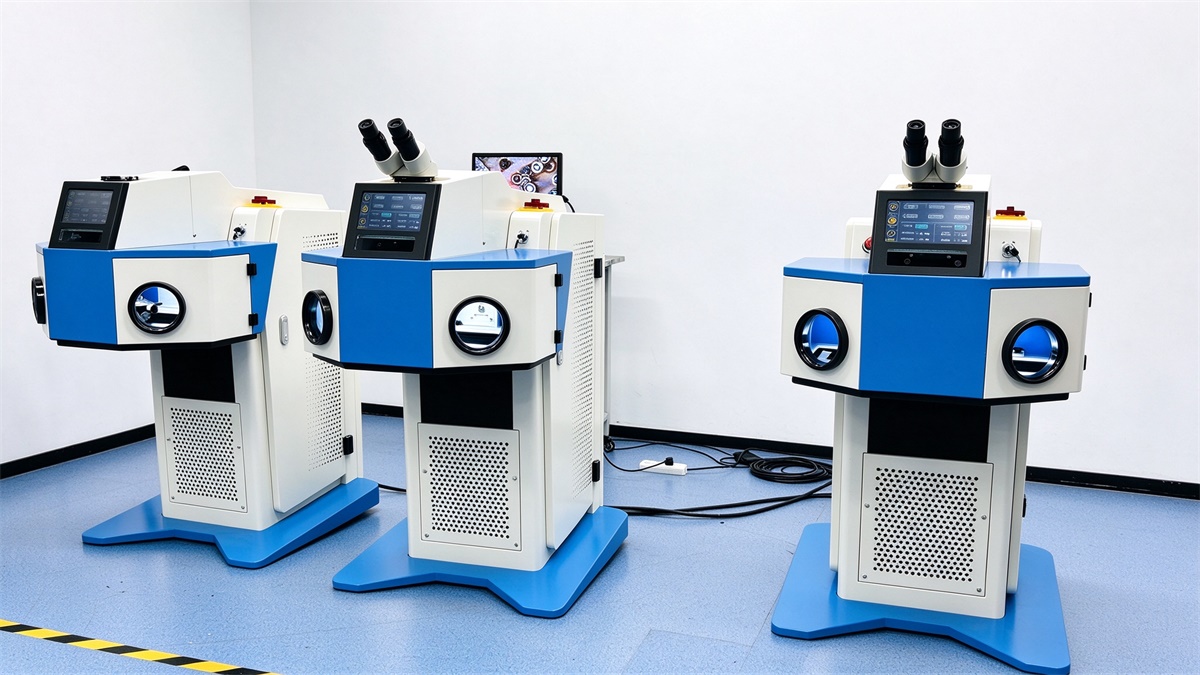
3. Microscope, CCD Camera, or Dual Observation System?
The observation system is another factor that affects the price of a jewelry laser welding machine.
During jewelry repair, operators need to position the laser accurately around small components without damaging nearby areas. Different observation configurations provide different levels of convenience.
Microscope Observation
A traditional microscope provides direct optical magnification. It allows jewelers to observe small welding points, delicate chains, ring joints, and prong settings in detail.
For many jewelry repair businesses, a quality microscope is an essential feature rather than an optional luxury.
CCD Camera and Display
A CCD camera displays the working area on a screen, making it easier to observe the welding position and monitor the process.
Microscope + CCD Dual Observation
Some advanced machines combine a microscope and CCD camera. This configuration provides more flexible observation options and can increase the equipment cost.
For example, Dowin’s 150W desktop jewelry laser welder features microscope and CCD observation, an LCD touch control panel, and an air-cooling configuration.
When comparing quotations, check whether the microscope, camera, display, and lighting system are included in the standard machine price.
4. Air Cooling vs. Water Cooling
The cooling system also affects the design, manufacturing cost, and maintenance requirements of a jewelry laser welder.
Air-cooled machines generally have a more compact configuration and do not require a separate industrial water chiller. They can be convenient for small workshops with limited space.
Water-cooled machines use a cooling system to manage operating temperatures. Depending on the laser configuration and workload, this can be an important consideration for stable operation during extended working periods.
| Comparison | Air Cooling | Water Cooling |
|---|---|---|
| Machine configuration | More compact | Includes water-cooling components |
| Installation | Generally simpler | Requires appropriate cooling setup |
| Maintenance | Airflow and cooling components need inspection | Coolant level, circulation, and chiller require inspection |
| Typical consideration | Compact workshops | Applications requiring dedicated water cooling |
Neither cooling method is automatically better for every application. Buyers should follow the manufacturer’s recommended configuration for the selected laser power and intended workload.
5. Worktable Design and Additional Features
Machine structure and working convenience can also create noticeable price differences.
Entry-level machines may use a relatively simple working table, while advanced models can include adjustable worktables, larger working spaces, improved lighting, and additional positioning features.
For professional jewelry workshops, these details can make everyday operation more convenient.
Consider the following features when comparing different machines:
- Electric lifting worktable.
- Adjustable LED shadowless lighting.
- Ergonomic operating position.
- Integrated control panel.
- Optional rotary fixture for repetitive welding tasks.
- Gas protection system.
For example, the Dowin 200W 180J YAG pulsed jewelry laser welder features microscope and CCD dual observation, an electric lifting worktable, adjustable LED shadowless lighting, and an optional rotary fixture.
These features make the machine worth considering for professional workshops that require greater flexibility in jewelry repair and production.
6. Manufacturer, Warranty, and After-Sales Support
Two jewelry laser welders may have similar technical specifications but different prices because of differences in manufacturing standards, quality control, warranty coverage, and technical support.
For international buyers, after-sales service is particularly important. A machine purchase should not end when the equipment arrives at the factory.
Before placing an order, check:
- Whether the supplier is an actual equipment manufacturer.
- What warranty coverage is included.
- Whether technical support is available remotely.
- Whether replacement parts can be supplied.
- Whether operating instructions and training are provided.
- Whether the machine has been tested before shipment.
A slightly cheaper quotation may not represent better value if the supplier cannot provide reliable technical support or replacement components.
7. What Other Costs Should Buyers Consider?
The machine price is not necessarily the total investment. International buyers should also calculate additional expenses before comparing quotations.
- Shipping: International freight and delivery costs depend on destination and machine size.
- Import duties: Taxes and customs charges vary between countries.
- Accessories: Chillers, fixtures, protective equipment, and other optional components may affect the final quotation.
- Electrical requirements: Confirm local voltage, frequency, and power compatibility.
- Installation and training: Check whether these services are included or charged separately.
- Maintenance: Consider consumable components, servicing, and long-term operating expenses.
When requesting quotations, always compare machines with the same configuration and delivery terms. Otherwise, a lower advertised price may not represent a lower total purchasing cost.
8. Which Dowin Jewelry Laser Welder Is Worth Considering?
Dowin provides several YAG pulsed jewelry laser welding machines for different workshop sizes and repair requirements.
60W Portable Jewelry Laser Welder
The Dowin 60W portable jewelry laser welder is designed for delicate jewelry repair and micro-welding applications. Its compact configuration makes it worth considering for jewelry stores and smaller repair workshops.
150W Desktop Jewelry Laser Welder
The Dowin 150W desktop model is designed for professional jewelry repair and fabrication. It features microscope and CCD observation, air cooling, and an adjustable spot range of 0.2–2 mm.
It is suitable for businesses looking for a versatile machine for fine gold, silver, platinum, and other metal repair applications.
200W 180J YAG Pulsed Jewelry Laser Welder
For more demanding welding applications, the Dowin 200W 180J jewelry laser welder provides higher pulse energy, microscope and CCD dual observation, an electric lifting worktable, and an optional rotary fixture.
It is particularly worth evaluating for professional jewelry manufacturers and repair workshops that need greater pulse energy and more flexible working arrangements.
Conclusion: What Is the Right Price for a Jewelry Laser Welder?
There is no single price that fits every jewelry laser welding machine. The final cost depends on laser power, pulse energy, optical components, observation systems, cooling configuration, machine structure, accessories, and after-sales support.
For small jewelry repair shops, a compact 60W or 100W machine may be sufficient for selected applications. Businesses handling a wider range of repair work may prefer a 150W model, while professional workshops with more demanding welding requirements can evaluate 200W high-energy configurations.
Instead of choosing the cheapest machine or simply purchasing the highest power rating, compare the complete specifications against your actual welding applications.
Looking for a jewelry laser welder quotation? Contact Dowin and provide your preferred laser power, main welding materials, typical jewelry repair tasks, and required observation system. We can recommend a suitable configuration and provide a quotation based on your requirements.
Frequently Asked Questions
1. Why do jewelry laser welders have different prices?
Price differences mainly come from laser power and pulse energy, laser source quality, optical components, microscope or CCD systems, cooling methods, machine structure, accessories, and after-sales service.
2. Is a 200W jewelry laser welder more expensive than a 150W model?
Not necessarily in every case, but 200W machines with higher pulse energy and more advanced configurations generally require a larger investment. Compare the actual pulse energy and included features.
3. Is a 100W jewelry laser welder enough for jewelry repair?
A 100W pulsed YAG jewelry welder can handle many selected small repair applications. However, suitability depends on metal type, thickness, joint structure, and required pulse energy.
4. Does a CCD camera increase the price of a jewelry laser welder?
Yes, adding a CCD camera, display, or dual observation system can increase the equipment cost. Whether the additional investment is worthwhile depends on operator preferences and repair requirements.
5. Is an air-cooled jewelry laser welder cheaper than a water-cooled model?
Air-cooled machines often have a simpler cooling configuration, while water-cooled systems include additional cooling components. The actual price difference depends on the complete machine design.
6. What information should I provide when requesting a jewelry laser welder quotation?
Provide your preferred power rating, materials, typical jewelry thickness, welding applications, observation requirements, cooling preference, destination country, and required accessories. This helps the manufacturer recommend a suitable configuration.
“`
Post time: Nov-13-2026
