
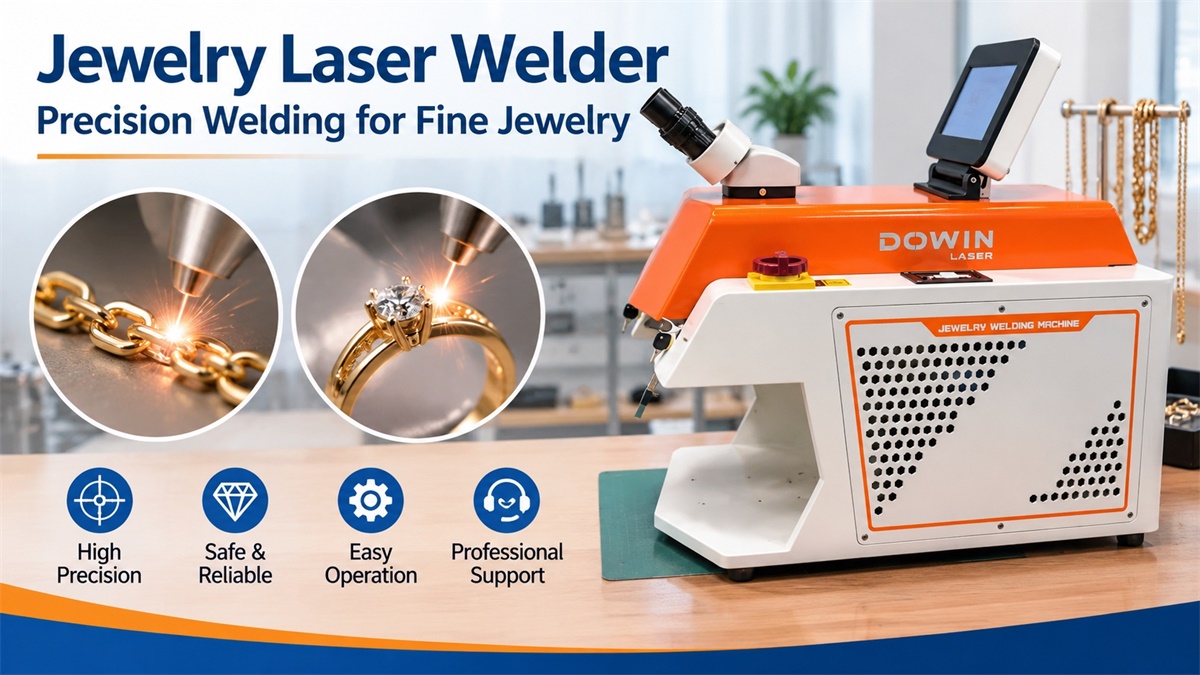
When choosing a jewelry laser welder, many buyers face the same question: Is 150W powerful enough for everyday jewelry repair, or should they invest in a 200W machine? A higher-power machine may offer more welding flexibility, but it does not necessarily mean better value for every workshop. For jewelry stores, repair studios, and small manufacturing businesses, a 150W desktop jewelry laser welder can be a practical solution for a wide range of precision welding jobs. Let’s examine its actual capabilities and limitations before making a purchasing decision.
1. What Can a 150W Jewelry Laser Welder Actually Do?
A 150W pulsed YAG jewelry laser welder is designed for localized welding on small metal components. Instead of heating an entire jewelry piece, it delivers concentrated laser energy to a specific welding point.
This makes it particularly useful for repair work where controlling the heat input and protecting the surrounding surface are important.
Common applications include:
- Broken gold chains: Reconnecting small chain links and repairing damaged joints.
- Ring repair: Repairing cracks, broken joints, and localized damaged areas.
- Prong repair: Building up or repairing worn prongs used to hold gemstones.
- Earring repair: Reattaching earring posts and small components.
- Bracelet repair: Repairing broken connections and small metal sections.
- Casting defect repair: Filling localized holes, cracks, and imperfections with suitable filler material.
- Fine jewelry fabrication: Joining small metal components with controlled laser pulses.
For workshops that mainly process gold, silver, and other precious metal jewelry, a properly configured 150W machine can cover many regular repair requirements.
2. Is 150W Enough for Gold and Silver Jewelry?
Yes, a 150W YAG jewelry laser welder can handle many gold and silver welding applications. However, actual welding performance depends on more than the rated laser power.
Material composition, workpiece thickness, joint geometry, pulse energy, pulse width, and welding technique all influence the result.
Gold Jewelry Welding
Gold jewelry repair is one of the most common applications for pulsed YAG laser welding. Jewelers frequently need to repair delicate chains, ring joints, small decorative components, and damaged settings.
A 150W machine provides adjustable pulse parameters, allowing the operator to control the energy delivered to the welding point.
It can be particularly useful when repairing small gold components where excessive heat may affect nearby decorative details.
Silver Jewelry Welding
Silver has different thermal properties from gold, so welding parameters need to be adjusted accordingly. A 150W jewelry laser welder can be used for selected silver jewelry repair and fabrication tasks.
Operators should test the appropriate pulse settings and filler material to obtain stable welding results without excessive melting or surface damage.
What About Platinum and Other Metals?
Laser welding can also be applied to selected platinum and other metal jewelry applications. However, the required energy and operating parameters vary according to the material and joint structure.
Always confirm the machine’s material compatibility and conduct sample welding before processing valuable jewelry.
3. Why Does Pulse Energy Matter More Than Wattage Alone?
This is something buyers should understand before comparing different jewelry laser welders.
Rated laser power, measured in watts, does not tell the complete story of a pulsed laser welding machine. Pulse energy, measured in joules, indicates how much energy is delivered in an individual pulse.
Other important parameters include:
- Pulse energy: Determines the energy available for each welding pulse.
- Pulse width: Controls how long the laser energy is delivered.
- Pulse frequency: Determines how many pulses can be delivered per second.
- Spot diameter: Influences the area receiving the laser energy.
For example, the Dowin 150W desktop jewelry laser welder provides the following specifications:
| Parameter | Specification |
|---|---|
| Maximum laser power | 150W / 200W configuration |
| Laser wavelength | 1064nm |
| Pulse frequency | 1–20Hz |
| Pulse width | 0.2–10ms |
| Spot adjustment range | 0.2–2mm |
| Observation system | Microscope + CCD |
| Cooling system | Air cooling |
| Control system | LCD touch control panel |
Note that the listed maximum power includes different configurations. Buyers should confirm the exact rated output and pulse energy of the quotation they receive.
The adjustable spot range is particularly useful for different repair requirements, from small jewelry details to larger localized welding areas.
4. Can a 150W Jewelry Laser Welder Repair Delicate Designs?
For many jewelry repair businesses, this is more important than simply having a higher power rating.
Consider a few typical working situations.
Repairing Fine Chains
Thin gold and silver chains have small connection points. Traditional soldering may heat a larger area than necessary, making it more difficult to protect nearby links.
A focused laser spot allows the operator to concentrate the welding energy around the damaged connection.
Welding Earring Posts
Earring posts are relatively small components that require accurate positioning. The operator needs a clear view of the joint and sufficient control over the laser pulse.
A microscope-based observation system is particularly valuable for this type of repair.
Repairing Ring Prongs
Prong repair requires controlled material deposition and careful finishing. A jewelry laser welder can help rebuild localized missing material using suitable filler wire.
When working near gemstones, the operator must assess the stone’s heat sensitivity, positioning, and protection requirements. Laser welding reduces the surrounding heat-affected area but does not eliminate the risk of gemstone damage.
5. Microscope + CCD: An Important Feature for Jewelry Workshops
A 150W jewelry laser welder is only as practical as its operating and positioning system.
When repairing small jewelry components, operators need to see exactly where the laser is acting. Poor visibility can lead to incorrect positioning and unnecessary rework.
The Dowin 150W desktop model combines a microscope and CCD observation system.
- Microscope: Provides direct magnified observation of small welding areas.
- CCD camera: Displays the working area on a screen.
- LCD touch panel: Provides convenient access to machine controls and parameter settings.
- Beam expansion system: Helps produce finer laser spots for precision jewelry work.
- Air cooling: Provides a compact cooling configuration without requiring a separate industrial water chiller.
These features make the machine suitable for workshops that prioritize precision, operator convenience, and a relatively compact installation.
6. 150W vs. 200W Jewelry Laser Welder: Which Should You Choose?
If your workshop mainly handles small jewelry repairs, a 150W machine may already meet most of your requirements. However, a 200W machine with higher pulse energy can offer more flexibility for demanding applications.
| Comparison | 150W Desktop | 200W / 180J Vertical |
|---|---|---|
| Typical positioning | Fine jewelry repair | Higher-energy repair and production |
| Laser system | Pulsed YAG | Pulsed YAG |
| Observation | Microscope + CCD | Microscope + CCD |
| Cooling | Air cooling | Water cooling |
| Working table | Desktop configuration | 160mm electric lifting table |
| Additional options | Compact workstation | Optional D69 rotary fixture |
| Key consideration | Everyday fine repair work | Higher pulse energy and extended production |
The Dowin 200W 180J YAG pulsed jewelry laser welder offers up to 180J pulse energy, dual microscope and CCD observation, adjustable LED shadowless lighting, and a 160mm electric lifting worktable.
Its matched 1P water chiller is designed to support continuous operation. It is worth considering for professional workshops that handle more demanding welding tasks or need additional working flexibility.
My recommendation is straightforward: do not pay for higher power unless your actual welding jobs require it. A correctly configured 150W machine is often a more economical choice for a workshop focused on routine fine jewelry repair.
7. Who Should Buy a 150W Jewelry Laser Welder?
Based on the applications and configuration, a 150W desktop jewelry laser welder is worth considering for the following businesses:
- Jewelry repair shops: Businesses regularly repairing broken chains, rings, earrings, and bracelets.
- Independent jewelers: Operators who need a versatile machine for small-batch repair and fabrication.
- Jewelry manufacturers: Workshops processing small metal components and precision welding jobs.
- Gold and silver workshops: Businesses that need controlled localized welding for precious metal products.
- Jewelry retailers: Stores looking to bring selected repair services in-house instead of outsourcing every welding job.
However, if your main business involves large ornaments, demanding pure gold welding, high-energy applications, or extended production schedules, it is worth evaluating a higher-energy configuration before purchasing.
Conclusion: Is 150W Enough?
For most workshops focused on fine jewelry repair, a 150W pulsed YAG laser welder can provide a practical balance between welding capability, precision, and equipment investment.
It can handle many common applications, including gold chain repair, silver jewelry welding, ring joint repair, earring post welding, and localized prong reconstruction.
The key is to evaluate pulse energy, spot adjustment, observation systems, and cooling configuration rather than judging the machine by its wattage alone.
For businesses with more demanding welding requirements, a 200W 180J machine may be a better investment. For everyday precision repair, however, a well-configured 150W desktop machine is often sufficient.
Considering a 150W jewelry laser welder for your workshop? Contact Dowin with photos or samples of your typical repair jobs, metal types, and workpiece dimensions. We can help evaluate whether the 150W desktop model is suitable or whether a higher-energy configuration would be more appropriate.
Frequently Asked Questions
1. Is 150W enough for a professional jewelry repair shop?
For many professional shops focusing on fine jewelry repair, yes. It can handle common tasks such as chain repairs, ring joints, earring posts, and localized prong reconstruction. More demanding applications should be tested before purchase.
2. Can a 150W jewelry laser welder weld gold and silver?
Yes. A properly configured 150W pulsed YAG machine can weld gold and silver jewelry. The appropriate pulse parameters depend on material composition, thickness, and joint structure.
3. Can a 150W jewelry laser welder repair platinum?
Selected platinum jewelry welding applications are possible, but the required parameters depend on the alloy, workpiece geometry, and welding requirements. Confirm compatibility with the manufacturer and perform sample tests.
4. Can a 150W laser welder repair jewelry near gemstones?
Localized laser welding can reduce heat transfer to surrounding areas. However, heat-sensitive gemstones may still be damaged. Each repair requires an assessment of stone type, position, and suitable protection methods.
5. What is the difference between a 150W and 200W jewelry laser welder?
The main difference is the available laser power and the capabilities of the complete pulse system. A 200W machine with up to 180J pulse energy provides higher-energy welding capability, while a 150W desktop machine is suitable for many fine jewelry repair tasks.
6. Is an air-cooled 150W jewelry laser welder reliable?
Air cooling can provide a convenient and compact configuration. Reliability depends on the cooling design, operating environment, machine quality, and workload. Follow the manufacturer’s recommended operating conditions.
“`
Post time: Nov-13-2026
