
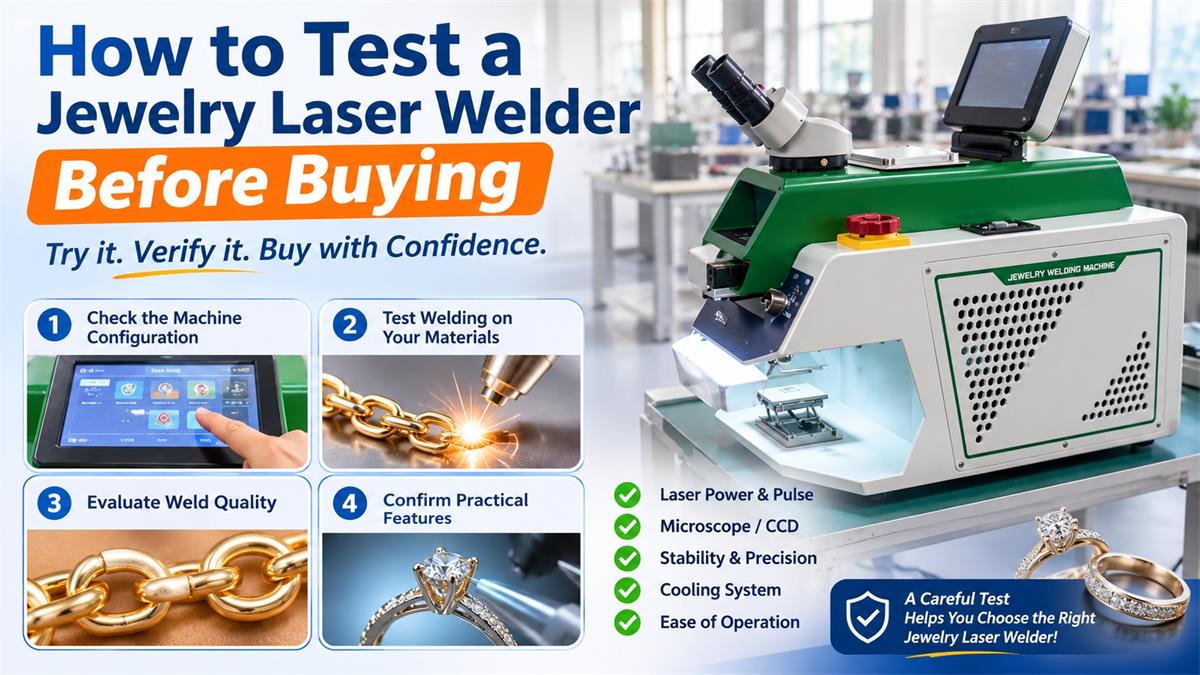
Buying a jewelry laser welder is an important investment for jewelry repair shops, goldsmiths, and jewelry manufacturers. However, reading technical specifications or watching a demonstration video is not enough to determine whether a machine is suitable for your business. Before placing an order, you should test the machine using your actual jewelry materials and typical repair applications. Whether you are considering a jewelry laser welding machine for a small repair shop or a professional production workshop, here are seven practical tests worth performing before making a purchasing decision.
1. Test the Machine with Your Actual Jewelry Materials
The first and most important step is to test the machine using the same metals you normally work with.
Different jewelry materials have different thermal and welding characteristics. A machine that produces excellent results on one type of gold alloy may require different settings when processing silver or platinum.
Prepare several samples before requesting a machine demonstration:
- Gold: Test the specific gold alloy and purity used in your business, such as 18K or 24K gold.
- Silver: Check whether the machine can produce clean and stable welds on your usual silver jewelry.
- Platinum: Test the actual platinum alloy and thickness used in your repair work.
- Stainless steel: Evaluate whether the equipment can handle additional metalworking applications relevant to your business.
Do not rely entirely on the supplier’s standard demonstration samples. Ask the manufacturer to test your own materials whenever possible.
2. Test Different Jewelry Repair Applications
A jewelry laser welder should be evaluated based on the jobs you expect it to perform, not just one successful welding demonstration.
Try the following applications:
Gold Chain Repair
Broken gold chains are a common repair job. Ask the supplier to weld several broken chain links using different link sizes.
Check whether the machine can deliver sufficient energy to create a solid connection without excessively melting the surrounding links.
Ring Joint Repair
Test welding on a cut or broken ring joint. Inspect the connection for uniformity, excessive melting, and visible gaps.
After welding, check whether the joint can withstand the appropriate mechanical handling and finishing process.
Earring Post Welding
Earring posts are relatively small components that require accurate positioning. Test whether the operator can clearly observe the connection and control the welding spot.
Prong and Setting Repair
Ask the supplier to demonstrate localized material buildup on a sample prong using suitable filler wire.
Check the operator’s ability to control material deposition and maintain the original shape of the setting.
For repairs involving mounted gemstones, first assess the stone’s heat sensitivity and use an appropriate protection procedure. A successful sample test without gemstones does not automatically prove that every mounted stone can be safely repaired.
3. Check Welding Strength and Surface Quality
A bright and attractive welding spot does not necessarily mean the joint is strong. Buyers should evaluate both the appearance and mechanical quality of the finished weld.
Here are several things to inspect:
- Weld penetration: Check whether the joint has sufficient fusion rather than simply attaching the surface.
- Weld consistency: Compare several welding points made under the same parameters.
- Surface appearance: Look for excessive spatter, deep craters, cracks, or unnecessary melting.
- Heat-affected area: Observe whether the surrounding metal has experienced excessive discoloration or deformation.
- Post-welding finishing: Check how much polishing or additional repair work is needed.
For a more reliable evaluation, ask the supplier to prepare sacrificial test pieces for appropriate bending, pulling, or sectioning tests. Do not perform destructive tests on valuable jewelry.
Different alloys and joint structures require different acceptance standards. The goal is to determine whether the machine can consistently achieve the welding quality your business needs.
4. Test the Laser Parameters and Adjustment Range
Laser power is important, but it is not the only factor determining jewelry welding performance.
Before buying, ask the manufacturer to demonstrate how different laser parameters affect the welding results.
Important parameters include:
- Laser power: The rated output power of the machine.
- Pulse energy: The energy delivered in each laser pulse.
- Pulse width: The duration of each pulse.
- Pulse frequency: The number of laser pulses delivered per second.
- Spot diameter: The size of the focused welding area.
Try different combinations of pulse energy, pulse width, and spot size on suitable test samples.
A good jewelry laser welder should provide practical parameter adjustment for different materials and welding applications.
Also, check whether the supplier can explain the recommended settings instead of simply providing a machine and asking the operator to experiment.
5. Check the Microscope, CCD, and Working Area
Observation quality is especially important in jewelry laser welding. Operators often work with tiny metal components, narrow joints, and delicate decorative structures.
During the demonstration, pay attention to the following features:
Microscope Clarity
Look through the microscope and check whether the working area is clear and properly focused. Make sure the operator can accurately position the jewelry under the laser.
CCD Observation
If the machine includes a CCD camera, check the screen image quality, positioning visibility, and overall convenience of operation.
Lighting Conditions
Test the working illumination. Good lighting helps operators identify small defects and position jewelry more accurately.
Working Space
Place several different jewelry pieces on the worktable. Check whether there is sufficient room for rings, bracelets, chains, and larger ornaments.
These details may seem minor during a short demonstration, but they can make a substantial difference during everyday production.
6. Run the Machine Continuously and Check Its Stability
One successful welding test cannot prove that a machine is suitable for daily commercial operation.
Ask the supplier to demonstrate a series of repeated welding operations rather than producing just one sample.
During the test, observe:
- Whether laser output remains consistent during repeated welding.
- Whether the cooling system operates normally.
- Whether the control panel responds correctly.
- Whether the microscope and positioning system remain stable.
- Whether any abnormal alarms or temperature issues appear.
For workshops with high production requirements, it is also worth discussing the machine’s recommended duty cycle and maintenance schedule with the manufacturer.
Air-cooled and water-cooled machines may have different operating requirements. Check that the cooling configuration is appropriate for the selected laser model and expected workload.
7. Check Safety, Accessories, and After-Sales Support
Besides welding performance, a professional jewelry workshop should evaluate the complete machine package.
Check the following items before confirming your order:
- Laser safety protection and appropriate operating procedures.
- Emergency stop and machine protection functions.
- Microscope and CCD configuration.
- Cooling system and required accessories.
- Argon gas connection and protection requirements, where applicable.
- Warranty terms and replacement parts availability.
- Remote technical support and operator training.
Also confirm that the exact configuration tested during the demonstration matches the machine listed in your quotation. Differences in laser power, pulse energy, observation systems, and cooling components can affect both performance and purchasing cost.
8. Which Dowin Jewelry Laser Welder Should You Test?
Dowin offers several YAG pulsed jewelry laser welding machines designed for different workshop requirements. Instead of choosing based on price or rated power alone, select a model that matches your typical repair applications.
Dowin 60W Portable Jewelry Laser Welder
The Dowin 60W portable jewelry laser welder is designed for delicate jewelry welding and repair.
It is worth evaluating for jewelry stores, small repair studios, and workshops that mainly handle fine, localized welding applications.
During testing, pay particular attention to small chain links, fine joints, and the machine’s ability to control the welding spot.
Dowin 150W Desktop Jewelry Laser Welder
The Dowin 150W desktop jewelry laser welder is designed for precision jewelry repair and fabrication.
Its configuration includes:
- 1064nm YAG laser system.
- 150W/200W maximum power configurations.
- 0.2–2mm adjustable spot range.
- Microscope and CCD observation.
- LCD touch control panel.
- Air-cooling system.
For this model, test different jewelry samples and pay attention to the microscope positioning, adjustable spot size, and parameter control. Confirm the exact power configuration when requesting a quotation.
Dowin 200W 180J Vertical Jewelry Laser Welder
For buyers who need higher pulse energy, the Dowin 200W 180J YAG pulsed jewelry laser welder is another model worth testing.
Its main features include:
- Up to 180J pulse energy.
- Microscope and CCD dual observation.
- Adjustable LED ring shadowless lighting.
- 160mm electric lifting worktable.
- Matched 1P water chiller.
- Optional D69 rotary fixture for batch processing.
During testing, pay special attention to demanding gold and silver welding applications, larger ornaments, and the machine’s ability to deliver consistent results across repeated welding operations.
9. A Practical Checklist Before Purchasing
Before confirming your order, use this checklist to evaluate the machine:
- Have you tested your actual gold, silver, or platinum samples?
- Have you tested broken chains, ring joints, or other typical repair jobs?
- Have you checked weld appearance and mechanical strength?
- Have you tested different pulse parameters?
- Is the microscope image clear and easy to operate?
- Does the machine have the correct cooling configuration?
- Have you confirmed the exact rated power and pulse energy?
- Have you checked the included accessories and warranty?
- Does the tested machine match the quotation?
Conclusion: Test Real Jewelry Samples Before Buying
Choosing a jewelry laser welder should involve more than comparing machine prices and technical specifications. The most reliable way to evaluate a machine is to test it with the materials, designs, and repair applications your business actually handles.
Pay attention to welding strength, surface quality, heat control, parameter adjustment, observation clarity, and operating stability. These factors will tell you much more about a machine’s suitability than its rated wattage alone.
Whether you are considering a compact 60W machine, a versatile 150W desktop model, or a higher-energy 200W/180J system, make sure the configuration matches your actual production requirements.
Want to test a Dowin jewelry laser welder before purchasing? Send us photos or samples of your jewelry, including the metal type, thickness, and repair requirements. Dowin can help arrange suitable welding tests and recommend a machine configuration based on your applications.
Frequently Asked Questions
1. What should I prepare before testing a jewelry laser welder?
Prepare samples of the metals and jewelry components you normally process, such as gold chains, silver rings, broken joints, and small metal parts. Include information about alloy composition and material thickness whenever possible.
2. How can I tell whether a jewelry laser weld is strong?
Inspect the weld visually and use suitable mechanical tests on sacrificial samples. Depending on the application, bending, pulling, or cross-section inspection can help evaluate joint quality.
3. Should I test a 150W or 200W jewelry laser welder?
Test the machine that best matches your expected workload. A 150W desktop model may be sufficient for many fine jewelry repairs, while a 200W/180J model offers higher pulse energy for more demanding applications.
4. Can I test a jewelry laser welder using my own gold?
Yes. Testing your own material is one of the best ways to evaluate compatibility. Ask the supplier to use an appropriate sample and record the parameters used during the demonstration.
5. Is a successful demonstration enough to confirm machine quality?
No. A single successful weld does not establish long-term stability or consistent performance. Ask for repeated welding tests, cooling system checks, and confirmation of the exact machine configuration.
6. Can a jewelry laser welder damage gemstones?
Yes, gemstones can still be affected by heat or laser exposure depending on their properties and position. The operator must assess the stone, use suitable protection, and determine whether it should be removed before welding.
7. Can Dowin test a jewelry laser welder before shipment?
Buyers can contact Dowin with their sample materials and welding requirements to discuss demonstration testing and machine configuration. Confirm the test arrangements and documentation with the sales team before ordering.
“`
Post time: Nov-13-2026
