
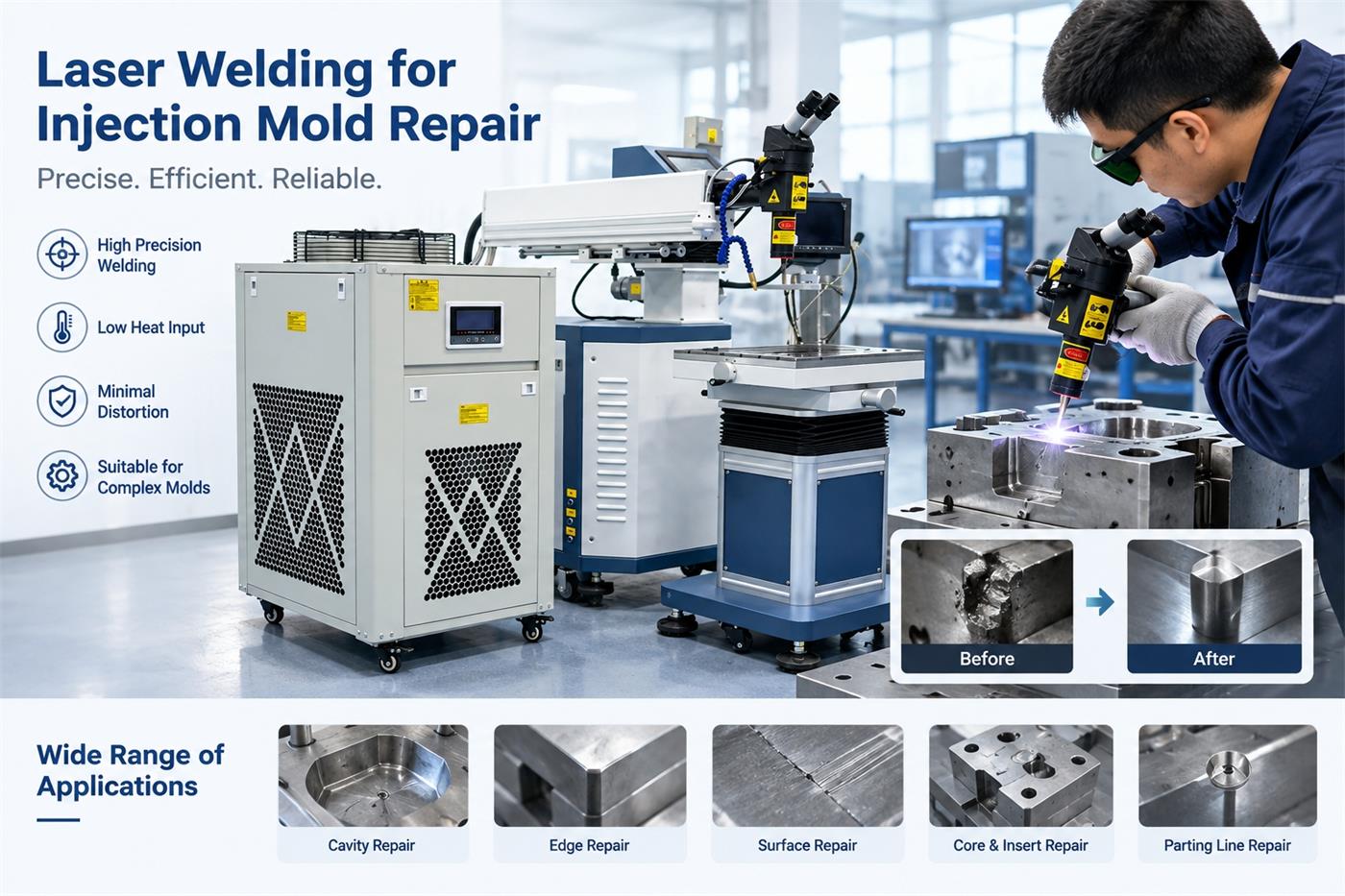
Electrical discharge machining (EDM) is widely used to produce complex cavities, ribs, sharp corners, and fine details in injection molds. However, EDM can sometimes leave behind a recast layer, microcracks, pits, rough areas, or localized dimensional damage.
When these defects affect the mold surface, simply polishing the area may not be enough. Laser welding can rebuild damaged material with controlled heat input, making it a practical method for precision injection mold repair.
For mold makers and repair workshops, the key is not only adding metal back to the damaged area, but also restoring the original geometry and surface condition.
What EDM Damage Can Occur on Injection Molds?
EDM damage varies depending on machining parameters, electrode condition, material, and the required surface finish.
Common problems include:
-
EDM pitting
-
Recast or white layer
-
Microcracks
-
Localized material loss
-
Over-burned areas
-
Damaged edges and corners
-
Small dimensional deviations
-
Surface defects after rough EDM
The problem can become more serious when aggressive EDM parameters are used. Excessive discharge energy can increase thermal damage and leave a thicker affected layer on the mold surface.
For precision injection molds, even a small damaged area can affect the final plastic part.
Why Use Laser Welding to Repair EDM Damage?
Traditional repair welding methods can introduce a relatively large amount of heat into the mold. This may cause distortion, additional machining, or changes to carefully finished mold surfaces.
A pulsed mold laser welding machine works differently. The laser delivers energy to a highly localized area, allowing the operator to deposit small amounts of compatible filler material where repair is required.
The main advantages include:
Precise Material Deposition
The operator can gradually rebuild a damaged cavity, edge, corner, or other small feature instead of adding excessive material.
Low Heat Input
Pulsed laser welding concentrates the energy around the welding point, helping limit the heat-affected area.
Suitable for Fine Mold Features
Small cavities, sharp edges, parting-line areas, and detailed structures can require a much more controlled repair process than conventional welding provides.
Less Risk of Mold Distortion
Reducing unnecessary heat is particularly important when repairing precision injection molds that must maintain dimensional accuracy.
How to Repair EDM Damage with Laser Welding
The actual repair process depends on the mold material and severity of the damage, but a typical workflow includes the following steps.
1. Inspect the EDM-Damaged Area
First, determine the type and extent of the damage.
Inspect the cavity or core for:
-
Pitting
-
Cracks
-
Burn marks
-
Recast material
-
Missing material
-
Dimensional changes
For critical molds, dimensional inspection should be performed before welding so the repair target is clearly defined.
2. Clean the Damaged Surface
The damaged area must be free from oil, dirt, oxides, and other contamination.
A clean welding surface helps improve the stability of the process and reduces the possibility of defects in the repaired area.
If the EDM process has created a severely affected surface layer, the damaged material may need to be removed mechanically before laser welding.
Laser welding should not simply be used to cover a defective surface layer without understanding the underlying condition.
3. Select a Compatible Filler Wire
Choosing the correct filler material is critical.
The filler should be compatible with the mold steel and the intended application. Common injection mold materials can include steels such as P20, H13, S136, and other tool steels, but the appropriate filler depends on the specific grade and required final properties.
For molds with demanding polishing requirements, the filler should also be selected with the final machining and polishing process in mind.
4. Set the Laser Welding Parameters
The operator then adjusts the welding parameters according to the damaged area.
Important parameters include:
-
Pulse energy
-
Pulse duration
-
Welding frequency
-
Spot diameter
-
Filler wire diameter
-
Welding position
-
Number of passes
Thin layers should generally be deposited progressively rather than attempting to rebuild a large damaged area in one pass.
This gives the operator better control over the repair geometry.
5. Rebuild the Damaged Geometry
The laser is directed at the damaged location while filler wire is introduced as required.
For an EDM-damaged corner, for example, the operator can gradually rebuild the missing material until the original profile is restored.
For pitting or localized erosion, small amounts of filler can be deposited into the damaged area.
The objective is to leave enough material for subsequent machining without creating unnecessary excess.
6. Machine and Polish the Repaired Area
Laser welding is only part of the mold repair process.
After welding, the repaired area normally needs to be:
-
Milled or ground if necessary
-
CNC machined
-
EDM finished where required
-
Polished
-
Dimensionally inspected
For high-precision injection molds, the final surface must match the surrounding mold geometry and finish.
Can Laser Welding Repair EDM Cracks?
It can repair certain localized EDM-related cracks, but the crack itself should not simply be welded over.
The crack must first be properly identified and prepared. Depending on its depth and location, the damaged material may need to be removed or the crack opened before laser welding.
For deeper or more extensive cracking, the repair strategy should be determined by an experienced mold repair technician.
The important principle is:
Remove or control the defective area first, then rebuild it with laser welding.
Which Injection Mold Areas Can Be Repaired?
Laser welding is particularly useful for localized damage in areas such as:
-
Mold cavities
-
Core surfaces
-
Parting lines
-
Sharp corners
-
Ribs
-
Edges
-
Slides
-
Inserts
-
Ejector-related areas
-
Textured or detailed surfaces
Its precision is especially valuable when the damaged feature is too small or geometrically complicated for conventional welding.
Laser Welding vs. Conventional Mold Repair Welding
For large structural repairs, conventional welding processes may still have advantages. However, for small precision defects, laser welding can provide better control over heat and material deposition.
| Feature | Laser Mold Welding | Conventional Welding |
|---|---|---|
| Heat input | Highly localized | Generally higher |
| Weld area | Very small and precise | Larger |
| Fine features | Excellent suitability | More difficult |
| Mold distortion | Lower risk when properly controlled | Greater thermal risk |
| Material addition | Highly controlled | Less precise |
| Small cavity repair | Highly suitable | Often difficult |
| Finishing work | Usually manageable | May require more rework |
The best process depends on the mold material, defect size, geometry, and repair requirements.
What Mold Steels Can Be Repaired?
Laser mold welding can be used with many commonly used tool and mold steels when the machine and filler material are correctly matched.
Examples include:
-
P20
-
H13
-
S136
-
718
-
Other compatible tool steels
However, steel grade alone is not enough to determine the welding parameters. Hardness, heat treatment, thickness, surface condition, and the location of the repair should also be considered.
Sample testing is recommended before repairing a critical production mold.
Why Laser Welding Is Valuable for Mold Repair
The biggest benefit is not simply that laser welding can add metal. It is the degree of control over where and how much material is added.
For injection mold manufacturers and repair shops, this can mean:
-
Repairing rather than replacing expensive mold components
-
Restoring damaged edges and corners
-
Correcting small dimensional errors
-
Repairing EDM-related defects
-
Reducing unnecessary thermal exposure
-
Supporting high-precision finishing and polishing
For expensive molds, being able to restore a localized defect instead of manufacturing a replacement component can significantly improve repair efficiency.
Final Thoughts
EDM is essential for modern injection mold manufacturing, but the resulting surface can sometimes contain pitting, recast layers, microcracks, or localized material loss.
Laser welding provides a precise method for rebuilding these damaged areas, particularly when the repair involves small features, sharp edges, cavities, or other precision mold surfaces.
The most reliable repair process combines proper inspection, surface preparation, compatible filler selection, controlled pulsed laser welding, and final machining or polishing.
For mold repair companies looking to repair P20, H13, S136 and other injection mold steels, a dedicated YAG pulsed mold laser welding machine can be a practical solution for localized EDM damage and other precision mold defects.
FAQ
Can laser welding repair EDM pitting on injection molds?
Yes. Small EDM pits and localized material loss can often be filled with compatible filler material using controlled laser welding, followed by machining and polishing.
Can laser welding remove the EDM white layer?
Laser welding itself should not be considered a substitute for proper removal or treatment of a damaged recast layer. If the affected layer is unsuitable for welding, it should first be removed or prepared appropriately before rebuilding the area.
Can H13 injection molds be repaired with laser welding?
Yes. H13 tool steel can be laser welded when appropriate welding parameters and compatible filler material are used.
Does laser mold welding cause mold distortion?
Laser welding has a relatively localized heat input compared with many conventional welding methods, which can help reduce the risk of distortion. However, distortion cannot be completely ruled out and depends on the material, repair size, parameters, and welding procedure.
Is YAG laser welding suitable for injection mold repair?
Yes. Pulsed YAG laser welding has long been used for precision mold repair because it allows controlled energy delivery and localized material deposition, making it suitable for small defects and detailed mold features.
Post time: Sep-14-2026
