
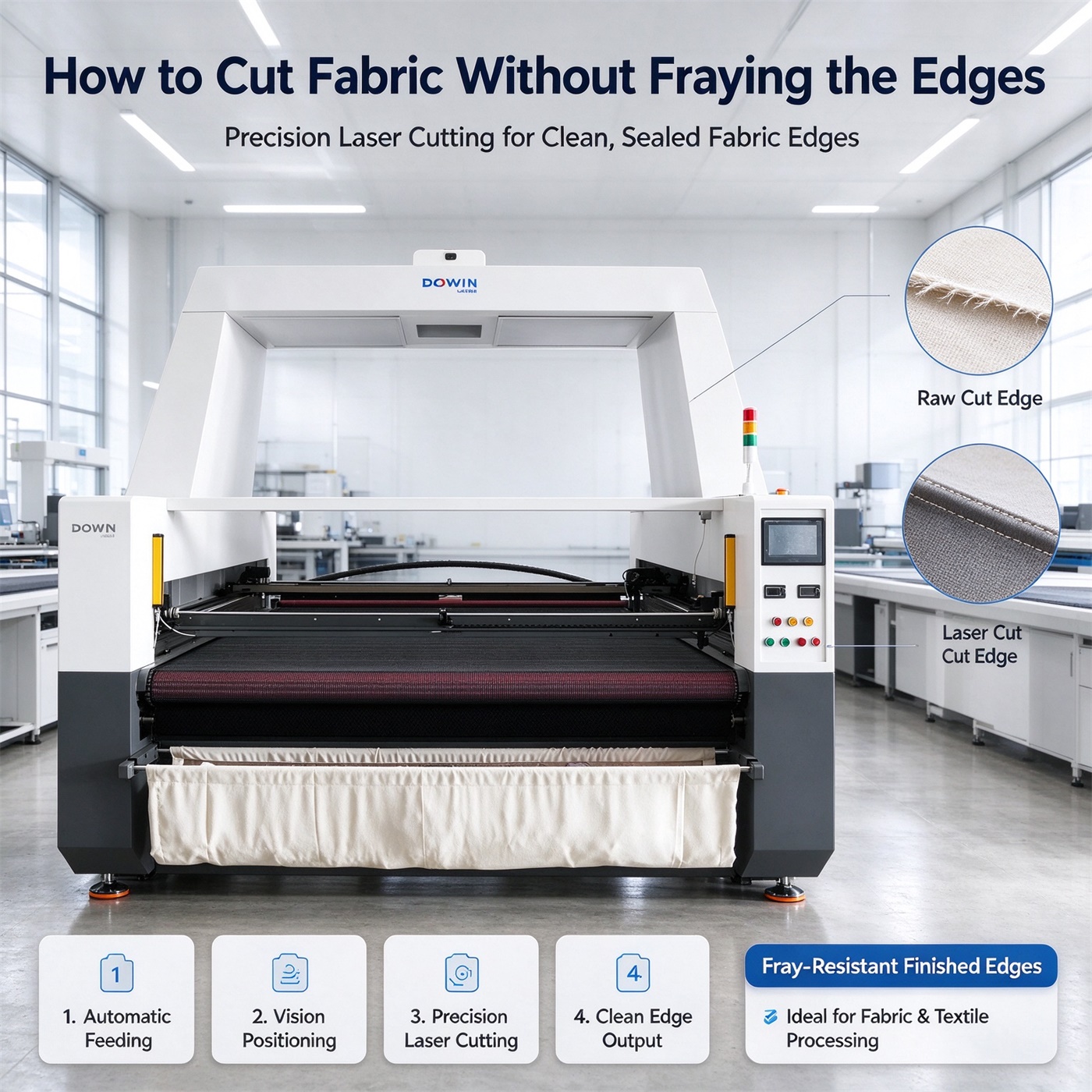
Cutting fabric without fraying the edges is essential for sewing, garment manufacturing, upholstery, textile production, and custom fabric processing. Frayed edges can reduce product quality, waste material, slow down production, and make fabric pieces more difficult to handle during sewing or assembly.
The best way to prevent fabric fraying depends on the fabric type, weave structure, cutting method, and production requirements. While some materials can be cut cleanly with ordinary scissors, others require specialized tools or additional edge-finishing processes.
This guide explains how to cut different fabrics without fraying, compares common cutting methods, and shows how manufacturers can improve cutting accuracy and edge quality.
Why Does Fabric Fray When Cut?
Fabric fraying occurs when individual yarns or fibers loosen and pull away from the cut edge. This is particularly common in woven fabrics because their yarns cross each other in a structured pattern.
Several factors influence how easily fabric frays:
-
Fabric construction: Loosely woven fabrics tend to fray more easily than tightly woven materials.
-
Fiber type: Cotton, linen, and many woven polyester fabrics can unravel after cutting.
-
Cutting quality: Dull blades, uneven pressure, and repeated cutting can pull yarns out of position.
-
Edge design: Curved cuts, narrow strips, and intricate patterns may expose more loose yarns.
-
Fabric thickness: Thick or layered textiles may require different cutting techniques to maintain consistent edges.
Knitted fabrics behave differently. Some knitted materials curl at the edges, while others stretch or run when cut. Therefore, the most effective cutting method depends on the material rather than a single universal solution.
7 Ways to Cut Fabric Without Fraying
1. Use Sharp Fabric Scissors
Sharp fabric scissors are one of the simplest solutions for preventing excessive fraying. A clean, continuous cut reduces the pulling and distortion that can occur when blades are dull.
For better results:
-
Use scissors designed specifically for fabric.
-
Cut on a flat, stable surface.
-
Avoid lifting or stretching the fabric while cutting.
-
Keep the blades clean and properly aligned.
-
Use long, smooth cutting strokes instead of repeatedly opening and closing the blades over the same area.
This method works well for home sewing, small workshops, and low-volume production.
However, manual cutting can become slow when processing large quantities of fabric. Maintaining consistent edges across multiple layers also requires operator skill and careful handling.
2. Apply Anti-Fray Products
Liquid seam sealants and fabric fray-prevention products can help secure loose fibers along cut edges.
These products are commonly used for decorative fabrics, small textile components, craft projects, and areas where a finished seam is not immediately available.
The main limitation is that anti-fray products add an extra processing step. They may also change the fabric’s texture, stiffness, color, or wash performance.
Always test the product on a small sample before applying it to the final material.
3. Use Zigzag Scissors
Pinking shears cut fabric into a zigzag pattern rather than a straight line. This reduces the length of exposed yarns along the edge and can slow fraying in suitable woven fabrics.
They are useful for sewing projects, garment samples, and decorative textile work.
However, pinking shears do not completely prevent fraying in every material. The edge may still unravel after repeated washing, abrasion, or handling. They are also less suitable for high-volume production and precise industrial cutting.
4. Sew or Overlock the Fabric Edges
Overlocking is a common method of securing fabric edges in garment manufacturing. An overlock machine wraps thread around the edge, helping prevent yarns from unraveling.
Other options include zigzag stitching, binding, and folded hems.
These methods provide reliable edge protection when the finished product requires a sewn edge. However, they require additional equipment, thread, labor, and processing time.
For manufacturers producing large volumes of textile components, preventing fraying during cutting can reduce the amount of edge-finishing work required later.
5. Use Heat Cutting for Suitable Synthetic Fabrics
Heat cutting uses a heated blade or wire to cut fabric while melting or fusing thermoplastic fibers along the edge.
It can be effective for materials such as polyester, nylon, and certain synthetic webbing fabrics. The fused edge helps prevent individual fibers from unraveling.
However, heat cutting is not suitable for every textile.
Natural fibers such as cotton and linen generally do not melt and fuse in the same way. Some coated, blended, or heat-sensitive materials may also discolor, shrink, harden, or release unwanted fumes when heated.
Before choosing this method, test the material under the intended cutting conditions.
6. Use a Laser Fabric Cutting Machine
A laser fabric cutting machine uses a focused laser beam to cut textile materials without direct mechanical contact. For suitable synthetic fabrics, the heat generated during cutting can seal the edge and significantly reduce fraying.
Laser cutting is particularly useful when manufacturers need to produce intricate shapes, repeated patterns, curved edges, or large quantities of identical textile components.
Key advantages include:
-
Reduced fraying: Thermoplastic fibers can fuse along the cut edge when the material and parameters are suitable.
-
High cutting precision: A focused beam supports detailed patterns and narrow features.
-
Non-contact processing: The cutting head does not drag a blade across the fabric, reducing mechanical pulling.
-
Repeatable results: Automated cutting paths help maintain consistency across production batches.
-
Complex pattern capability: Digital designs can be used to cut curves, holes, and intricate outlines.
Laser cutting is commonly used for polyester textiles, synthetic technical fabrics, certain nonwoven materials, and other laser-compatible textiles.
It is important to understand that laser cutting does not guarantee fray-free edges on every material. Cotton and other natural fabrics do not form the same fused edge as thermoplastic synthetics. Depending on the weave, fiber composition, and laser settings, some fabrics may still require overlocking, binding, or another finishing process.
Manufacturers should also evaluate discoloration, scorching, edge stiffness, smoke extraction, and the effect of heat on coatings or laminated layers.
For businesses processing textile rolls or repeated fabric patterns, an automatic fabric laser cutting machine can combine digital cutting, repeatable positioning, and automated feeding to improve production efficiency.
Explore the Dowin automatic fabric laser cutting machine to learn more about automated textile cutting solutions.
7. Choose the Right Cutting Method for Each Fabric
No single cutting method works best for every textile. Choosing the right process requires balancing edge quality, production speed, material compatibility, and finishing requirements.
For example, a cotton garment manufacturer may still need overlocking after precision cutting. A polyester ribbon producer may benefit from heat sealing, while a manufacturer cutting intricate synthetic textile patterns may prefer laser processing.
The most effective approach is to test the actual production material before selecting equipment or finalizing cutting parameters.
Which Fabrics Can Be Cut Without Fraying?
Different textile materials respond differently to cutting. The following table provides a practical starting point.
| Fabric type | Recommended cutting method | Important consideration |
|---|---|---|
| Cotton | Sharp scissors, rotary cutting, or laser cutting with testing | Laser cutting does not normally fuse cotton fibers |
| Linen | Sharp scissors or rotary cutting | Loose weaves may fray quickly |
| Polyester | Laser cutting or heat cutting | Heat can seal suitable thermoplastic fibers |
| Nylon | Laser cutting or heat cutting | Check for melting, discoloration, and edge stiffness |
| Fleece | Scissors, rotary cutting, or suitable laser processing | Construction and fiber composition affect edge quality |
| Felt and nonwoven fabrics | Scissors, die cutting, or laser cutting | Some materials produce cleaner edges than woven textiles |
| Stretch fabrics | Sharp rotary cutting or suitable automated cutting | Avoid stretching or distorting the material |
| Coated technical textiles | Manufacturer-approved cutting method | Heat may damage coatings or laminated layers |
This table is a general guide rather than a guarantee. Fiber blends, fabric density, dyes, coatings, and finishing treatments can change the result.
Laser Cutting vs. Traditional Fabric Cutting
For manufacturers seeking clean edges and consistent production, it is useful to compare laser cutting with conventional mechanical methods.
| Feature | Scissors or rotary cutter | Laser fabric cutting |
|---|---|---|
| Edge quality | Depends on blade condition and operator technique | Depends on material compatibility and laser settings |
| Fraying control | Usually requires separate finishing for fray-prone fabrics | Can seal suitable synthetic fibers during cutting |
| Intricate patterns | Requires careful manual work | Supports digitally controlled complex shapes |
| Contact with fabric | Direct mechanical contact | Non-contact cutting |
| Batch consistency | Depends on operator and cutting setup | Repeatable with a properly configured automated system |
| Material limitations | Broad range of fabrics | Some materials may scorch, melt, discolor, or release hazardous fumes |
| Production automation | Limited unless integrated with specialized equipment | Can be integrated with automatic feeding and digital cutting workflows |
Traditional cutting remains practical for small projects, simple shapes, and materials that are unsuitable for laser processing.
Laser cutting becomes more attractive when precision, complex outlines, repeatability, and production automation are important. The final decision should be based on actual sample-cutting results and total production costs rather than edge appearance alone.
How to Prevent Fraying When Cutting Fabric in Bulk
For textile manufacturers, controlling fraying is not just a cutting issue. It is also a production-quality and material-utilization issue.
The following practices can help improve results.
1. Test fabric samples before mass production.
Check the fiber composition, weave, thickness, coating, and response to the intended cutting process. For laser processing, test different power, speed, and focus settings to identify a suitable operating window.
2. Keep the fabric flat and properly tensioned.
Wrinkles, stretching, and uneven feeding can cause inaccurate cuts. Automatic feeding systems can help maintain a more consistent material position when properly configured.
3. Use appropriate cutting parameters.
For mechanical cutting, maintain sharp blades and suitable cutting pressure. For laser cutting, balance cutting speed and power to achieve complete cuts without excessive heat damage.
4. Inspect edges after cutting.
Check for loose yarns, discoloration, melting beads, rough edges, and inconsistent dimensions. Evaluate the material after washing or abrasion if the finished product will experience those conditions.
5. Consider the complete production workflow.
A clean cut can reduce rework, but the fabric may still need stitching, binding, or sealing. Evaluate cutting and finishing together to determine the most cost-effective process.
How Does an Automatic Fabric Laser Cutting Machine Improve Efficiency?
For textile factories, cutting fabric without excessive fraying is only one part of the production requirement. Manufacturers must also maintain cutting accuracy, minimize material waste, and process repeated patterns efficiently.
An automatic fabric laser cutting machine can help address these needs through digitally controlled cutting and automated material handling.
Depending on the machine configuration, relevant features may include:
-
Automatic fabric feeding for continuous or batch processing.
-
Digital cutting paths for repeated patterns and custom shapes.
-
Non-contact cutting to avoid mechanical blade drag.
-
Adjustable laser parameters for different compatible materials.
-
Integration with production workflows for textile products, garment components, and technical fabrics.
The suitability of a machine depends on the fabric width, material thickness, required cutting speed, pattern complexity, and production volume.
Before purchasing equipment, manufacturers should request sample cutting on their own fabric. This helps verify edge quality, dimensional accuracy, processing speed, and any need for additional finishing.
For larger-scale textile production, see the Dowin automatic fabric laser cutting machine for information about automated cutting equipment.
Frequently Asked Questions
How can I cut fabric without fraying at home?
Use sharp fabric scissors or a rotary cutter, keep the material flat, and avoid stretching it while cutting. For woven fabrics that fray easily, consider pinking shears, seam sealant, or stitching the edge.
Does laser cutting prevent fabric from fraying?
Laser cutting can significantly reduce fraying in suitable thermoplastic synthetic fabrics because heat can fuse the fibers along the cut edge. It does not automatically prevent fraying in every fabric, particularly natural fibers such as cotton and linen.
Is laser cutting better than scissors for fabric?
Laser cutting is generally more suitable for automated production, intricate patterns, and repeatable cuts. Scissors are often more economical for small projects, simple shapes, and fabrics that are unsuitable for laser processing.
Can cotton fabric be laser cut without fraying?
Cotton can be laser cut under suitable conditions, but its fibers do not normally melt and fuse into a sealed edge. The cut may require additional finishing to prevent unraveling.
What is the best way to cut polyester fabric without fraying?
For suitable polyester fabrics, laser cutting or heat cutting can create a fused edge that helps prevent fraying. The correct method depends on the fabric construction, thickness, coating, and required edge flexibility.
How can manufacturers reduce fabric cutting waste?
Manufacturers can improve material utilization by optimizing pattern layouts, maintaining consistent fabric feeding, selecting suitable cutting parameters, and inspecting cut quality before moving to the next production stage.
What should I consider when buying an industrial fabric cutting machine?
Evaluate the fabric types you process, cutting width, material thickness, production volume, pattern complexity, automation requirements, edge quality, maintenance, and total operating cost. Request sample cuts using your actual production material before making a purchase.
Conclusion
Cutting fabric without fraying the edges requires the right combination of material knowledge, cutting tools, and finishing techniques. Sharp scissors and rotary cutters work well for small projects, while overlocking and edge treatments provide additional protection when necessary.
For industrial applications, laser fabric cutting can deliver precise, repeatable cuts and help seal the edges of compatible synthetic fabrics. However, natural fibers and heat-sensitive textiles may still require additional finishing.
The best solution is the one that produces the required edge quality while meeting your production speed, accuracy, and cost targets. For manufacturers processing fabric rolls and repeated textile patterns, automated laser cutting is worth evaluating through real-material cutting tests before investing in equipment.
Post time: Oct-14-2026
