
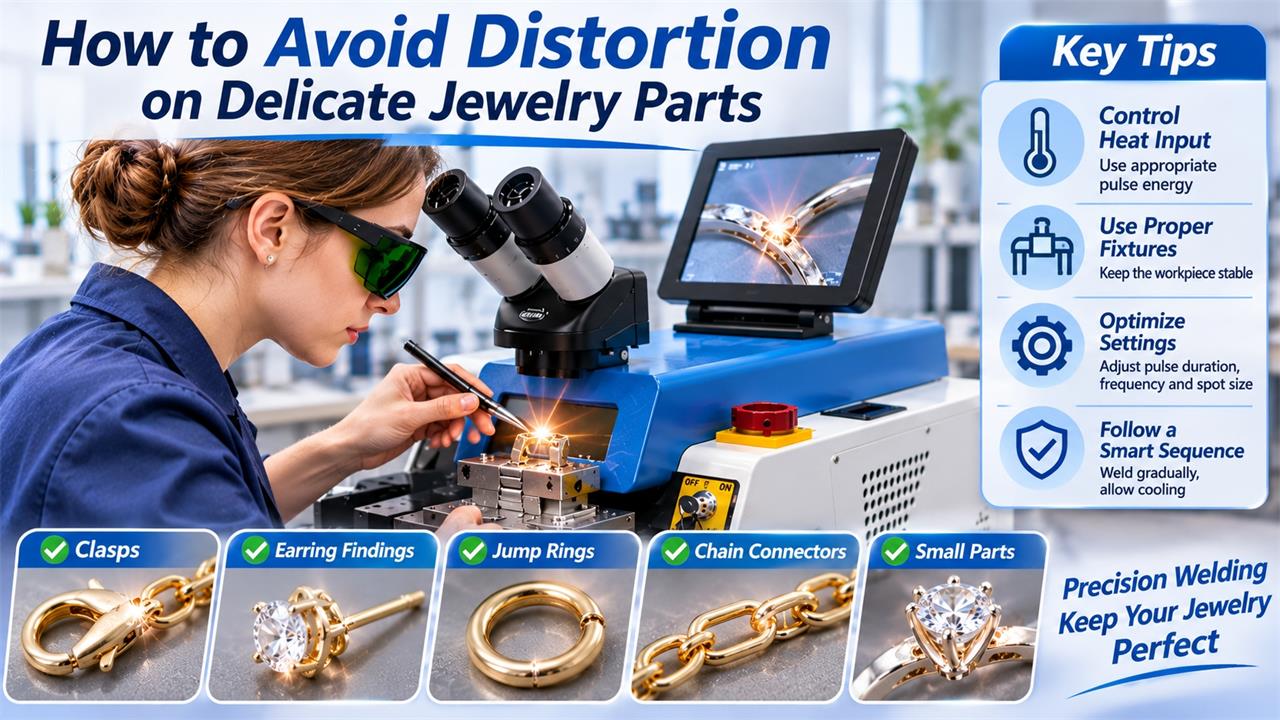
Distortion is one of the biggest challenges when repairing or manufacturing delicate jewelry. Thin gold chains, narrow ring bands, small earring components, and decorative metal structures can easily lose their original shape during welding. Even though laser welding provides concentrated energy and a relatively small heat-affected zone, improper settings or poor positioning can still cause deformation, shrinkage, and unwanted melting. Understanding how to control heat input, prepare the joint, and position the workpiece is essential for achieving clean and accurate results. In this guide, we explain practical ways to prevent distortion during jewelry repairs and introduce the Dowin Jewelry Laser Welding Machine for precision welding applications.
1. Why Does Jewelry Become Distorted During Welding?
Metal expands when heated and contracts as it cools. During welding, the temperature around the joint changes rapidly. If the heating and cooling process is uneven, internal stresses can develop and cause the jewelry to change shape.
This problem is particularly noticeable in thin and lightweight jewelry components because they have less material to resist deformation.
There are several common causes:
Excessive Heat Input
Applying too much laser energy to a small metal component can create an oversized molten area. As the metal cools, the joint may shrink and pull the surrounding material out of its original position.
Repeated Welding in the Same Area
Applying too many overlapping pulses without allowing sufficient cooling can gradually increase heat accumulation. This may cause thin metal sections to soften, deform, or melt through.
Poor Joint Alignment
If two metal parts are not correctly aligned before welding, the joint may contract unevenly during cooling. This is especially problematic when repairing narrow chain links, ring bands, and small decorative connections.
Incorrect Clamping
A workpiece that moves during welding can produce uneven results. However, excessive clamping pressure can also deform thin jewelry components before welding even begins.
Excessive Filler Material
Adding too much filler wire can create a large weld deposit that requires additional heat and finishing. This may increase the risk of deformation and make the repaired area difficult to polish.
2. Choose the Right Laser Welding Parameters
Parameter adjustment is one of the most important factors in preventing distortion. A jewelry laser welder should be configured according to the metal type, thickness, joint design, and repair location.
Four parameters deserve particular attention.
1. Laser Pulse Energy
Pulse energy determines how much energy is delivered to the metal during each laser pulse.
For thin jewelry components, excessive pulse energy can cause burn-through, enlarged weld pools, and unwanted melting.
Start with a suitably low energy setting on a representative sample, then increase it gradually until adequate fusion is achieved.
2. Pulse Duration
Pulse duration affects how long the metal is exposed to laser energy.
Longer pulses can increase heat transfer into the surrounding material, depending on the energy and spot size. Carefully adjusting pulse duration helps control the size and depth of the molten area.
3. Pulse Frequency
Pulse frequency determines how many laser pulses are delivered per second.
When welding delicate jewelry, a high repetition rate combined with excessive energy may cause heat accumulation if pulses are delivered continuously to the same location.
Adjust frequency according to the repair process and allow suitable cooling intervals when necessary.
4. Laser Spot Diameter
The spot diameter determines the approximate area receiving laser energy.
A smaller spot can help target narrow connections, such as thin chain links and small cracks. A larger spot may be appropriate for wider joints.
However, a smaller spot does not automatically guarantee less distortion. The energy density must also be controlled to avoid excessive penetration or localized melting.
3. Use Proper Fixtures to Prevent Jewelry Movement
Positioning is just as important as laser parameters. If a jewelry component moves during welding, the resulting joint may be uneven or misaligned.
A suitable fixture helps keep the workpiece stable while allowing the operator to access the welding area.
Consider these practical recommendations:
- Support thin metal sections: Use an appropriate support surface beneath delicate components to prevent bending.
- Keep the joint aligned: Make sure both sides of a broken connection meet correctly before welding.
- Avoid excessive clamping: Hold the jewelry securely without squeezing or changing its original geometry.
- Use suitable metal fixtures: Select fixtures that tolerate the welding process and do not introduce unwanted contamination or reflections.
- Check the workpiece before welding: Inspect its shape in an unclamped condition so that pre-existing deformation is not mistaken for welding distortion.
For small jewelry repairs, even a simple positioning fixture can make a significant difference in consistency.
4. Control the Welding Sequence
Another effective way to reduce distortion is to avoid concentrating all the welding heat in one location.
When a repair requires multiple weld spots, the order in which they are applied can influence the final shape.
Use Tack Welding First
For suitable joints, begin with a few small tack welds to hold the components in alignment.
Once the position is confirmed, complete the remaining welding work gradually.
Alternate Welding Positions
When working on a component with multiple repair points, avoid applying every pulse to one side before moving to the other.
Alternating between separated repair locations can help distribute heat more evenly.
Allow Cooling Intervals
For delicate components, short cooling intervals between welding passes can reduce excessive heat accumulation.
Do not rely on continuous firing when the material is visibly heating beyond the intended repair area.
Avoid Excessive Overlapping
Repeatedly welding the same spot can enlarge the molten area and increase the risk of deformation.
Use only the necessary number of pulses to achieve the required joint quality.
5. How to Prevent Distortion on Different Jewelry Parts
Different jewelry structures have different weaknesses. The best welding approach depends on the component being repaired.
Thin Gold and Silver Chains
Fine chains are particularly vulnerable to excessive melting because their individual links have very little material.
To minimize distortion:
- Position the broken links carefully before welding.
- Use a suitable small welding spot.
- Start with tested low-energy settings.
- Avoid applying too many overlapping pulses.
- Check that adjacent links remain free to move after welding.
The goal is to create a reliable connection without filling the entire gap with excess metal.
Thin Ring Bands
Thin ring bands can become oval or uneven when a repair introduces localized shrinkage.
Before welding, check the ring’s original shape and identify whether the damaged area has already been deformed.
Use appropriate support and control the welding sequence. For a repair involving multiple points around the circumference, distribute the welding work rather than concentrating heat in one area.
Small Earring Components
Earring posts, hooks, and small connecting loops are often made from thin metal sections.
Use accurate microscope positioning and avoid excessive pulse energy. When attaching an earring post, make sure it remains perpendicular to the intended mounting surface.
Delicate Decorative Structures
Filigree jewelry and intricate decorative components often contain narrow metal connections and open structures.
These designs are particularly sensitive to deformation. Support the structure carefully, minimize unnecessary welding, and avoid forcing the workpiece into position with excessive clamping pressure.
Prongs and Gemstone Settings
Prong repair requires special attention because the surrounding gemstone may be sensitive to heat.
Laser welding can help rebuild suitable damaged prongs, but the stone type, treatment, inclusions, and distance from the weld must be evaluated first.
For heat-sensitive gemstones or high-risk repair locations, removing the stone before welding is often the safer option.
6. Why Microscope Observation Helps Reduce Welding Errors
When repairing delicate jewelry, the actual welding area may be smaller than a few millimeters.
Working without clear observation makes it difficult to identify the exact joint position and control the laser spot.
A microscope provides several practical benefits:
- Accurate positioning of the laser spot.
- Better observation of the molten weld pool.
- More control over narrow metal connections.
- Easier identification of excessive melting.
- Improved inspection of the repaired area.
For precision jewelry repair, a machine equipped with a microscope and suitable positioning system can help operators achieve more consistent results.
7. How to Check Whether Welding Has Caused Distortion
Do not judge distortion only by looking at the welding spot. A small joint may look acceptable under the microscope while the overall jewelry component has changed shape.
After welding and allowing the component to cool, check the following:
- Original geometry: Compare the repaired part with its original shape or reference measurements.
- Joint alignment: Check whether the two connected metal sections remain correctly aligned.
- Surface condition: Look for excessive melting, dents, cracks, or unwanted weld deposits.
- Mechanical function: Make sure chains, hinges, clasps, and other moving components still operate correctly.
- Weld integrity: Inspect for incomplete fusion, porosity, and other visible defects.
Importantly, inspect the workpiece after removing it from the fixture. A part that appears straight while clamped may change shape after the fixture is released.
8. Choosing a Jewelry Laser Welder for Delicate Parts
If your workshop frequently repairs thin chains, small earrings, narrow ring bands, and delicate decorative components, machine selection should focus on control and observation capabilities.
Important features include:
- Adjustable pulse energy: Allows the operator to match energy delivery to different metal thicknesses.
- Adjustable pulse duration: Provides more control over the heating process.
- Variable spot diameter: Supports different joint sizes and repair applications.
- Microscope and CCD observation: Helps with accurate positioning and monitoring.
- Stable laser output: Supports consistent results across repeated repairs.
- Argon shielding: Helps protect suitable molten metal areas from oxidation when required.
Dowin’s New 150W Desktop Jewelry Laser Welder is equipped with a microscope and CCD observation system, an LCD touch control panel, and an adjustable 0.2–2 mm spot diameter.
Its adjustable pulse settings can support different precision welding applications when correctly configured for the material and joint.
Learn more about the Dowin New 150W Desktop Laser Jewelry Welder.
9. Common Mistakes That Cause Jewelry Distortion
Even with a precision laser welding machine, some operating mistakes can lead to deformation.
Using the Same Settings for Every Metal
Gold, silver, platinum, and stainless steel have different thermal and welding characteristics. Copying one parameter combination across all materials can produce inconsistent results.
Welding Without Checking the Original Shape
Some jewelry components are already bent or twisted before repair. Without checking their original geometry, operators may incorrectly attribute existing deformation to the welding process.
Using Too Much Filler Wire
Excessive filler material creates larger weld deposits and can require additional heat and finishing.
Add compatible filler in controlled amounts rather than trying to fill an entire gap in one operation.
Overheating the Same Area
Repeated pulses without sufficient cooling can accumulate heat and increase deformation risk.
Removing the Component Too Early
Evaluating the workpiece while it is still hot or held under clamping pressure may give an inaccurate impression of its final shape.
Allow it to cool naturally and inspect it after releasing the fixture.
10. Frequently Asked Questions
Can laser welding completely eliminate distortion in jewelry?
No. Laser welding can reduce the heat-affected area, but it cannot eliminate thermal expansion, contraction, or residual stress. Correct parameter selection, joint preparation, fixtures, and welding sequence are still necessary.
Why does a thin gold chain melt during laser welding?
This usually happens when the energy delivered to the small metal link is excessive for its thickness and geometry. Pulse energy, duration, spot size, and positioning should be reviewed using sample tests.
Does a smaller laser spot always prevent distortion?
Not necessarily. A smaller spot improves localization, but excessive energy density can still cause deep penetration or burn-through. Spot size and pulse parameters must be considered together.
Should I use a fixture when laser welding delicate jewelry?
Yes, when the component requires support or accurate alignment. However, avoid excessive clamping pressure because it can deform thin jewelry before welding and create springback after release.
Can a 150W jewelry laser welder repair thin gold chains?
A 150W YAG jewelry laser welder can handle many suitable fine jewelry repair applications. Whether it can safely repair a particular chain depends on link thickness, alloy composition, joint geometry, spot size, and pulse settings. Test representative samples first.
How long should I wait between laser welding pulses?
There is no universal cooling interval. It depends on the metal, component size, pulse energy, repetition rate, and welding sequence. Observe heat accumulation and use suitable intervals during sample testing.
Can I laser weld jewelry without removing gemstones?
Some repairs can be performed with stones remaining mounted, but this depends on the gemstone type, condition, treatment, and distance from the weld. Removing heat-sensitive stones is generally safer when the repair location presents a significant risk.
Conclusion
Avoiding distortion on delicate jewelry parts requires more than choosing a laser welding machine with sufficient power. The most important factors are controlled heat input, accurate positioning, proper joint preparation, and a carefully planned welding sequence.
By using suitable fixtures, adjusting pulse parameters, and allowing adequate cooling, jewelry repair professionals can reduce deformation risks when working with thin chains, ring bands, earring findings, and intricate metal structures.
For workshops that regularly perform precision jewelry repairs, explore the Dowin Jewelry Laser Welding Machine Collection to compare available models and find equipment suitable for delicate metal welding applications.
“`
Post time: Nov-24-2026
