
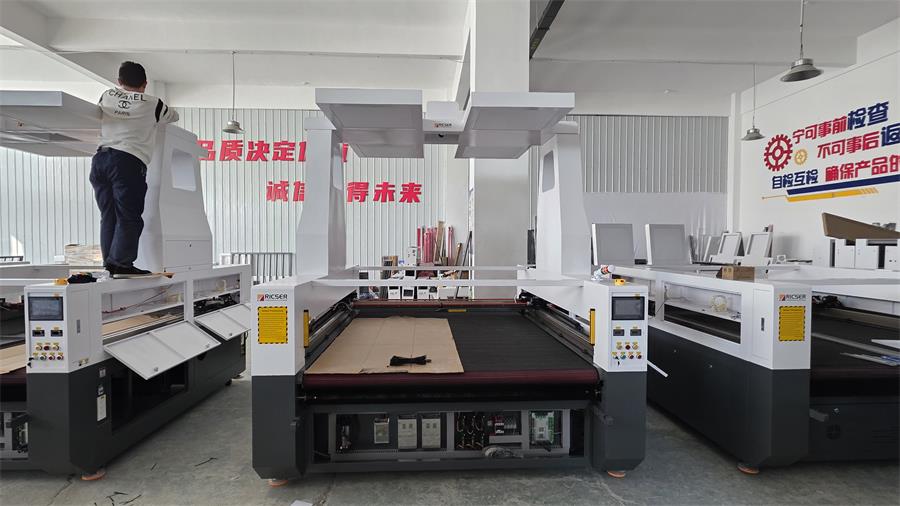
Auto feeding laser cutters are designed to streamline fabric processing by combining automatic material feeding with high-speed laser cutting. They are widely used in garment manufacturing, home textiles, and industrial fabric production where efficiency, accuracy, and scalability are essential.
A typical Fabric Auto Feeding Laser Cutting Machine integrates a conveyor system and laser head to enable continuous, high-precision cutting with minimal manual intervention.
1. Continuous Feeding Eliminates Downtime
Traditional cutting methods require frequent manual loading and repositioning of fabric, which slows production.
Auto feeding systems solve this by:
- Unrolling fabric automatically from rolls
- Feeding material continuously into the cutting area
- Allowing uninterrupted production cycles
This reduces idle time and significantly increases throughput.
2. Faster Cutting Speed with Laser Precision
Laser cutting is inherently faster than mechanical cutting for complex shapes.
Efficiency gains include:
- High-speed cutting of intricate patterns
- No tool change or blade replacement
- Instant adaptation to digital designs
Combined with auto feeding, production becomes continuous and high-speed.
3. Reduced Manual Labor and Handling Time
Automation reduces the need for operator involvement in repetitive tasks.
Key labor-saving improvements:
- No manual fabric alignment
- Reduced handling between batches
- One operator can supervise multiple machines
This lowers operational costs while increasing output consistency.
4. Improved Material Utilization Through Smart Nesting
Modern systems use software optimization to arrange cutting layouts efficiently.
Benefits:
- Higher fabric utilization rate
- Reduced scrap and waste
- Lower material cost per unit
Over large production volumes, this significantly improves profit margins.
5. High Accuracy and Repeatability
Laser cutting ensures consistent results across large batches.
This includes:
- Identical dimensions for every piece
- No variation caused by human error
- Stable performance during long production runs
Consistency is especially important for apparel and uniform manufacturing.
6. Edge Sealing Reduces Post-Processing
For many synthetic fabrics, laser cutting provides a thermal sealing effect.
Advantages:
- Clean, sealed edges
- No fraying or loose threads
- Reduced need for hemming or finishing
This eliminates additional production steps and saves time.
7. Quick Design Switching for Flexible Production
Auto feeding laser systems are fully digital and do not require physical tooling.
This allows:
- Fast switching between product designs
- Easy handling of small and large batches
- Efficient custom order production
Manufacturers can respond quickly to market demand changes.
8. Stable Operation for Large-Scale Production
Industrial-grade machines are built for continuous operation:
- Conveyor-based feeding stability
- Efficient cooling systems
- Consistent laser output
- Reduced downtime and maintenance interruptions
A Fabric Auto Feeding Laser Cutting Machine is especially suitable for factories requiring long-hour production cycles.
9. Lower Overall Production Cost
By improving speed and reducing waste, efficiency gains translate into cost savings:
- Lower labor expenses
- Reduced material waste
- Faster production cycles
- Higher output per shift
This improves overall competitiveness in textile manufacturing.
Conclusion
Auto feeding laser cutters significantly improve fabric cutting efficiency by combining continuous material feeding, high-speed laser processing, and intelligent software optimization. They reduce labor, minimize waste, and ensure consistent production quality.
For manufacturers seeking scalable and efficient textile production, a Fabric Auto Feeding Laser Cutting Machine provides a reliable solution for modern high-volume cutting needs.
Post time: Jun-29-2026
