
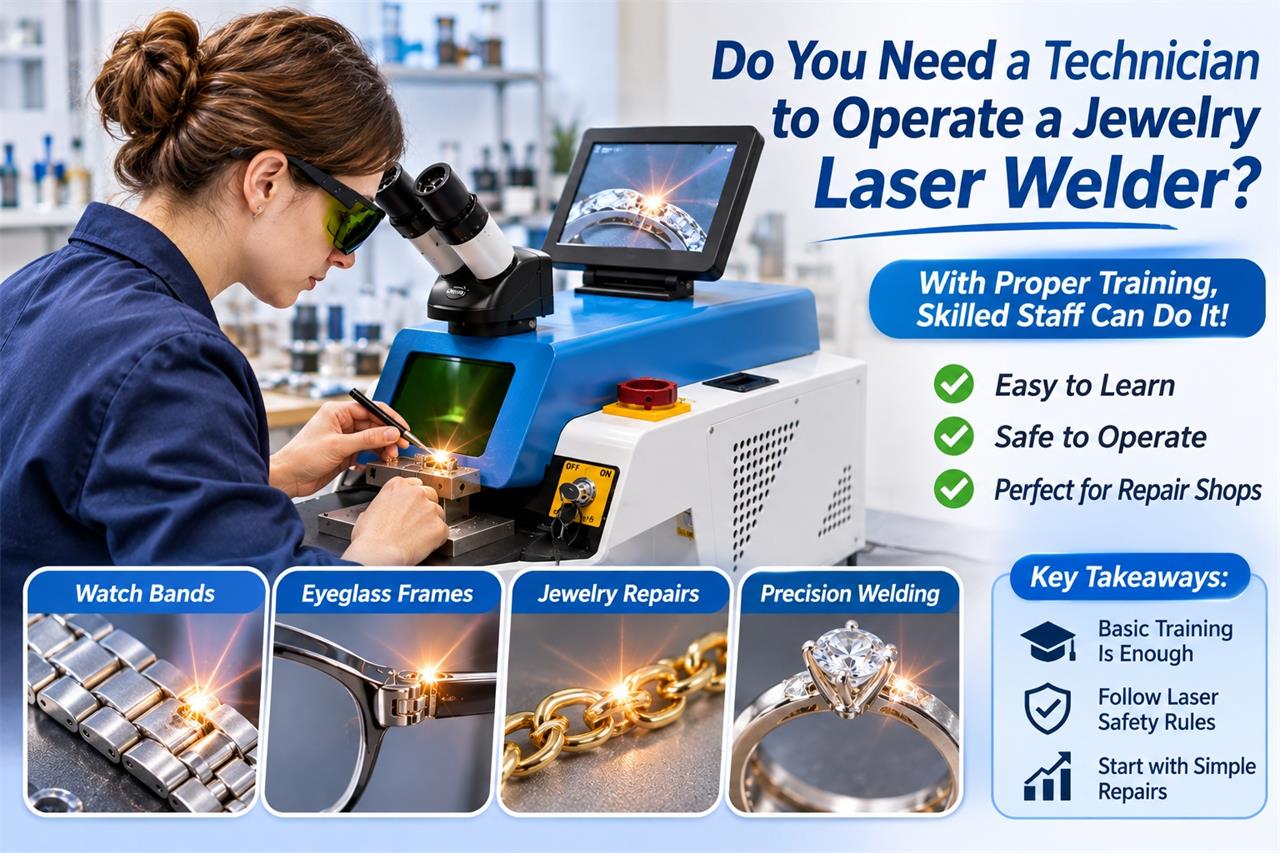
When considering a jewelry laser welder, many jewelry repair shops have the same question: Do you need a professional technician to operate it? Some business owners worry that laser welding requires advanced engineering knowledge or years of industrial experience. In practice, operating a dedicated jewelry laser welding machine is different from operating a large industrial laser system. With proper training, a jeweler or workshop employee can learn routine welding operations without being a laser engineer. However, understanding welding parameters, material characteristics, and laser safety is essential. In this guide, we explain the skills required and what businesses should know before purchasing a Dowin Jewelry Laser Welding Machine.
1. Do You Need to Be a Professional Technician?
No. You do not necessarily need to hire a dedicated laser technician to operate a jewelry laser welder for everyday repair work.
A professional jeweler with basic metalworking experience can learn to operate the machine through manufacturer training and practical exercises.
However, there is an important difference between operating a machine and maintaining or repairing its internal systems.
Routine operation generally requires:
- Understanding the machine control panel and operating procedures.
- Knowing how to position jewelry under the microscope.
- Understanding basic welding parameters.
- Recognizing different metals and their welding characteristics.
- Following laser safety procedures.
- Inspecting weld quality after each repair.
Specialized technical work may require a qualified technician:
- Repairing electrical or laser power supply faults.
- Servicing internal optical components.
- Performing advanced optical alignment.
- Diagnosing cooling system or control system failures.
- Replacing internal components and performing major maintenance.
For most small jewelry workshops, one trained operator can handle daily welding tasks, while more complex technical work can be referred to the equipment supplier or a qualified service technician.
2. What Skills Are Required to Operate a Jewelry Laser Welder?
Although a jewelry laser welder is designed for precision work, operating it successfully requires several practical skills.
1. Basic Jewelry Repair Knowledge
Understanding jewelry construction is more important than having an engineering degree.
An operator should recognize common repair locations, including:
- Broken gold and silver chains.
- Cracked ring bands.
- Damaged prongs and settings.
- Broken earring posts.
- Small casting defects and pores.
- Separated metal connections.
Knowing how the metal parts fit together helps the operator determine where welding is necessary and how to position the workpiece.
2. Understanding Different Metals
Gold, silver, platinum, stainless steel, and titanium have different welding characteristics.
For example, silver has high thermal conductivity, while gold alloys vary according to their composition. These differences affect how energy is transferred during welding.
An experienced jeweler may already understand many of these material characteristics. However, laser welding introduces additional considerations, such as pulse energy, spot size, and heat distribution.
3. Basic Control Panel Operation
Operators need to understand how to adjust welding parameters and select suitable settings for different repair jobs.
Common parameters include:
- Laser energy: Controls the energy delivered during each pulse.
- Pulse duration: Determines how long each laser pulse lasts.
- Pulse frequency: Controls the number of pulses delivered per second.
- Spot diameter: Determines the size of the laser welding area.
These parameters work together. Increasing one parameter does not always improve the welding result. The correct combination depends on material composition, thickness, joint design, and repair requirements.
3. Is a Jewelry Laser Welder Difficult for Beginners to Learn?
For basic jewelry welding applications, the learning process is relatively straightforward when proper training and sample materials are available.
A beginner does not need to master every advanced welding technique before starting. It is better to learn progressively, beginning with simple metal connections and moving toward more delicate repairs.
Here is a practical learning sequence:
Stage 1: Understand the Machine
Learn the function of the main components, including the laser source, microscope, control panel, work area, and cooling system.
Understand the startup and shutdown procedures, operating indicators, emergency stop, and machine protection functions.
Stage 2: Practice on Sample Materials
Before repairing customer jewelry, practice on scrap gold, silver, or other compatible metal samples.
Start with simple welding exercises to understand how different parameter settings affect the weld pool and final joint.
Stage 3: Learn Microscope Positioning
The microscope is one of the most important parts of a jewelry laser welder.
Operators need to learn how to position the metal accurately, focus on the repair location, and keep the welding area stable.
Good positioning reduces the chance of accidentally directing laser energy toward an unwanted area.
Stage 4: Practice Real Repair Applications
After understanding basic welding, operators can progress to more practical exercises, such as:
- Joining small metal wires.
- Filling tiny metal gaps.
- Repairing simple chain connections.
- Welding small metal cracks.
- Adding compatible filler wire to damaged areas.
Complex repairs involving mounted gemstones, thin structures, or valuable customer jewelry should only be attempted after sufficient practice and material-specific assessment.
4. How Important Is Microscope Operation?
Unlike conventional welding, jewelry laser welding often involves very small repair areas. A microscope helps the operator observe the exact position of the laser spot and the metal being repaired.
For beginners, microscope operation is an important skill to develop.
There are three things to pay attention to:
- Focus: Keep the repair area clearly visible and properly positioned.
- Alignment: Position the intended welding location accurately before firing the laser.
- Stability: Keep the workpiece steady during welding to avoid inconsistent results.
Dowin’s desktop jewelry laser welder uses a dedicated crosshair microscope for positioning, together with a camera observation system on the applicable model. These features help operators locate small repair areas more accurately.
5. Do You Need Special Laser Safety Training?
Yes. This is the most important part of operating a jewelry laser welder.
Even if the machine is relatively easy to operate, laser safety should never be treated as an optional skill.
Jewelry laser welders commonly use a 1064nm Nd:YAG laser source. This wavelength is in the near-infrared range and cannot be judged safely by simply looking at the visible working area.
Operators should understand the following safety requirements:
Laser Eye Protection
Use the specified wavelength-rated eye protection and any manufacturer-provided protective viewing system. Never assume that ordinary glasses or general-purpose safety goggles provide sufficient protection.
Controlled Working Area
Keep unauthorized people away from the operating area. Follow the machine’s enclosure, protective interlock, warning, and access-control requirements.
Prevent Unwanted Reflections
Metal jewelry has reflective surfaces. Operators should understand the risks associated with direct and reflected laser radiation and follow the manufacturer’s approved workholding and protection procedures.
Fire Prevention
Remove flammable materials from the welding area. Keep suitable fire protection equipment available and monitor the work area during operation.
Follow Manufacturer Instructions
Laser safety requirements depend on the specific machine design, laser classification, accessible radiation, and local regulations. Operators must receive training appropriate to the equipment and workplace.
For certain higher laser classifications, additional training, a designated laser safety responsible person, or a documented safety program may be required under applicable regulations.
6. How Long Does It Take to Learn Jewelry Laser Welding?
There is no single training period that applies to every operator. Learning time depends on previous jewelry repair experience, machine configuration, training quality, and the complexity of the jobs being performed.
For a practical workshop training plan, the learning process can be divided into three levels:
| Training Level | Main Content | Learning Objective |
|---|---|---|
| Basic | Machine operation, safety, microscope positioning, sample welding | Understand normal machine operation |
| Intermediate | Parameter adjustment, different metals, small repair jobs | Handle common welding applications |
| Advanced | Complex joints, filler wire, delicate jewelry repairs, troubleshooting | Improve repair consistency and handle more difficult jobs |
Operators should demonstrate consistent welding results and understand the relevant safety procedures before handling customer jewelry independently.
Rather than focusing only on how many days of training are required, businesses should evaluate whether the operator can produce acceptable sample welds and follow the correct safety procedures.
7. Can One Employee Operate a Jewelry Laser Welder?
In many small and medium-sized jewelry workshops, one trained employee can perform routine welding operations.
The machine does not necessarily require a separate operator and technician to be present for every repair.
For example, a typical jewelry repair workflow may look like this:
- Inspect the damaged jewelry and identify the metal.
- Determine whether laser welding is an appropriate repair method.
- Remove or protect sensitive components where necessary.
- Prepare and position the workpiece.
- Select suitable welding parameters based on tested procedures.
- Perform the welding operation using the microscope.
- Inspect the completed joint and perform necessary finishing.
One trained jeweler can manage these steps for suitable repair jobs. However, electrical servicing, internal optical maintenance, and other specialized work should be handled by qualified personnel.
8. Does the Dowin Jewelry Laser Welder Support Easy Operation?
Dowin’s desktop jewelry laser welding machine is designed for precision jewelry processing. Its operating features are intended to make small repair applications easier to position and control.
For example, the Dowin 150W/200W desktop jewelry laser welder includes:
- Microscope and CCD observation: Helps operators position the laser accurately.
- LCD touch control panel: Provides an interface for operating and adjusting machine settings.
- Adjustable spot diameter: A 0.2–2mm adjustment range on the listed desktop model.
- Adjustable pulse settings: Supports different welding requirements.
- Air cooling: Uses an air-cooled configuration.
- Crosshair positioning: Helps locate small welding areas.
These features can make routine operation more convenient, but they do not eliminate the need for operator training and laser safety procedures.
For more details, visit the Dowin New 150W Desktop Laser Jewelry Welder product page.
9. What Should You Ask the Supplier Before Buying?
For buyers who have never operated a jewelry laser welder, supplier support is an important purchasing consideration.
Before placing an order, consider asking the manufacturer these questions:
- Does the supplier provide an operating manual and training videos?
- Can the supplier demonstrate welding on gold and silver samples?
- Are recommended starting parameters available for common repair applications?
- Does the machine include a microscope or camera observation system?
- What safety equipment and workplace arrangements are required?
- Can the supplier provide remote troubleshooting support?
- Are spare parts and technical maintenance services available?
A good equipment supplier should help customers understand not only how to start the machine but also how to use it safely and achieve consistent welding results.
10. Frequently Asked Questions
Can a jeweler operate a laser welder without an engineering background?
Yes. A jewelry repair professional does not need an engineering degree to perform routine welding operations. However, the operator must understand machine controls, welding parameters, material characteristics, and laser safety.
Do I need to hire a professional laser technician?
Not necessarily. One trained employee can generally handle routine welding tasks. A qualified technician may be needed for installation, internal electrical repairs, optical servicing, and advanced troubleshooting.
Is jewelry laser welding suitable for beginners?
Yes, beginners can learn the basic operation through manufacturer instruction and practice on sample materials. They should not immediately start with complicated customer repairs or valuable gemstone-set jewelry.
Does the machine automatically select the correct welding parameters?
Not necessarily. Some machines provide parameter memory or preset functions, but the operator must still select and verify suitable settings for the material, thickness, and joint design.
Can I learn jewelry laser welding through videos?
Training videos are useful for understanding machine controls and basic techniques. However, practical training and supervised sample welding are also important, especially for laser safety and parameter adjustment.
Is laser safety training really necessary for a small jewelry shop?
Yes. Workshop size does not remove laser hazards. Operators must follow the machine’s safety instructions, understand its laser classification, and comply with applicable local requirements.
Conclusion
You do not need to be a professional laser engineer to operate a jewelry laser welder. A jeweler or workshop employee can learn routine operation through proper training, practical exercises, and an understanding of different metal materials.
However, easy operation should never be confused with no training. Laser safety, parameter adjustment, microscope positioning, and weld inspection are essential skills. Internal machine servicing and complex technical repairs should be left to qualified technicians.
For jewelry repair shops planning to introduce laser welding, choosing a machine with a practical observation system, convenient controls, and reliable supplier support can make the learning process easier.
Explore the Dowin Jewelry Laser Welding Machine Collection to compare available models and find a suitable solution for your workshop.
“`
Post time: Nov-24-2026
