
Leather products are widely used in fashion, footwear, furniture, accessories, and promotional gifts. As manufacturers look for more flexible ways to customize their products, laser marking has become an option for applying logos, patterns, text, serial numbers, and personalized designs.
A CO2 laser marking machine for leather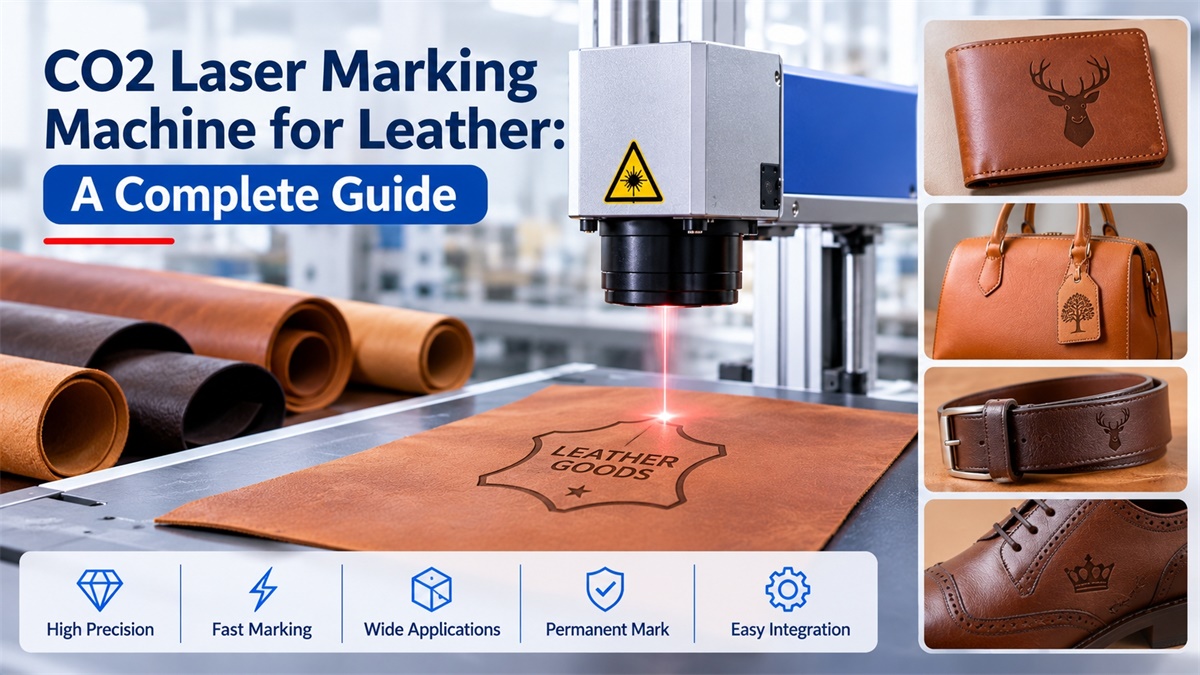 uses a focused infrared laser beam to produce a visible surface change on compatible leather materials. Depending on the leather composition and processing parameters, the result may appear as a darker mark, a color change, or a shallow engraved pattern.
However, leather is not a uniform material. Genuine leather, vegetable-tanned leather, chrome-tanned leather, and synthetic leather can respond very differently to laser processing. The quality of the result depends on the leather’s composition, tanning process, dye, surface finish, and thickness.
This guide explains how CO2 laser marking works on leather, which applications are suitable, what to consider when selecting a machine, and how to avoid common processing problems.
1. How Does a CO2 Laser Mark Leather?
A CO2 laser marking machine typically uses a 10.6 μm wavelength infrared laser source. The laser beam is directed through a scanning system and focused onto the leather surface.
When the beam interacts with a compatible leather surface, localized heat changes the material’s appearance. Depending on the energy input and leather characteristics, this can produce:
-
Darkened logos and text
-
Surface color changes
-
Shallow engraved patterns
-
Decorative textures
-
Personalized names and numbers
Unlike ink printing, laser marking does not deposit a layer of ink onto the leather. The visual effect is created through the interaction between laser energy and the material itself.
Laser Marking vs. Laser Engraving on Leather
These terms are often used interchangeably in the leather industry, but they describe different processing results.
Laser marking generally refers to creating a visible surface change with limited material removal. It is suitable for logos, text, product identification, and decorative details.
Laser engraving involves removing more material to create a noticeable recessed pattern or design. It may produce greater depth and stronger texture, but it also increases the risk of burning, discoloration, and damage to the leather.
For leather goods manufacturers, the required appearance should be defined before selecting the machine and processing parameters. A clean logo mark and a deeply engraved decorative pattern do not necessarily require the same settings.
2. What Types of Leather Can a CO2 Laser Mark?
Material identification is the first step in choosing a leather laser marking solution. The term “leather” covers materials with very different chemical compositions and surface treatments.
Genuine Leather
Genuine leather is made from animal hide and is used in wallets, handbags, belts, shoes, furniture, and other products.
CO2 laser processing can be evaluated on certain genuine leather grades. However, the results depend on the tanning method, dye, finishing layer, moisture content, and surface texture.
Potential applications include:
-
Brand logos on leather wallets
-
Decorative patterns on leather bags
-
Names and personalized text
-
Product identification on leather accessories
Natural leather is not completely uniform. Even pieces from the same production batch may have differences in grain, thickness, and surface treatment. These variations can lead to inconsistent marking darkness.
For this reason, manufacturers should test representative leather samples before establishing production parameters.
Vegetable-Tanned Leather
Vegetable-tanned leather is processed using plant-based tanning agents and is commonly used for premium leather goods, handmade accessories, belts, and craft products.
Its relatively natural surface can make it a candidate for CO2 laser marking tests.
Possible results include darker logos, decorative patterns, and shallow engraved details.
However, vegetable tanning alone does not guarantee a consistent result. Dyes, oils, waxes, coatings, and other finishing treatments can change the laser response.
Chrome-Tanned Leather
Chrome-tanned leather is widely used in footwear, upholstery, handbags, and other commercial leather products.
Its chemical composition differs from vegetable-tanned leather, and laser processing may produce different marking behavior.
Manufacturers should not assume that a CO2 laser setting developed for vegetable-tanned leather will work on chrome-tanned material.
The tanning chemicals and any restricted substances must be identified before processing. Leather containing hazardous substances, including chromium VI, must not be treated as an ordinary laser-marking material. Follow the machine manufacturer’s material restrictions and applicable safety requirements.
PU Synthetic Leather
PU leather is a synthetic material made with polyurethane-based coatings or layers. It is commonly used in bags, shoes, furniture, automotive interiors, and fashion accessories.
Some PU-based materials may be evaluated for laser marking, but the result depends on the complete material construction, including its coating, backing, adhesives, and other additives.
Potential problems include:
-
Melting or deformation
-
Uneven discoloration
-
Surface blistering
-
Unwanted odor
-
Damage to the coating or backing
A material described only as “synthetic leather” is not sufficiently identified for laser processing.
PVC Synthetic Leather: A Critical Safety Warning
PVC-based artificial leather and vinyl materials must not be processed with a laser.
Heating PVC can release hazardous chlorine-containing gases that can harm operators and corrode machine components. An exhaust system does not make PVC laser processing safe.
Do not rely on appearance, product names, or supplier descriptions to determine whether synthetic leather is suitable. Obtain the material composition or safety data sheet (SDS). If the composition cannot be confirmed, do not put the material into the laser machine.
3. Applications of CO2 Laser Marking on Leather Products
Leather manufacturers use laser marking for product customization, branding, and decorative processing. The machine configuration depends on the size, shape, quantity, and marking position of the products.
Leather Wallets
Wallets are one of the most common products for personalized leather marking.
A CO2 laser can be evaluated for marking:
-
Brand logos
-
Customer names
-
Initials
-
Decorative patterns
-
Serial numbers
The marking area is usually relatively small, so positioning accuracy and graphic detail are important.
Leather Bags and Handbags
Leather bags often require branding on different parts of the product, including front panels, handles, tags, and interior labels.
Laser marking can be used for logos, custom graphics, and decorative elements on compatible leather surfaces.
For finished bags, manufacturers should consider the available working space and whether the product can be positioned securely under the scanning head.
Leather Belts
Leather belts may require logos, text, decorative patterns, or personalized information.
For long belts, a suitable working area or positioning method is important. If the marking position changes along the belt, the operator may need to reposition the material or use a suitable fixture.
Leather Shoes
Laser marking can be used for selected shoe components, including leather uppers, labels, and decorative panels.
The main challenge is product geometry. A flat leather sheet is easier to position than a finished shoe with curved surfaces and seams.
For finished products, the machine’s working distance, focus range, and fixture design should be considered carefully.
Leather Patches and Labels
Leather patches and labels are widely used in clothing, denim products, hats, bags, and accessories.
Typical marking content includes:
-
Brand names
-
Logos
-
Decorative graphics
-
Product information
-
Custom lettering
For manufacturers producing large batches of patches, a consistent fixture can improve positioning and reduce manual adjustment between pieces.
Leather Furniture and Upholstery
Leather furniture manufacturers may use laser marking for decorative details, logos, and identification on selected leather components.
Large material dimensions and irregular surfaces can make positioning more difficult. The required working area and material-handling method should therefore be considered before purchasing a machine.
4. What Can Affect Leather Laser Marking Quality?
A common mistake is to focus only on laser power. In practice, marking quality is influenced by several variables.
Leather Composition and Surface Finish
The same laser settings may produce different results on two pieces of leather that look almost identical.
Important factors include:
-
Genuine or synthetic construction
-
Tanning method
-
Dye and pigment
-
Protective coating
-
Oil and wax content
-
Surface texture
-
Moisture content
For repeat production, record the material supplier, material grade, finish, and approved laser parameters.
Laser Power and Marking Speed
Laser power determines the energy available for processing, while marking speed affects how long the laser interacts with each point on the surface.
Excessive energy input can cause:
-
Heavy carbonization
-
Scorch marks around the design
-
Excessive material removal
-
Uneven darkness
-
Unwanted odor and smoke
Insufficient energy may produce a weak or barely visible mark.
The correct combination must be determined through controlled sample testing. There is no universal power and speed setting for all leather types.
Focus and Marking Resolution
Correct focusing helps maintain a consistent beam spot size across the marking area.
For fine logos, small text, and detailed patterns, focus accuracy and scanning resolution are important. An incorrect focus position may result in blurred edges or uneven marking depth.
Graphic Design and Line Density
Dense graphics require more laser processing than simple outlines.
Large filled areas, closely spaced lines, and complicated patterns can increase heat accumulation. This may cause darker areas, excessive burning, or inconsistent results.
For leather applications, designs should be tested at the actual size and resolution intended for production.
Fume Extraction and Work Area Cleaning
Leather processing can generate smoke, odor, and residue.
A suitable enclosure and effective fume extraction system are important for controlling emissions and keeping the optical and working areas clean. Extraction must be designed for the actual material and process; it does not make an unsuitable material safe to laser.
Operators should also follow the machine manufacturer’s maintenance instructions and inspect the working area regularly.
5. How to Choose a CO2 Laser Marking Machine for Leather
Selecting a machine requires more than comparing laser power and price. The following factors are particularly important for leather manufacturers.
Choose the Appropriate Laser Source
CO2 laser marking machines are used for various non-metallic materials, including selected leather applications.
For leather, the laser source should be evaluated against the actual material and required result. The supplier should be able to demonstrate the marking quality on representative samples rather than relying only on a general material compatibility list.
Select a Suitable Marking Area
The marking area should match the dimensions of the leather products.
For small items such as wallet logos and leather labels, a compact marking field may be sufficient.
For larger bag panels, upholstery pieces, and decorative leather sheets, a larger working area or a suitable material-positioning arrangement may be necessary.
A larger marking area should not be selected without considering the required marking resolution and scanning performance.
Consider Laser Power
Laser power affects the available processing energy, but higher power does not automatically produce better leather marking.
The appropriate power depends on the material, desired contrast, marking depth, graphic complexity, and production requirements.
A supplier should recommend the configuration based on sample results and the intended processing method.
Choose the Right Working Configuration
Common configurations include:
-
Desktop laser marking machines for small leather products
-
Open-workstation systems for larger flat leather pieces
-
Enclosed marking systems for controlled production environments
-
Customized fixtures for repeatable positioning
-
Automated systems for batch processing
The correct configuration depends on the size and shape of the products, operator workflow, and production volume.
Check Software and File Compatibility
Leather manufacturers may need to mark logos, text, vector graphics, and variable information.
Before purchasing, confirm that the control software supports the file formats and graphic workflow used by the design team.
Common graphic formats may include PLT, BMP, JPG, PNG, and DXF, depending on the machine controller and software configuration.
6. How to Improve Consistency in Leather Laser Marking
Consistency is particularly important for manufacturers producing branded leather goods for different customers.
The following practices can help improve production results.
Use representative material samples. Test leather from the actual supplier and production batch. A sample from a different finish or material grade may not provide a reliable reference.
Keep the leather flat and stable. Uneven surfaces can change the focus distance and lead to inconsistent marking.
Create a parameter test matrix. Test controlled combinations of power, speed, and other available settings. Record the results instead of adjusting parameters randomly.
Use consistent positioning fixtures. A fixed template or fixture helps maintain the same marking location across repeated products.
Inspect the finished appearance. Check logo edges, darkness, surface damage, and residue. A visually strong mark is not necessarily an acceptable production result.
Test durability. Depending on the product, evaluate the mark after bending, rubbing, handling, and other expected use conditions.
7. CO2 Laser Marking Machine for Leather: Technical Considerations
When requesting a quotation, manufacturers should provide enough information for the supplier to recommend a suitable configuration.
| Parameter | What to Confirm |
|---|---|
| Laser source | CO2 RF metal tube or other specified source |
| Laser power | Based on material tests and application |
| Wavelength | Typically 10.6 μm for CO2 laser sources |
| Marking area | Matched to product dimensions |
| Minimum detail | Based on logo, text, and graphic requirements |
| Control software | Compatible with required graphic formats |
| Working configuration | Desktop, open workstation, or enclosed system |
| Extraction | Suitable for the confirmed material and process |
| Positioning | Manual alignment, fixture, or automation |
For example, Dowin’s DW-30CO2 CO2 laser marking machine lists 35W/60W laser power options, a 10.64 μm wavelength, and marking areas of 110 × 110 mm or 200 × 200 mm, depending on configuration.
These specifications provide a starting point for machine evaluation. They should not be interpreted as guaranteed leather-processing results. The final configuration must be confirmed through application testing.
8. Dowin CO2 Laser Marking Machine for Leather Applications
Dowin provides CO2 laser marking machine solutions for non-metallic materials and industrial applications, including leather, textiles, wood, acrylic, and selected plastics.
For leather manufacturers, the most important step is to match the machine configuration to the actual leather material and required marking effect.
Dowin’s CO2 Laser Marking Machine DW-30CO2 is one option to evaluate for leather logos, text, decorative graphics, and other non-metallic marking applications.
You can also explore the Dowin Laser Marking Machine Collection to compare available laser marking configurations.
Before selecting a machine, prepare the following information:
-
Leather type and material composition
-
Surface finish and thickness
-
Product dimensions
-
Logo or artwork file
-
Required marking size
-
Expected marking appearance
-
Daily or monthly production volume
If possible, provide actual leather samples for testing. This is the most reliable way to confirm whether the proposed CO2 laser configuration can meet the required appearance and production conditions.
9. Frequently Asked Questions
Can a CO2 laser marking machine mark genuine leather?
Certain genuine leather grades can be evaluated for CO2 laser marking. However, tanning method, dye, surface finish, and chemical composition influence the result. Test the actual material before production.
Can a CO2 laser mark PU leather?
Some PU-based synthetic leather materials may be suitable for laser evaluation. Their coatings, backing layers, and additives can affect the result. Confirm the composition and safety information before testing.
Can a CO2 laser mark PVC leather?
No. PVC-containing materials must not be processed with a laser because hazardous chlorine-containing gases can be released. Obtain material composition information and do not process unidentified synthetic leather.
Does CO2 laser marking burn leather?
CO2 laser marking works through localized heating, so some degree of thermal discoloration or carbonization may occur. Excessive energy can cause heavy burning, dark edges, and unwanted surface damage. Proper material selection and parameter testing are essential.
Can a CO2 laser engrave logos on leather wallets?
Yes, compatible leather wallets can be evaluated for logo marking or shallow engraving. The marking area, wallet geometry, leather finish, and required appearance should be considered when selecting the machine.
Is CO2 laser marking better than traditional printing for leather?
It depends on the application. Laser marking does not require printing ink and can create permanent surface changes on compatible materials. Traditional printing may be more suitable when manufacturers need specific colors, large filled graphics, or a particular surface appearance.
What information is needed to buy a leather laser marking machine?
The supplier needs to know the leather composition, surface finish, product size, marking content, required marking area, and production volume. Actual samples and artwork files make the evaluation more accurate.
Conclusion
A CO2 laser marking machine can be considered for logos, text, decorative patterns, and personalized designs on selected leather products. Applications include wallets, bags, belts, shoes, patches, labels, and furniture components.
However, leather processing requires careful material evaluation. Genuine leather and synthetic leather are not interchangeable, and even two pieces of genuine leather may produce different results because of tanning, dye, and surface finishing.
For manufacturers choosing a CO2 laser marking machine, the best approach is to identify the exact material, define the required marking effect, and test representative samples before confirming the machine configuration. This helps achieve more consistent marking quality while avoiding unsuitable materials and unnecessary production risks.
Post time: Nov-02-2026
