
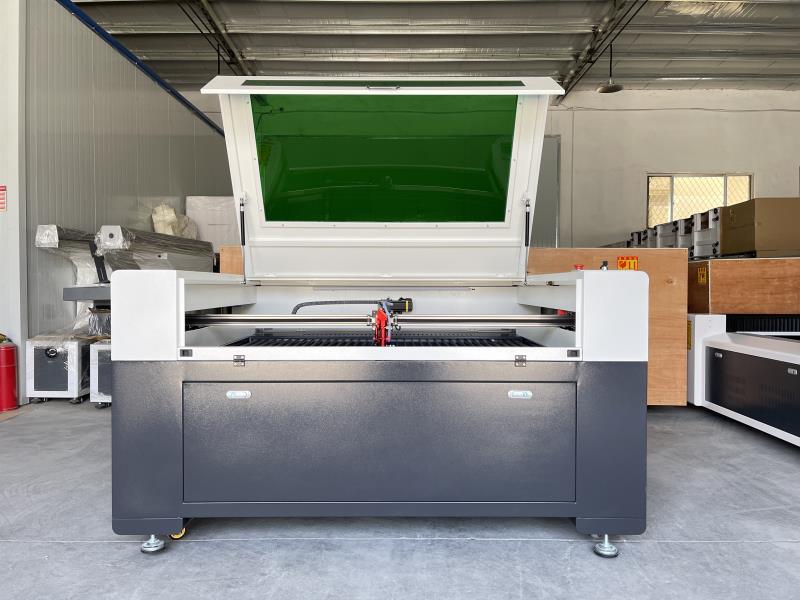
CO₂ laser cutting machines are often described in simple terms: tools for cutting wood, acrylic, or plastic. That definition is outdated.
At a deeper level, CO₂ systems are energy modulation platforms—they transform infrared light (typically 10.6 μm wavelength) into highly localized thermal reactions that vaporize or decompose non-metal materials with extreme precision.
This wavelength is not arbitrary. It is strongly absorbed by organic and polymer-based materials, which is why CO₂ lasers dominate non-metal processing while remaining inefficient for reflective metals.
The result is a manufacturing method that replaces physical tools with pure photonic interaction—no contact, no mechanical stress, no tool wear.
From Workshop Tool to Industrial Backbone
Originally confined to signage and craft production, CO₂ laser cutting has scaled into a multi-industry infrastructure technology. Today, it powers:
- Advertising and display manufacturing
- Furniture and interior fabrication
- Packaging and prototyping ecosystems
- Architectural model production
This expansion is driven by three converging forces:
- Customization economy – demand for small-batch, high-variation products
- Material diversity – rise of composites, polymers, and engineered boards
- Digital manufacturing – CAD-to-production workflows
Machines capable of handling large formats (up to 3000 × 2500 mm) and thick materials (e.g., 30 mm acrylic) are no longer exceptions—they define the new baseline.
Structural Engineering: Why Stability Defines Precision
Precision in CO₂ cutting is not just about the laser—it’s about the machine architecture behind it.
1. Rigid Frame = Long-Term Accuracy
Industrial systems use heat-treated welded frames to eliminate internal stress, ensuring dimensional stability over time.
2. Lightweight Motion = Speed Without Vibration
Aluminum alloy beams reduce inertia, enabling faster movement while maintaining cutting consistency.
3. Optical Path Design = Uniform Energy Delivery
Advanced beam paths (semi-flying or constant optical systems) minimize energy loss across large work areas, ensuring consistent cut quality from center to edge.
This is where many buyers misunderstand the market:
Two machines with identical laser power can produce radically different results depending on structural design.
Cutting Quality: The Real Competitive Advantage
CO₂ laser cutting is often praised for “clean edges,” but the underlying mechanism is more significant.
- The laser induces instantaneous vaporization or controlled combustion
- The heat-affected zone remains small
- The kerf (cut width) is narrow and consistent
This produces:
- Burr-free edges
- Minimal post-processing
- High repeatability (often ±0.1 mm accuracy)
In industries like signage or decorative panels, this is not just a quality feature—it eliminates entire downstream processes.
Intelligent Systems: The Rise of Software-Driven Cutting
Modern CO₂ machines are no longer hardware-centric. The real transformation lies in software integration.
Key Capabilities Emerging Today:
- Automatic nesting algorithms → maximize material utilization
- CAD/CAM integration → seamless design-to-production workflow
- Vision-guided processing → camera-based alignment and feature recognition
- Data-driven optimization → adaptive cutting parameters
These features turn the machine into a production intelligence node, not just a cutting device.
Efficiency Is Not Speed—It’s Material Economics
Traditional thinking: faster cutting = higher efficiency.
Modern reality: material utilization defines profitability.
With intelligent nesting and multi-shape layout optimization:
- Scrap rates drop significantly
- Mixed-batch production becomes viable
- Small orders become economically feasible
In high-cost materials like acrylic or specialty composites, this shift can outperform raw speed improvements in ROI.
Safety and Environmental Shift: From Pollution to Precision
Compared to traditional methods (mechanical cutting, chemical etching), CO₂ laser systems introduce:
- Lower dust and noise levels
- Integrated fume extraction systems
- Reduced chemical waste
- Automated fire suppression mechanisms
This aligns with stricter global environmental regulations and ESG-driven manufacturing trends.
The Hidden Constraints Most People Ignore
Despite its advantages, CO₂ laser cutting has clear limitations:
- Poor performance on reflective metals
- Challenges with transparent materials
- Heat accumulation risks on certain plastics
- Higher maintenance due to optical components
Understanding these constraints is critical. The mistake is not choosing CO₂—it’s using it outside its material logic.
Breaking the Old Mindset: Machines vs Material Strategy
Most buyers still ask:
“Which machine is better?”
That’s the wrong question.
The real question is:
“What material system am I optimizing for?”
Because:
- CO₂ lasers are not general-purpose tools
- They are highly specialized for organic and polymer ecosystems
- Their true power emerges when aligned with the right materials and workflows
Final Insight: The Future Is Not Bigger Machines—It’s Smarter Processing
The next phase of CO₂ laser evolution will not be defined by higher wattage or larger beds.
It will be driven by:
- AI-assisted parameter tuning
- Real-time process feedback
- Hybrid manufacturing systems
- Fully automated production lines
In that future, the laser is no longer the centerpiece.
The system is.
And those who understand this shift will move from “cutting materials” to engineering production ecosystems.
Post time: Apr-16-2026
