
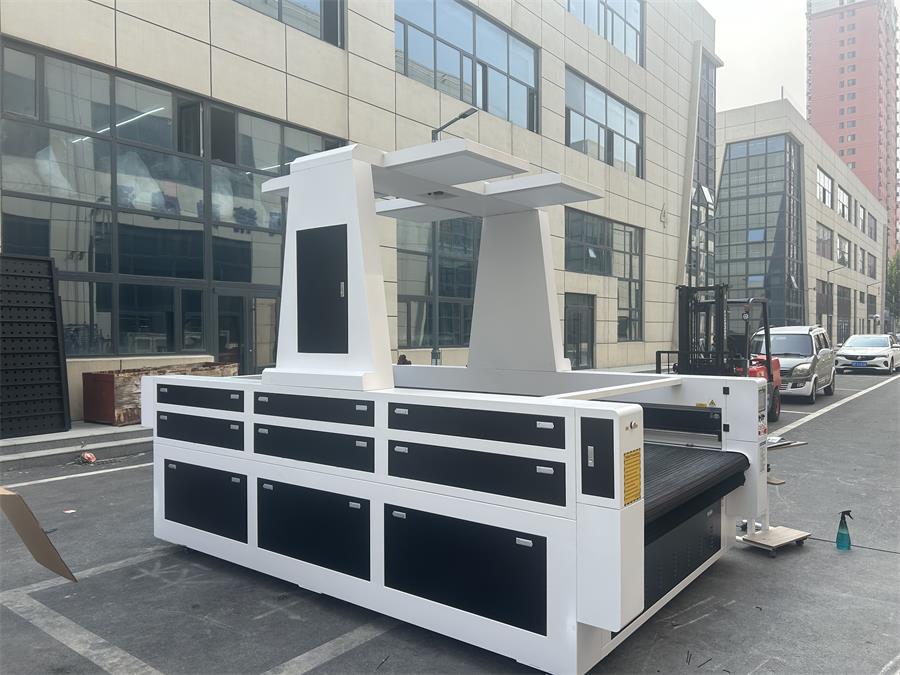
An auto feeding fabric laser cutting machine is designed for high-volume textile processing, combining conveyor feeding systems with continuous laser cutting. It is widely used in garment manufacturing, home textiles, and industrial fabric production where speed, consistency, and automation are critical.
Systems such as a Fabric Auto Feeding Laser Cutting Machine are specifically built to support mass production environments with stable performance and reduced labor dependence.
1. Continuous Production for High Output
The biggest advantage in mass production is uninterrupted operation.
With an automatic feeding and conveyor system:
- Fabric rolls are fed continuously
- Cutting does not stop between batches
- Long production cycles run without manual intervention
This significantly increases daily output compared to manual loading systems.
2. Reduced Labor Requirements
Automation replaces much of the manual handling work:
- No need for constant operator feeding
- Less alignment and repositioning work
- Reduced dependency on skilled labor
One operator can supervise multiple machines, lowering overall production costs.
3. High Cutting Consistency
In mass production, consistency is critical.
Laser cutting ensures:
- Identical dimensions across all pieces
- Stable accuracy over long runs
- No variation caused by manual cutting errors
This is especially important for garment and uniform manufacturing.
4. Improved Material Utilization
Auto feeding systems work with nesting software to optimize layout:
- Efficient fabric usage
- Reduced scrap and waste
- Better cost control per unit
Over large production volumes, even small savings per meter significantly impact profitability.
5. Clean and Sealed Cutting Edges
Laser cutting provides an additional advantage for synthetic fabrics:
- Edges are clean and smooth
- Many materials are automatically heat-sealed
- No fraying or post-processing needed
This reduces finishing time and labor costs.
6. Flexible Production for Multiple Designs
Unlike traditional die cutting, laser systems require no physical molds:
- Easy switching between designs
- Fast response to custom orders
- Suitable for mixed production batches
This flexibility is valuable for fashion and fast-moving textile markets.
7. Stable Performance for Long Working Hours
Machines designed for mass production are built for endurance:
- Industrial-grade conveyor systems
- Stable laser output over time
- Continuous cooling support
- Reduced downtime for maintenance
A properly configured Fabric Auto Feeding Laser Cutting Machine can operate efficiently for extended shifts.
8. Lower Production Cost per Unit
Combining automation and high efficiency results in:
- Lower labor cost
- Reduced material waste
- Faster throughput
- Less rework or defect rate
This improves overall unit economics in large-scale manufacturing.
9. Wide Range of Application Materials
These machines support various fabrics used in mass production:
- Cotton and polyester
- Denim and canvas
- Non-woven fabrics
- Synthetic textiles
- Industrial soft materials
This makes them suitable for diverse product lines.
Conclusion
An auto feeding fabric laser cutter is a powerful solution for mass production environments. It enables continuous cutting, reduces labor dependency, improves material efficiency, and ensures consistent product quality.
For textile manufacturers aiming to scale efficiently, a Fabric Auto Feeding Laser Cutting Machine provides a strong combination of automation, precision, and production stability.
Post time: Jun-29-2026
