
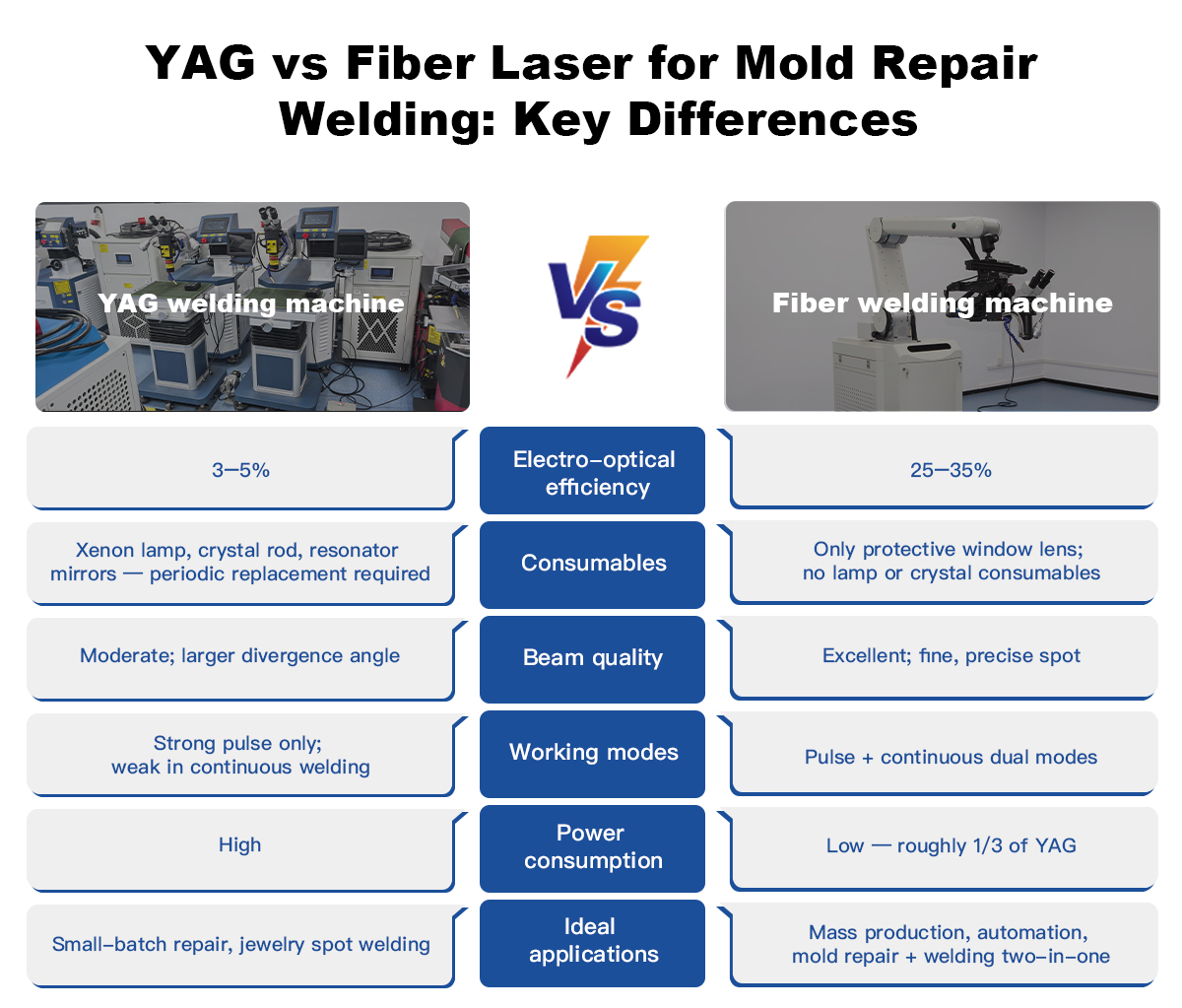
When choosing a laser welding machine for mold repair, two technologies often come up: YAG laser welding and fiber laser welding.
Both can repair mold steel, but they differ in laser source, pulse characteristics, heat control, maintenance, and typical applications. Understanding these differences can help mold manufacturers choose the right machine for precision repair work.
What Is YAG Laser Mold Welding?
YAG mold welding machines typically use a pulsed Nd:YAG laser. The laser delivers short pulses of energy to create a small, controlled weld pool.
This makes YAG particularly suitable for precision work such as:
-
Mold cracks
-
Small worn areas
-
Broken edges
-
Fine corners
-
EDM damage
-
Small dimensional corrections
The operator can carefully control pulse energy and duration, which is important when repairing delicate mold features.
What Is Fiber Laser Welding?
A fiber laser generates and delivers the laser beam through an optical fiber. Fiber laser welding systems are widely used for industrial metal fabrication and automated production.
They can provide high energy efficiency, stable output and high welding speeds.
Fiber laser systems are commonly used for:
-
Sheet metal welding
-
Stainless steel components
-
Structural parts
-
Automotive components
-
Larger mold repairs
-
Automated welding applications
Depending on the configuration, fiber lasers can operate in continuous-wave or pulsed modes.
YAG vs Fiber Laser: Key Differences
| Feature | YAG Laser | Fiber Laser |
|---|---|---|
| Typical operation | Pulsed | Continuous or pulsed |
| Heat control | Excellent for fine repairs | Excellent, especially for production |
| Precision mold repair | Excellent | Good to excellent |
| Small damaged areas | Excellent | Good |
| Welding speed | Moderate | Generally higher |
| Energy efficiency | Lower | Higher |
| Maintenance | More components | Generally lower |
| Automation | Available | Excellent |
| Typical strength | Precision repair | Production and high-speed welding |
Which Is Better for Precision Mold Repair?
For fine mold repair, pulsed YAG remains a strong choice.
A YAG laser can deliver short, controlled pulses that allow the operator to add small amounts of filler material precisely where needed. This is useful for repairing thin edges, corners, cavities and localized wear.
Fiber laser technology can also be highly precise, particularly with modern pulsed fiber systems, but the best choice depends on the specific mold material and repair requirements.
Which Has Better Heat Control?
Both technologies can provide controlled heat input when properly configured.
For delicate mold repairs, however, the ability to adjust pulse energy, pulse duration, frequency and spot size is particularly important.
The objective is to create a strong weld while minimizing unnecessary heat transfer into the surrounding mold.
This can help reduce thermal distortion and preserve dimensional accuracy.
Which Has Lower Maintenance?
Fiber lasers generally have an advantage in maintenance because they use a solid-state laser architecture with fewer consumable components than traditional lamp-pumped YAG systems.
For businesses focused on long-term production efficiency, this can be an important consideration.
However, maintenance requirements depend on the specific machine design, laser source and operating environment.
Which One Should You Choose?
Choose a YAG laser mold welding machine when your priority is:
-
Precision mold repair
-
Small cracks and defects
-
Fine edges and corners
-
Controlled pulsed welding
-
Manual precision repair
Consider a fiber laser welding machine when you need:
-
Higher welding speed
-
Higher energy efficiency
-
Lower long-term maintenance
-
Automated production
-
Larger or more repetitive welding applications
For a dedicated mold repair workshop, a pulsed YAG system can still be an excellent choice. For manufacturers looking to combine mold repair with broader industrial welding or automation, a fiber laser system may provide greater versatility.
Final Takeaway
The choice between YAG and fiber laser for mold repair welding is not simply about which technology is newer or more powerful.
YAG: excellent for precise, localized mold repair with highly controlled pulses.
Fiber: excellent for efficiency, higher-speed welding and automated production.
Before purchasing, test the machine with your actual mold steel, crack size and filler material. The welding result—not just the laser specification—should be the final basis for your decision.
Post time: Sep-02-2026
