
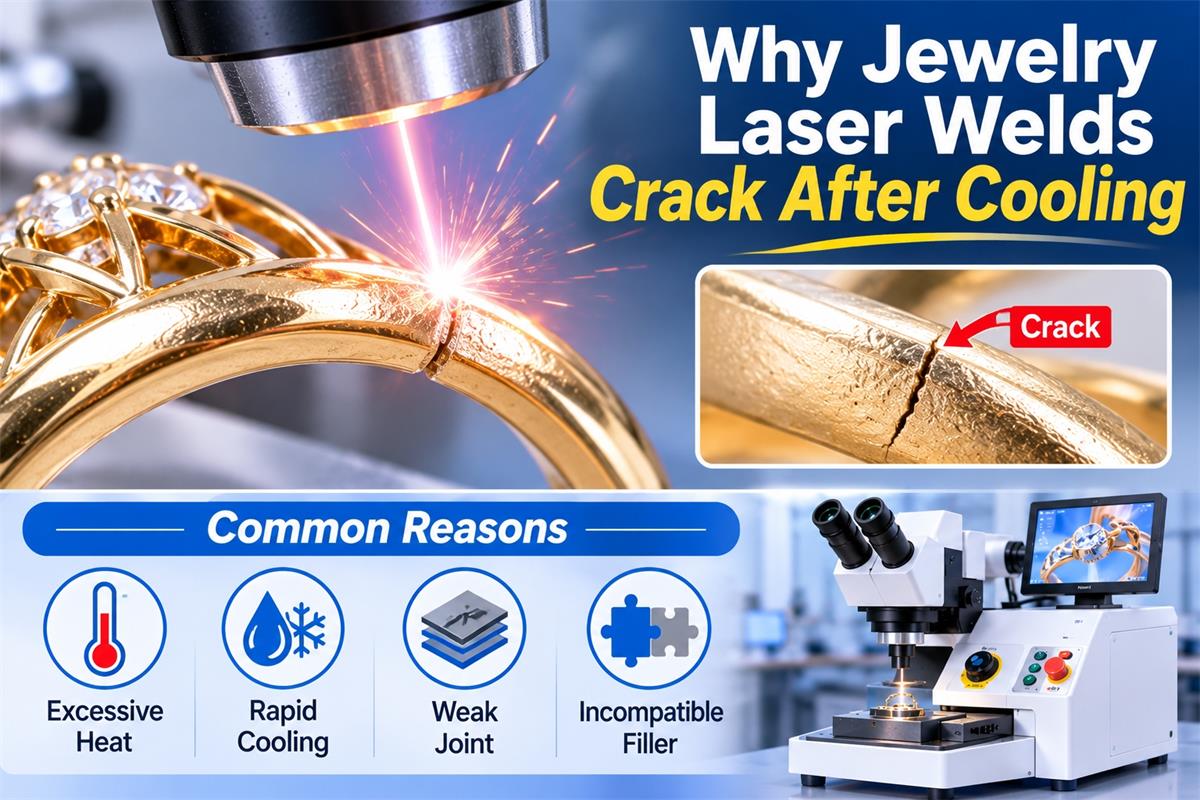
A jewelry laser weld may look perfect immediately after welding, but small cracks sometimes appear after the metal cools. This problem can affect gold rings, silver chains, earrings, and other delicate jewelry components. Understanding why these cracks develop is essential for jewelry manufacturers and repair shops. A jewelry laser welding machine provides localized heat and adjustable pulse control, but correct parameters, filler selection, and welding technique are still necessary to achieve reliable joints.
1. Why Do Jewelry Laser Welds Crack After Cooling?
Most cooling cracks are related to solidification behavior, thermal stress, or poor weld quality. Several factors can contribute to the problem.
Excessive Heat Input
Too much laser energy can create an oversized molten pool. As the metal cools and contracts, stress develops around the weld. Thin jewelry components are particularly sensitive to this problem.
Incorrect Filler Metal
Using filler wire that is incompatible with the base alloy can result in differences in melting behavior, strength, and contraction. This increases the risk of cracking or weak welds.
Rapid and Uneven Cooling
Different sections of a jewelry component may cool at different rates. This can create residual stress, especially around thick-to-thin transitions or rigid joints.
Contaminated Welding Surfaces
Oil, oxidation, polishing compounds, and other contaminants can interfere with metal fusion. Poor fusion and porosity may create weak areas where cracks develop.
Poor Joint Preparation
Large gaps, uneven edges, or insufficient contact between metal surfaces can produce an inconsistent weld. The deposited metal may not bond properly with the surrounding material.
2. Which Jewelry Materials Are More Sensitive to Cracking?
Different jewelry alloys respond differently to laser welding. Operators should not assume that the same settings will work for every material.
- Yellow gold: Generally suitable for laser welding, but alloy composition and karat affect welding behavior.
- White gold: Some formulations can be more challenging because of their alloying elements and cracking sensitivity.
- Rose gold: Copper-rich compositions require careful parameter and filler selection.
- Sterling silver: Its high thermal conductivity makes heat control important, particularly on thin components.
- Platinum: Requires material-specific welding procedures and compatible filler.
For valuable or unfamiliar alloys, testing on matching scrap material before repairing the actual jewelry is strongly recommended.
3. How to Prevent Jewelry Laser Welds from Cracking
Start with Appropriate Laser Parameters
Avoid using excessive pulse energy. Start with conservative settings and adjust them according to the material thickness, joint gap, and required penetration.
Pay attention to pulse energy, pulse duration, frequency, and spot diameter. Increasing energy to compensate for poor joint preparation is usually the wrong solution.
Choose Compatible Filler Wire
Select filler metal that closely matches the base alloy in composition and color. For gold jewelry, consider both karat and color. For silver and platinum, use suitable alloy-specific filler materials.
Clean the Surface Before Welding
Remove oil, oxidation, dirt, and polishing residue. Clean surfaces help achieve consistent fusion and reduce contamination-related defects.
Control Heat Accumulation
Apply controlled pulses and avoid repeatedly concentrating heat on the same location. Allow the component to cool when necessary, especially when welding thin sections or longer joints.
Inspect the Weld Before Finishing
Use magnification to check for cracks, pores, incomplete fusion, and excessive material buildup. A weld that looks smooth on the surface may still contain defects underneath.
4. Recommended Welding Considerations
There is no universal laser setting for preventing cracks. The appropriate setup depends on the alloy, thickness, joint geometry, and machine configuration.
| Factor | Recommended Approach |
|---|---|
| Pulse energy | Use only enough energy for proper fusion |
| Pulse duration | Adjust according to material thickness |
| Frequency | Avoid excessive heat accumulation |
| Spot diameter | Match the spot to the joint size |
| Filler material | Use compatible alloy-specific filler |
| Cooling | Avoid sudden or uneven thermal changes |
Test the settings on a sample with the same alloy and similar dimensions. Inspect the sample after it has completely cooled, not only immediately after welding.
5. Can a Jewelry Laser Welder Improve Weld Quality?
Machine stability and precise positioning are important when welding small jewelry components. A suitable pulsed YAG laser welder allows operators to adjust welding parameters and concentrate energy on a specific joint.
Dowin’s 150W jewelry spot laser welding machine is designed for precision jewelry repair and manufacturing applications.
Its features include:
- 150W YAG laser source for jewelry spot welding.
- Adjustable 0.2–2 mm spot diameter.
- Microscope observation for accurate welding positioning.
- LED shadowless lighting for improved visibility.
- Adjustable welding parameters for different applications.
For workshops handling more demanding welding applications, the 200W YAG pulsed jewelry laser welder is another option worth evaluating.
However, higher machine power does not automatically mean fewer cracks. Material compatibility, parameter control, joint preparation, and operator experience remain essential.
6. FAQ: Jewelry Laser Welding Cracks
Why does a jewelry laser weld crack after cooling?
Common causes include excessive heat input, solidification shrinkage, incompatible filler metal, contamination, and residual thermal stress. The exact cause depends on the metal and joint design.
Can too much laser energy cause cracks?
Yes. Excessive energy can create a large molten pool and increase contraction stress during cooling. It may also cause burn-through or changes in the surrounding metal structure.
Does gold karat affect laser welding results?
Yes. Different gold karats contain different proportions of alloying metals. These differences affect melting behavior, weldability, and filler selection.
Should I cool jewelry quickly after laser welding?
Do not use sudden cooling as a universal method. Allow the component to cool under controlled conditions appropriate for the alloy and jewelry design. Avoid unnecessary thermal shock.
Can cracked laser welds be repaired?
Many localized cracks can be repaired after the damaged area is properly inspected and prepared. Remove defective or contaminated material as necessary, then repeat the welding process with corrected parameters and compatible filler.
Conclusion
Cracks appearing after jewelry laser welding are usually signs of problems with heat input, material compatibility, surface preparation, or weld design. The solution is not simply to increase laser power or add more filler.
By selecting compatible materials, controlling pulse energy, preparing clean joints, and inspecting welds after cooling, jewelry workshops can improve repair consistency and reduce rework. Explore Dowin Jewelry Laser Welding Machines for precision welding applications involving gold, silver, and other precious-metal jewelry.
Post time: Nov-19-2026
