
The Truth Most Equipment Sellers Don’t Want to Explain
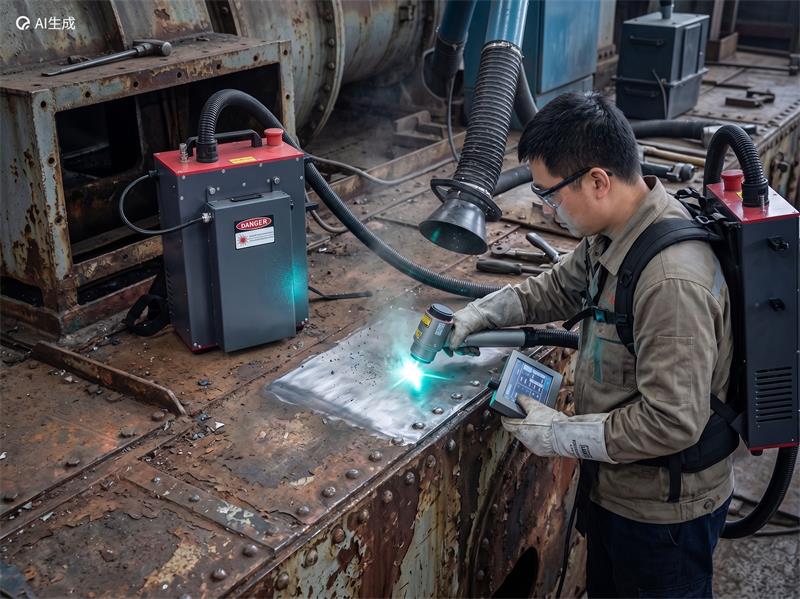
At first glance, laser rust removal machines look deceptively simple. A handheld gun, a control cabinet, some cables, and a laser source. To many buyers, especially first-time buyers, the obvious question appears immediately:
Why does a laser rust removal machine cost dramatically more than sandblasting equipment, grinders, or chemical cleaning systems?
The short answer is this:
Because laser cleaning is not actually a “cleaning tool.”
It is a precision energy-control system disguised as a cleaning machine.
Most people compare laser cleaning to traditional rust removal methods the wrong way. They compare purchase price only. But industrial economics never works that way. The real comparison is operational efficiency, material protection, labor cost, environmental liability, automation potential, and long-term process control.
That changes the conversation completely.
The Real Reason Laser Rust Removal Machines Cost More
A professional laser cleaning system combines multiple high-value technologies into one industrial platform:
- Fiber laser source
- Optical scanning system
- Galvo control system
- Cooling architecture
- Motion control algorithms
- Fume extraction integration
- Safety protection systems
- Precision power modulation
- Industrial-grade software
This is why two machines that “look identical” can have completely different prices.
One machine may survive continuous factory operation for 5 years.
Another may fail after several months of unstable use.
The outside tells you almost nothing.
According to industry reports, the global laser cleaning market is expanding rapidly because manufacturers increasingly demand non-contact, environmentally friendly surface treatment solutions. Portable laser cleaning equipment alone has become one of the fastest-growing industrial laser segments.
Buyers Often Focus on the Wrong Metric
Most buyers immediately ask:
- “How much is a 100W machine?”
- “How much is a 200W machine?”
- “Why is 300W more expensive?”
This mindset is understandable — but flawed.
Power is only one variable.
A low-quality 200W machine can perform worse than a well-engineered 100W system because laser cleaning performance depends heavily on:
- Beam stability
- Pulse control
- Optical precision
- Cooling consistency
- Energy distribution
- Software tuning
- Scanning efficiency
This is why industrial users eventually stop asking only about wattage and start asking better questions:
- Can the machine operate continuously?
- Does it damage the substrate?
- Is the cleaning consistent?
- How stable is the beam after long operation?
- Can operators easily adjust parameters?
- Is maintenance manageable?
Those questions determine real value.
Pulse Lasers Are Expensive for a Reason
One of the biggest price gaps in the laser cleaning industry comes from the difference between pulsed lasers and continuous lasers.
Continuous Laser Cleaning
Continuous laser systems focus on brute-force efficiency.
They are faster for:
- Heavy rust removal
- Large-area cleaning
- Industrial-scale stripping
- Thick contamination layers
But they also generate more heat.
For rough industrial cleaning, this may not matter much.
For precision cleaning, it matters a lot.
Pulsed Laser Cleaning
Pulsed lasers control energy in extremely short bursts.
This allows:
- Better substrate protection
- Lower heat impact
- More precise cleaning
- Reduced deformation risk
- Superior surface preservation
That precision comes at a cost.
The laser source itself is more complex. The control system is more demanding. Beam management becomes significantly harder.
This is why pulsed laser cleaning systems often cost substantially more than continuous systems.
But here’s the uncomfortable truth many people ignore:
Cheap laser cleaning usually becomes expensive later.
Poor precision damages parts. Unstable energy causes inconsistent cleaning. Weak cooling systems shorten machine lifespan. Cheap optics create long-term maintenance problems.
Industrial buyers eventually learn this the hard way.
The Laser Source Is the Heart of the Machine
The laser source alone can represent a huge percentage of the total machine cost.
And no — not all fiber lasers are equal.
A high-end laser source delivers:
- Stable beam quality
- Longer lifespan
- Better thermal management
- Lower failure rate
- More consistent cleaning performance
Inferior laser sources often suffer from:
- Power instability
- Weak pulse consistency
- Thermal drift
- Reduced efficiency
- Shorter service life
Most buyers cannot see these differences immediately.
They only become obvious after hundreds of working hours.
Cooling Systems Matter More Than People Think
Heat is the hidden enemy of every laser cleaning machine.
As power increases, thermal management becomes exponentially more important.
A machine may look impressive during a short demo.
But continuous industrial operation is a completely different reality.
Weak cooling systems lead to:
- Beam instability
- Reduced cleaning consistency
- Higher failure rates
- Optical damage
- Shortened laser lifespan
This is why industrial-grade water cooling systems dramatically increase overall equipment cost.
Ironically, many low-cost machines cut corners exactly here.
That decision rarely ends well.
Environmental Regulations Are Quietly Driving Laser Cleaning Growth
Traditional rust removal methods are increasingly under pressure worldwide.
Sandblasting creates dust pollution.
Chemical cleaning creates hazardous waste.
Grinding damages surfaces and increases labor intensity.
Laser cleaning changes the equation because it:
- Uses no chemicals
- Produces minimal secondary waste
- Reduces consumable costs
- Improves workplace cleanliness
- Supports automation
This is one reason why industries such as aerospace, automotive manufacturing, shipbuilding, battery production, and mold maintenance are rapidly adopting laser cleaning systems.
Environmental compliance itself now has economic value.
That value is often ignored when buyers compare only machine prices.
The Hidden Costs Nobody Talks About
Many suppliers advertise attractive machine prices.
But the real ownership cost often includes:
- Fume extraction systems
- Ventilation upgrades
- Protective lenses
- Filter replacement
- Operator training
- Installation
- Electrical setup
- Downtime risk
- Maintenance response time
A cheap machine with poor after-sales support can easily become more expensive than a premium machine with reliable technical service.
Industrial equipment is not judged by purchase price alone.
It is judged by stability over time.
Not Every Business Should Buy a Laser Cleaning Machine
This part is rarely discussed honestly.
Laser cleaning is not automatically the right choice for everyone.
If a company only occasionally removes rust, traditional methods may still make more financial sense.
Laser cleaning becomes truly valuable when businesses require:
- Precision cleaning
- Repeatable quality
- Surface protection
- Automation potential
- Long-term operational efficiency
- Environmental compliance
- Reduced consumables
For high-frequency industrial use, laser cleaning often transforms from “expensive equipment” into a long-term cost-control strategy.
That is the real shift happening in manufacturing right now.
The Future of Rust Removal Is About Control, Not Cleaning
This is where the industry is evolving.
Laser cleaning is no longer simply about removing rust.
It is becoming part of intelligent manufacturing systems:
- Robotic integration
- AI-assisted cleaning
- Smart parameter control
- Automated surface inspection
- Digital production management
Factories increasingly want controllable, programmable, data-driven surface treatment processes.
Traditional methods struggle to provide that level of precision.
Laser cleaning can.
And that is the deeper reason these systems are expensive.
You are not just paying for rust removal.
You are paying for controllable energy, repeatable precision, lower environmental burden, and future-ready industrial capability.
That distinction changes everything.
Post time: May-08-2026
