
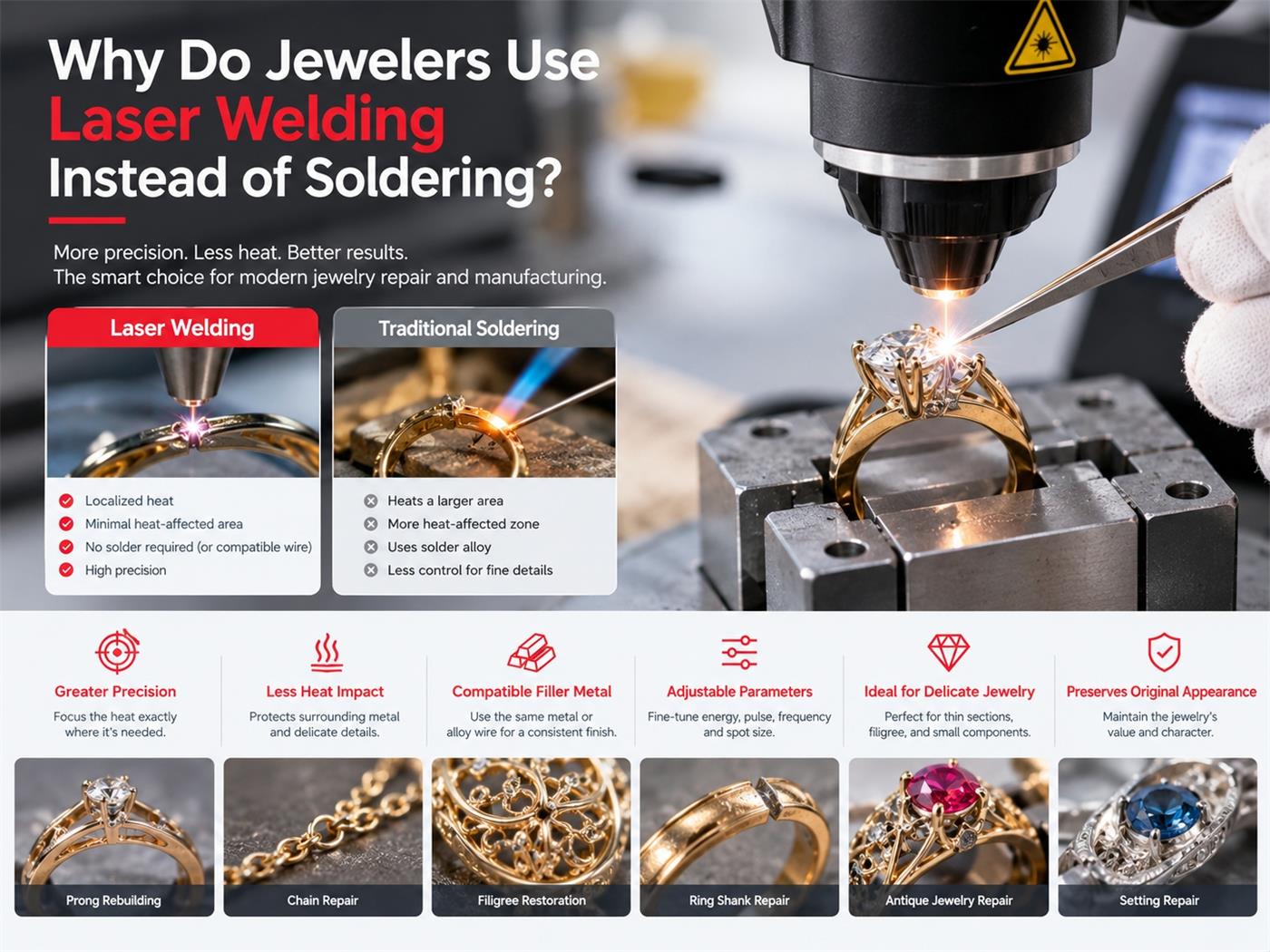
Laser welding has become an increasingly useful technology in modern jewelry repair and manufacturing. While traditional soldering is still widely used, jewelers often choose a jewelry laser welder when they need greater precision, localized heat control, or the ability to repair delicate areas with minimal disturbance to the surrounding metal.
The difference is not simply that laser welding is “better.” Each process has its place. However, for many detailed jewelry repairs, laser welding offers several practical advantages.
1. Laser Welding Concentrates Heat in a Small Area
The biggest difference between laser welding and soldering is how heat is delivered.
Soldering generally heats a relatively large area so that the solder can flow between the components being joined. Laser welding, by contrast, concentrates a controlled amount of laser energy directly onto the repair point.
This localized heating can help reduce heat transfer to surrounding metal and makes laser welding particularly useful for:
-
Fine jewelry
-
Thin gold chains
-
Small prongs
-
Filigree
-
Delicate rings
-
Intricate settings
-
Previously repaired jewelry
For small and precise repairs, controlling where the heat goes can be just as important as the welding itself.
2. Laser Welding Can Reduce Heat-Affected Areas
Jewelry often contains details that can be affected by excessive heat. Polished surfaces, decorative textures, thin sections, and nearby components may require careful handling during repair.
Because a pulsed laser can deliver energy in very short bursts, the operator can control the amount of heat introduced into the workpiece.
This does not mean laser welding creates no heat. The welding area becomes extremely hot, but the surrounding material can experience significantly less unnecessary heating when the parameters are properly selected.
3. No Solder Is Required for Many Repairs
Soldering uses a separate filler material with a lower melting point than the jewelry metal.
Laser welding can often use the same or compatible metal as filler wire. For example, a jeweler repairing a gold ring can add a suitable gold alloy wire while welding it directly into the damaged area.
This can be advantageous when the repaired area needs to maintain a consistent metal appearance and composition.
4. Better Control for Small Repairs
Jewelry repair often involves extremely small damaged areas.
A laser welding machine allows the operator to adjust parameters such as:
-
Pulse energy
-
Pulse duration
-
Welding frequency
-
Spot size
-
Filler wire size
These controls allow the welding process to be adapted to different metals, thicknesses, and repair conditions.
For example, rebuilding a worn prong requires a different approach from repairing a broken ring shank or filling a small casting defect.
5. Laser Welding Is Useful Around Delicate Jewelry Details
Traditional soldering can be difficult when a repair is close to another component that should not be heated unnecessarily.
Laser welding can target a specific point while leaving much of the surrounding area relatively unaffected.
This makes it useful for repairing jewelry with:
-
Fine engraving
-
Filigree
-
Decorative edges
-
Small links
-
Thin prongs
-
Intricate settings
The jeweler can work progressively rather than heating the entire component at once.
6. Laser Welding Can Help Preserve the Original Appearance
Antique and vintage jewelry can be particularly challenging to repair. The original metal may be thin, worn, or contain previous solder repairs.
A broad heating process may alter the surrounding area or make it more difficult to preserve delicate details.
With appropriate parameters, laser welding allows the jeweler to focus the repair on the damaged section. After welding, the area can be filed, polished, and finished to match the original jewelry.
For restoration work, this level of control can be particularly valuable.
7. Less Post-Repair Cleanup in Certain Applications
Because laser welding can produce a highly localized weld, some repairs require less cleanup compared with conventional soldering.
The actual amount of finishing work still depends on the repair. A larger buildup of filler metal may need grinding or polishing, while a very small laser weld may require only minimal finishing.
For professional jewelry workshops handling many small repairs, reducing unnecessary finishing work can improve overall efficiency.
Laser Welding vs. Soldering: Which Should Jewelers Choose?
Laser welding should not be considered a complete replacement for soldering.
Soldering remains practical for many conventional jewelry repairs, especially when larger areas need to be joined or when the process does not require extremely localized heat control.
Laser welding becomes particularly attractive when precision, heat control, and localized repair are important.
| Feature | Laser Welding | Traditional Soldering |
|---|---|---|
| Heat concentration | Highly localized | Wider heating area |
| Filler material | Often compatible metal wire | Solder alloy |
| Fine repair work | Excellent | More challenging |
| Thin jewelry | Very suitable | Requires careful heating |
| Filigree repair | Suitable | Can be difficult |
| Prong rebuilding | Excellent | Possible |
| Antique jewelry | Highly useful | Depends on condition |
| Parameter control | High | Moderate |
| Learning curve | Requires training | Widely established |
When Should You Use a Jewelry Laser Welder?
A jewelry laser welder is especially useful when the repair requires precise control rather than simply joining two pieces of metal.
Typical applications include ring repair, prong rebuilding, chain repair, crack filling, casting defect repair, filigree restoration, and antique jewelry restoration.
For professional jewelers, the main advantage is the ability to control where and how much energy is applied. This gives the operator more options when working with small, delicate, or difficult-to-repair jewelry.
Final Thoughts
Jewelers use laser welding instead of soldering when the repair demands precision, localized heating, and greater control over the surrounding metal. Soldering remains an important jewelry repair technique, but laser welding provides a valuable alternative for delicate and high-precision work.
For modern jewelry workshops, combining both technologies can provide the flexibility to select the most appropriate repair method for each piece.
Post time: Oct-08-2026
