
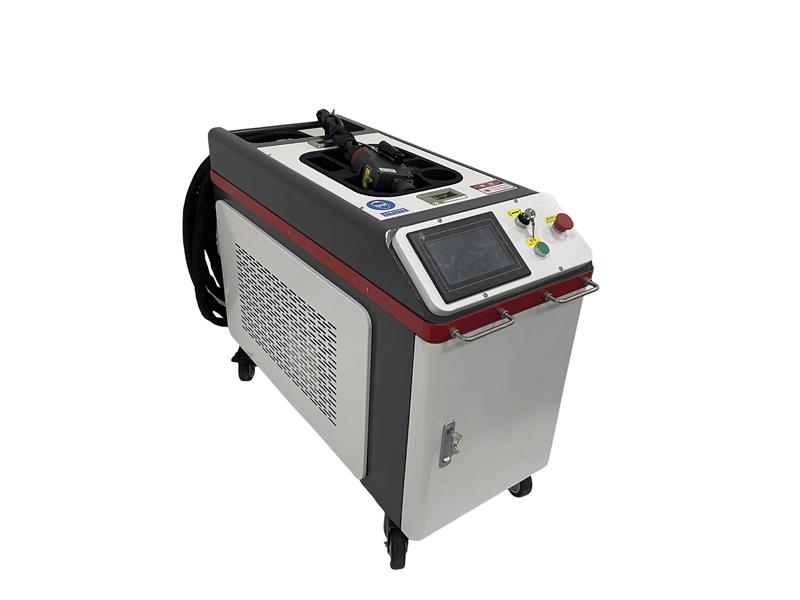
Industrial cleaning is no longer a background process—it is a profit lever, compliance risk, and efficiency bottleneck all at once. What appears to be a simple maintenance task often hides a complex cost structure: labor inefficiencies, environmental liabilities, and production downtime.
Against this backdrop, 500W laser cleaning machines are not just a technical upgrade. They represent a system-level optimization of industrial operations.
The Hidden Cost Structure of Traditional Cleaning
Conventional methods—chemical cleaning, sandblasting, ultrasonic systems—carry costs far beyond equipment and materials.
- Labor intensity: Manual handling, repeated processes, and safety precautions significantly increase operational time
- Environmental burden: Toxic waste, VOC emissions, and wastewater treatment drive compliance costs
- Inconsistent results: Output depends heavily on operator skill and fatigue
Data from industrial case studies shows that hidden costs can account for 30–40% of total cleaning expenses, often overlooked in procurement decisions.
More critically, inefficiency compounds over time. Extended cleaning cycles lead to overtime, increased injury risk, and reduced workforce productivity.
Why 500W Is the “Operational Sweet Spot”
In the spectrum of laser cleaning power levels, 500W occupies a uniquely strategic position.
- Lower power systems (100–300W) often struggle with thick coatings or rust, requiring multiple passes
- Higher power systems (1000W+) deliver speed but introduce higher costs, energy demands, and safety complexity
A 500W system balances these trade-offs by delivering:
- Sufficient energy density for industrial tasks
- Controlled precision for delicate surfaces
- Manageable operating and investment costs
This balance makes it highly adaptable across industries—from manufacturing and automotive to restoration and aerospace.
Efficiency Is Not Just Speed—It’s System Compression
Laser cleaning fundamentally changes how time is distributed in production.
Traditional workflow:
- Disassembly → transport → cleaning → drying → reassembly
Laser-enabled workflow:
- Direct, in-place cleaning
This shift reduces downtime by up to 70%, allowing equipment to remain in operation longer and minimizing production interruptions.
In high-throughput environments, this translates into additional operational days per year, effectively increasing revenue without expanding capacity.
Labor Reduction and Skill Reconfiguration
Traditional cleaning relies heavily on manual labor. In contrast, 500W laser systems:
- Require fewer operators
- Reduce training complexity through preset parameters
- Deliver consistent results regardless of operator experience
In practical scenarios, switching to laser cleaning can save hundreds of labor hours annually, significantly lowering long-term labor costs.
But the deeper shift is not just cost reduction—it is labor transformation.
Human effort moves from repetitive execution to process control.
Environmental Compliance: From Risk to Advantage
Global regulations are tightening around industrial emissions and hazardous waste. Traditional cleaning methods generate:
- Volatile organic compounds (VOCs)
- Chemical residues
- Contaminated wastewater
Non-compliance can lead to fines, production shutdowns, and reputational damage.
Laser cleaning eliminates the need for chemicals entirely, operating as a dry, non-contact process. This:
- Removes waste disposal requirements
- Reduces regulatory exposure
- Aligns with ESG and sustainability goals
In many regions, compliance costs alone can increase operational expenses by 15–20% when using traditional methods.
Precision Without Damage: A Key Industrial Advantage
Unlike abrasive or chemical methods, laser cleaning works through controlled energy delivery:
- Contaminants absorb laser energy and are vaporized or detached
- The underlying substrate remains intact when parameters are optimized
This makes it suitable for:
- Precision molds
- Aerospace components
- High-value industrial parts
The non-contact nature also eliminates mechanical wear, extending both tool and component lifespan.
Cost Structure Redefined
Traditional cleaning is a consumable-based model:
- Chemicals
- Abrasive media
- Protective equipment
- Waste disposal
Laser cleaning shifts this to a capital-efficient model:
- No consumables
- Minimal maintenance
- Predictable operating costs
While initial investment is higher, the long-term ROI is driven by:
- Reduced labor
- Eliminated consumables
- Lower compliance costs
- Increased uptime
Limitations That Define Strategic Use
Despite its advantages, 500W laser cleaning is not universally optimal.
- High upfront investment may challenge smaller operations
- Performance varies on highly reflective or sensitive materials
- Thick grease or deeply embedded contaminants may require multiple passes
These are not failures—they define where laser cleaning delivers the highest value.
The Bigger Shift: From Cleaning to Process Engineering
The real transformation is conceptual.
Traditional cleaning = a necessary cost
Laser cleaning = a controllable, data-driven process
This shift enables:
- Integration with automation and robotics
- Repeatable, programmable cleaning cycles
- Alignment with smart manufacturing systems
Cleaning is no longer a maintenance step.
It becomes part of the production architecture.
Final Insight
The rise of 500W laser cleaning machines is not accidental. It reflects a broader industrial evolution:
- From labor-intensive to technology-driven operations
- From reactive maintenance to proactive efficiency
- From environmental liability to sustainable practice
Choosing a 500W system is not simply about cleaning better.
It is about redefining how industrial value is created, protected, and scaled.
Post time: Apr-14-2026
